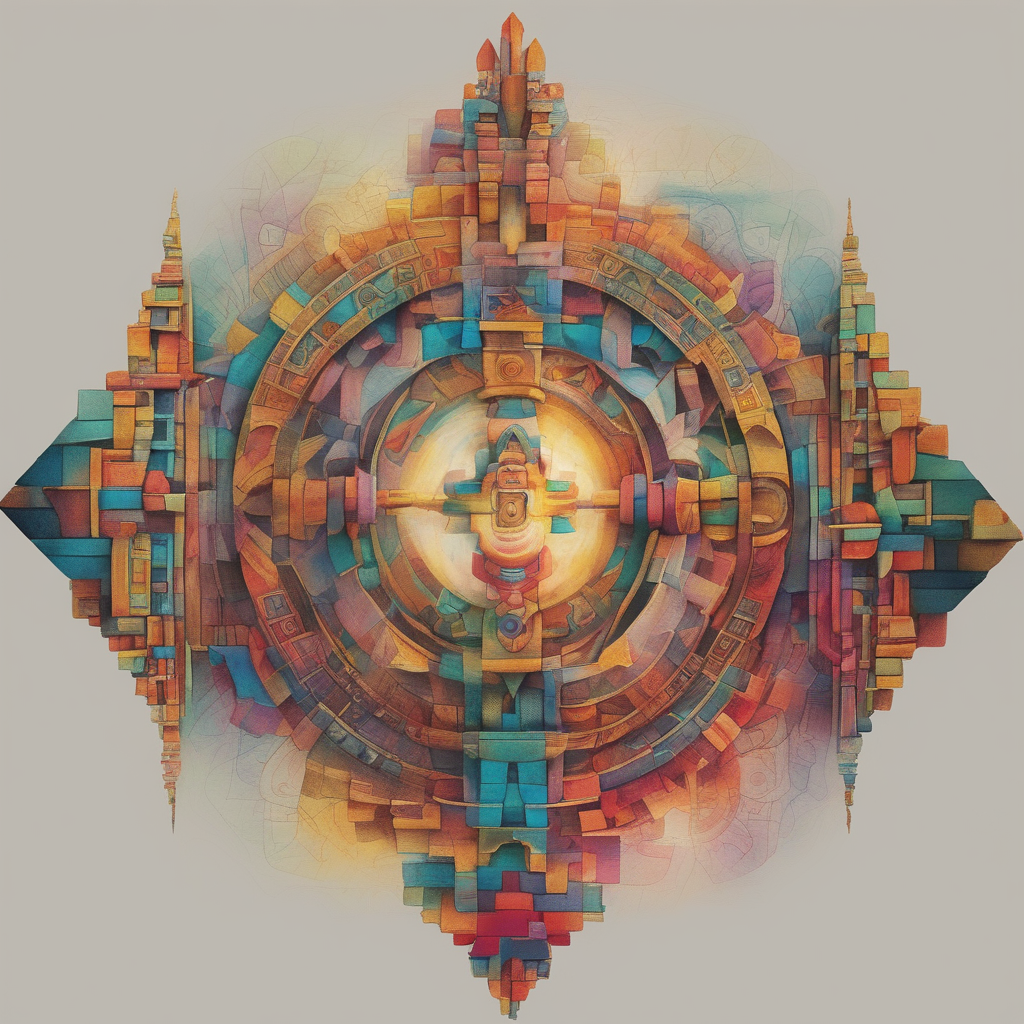
The Paradox of Perfection

Ground of All Being and Maya

The universe, in its vastness and complexity, brings forth a myriad of questions that have perplexed thinkers across generations. One of the most profound concepts to grapple with is the nature of reality itself. Within the philosophical tapestry, two concepts emerge with force and subtlety: the “Ground of All Being” and “Maya”.

**Ground of All Being**

The Ground of All Being is an abstract principle suggesting that there exists an ultimate foundation or source for everything in existence. This ground isn’t a tangible thing but a concept – the idea that there’s an underpinning, unchangeable reality beneath the mutable surface of life. This can be likened to the depths of an ocean where calmness reigns, contrasting with the choppy waves on the surface.

**Maya: The Illusion**

Hailing primarily from Eastern traditions, particularly Hinduism, Maya is the term that describes the world as we see it: a world of illusion, impermanence, and change. Maya doesn’t suggest that the world is fake, but that our perceptions and understandings are limited, sometimes deceiving us from the true nature of reality.

**The Paradox of Perfection**

At a glance, it seems paradoxical: How can a universe so perfect birth what is perceived as imperfection? The beauty of this conundrum is that perfection and imperfection are inherently subjective, shaped by our limited human perceptions and conditioned understandings.

Perhaps the universe is so intricately and impeccably designed that it incorporates imperfection as part of its perfection. Much like a symphony that uses dissonance to make the harmonious notes shine brighter. The imperfections, the fleeting moments, the transient joys and sorrows – they all serve a purpose. They make the canvas of life more prosperous, pushing us to question, seek, and understand.

Imperfections are not flaws but opportunities: windows into deeper layers of understanding, growth, and realization. When we confront Maya, we’re not battling falsehoods but navigating layers of reality, slowly inching closer to the Ground of All Being.

**In Conclusion**

The journey from Maya’s illusion to the Ground of All Being isn’t a path of renunciation, but one of realization. Realizing that the imperfections we see, feel, and experience are not mere aberrations, but intrinsic facets of a grand design. They challenge us, shape us, and push us closer to understanding the paradoxical nature of existence: that within perfection lies imperfection and within imperfection, an underlying, unchanging perfection.

Morgan O. Smith

Yinnergy Meditation & My Book, Bodhi in the Brain…Available Now!
https://linktr.ee/morganosmith

The Veils of Maya

Navigating Illusion in the Quest for Truth

The labyrinthine nature of existence, adorned with its pleasures and pitfalls, has been a subject of deep contemplation for ages. At the heart of many philosophical inquiries in Hinduism lies the enigmatic concept of ‘Maya’. Far from being a mere illusion, Maya reveals layers of truth, each pointing towards an understanding of the universe and our place in it.

**The Cosmic Dance of Prakriti and the Three Gunas**


Imagine the universe as a grand stage, with Prakriti, the primal nature, as the backdrop. From this vast expanse springs forth everything we see, feel, and experience. Yet, what gives rhythm to this cosmic dance?

Enter the Three Gunas – Sattva, Rajas, and Tamas. These are not just passive qualities but dynamic forces shaping our experiences. The serenity of a tranquil lake embodies Sattva, the turbulence of a storm epitomizes Rajas, and the still darkness of the night echoes Tamas. Together, they create a spectrum of experiences in our lives.

**The Individual’s Tryst with Ignorance**


Closer to our personal experience is Avidya, the fog of ignorance clouding our perception. Under its influence, we misidentify with our transient selves, overlooking the eternal essence within. It’s like mistaking the waves for the vast ocean.

In this state, we are ensnared by Karma, the ever-entwining web of action and consequence. The Kleshas, those tormenting afflictions, further deepen our entanglement. Desires and aversions play tug-of-war, with the ego stoking the flames.

**The Divine Masquerade**

But is Maya merely a cosmic error or a deceptive trap? Not necessarily. Maya, when seen as the divine power or Shakti, becomes the grand choreographer of the universe’s dance. It’s a divine play, a Leela, where the One chooses to manifest as many, experiencing itself through myriad forms.

**Beyond Duality: The Advaita Perspective**


The school of Advaita Vedanta offers a profound insight. It suggests that beneath the multiplicity lies a singular truth, the Brahman. Maya, in this view, is the sublime artist crafting the many from the one, making the undivided appear divided.

**Conclusion: The Play and Beyond**

Maya, far from being a mere illusion to discard, becomes a lens to navigate our existence. It offers lessons, challenges, and experiences, pushing us to question, understand, and ultimately transcend.

In the dance of Maya, we are both the dancer and the audience. The key lies in recognizing the play, enjoying its beauty, and seeking the truth beyond the performance. In this quest, we don’t just find answers about the universe, but also about ourselves.

Morgan O. Smith

Yinnergy Meditation & My Book, Bodhi in the Brain…Available Now!

https://linktr.ee/morganosmith

A Meeting of East and West

Advaita Vedanta and Ken Wilber’s Four Quadrants

As we navigate through life’s labyrinth, we encounter myriad philosophical viewpoints designed to offer us clarity about the nature of reality. Two such perspectives – one rooted in ancient Eastern spirituality, Advaita Vedanta, and the other a more contemporary Western theory, Ken Wilber’s Integral Theory – provide us with intriguing interpretive lenses. While appearing distinct, when juxtaposed, they unfold a captivating dialogue, revealing the interconnectedness of diverse paths of wisdom.

**Non-Duality: The Heart of Advaita Vedanta**

At the core of Advaita Vedanta lies the profound principle of non-duality. The term ‘Advaita’ translates to ‘not two’, pointing towards the notion of unity beneath apparent multiplicity. According to this philosophy, all phenomena – whether perceived as separate entities or diverse experiences – are manifestations of a singular absolute reality known as Brahman.

This philosophy posits that the perceived distinction between the individual self (Atman) and the ultimate reality (Brahman) is an illusion (Maya), born out of ignorance (Avidya). The journey of spiritual awakening in Advaita Vedanta is about transcending this illusion, recognizing the non-dual nature of existence, where the Atman and Brahman are not separate but one.

**Ken Wilber’s Four Quadrants: A Comprehensive Map of Reality**

Ken Wilber’s Integral Theory, particularly the Four Quadrants model, offers a different but complementary perspective. Wilber presents a holistic map of reality, dividing it into four quadrants: Individual Interior (consciousness), Individual Exterior (behaviour), Collective Interior (culture), and Collective Exterior (society). Each quadrant represents an integral part of our existence and must be considered to understand reality holistically.

**The Interplay: Advaita Vedanta and Four Quadrants**

Drawing parallels between Advaita Vedanta and the Four Quadrants can create a fascinating synthesis of Eastern and Western thought.

The Upper Left Quadrant (Individual-Interior) aligns with the individual’s subjective experience, mirroring the Advaita exploration of Atman. The Upper Right Quadrant (Individual-Exterior) encapsulates the physical manifestation of the individual, aligning with the Advaita concept that even our physical existence is a manifestation of Brahman.

The Lower Left Quadrant (Collective-Interior) represents shared beliefs and cultures, resonating with the Advaita perspective that cultural differences are superficial, and at a deeper level, unity prevails. The Lower Right Quadrant (Collective-Exterior) mirrors societal structures, all manifestations of the same non-dual reality.

From the Advaita viewpoint, the division of the four quadrants are themselves expressions of Maya, as they create apparent separations where none ultimately exist. They are valuable tools for understanding and navigating the world but do not represent the deepest truth of non-duality.

**Uniting Perspectives: A Path to Enlightenment**

Exploring the intersection of Advaita Vedanta and Ken Wilber’s Four Quadrants offers a richer understanding of reality, harmonizing subjective and objective, individual and collective, Eastern spirituality and Western theory. As we understand that the lines dividing these quadrants are more porous than they seem, we move closer to the non-dual truth of Advaita – that beneath apparent diversity, unity pervades.

At a time when division and fragmentation are rampant, this synthesis could offer a path toward the kind of transcendental insight that can bridge divides, fostering a deeper sense of interconnectedness and wholeness. After all, as Advaita Vedanta teaches us, beneath the surface of multiplicity, we are ‘not two’ but one. As we embrace the wisdom of the four quadrants, we might just find ourselves taking a step closer to that unity, opening ourselves to a richer, more holistic understanding of the world.

Morgan O. Smith

Yinnergy Meditation & My Book, Bodhi in the Brain…Available Now!
https://linktr.ee/morganosmith