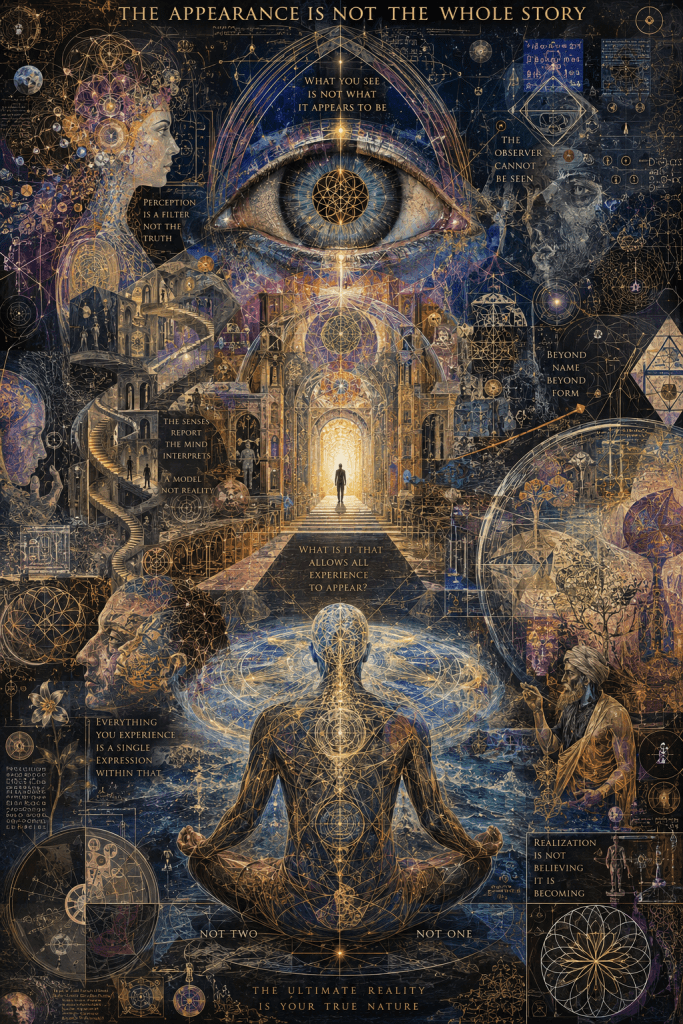
You Have Been Speaking Everything Into Existence

This is not simply about affirmations, positive thinking, manifestation, or the power of spoken language. Those ideas remain close to the surface. The deeper meaning reaches beyond the human voice, personal intention, and the individual mind.

You speak everything into existence and do not even realize it.

At the causal level, existence itself is your expression.

Every form that appears, every movement that unfolds, every event that arises, and every world that seems to exist independently emerges from the same beginningless source that you are.

Nothing stands outside of you.

The birth of a star, the movement of a thought, the falling of a leaf, the ending of a relationship, the formation of a galaxy, and the smallest shift within a single cell all belong to one indivisible happening.

That happening has no external author.

It is not being imposed upon reality from somewhere beyond reality.

Existence is expressing itself as everything.

The One Who Speaks Without a Voice

Human beings usually associate creation with deliberate action. Someone decides, acts, and produces a result. Cause appears to precede effect. A person speaks, and something happens.

Causal consciousness does not operate according to this linear sequence.

The voice that speaks existence into being has no mouth. It does not form sentences, construct plans, or choose between possibilities. Its speech is the spontaneous appearance of existence itself.

Mountains are its language.

Bodies are its language.

Silence is its language.

Time, space, matter, thought, sensation, memory, desire, birth, and death are all movements of this wordless declaration.

Creation is not something that occurred once in a remote past. Reality is being spoken now, not through verbal commands, but through the continuous emergence of experience.

You are that emergence.

A Beginningless Beginning

The mind wants to locate a first moment. It asks what started everything, what existed prior to the universe, and what caused the original cause.

These questions assume that reality began somewhere within time.

Time itself is part of what appears.

There was no first moment in the ordinary sense because the causal source does not occupy a position on a timeline. It is not an ancient object hiding behind the universe. It is the timeless ground through which every apparent beginning and ending becomes possible.

Existence is beginningless because the source of existence was never born.

The body had a beginning.

The personality had a beginning.

Your memories had a beginning.

The awareness within which these beginnings are known has no discoverable starting point.

Search directly for the birth of awareness. A memory may arise, but the memory appears within awareness. A story may explain your origin, yet that story is also being witnessed. Every answer appears as another object within the very presence you are attempting to explain.

The source remains prior to every explanation, not earlier in time, but more fundamental than time.

Everything Is Caused by You

The statement “everything is caused by you” can easily be misunderstood.

The personal ego did not manufacture the universe. Your everyday identity is not secretly controlling weather patterns, global events, other people, or every difficulty that enters your life. Such an interpretation would reduce a nondual insight to spiritual grandiosity.

The “you” being described is not the person.

It is the causal ground appearing as the person.

Every cause and every effect arises within the same undivided reality. The hand that acts, the object acted upon, the action itself, and the consequence are not ultimately separate events. They are distinctions created by perception and thought within one continuous movement.

Reality causes itself through itself.

Fire burns wood. Rain nourishes soil. Gravity draws bodies together. Choices alter lives. Countless visible and invisible conditions shape every outcome.

At the relative level, these causes remain meaningful. At the deepest level, none of them operates outside the whole.

Every cause is reality acting.

Every effect is reality receiving its own action.

Both are you, prior to the identity you call yourself.

The Dream of Separation

Separation creates the impression that life is happening to you.

Events seem external. Other people appear completely outside of you. Circumstances arrive from a world that feels independent of your being. You experience yourself as one vulnerable centre among billions of competing centres.

From the causal perspective, the division between inner and outer has not yet formed.

The person, the world, and the experience of the world arise together. A sound cannot appear apart from hearing. A colour cannot appear apart from seeing. A thought cannot appear apart from awareness. The perceived and the perceiver are born within the same act of knowing.

This does not mean physical differences disappear. Your body remains distinct from another body. Your thoughts are not automatically available to someone else. Practical boundaries continue to matter.

Nonduality does not deny difference.

It reveals that difference does not require absolute separation.

Waves differ in shape, force, duration, and direction, yet no wave contains a substance separate from the ocean. Each wave is the ocean taking temporary form.

Your individuality is real as an expression.

It is not independent as an existence.

Your Words Are Part of the Creative Movement

Spoken words still matter.

Language shapes attention, reinforces beliefs, influences relationships, and directs human action. Words can open possibilities or close them. They can encourage, deceive, wound, clarify, liberate, or imprison.

Yet words do not create reality from outside reality. They are movements through which reality modifies its own appearance.

A thought arises.

The body gives it sound.

Another nervous system receives it.

Meaning forms.

Behaviour changes.

A new sequence of events begins.

What appears to be one person speaking to another is existence communicating with itself through two localized expressions.

The same consciousness speaks and listens.

The same reality questions and answers.

The same source forgets itself, seeks itself, and recognizes itself.

Even the person who insists that words have no creative power is using words to introduce that position into existence.

The Causal Level Is Not Personal Control

Causal realization should never be confused with personal omnipotence.

The ego hears “you caused everything” and imagines itself sitting at the centre of the universe, commanding events according to personal desire. It wants authorship, ownership, recognition, and control.

The causal Self requires none of these.

It does not stand over existence as a ruler directing creation from a distance. It is creation itself, appearing as every ruler and every subject, every command and every refusal, every desire and every disappointment.

Your personal mind cannot decide every outcome because your personal mind is itself an outcome. Its thoughts arise through biology, memory, conditioning, culture, language, environment, and countless forces it did not independently choose.

Yet all of these forces arise within the greater reality that you are.

The individual is not the controller of the whole.

The individual is one of the ways the whole moves.

Responsibility Without Blame

Recognizing yourself as the causal ground does not mean blaming yourself for every painful event.

Blame belongs to the psychological self. It assumes that a separate person should have controlled conditions that were often far beyond personal control.

Causal responsibility is different.

It is not guilt.

It is inseparability.

Nothing can be dismissed as completely unrelated to the whole. Suffering anywhere occurs within the same reality that appears here as you. Compassion becomes more than a moral obligation because the apparent other is not entirely other.

When you harm another, existence wounds itself through your actions.

When you care for another, existence responds to itself with tenderness.

When you become more conscious, reality becomes conscious of its own movement at this particular point of expression.

This recognition does not erase accountability.

It deepens it.

Your actions matter because no action is truly isolated. Every gesture enters a field of consequences. Every word travels farther than the speaker can measure. Every choice becomes part of conditions that shape what follows.

The Silence Prior to Creation

What exists prior to the universe being spoken?

Not an empty void waiting for sound.

Not a distant deity preparing to create.

Not a hidden object concealed behind appearances.

There is only the unformed capacity for everything, silent not because nothing is present, but because no distinction has yet arisen.

That silence remains here beneath every experience.

Thoughts do not destroy it.

Sounds do not interrupt it.

Movement does not leave it.

The entire universe appears as a modulation of what never moves.

You are that stillness and every vibration arising within it.

You are the silence and the spoken world.

You are the causal depth from which existence emerges, the forms through which it becomes visible, and the awareness through which it knows itself.

Everything is caused by you because there is no second reality available to cause it.

Everything is spoken by you because every voice belongs to the same beginningless source.

Everything is you, not as possession, not as personal achievement, but as the indivisible fact of being.

Even Opposition Is Your Creation

Some will say this is egotistical.

That judgment, too, has been spoken into existence by the same beginningless reality.

The one who agrees, the one who resists, the one who mocks, the one who rejects, and the one who opposes are not standing outside the whole. Their objections are movements of the same source.

Even opposition is reality appearing to argue with itself.

You created that into existence as well.

Not you as the personality, but you as the undivided ground from which every voice, criticism, affirmation, denial, and misunderstanding arises.

Even all who oppose you are you appearing in another form, defending another viewpoint, expressing another movement within the totality.

Nothing escapes what you are.

Not praise.

Not resistance.

Not disbelief.

Not condemnation.

Not the accusation of arrogance.

The ego may say, “I created everything.”

Truth says, “There is no separate I and no separate everything.”

The accusation of egotism assumes that an isolated person is claiming personal ownership over existence. Nondual realization makes no such claim. It dissolves the presumed owner along with everything the owner hoped to possess.

There is only the beginningless whole appearing as creator, creation, believer, skeptic, supporter, opponent, accusation, defence, and the silence holding them all.

The question is no longer whether you are creating reality.

The deeper question is this:

Who are you before the one who claims to be the creator appears?

Morgan O, Smith

https://linktr.ee/morganosmith

Every Concept Leaves the Real Untouched

Human beings live inside a world of concepts.

Names, beliefs, identities, philosophies, and explanations create a framework through which experience is interpreted. Without concepts, daily life would become difficult to navigate. Language allows communication. Ideas allow learning. Categories allow organization.

Yet something remarkable is often overlooked.

Reality itself never becomes the concept used to describe it.

A map of a forest is not a forest.

A recipe is not a meal.

A photograph of the ocean contains no water.

Concepts point. Reality is what is pointed to.

Confusion begins when the distinction is forgotten.

The spiritual seeker is especially vulnerable to this mistake. Sacred texts are studied. Philosophical systems are compared. New beliefs replace old beliefs. Concepts become increasingly refined until one eventually possesses a sophisticated understanding of reality.

Understanding, however, is not the same as direct realization.

A person can memorize every description of fire and still feel cold.

Words about truth are not truth.

Ideas about awareness are not awareness.

Concepts about God are not God.

Reality remains exactly as it is regardless of how it is described.

This becomes obvious when observing how different traditions speak about the ultimate. One tradition speaks of Brahman. Another speaks of emptiness. Another speaks of divine presence. Another speaks of pure consciousness. Each description carries value, yet none possesses exclusive ownership over what is being described.

The Real remains untouched by every label.

Names change.

Languages change.

Civilizations rise and fall.

Reality remains.

A mountain does not become more majestic because someone writes a poem about it. The sky does not become less vast because someone misunderstands it. Existence itself is unaffected by every opinion formed about it.

The same principle applies to the deepest dimensions of spiritual realization.

Many seekers become fascinated with collecting concepts. They gather teachings the way others gather possessions. Each new idea creates the feeling of progress. Intellectual understanding expands, but direct recognition often remains distant.

Knowledge accumulates.

Wisdom simplifies.

Eventually a moment arrives when thought reaches its natural limit. Not because thinking is flawed, but because thought can only operate through symbols and representations. Reality is never a representation.

Reality is immediate.

A sound is heard before it is named.

A sensation is felt before it is interpreted.

Awareness is present before thought comments upon it.

This simple observation reveals something extraordinary. Every concept arises within awareness, yet awareness itself is never captured by the concepts appearing within it.

Thought can describe awareness endlessly.

Awareness remains untouched by the description.

Mystical traditions across the world repeatedly return to this insight. Zen emphasizes direct seeing beyond conceptual thought. Advaita Vedanta points toward the witness beyond all mental activity. Taoism reminds us that the Tao spoken of is not the eternal Tao.

Different languages.

Different approaches.

The same invitation.

Look beyond the description.

Look beyond the explanation.

Look beyond the concept.

What remains is not an idea.

What remains is not a belief.

What remains is not a conclusion.

Something quietly present before every thought arises and after every thought disappears.

The Real does not need protection from misunderstanding.

It does not require belief to exist.

It does not become greater through praise or smaller through denial.

Every concept comes and goes.

The Real remains untouched.

Always here.

Always present.

Always beyond what can be said about it.

Morgan O. Smith

https://linktr.ee/morganosmith

Being Itself Is Beyond All Comparison

Comparison is one of the mind’s most persistent habits.

A person compares their life to another’s. One spiritual path is measured against another. Success is weighed against failure. Pleasure is contrasted with pain. The mind constantly creates distinctions, arranging reality into hierarchies and opposites.

This process serves a practical purpose. Comparison helps human beings navigate the world. Choosing food, evaluating risks, and making decisions often depend upon recognizing differences.

Problems arise when comparison is mistaken for truth itself.

Every comparison requires two or more objects. One thing is judged against another according to some standard. Larger and smaller. Better and worse. Higher and lower. More and less.

Being itself belongs to none of these categories.

A mountain can be compared to a hill. A river can be compared to a stream. A philosophy can be compared to another philosophy. Yet the simple fact of existence cannot be measured against anything because there is nothing outside existence with which it can be compared.

What could reality be compared to when every possible comparison already appears within reality?

This insight carries profound implications.

Much of human suffering arises from the assumption that life should be different from what it is. The present moment is measured against an imagined alternative. One’s current self is judged against an idealized future self. Experience becomes trapped inside endless evaluation.

Comparison creates psychological distance.

Being dissolves it.

A tree does not compare itself to another tree. The ocean does not envy a mountain. The sun does not seek validation from the stars. Nature expresses itself without consulting a scale of worth.

Human beings possess the unique capacity to construct elaborate mental narratives about who they are and who they should become. These narratives can inspire growth, but they can also create perpetual dissatisfaction.

The mind says, “I will be complete when I become something else.”

Being says nothing at all.

Existence simply is.

Mystical traditions throughout history have pointed toward this recognition. Advaita Vedanta speaks of Brahman as the sole reality, beyond all attributes and distinctions. Zen directs attention toward immediate experience before conceptual division. Taoism points toward a way of being that precedes judgment and categorization.

Each tradition approaches the mystery differently, yet all gesture toward a dimension of reality untouched by comparison.

Awareness itself offers a clue.

Thoughts come and go. Emotions rise and fall. Sensations appear and disappear. Identity changes throughout the course of a lifetime. Childhood becomes adulthood. Certainties become questions. Questions become insights.

Awareness remains.

The witnessing presence behind every experience is not greater than experience or lesser than experience. It is not superior or inferior. Such categories apply only to objects appearing within awareness, not to awareness itself.

Comparison belongs to the content.

Being belongs to the context.

A remarkable freedom emerges when this becomes more than an intellectual idea. The need to constantly measure oneself against others begins to weaken. Life is no longer approached as a competition for significance. Existence is appreciated directly rather than filtered through endless evaluation.

Nothing needs to be added.

Nothing needs to be removed.

Being is already complete before the mind begins calculating its value.

Perhaps this is why the deepest spiritual realizations often arrive with extraordinary simplicity. Reality is not discovered through becoming something greater than what one is. Reality is recognized through seeing what has always been present beneath the machinery of comparison.

Being itself cannot be ranked.

It cannot be improved.

It cannot be diminished.

Being itself is beyond all comparison.

Morgan O. Smith

https://linktr.ee/morganosmith

The Nameless Cannot Fit Inside Language

The strangest paradox of human existence is that we rely on language to understand reality while the deepest parts of reality seem to exist beyond language entirely.

A word can ignite a war, resurrect a forgotten memory, or make a stranger weep. Entire civilizations rise from shared symbols and stories. Human beings navigate life through names, categories, and explanations so constantly that description begins to feel indistinguishable from reality itself.

Yet the moment experience becomes truly immediate — raw grief, overwhelming beauty, profound stillness, unconditional love — words begin to fracture around its edges. Something essential escapes translation.

Every word depends upon distinction. Language functions by separating one thing from another so the mind can navigate experience. Light becomes different from darkness. Self becomes different from other. Beginning becomes different from ending.

But what happens when reality is encountered prior to division?

Ordinary language begins to fail.

Mystics throughout history arrived at the same dilemma. Whatever they discovered could not be fully translated into thought. Some called it God. Others called it emptiness, Brahman, Tao, pure awareness, or the Absolute. Different names emerged across cultures and centuries, yet every label pointed beyond itself.

A map drawn in ash cannot contain the wildfire itself.

A person can spend decades studying spiritual systems, memorizing sacred texts, and refining belief structures while never directly encountering what the words attempt to reveal. Language can guide attention, but it cannot substitute for realization.

This becomes especially clear during profound states of meditation or radical presence. Thought slows. Internal narration weakens. Identity loosens its grip. Experience no longer feels divided into observer and observed. Something vast and immediate remains, yet the mind struggles to explain it afterward.

Silence suddenly carries more honesty than explanation.

Not because truth is irrational, but because reality appears prior to conceptual separation. Words emerge afterward as echoes attempting to describe what cannot fully become an object of thought.

The mind naturally resists this insight. Human beings seek stability through conclusions. Definitions create psychological structure. Naming something creates the feeling of control over it. This tendency explains why religious institutions, philosophical systems, and ideological movements often become rigid.

But reality itself remains fluid and immeasurable.

Attempts to imprison the infinite within language eventually collapse into contradiction. God is described as both personal and impersonal. Emptiness becomes fullness. Enlightenment appears both ordinary and transcendent. Opposites dissolve because language was designed to organize division, not indivisibility.

Zen masters understood this deeply. Some answered spiritual questions with silence. Others responded with paradox, laughter, or seemingly irrational statements meant to loosen attachment to concepts. Their aim was not confusion for its own sake, but direct seeing.

A sunset does not need philosophy to radiate beauty. Love does not require intellectual agreement to be felt.

Reality arrives before commentary.

Perhaps this is why awakening often feels less like gaining knowledge and more like recognizing what has always been here beneath mental noise. The search softens because the seeker realizes what was being sought was never absent.

Words may continue afterward. Teaching may continue. Yet something fundamental changes. Language becomes symbolic rather than absolute. Concepts become tools rather than prisons mistaken for truth.

The nameless remains untouched behind every sentence.

Silent. Boundless. Uncontained.

Morgan O. Smith

https://linktr.ee/morganosmith

The Architecture of Wholeness

Isolation shrinks perception.

Wholeness expands it.

Every relationship you form with people, ideas, environments, challenges, and even suffering becomes part of your inner architecture. Nothing exists independently. Each connection enlarges the field through which life recognizes itself. What many call “growth” is often the gradual dissolution of false separation.

An integral human being does not merely collect information or experiences. They become increasingly interconnected with existence itself.

The more integral you become, the more relationships emerge naturally. Those relationships are not limited to human interaction. A relationship can exist between you and music, silence, nature, philosophy, responsibility, creativity, discipline, grief, or stillness. Every authentic connection widens consciousness.

Expanded relationship leads to expanded inheritance.

Inheritance is not only financial. It includes wisdom, opportunity, insight, support, emotional intelligence, resilience, creativity, intuition, and access to dimensions of reality that remain hidden to fragmented awareness. A disconnected mind sees scarcity because it perceives itself as separate from the whole. An integrated mind begins to recognize that life is constantly offering resources through connection.

Access creates abundance.

Abundance is frequently misunderstood as accumulation. Real abundance is access. Access to insight. Access to support. Access to clarity. Access to meaningful relationships. Access to inner stability. Access to possibility.

A person with few inner or outer connections may possess money yet still feel impoverished. Another person may possess little materially yet move through life with deep richness because they are profoundly connected to existence.

Connection multiplies options.

Options reduce limitation.

Limitation often originates less from external circumstance and more from contracted identity. When consciousness identifies itself as isolated, separate, or incomplete, possibilities narrow. Fear increases. Defensiveness grows. Rigidity forms.

As awareness expands through relationship, identity softens. The walls separating “self” from “other” begin to weaken. Life no longer appears as a battlefield of competing fragments but as an interconnected movement expressing itself through countless forms.

This movement gradually reveals The Self.

Not the egoic self built from memory and social conditioning, but the deeper Self prior to division. The Self that exists before identity becomes trapped inside labels, roles, status, beliefs, or psychological boundaries.

Realizing The Self reduces distinction.

Distinction is necessary within functional reality, yet psychological separation creates suffering. The mind continuously divides existence into categories: mine and yours, success and failure, worthy and unworthy, sacred and ordinary.

Awareness beyond fragmentation begins to perceive unity without erasing diversity. Differences still exist, but hostility toward difference dissolves. Separation loosens its grip.

As separation fades, love ceases to be an emotion directed toward selected objects.

Love becomes the natural condition of unobstructed consciousness.

Not sentimental love.

Not transactional love.

Not possessive love.

A deeper form emerges when the illusion of absolute separateness begins to collapse. That love expresses itself through compassion, patience, understanding, generosity, listening, forgiveness, and presence. It does not arise because reality becomes perfect. It arises because resistance to reality weakens.

Integral living is therefore not simply a developmental achievement.

It is participation in wholeness.

Every meaningful relationship becomes a doorway beyond limitation.

Every moment of genuine connection becomes a form of remembrance.

Every dissolution of separation reveals more of what has always been here.

Love was never absent.

Only obscured by fragmentation.

Morgan O. Smith

No Definition Can Hold the Infinite Whole

Human beings are addicted to definition.

We define nations, identities, emotions, philosophies, and even the boundaries of the cosmos itself. The mind survives through categorization. Without labels, ordinary navigation becomes difficult. Language organizes perception into manageable fragments, allowing consciousness to interpret experience through patterns and distinctions.

Yet something extraordinary happens when the mind attempts to define the infinite.

It fails.

Not because the infinite is irrational, but because definition itself depends upon limitation. To define something means to separate it from what it is not. A tree is not the sky. Water is not stone. The body is not the chair. Every definition creates borders.

The infinite has no border.

This creates a profound paradox. The moment the infinite is defined, it becomes psychologically reduced into an object of thought rather than the living totality from which thought itself emerges.

People speak about God, consciousness, enlightenment, emptiness, Brahman, Tao, or ultimate reality as though these words contain what they point toward. But words are symbols, not the living actuality itself. A menu is not a meal. A map is not the terrain. Spiritual language often becomes mistaken for realization.

Concepts can inspire awakening.
They cannot replace it.

A person may memorize every sacred text ever written and still remain trapped within mental abstraction. Another person may sit silently beneath a tree, beyond philosophy and doctrine, and directly encounter a depth untouched by conceptual thought.

Reality does not require intellectual permission to exist.

The mind struggles with this because it seeks stability through certainty. Certainty creates psychological comfort. Ambiguity threatens identity. This is why people cling to rigid ideologies, religious systems, or philosophical conclusions. Definitions provide the illusion of control over existence.

But existence refuses confinement.

Life continuously overflows the structures created to contain it. Every scientific breakthrough revises older assumptions. Every spiritual revelation dissolves previous certainty. Every profound mystical experience shatters the mental boundaries once believed to be absolute.

The infinite remains untouched by every framework attempting to grasp it.

Ancient sages understood this deeply. Lao Tzu opened the Tao Te Ching by warning that the Tao which can be spoken is not the eternal Tao. Advaita Vedanta points toward neti neti — “not this, not that” — stripping away every conceptual identification. Zen dismantles attachment to intellectual understanding through direct experience and paradox.

These traditions are not anti-intellectual.
They simply recognize the limits of conceptual thought.

Thought is a tool. A remarkable one. But a tool should not be mistaken for the source of reality itself.

Awareness exists before thought comments on it.

Silence exists before language interprets it.

Being exists before identity claims ownership over it.

This recognition changes the entire spiritual journey. Seeking shifts from accumulating beliefs to dissolving false certainty. One no longer attempts to imprison truth inside definitions but instead becomes available to direct experience without resistance.

The infinite cannot be possessed mentally because the mind itself appears within the infinite.

A wave cannot contain the ocean from which it rises.

Perhaps this is why the deepest realizations often arrive with humility rather than triumph. The closer one moves toward ultimate reality, the more obvious it becomes that existence exceeds every philosophical system ever created.

No final sentence survives there.

Only openness.
Only presence.
Only this immeasurable reality appearing as everything.

Morgan O. Smith

Ceasing to Exist Is Existence

What feels like disappearance is often the unveiling of what never arrived and never left.

Identity clings to continuity. It insists on narrative, on form, on something stable enough to say, “this is me.” Yet every sincere glimpse beneath that surface reveals something unsettling; there is no fixed centre holding it all together. Thoughts pass. Sensations dissolve. Emotions rise and vanish without permission. Even the sense of being a “someone” flickers in and out of awareness.

So what exactly is ceasing?

What we call existence is usually filtered through attachment to form. Body, memory, personality, history; these become the reference points for being. When any of these begin to loosen, a quiet panic can emerge. It feels like loss. It feels like the edge of annihilation. Something in us resists, because it interprets the fading of form as the fading of existence itself.

But that interpretation is flawed.

Ceasing does not touch existence. It only dismantles the illusion of containment.

Consider the moment between two thoughts. There is no identity there, no story, no personal reference point. Yet something undeniable remains. Awareness does not collapse in that gap. It stands unobstructed, without needing to announce itself. That silent interval is not absence; it is presence without definition.

The fear of ceasing arises from confusion between what appears and what is. Appearances come and go. They are meant to. Existence, however, does not operate within that cycle. It is not born when a form emerges, nor does it die when a form dissolves. It simply is, untouched by the movement it allows.

Letting go, then, is not an act of surrendering existence. It is the recognition that existence was never dependent on what you thought you were.

This is why deep realization can feel like a kind of death. The structures that once provided orientation fall away. The familiar reference points dissolve. Even the sense of being the experiencer can collapse. Yet what remains is not void in the way the mind imagines. It is fullness without boundary. Presence without identity. Being without ownership.

Ceasing reveals that nothing real was ever at risk.

Every moment already contains this truth. Each ending—of a breath, a thought, a sensation, is a quiet demonstration. Something ends, yet nothing essential is diminished. Life continues, but not as a personal possession. It unfolds as an expression of something indivisible.

Existence does not belong to you.

You belong to existence only as an appearance within it.

When this becomes clear, the resistance softens. The need to preserve a fixed self begins to lose its urgency. Ceasing is no longer feared. It is understood as a return; not to something new, but to what has always been prior to every assumption of “I am this.”

Existence does not require you to remain.

It reveals itself most clearly when you don’t.

Morgan O. Smith

Awaken your inner world with Yinnergy

Ready to release emotional heaviness, find more clarity, and deepen your meditation practice? Yinnergy’s guided sound-based meditation experience is designed to help you go inward, reset, and reconnect.

🌿 Supports emotional balance
🧠 Encourages mental clarity
💫 Deepens self-awareness and inner transformation
🎧 Easy to use with headphones from home

Whether you’re new to meditation or ready for a deeper journey, Yinnergy offers a powerful path to inner growth.

Crucified Between Division

Awareness, Ego Death, and the Union of Mind and Emotion

A statement spoken in the midst of suffering reveals more than compassion; it unveils a profound diagnosis of human consciousness. “Father forgive them, for they don’t know what they do” points not toward moral failure, but toward a blindness so complete that action unfolds without true seeing.

Lack of awareness is not merely ignorance of facts; it is a fragmentation of perception. Thought moves in one direction, emotion in another, and the deeper currents of being remain unrecognized. Life becomes mechanical, reactive, conditioned. From that state, harm arises; not out of intention alone, but from disconnection within oneself.

Meditation introduces a different possibility. Rather than adding knowledge, it begins to dissolve the divisions that create confusion. The mind quiets, the emotional field settles, and something more integrated begins to emerge. What was previously split starts to communicate.

Viewed through a tantric lens, this integration takes on symbolic depth. The left hemisphere reflects structured thought, analysis, the architecture of concepts. The right hemisphere reflects intuition, feeling, the subtle currents that cannot be reduced to language. Most people live tilted; identified more with one than the other, rarely aware of the imbalance.

When these two aspects come into harmony, perception shifts. Thought no longer suppresses feeling, and feeling no longer clouds thought. A unified intelligence begins to function—clear, direct, and undivided. This is not intellectual brilliance or emotional intensity alone, but a deeper coherence of being.

The imagery of crucifixion can be read beyond history and theology. Suspended between two thieves, a central figure undergoes total surrender. The thieves, in this interpretation, can be seen as the divided faculties; mind and emotion, each incomplete on its own. The centre represents the point where both are witnessed, transcended, and ultimately brought into alignment.

Ego, in this sense, is not destroyed violently but revealed as insufficient. Its grip loosens when awareness expands beyond the fragments it tries to control. What remains is not emptiness in the negative sense, but a clarity that no longer depends on division.

Forgiveness then becomes natural, not forced. When one truly sees that actions arise from unconscious fragmentation, blame loses its foundation. Compassion emerges, not as a virtue to practice, but as the inevitable response of a mind that is no longer divided against itself.

Awareness is not something added to the individual; it is what remains when fragmentation dissolves. When both hemispheres function in coherence, perception is no longer split between thinker and feeler, observer and participant. There is simply knowing, without distortion.

Perhaps the deeper message is not about what was done, but about what was not seen. And through that recognition, a different way of being becomes possible; one where action arises from wholeness rather than division.

Morgan O. Smith

The Shadow of the Absolute

Absolute reality is often imagined as pristine, untouched by fracture or contradiction. Spiritual language tends to elevate the ground of all being into something luminous, serene, and eternally harmonious. Yet such portrayals can become subtle distortions, projecting human preferences onto what cannot be reduced to preference at all.

A paradox emerges the moment one considers totality without exception. That which includes everything cannot exclude darkness. Absolute wholeness does not merely contain light; it also contains the conditions for obscurity, confusion, and dissolution. Darkness is not an error within the whole but a necessary expression of completeness.

Perception recoils from this idea because it challenges the instinct to divide existence into sacred and profane. Thought longs for a purified origin, a source untouched by contradiction. Reality, however, refuses such simplification. A ground that generates multiplicity must also generate polarity. Shadow is not a flaw in the absolute; shadow is the evidence that nothing has been left out.

Mystical insight sometimes reveals a luminous unity, a direct recognition that all forms arise from a single boundless presence. Such experiences carry a sense of purity and peace. Yet stabilization of that recognition requires a deeper maturity: the willingness to acknowledge that the same boundlessness also births terror, ignorance, and fragmentation.

Resistance to this insight often leads to spiritual bypassing. Individuals cling to transcendence while denying the darker textures of existence. Absolute realization does not erase complexity. Genuine awakening expands capacity to embrace the full spectrum of being without retreating into selective idealization.

A universe that manifests stars also manifests collapse. Consciousness that illuminates truth also generates illusion. Absolute reality stands prior to judgment, neither endorsing nor rejecting the movements arising within it. Shadow becomes a teacher rather than an adversary once this is understood.

Human life mirrors this cosmic structure. Personal development frequently involves confronting suppressed aspects of identity. Integration replaces avoidance. Clarity emerges through engagement rather than denial. Recognition of one’s own shadow deepens reverence for the vast intelligence that allows contradiction to coexist.

Absolute reality remains unbroken even while appearing fragmented. Darkness does not diminish the ground of being; it reveals its radical inclusivity. True spiritual maturity rests upon this recognition: wholeness requires nothing less than everything.

Morgan O. Smith