Author, Philosopher, Spiritual Teacher, A Lead Facilitator at Sacred Media's Integral Mastery Academy, Founder of Yinnergy Meditation/Neurofeedback, Bodhi Mental Care & Wellness, Co-founder of KeMor Centre for Innovative Development
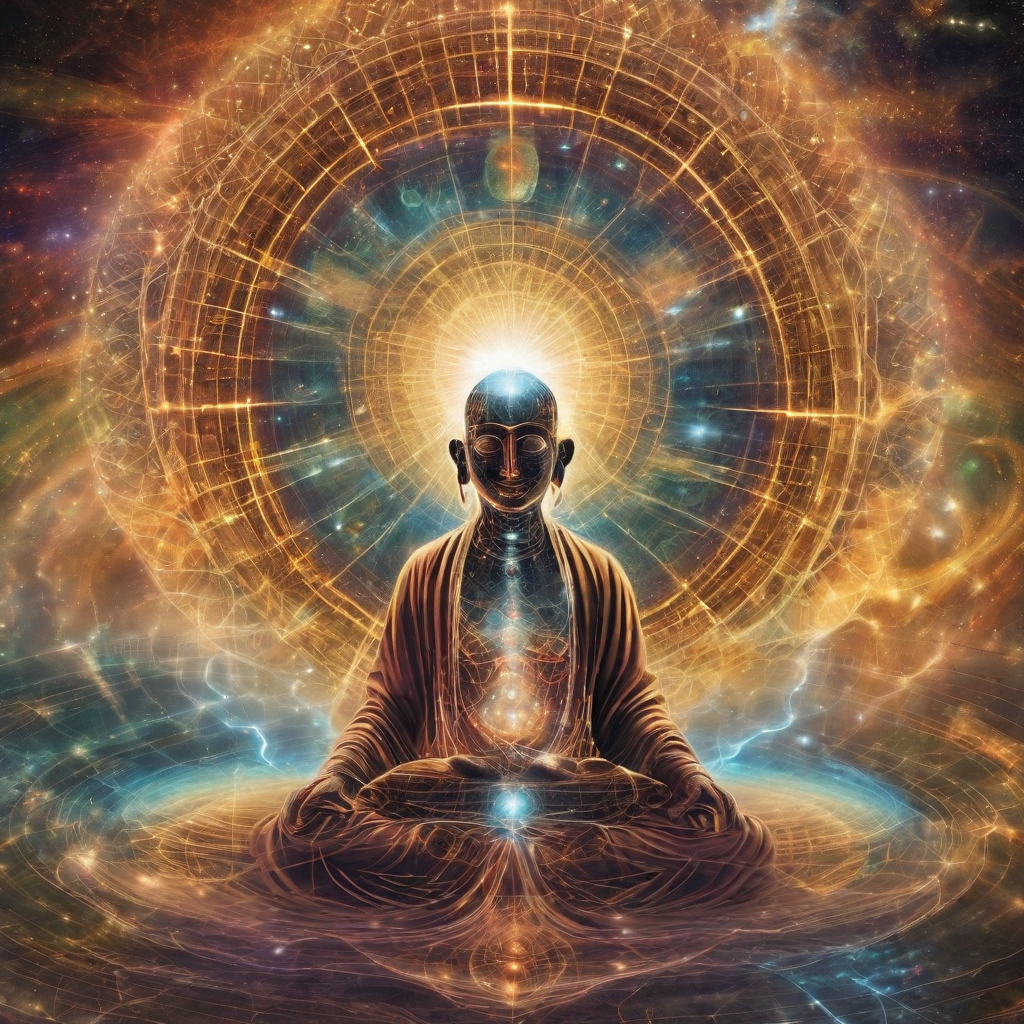
As the silent veil of ignorance lifts, a momentous spark of enlightenment ignites within the seeker, unfurling its tendrils across the boundless cosmos. It is said in ancient texts that the rare nondual state of Turiyatitta represents a zenith of spiritual awakening, where the perceived separation between self and the universe dissolves into a serene ocean of oneness. A hypothesis resonating within the modern quantum paradigm posits that this transcendent state mirrors quantum entanglement at its pinnacle, orchestrating a cosmic dance of interconnectedness.
At the juncture of enlightenment, it is conjectured that every particle within the brain, the body, across terrestrial beings, and through the inanimate, entwines in a profound network of entanglement. Like notes in a grand symphony, all entities, all matter, and perhaps even the ephemeral dance of thoughts and consciousness, become orchestrated in a divine, harmonious rhythm that underpins the entire multiverse.
This notion elevates our understanding of Turiyatitta from a mere inner experience to a cosmic event, suggesting that enlightenment transcends the corporeal, resonating across the quantum fabric of reality. Such a realization steers the human spirit towards a profound acknowledgement: as we seek inner illumination, we are, in essence, yearning for a union with the cosmos, a sublime harmony that exists beyond the veil of duality.
The curious intersection of ancient spiritual insight and quantum mechanics unfurls a rich tapestry of exploration. It beckons us to transcend the superficial boundaries of empirical investigation and delve into the metaphysical, to meditate upon the profound interconnectedness that weaves the human experience into the cosmic narrative.
This quest for a deeper understanding of Turiyatitta and quantum entanglement does not merely reside in the realms of philosophical musings; it echoes the ancient call for a universal communion, a unifying essence that seeds within us the potential to transcend the illusory veil of separateness. And as science inches closer to the bosom of mysticism, we find a poetic elegance in the pursuit of truth, a whisper of the cosmos that hums the ancient melody of oneness.
Morgan O. Smith
Yinnergy Meditation & My Book, Bodhi in the Brain…Available Now!
A Metaphysical Exploration into the Significance of a Singular Number
In the vast expanse of numbers and their mathematical precision, there lies a mystical depth, a metaphysical dimension that transcends their apparent functionality and dives into realms of deeper significance. During our conversation with Steve James on Guru Viking, I ventured into the enigmatic world of the number nine, inspired by a co-worker and the intriguing references from Nikola Tesla.
The number nine, often revered and highlighted in various spiritual, cultural, and scientific contexts, became a subject of my exploration, hinting at a journey that is both deeply personal and universally resonant. My intrigue was kindled by a co-worker and further fueled by Tesla’s assertion that the secrets of the universe could be unravelled through the numbers 3, 6, and 9.
Embarking on a journey to explore the significance of nine, I found myself navigating through a tapestry where mathematics, spirituality, and metaphysics intertwine in a delicate dance of understanding and mystery. The number nine, in its mathematical behaviour, holds a peculiar characteristic: when multiplied, the digits of the products, when added together, often reduce back to nine (e.g., 9 x 5 = 45, and 4 + 5 = 9). This cyclical, almost self-referential nature, hinted at a deeper, perhaps cosmic significance.
In the realms of spirituality and metaphysics, nine emerges as a symbol of completion and transition, often associated with the culmination of a cycle and the impending advent of a new one. It symbolizes a space where endings and beginnings coalesce into a singular point of infinite potential.
My exploration into the significance of nine became a metaphysical journey that transcended the boundaries of tangible understanding and ventured into spaces where logic, intuition, and mystery coexist. It became a path where the finite and the infinite, the known and the unknown, danced in a space of enigmatic beauty, inviting a deeper exploration into the cosmos and the self.
As I continue to explore the depths and heights of existence, the number nine remains a profound symbol, a reminder that within the precision of mathematics lies a mystical depth, within the finite lies the infinite, and within the known lies the boundless unknown.
Morgan O. Smith
Watch Enlightened Comedian:
Ep195: Enlightened Comedian
Welcome to Episode 195, “Enlightened Comedian,” where humour meets the profound depths of spiritual awakening. In this episode, we explore the whimsical yet insightful journey of a comedian whose quest for laughter led him to the shores of enlightenment. Through a blend of comedy and consciousness, we delve into a narrative that celebrates the divine gift of laughter and the profound wisdom it unveils. Tune in to this heartwarming episode as we unravel the laughter-laden path to self-realization.
A friendly reminder for seekers everywhere: Guru Viking continues to unfurl wisdom every Friday on YouTube. Enrich your spiritual palette on Apple, SoundCloud, and Spotify as well. https://www.guruviking.com/
Yinnergy Meditation & My Book, Bodhi in the Brain…Available Now!
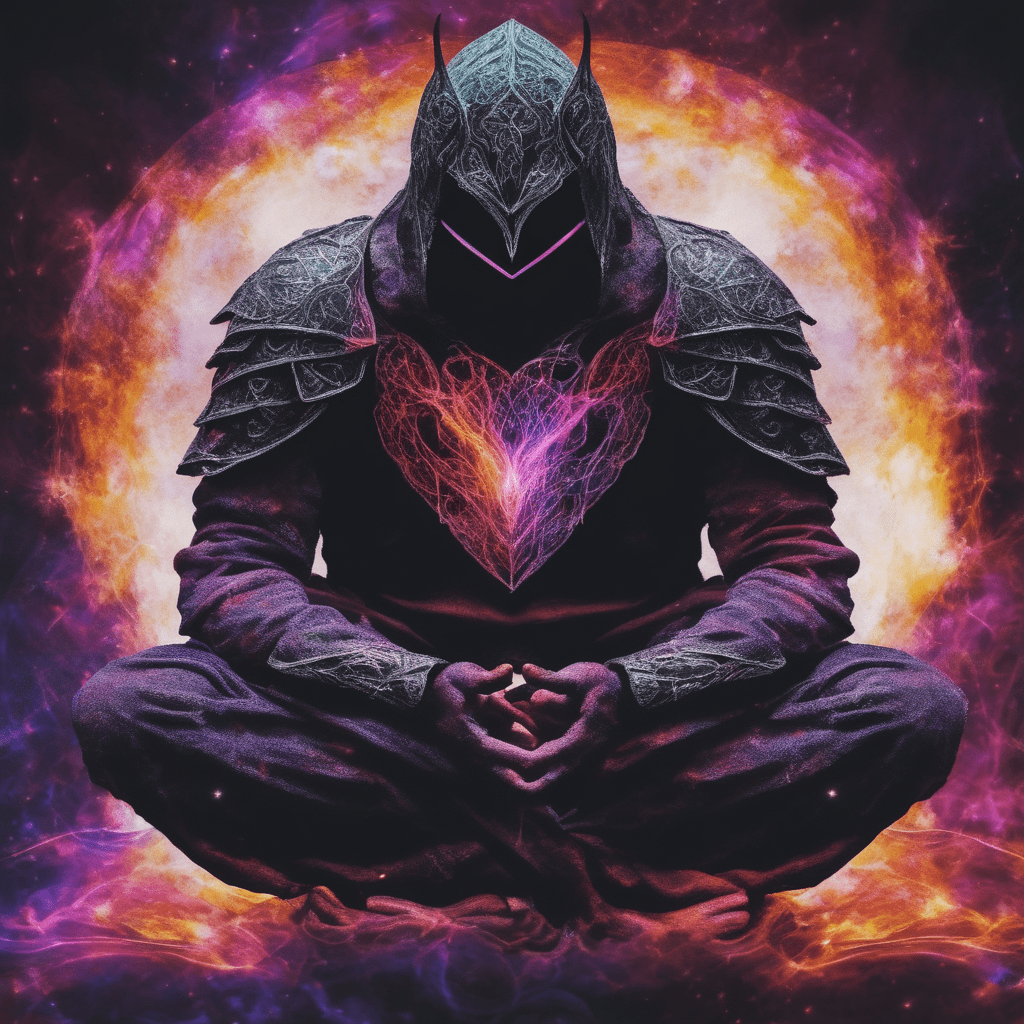
In the labyrinthine corridors of the soul, there lies a path seldom tread, shadowed by mystery and often enveloped by fear. It is a path that leads to a place known as the “dark night of the soul,” a phase of spiritual desolation that has baffled seekers across generations. Yet, within the enigmatic darkness, emerges an unexpected companion – the “dark knight of the soul.”
The Dark Night: A Crisis of Faith
The “dark night of the soul,” a term coined by St. John of the Cross, represents a profound spiritual crisis, a period where the familiar becomes strange, and the divine seems distant. It is a time of purging, where doubts, fears, and the hidden shadows of the soul rise to the surface. The comfort of belief evaporates, replaced by a void that challenges the very core of spiritual identity.
In the “dark night,” one is forced to confront the most profound existential questions. What is the nature of divinity? Why does it seem so elusive? What is the purpose of suffering? The answers are not easily found, and the path becomes obscured.
The Dark Knight: The Warrior Within
In contrast to the disorienting emptiness of the “dark night,” the concept of the “dark knight of the soul” represents a heroic inner archetype. It is the spiritual warrior within, forged not in battles against external foes but in the internal struggles against one’s demons.
The “dark knight” is not a saviour but a guide, a symbol of the courage, resilience, and wisdom needed to navigate through the night. It embodies the willingness to face the darkness, wrestle with doubt, challenge fears, and integrate the shadows rather than shunning them.
The “dark knight” does not vanquish the night but learns to dance with it, finding grace in struggle and meaning in confusion.
The Dance of Darkness and Light
The interplay between the “dark night” and the “dark knight” is a profound spiritual odyssey. One cannot exist without the other. The “dark night” provides the terrain, the challenge, and the abyss that must be crossed. The “dark knight” offers the tools, the strength, and the inner fire that illuminates the way.
In this spiritual dance, the darkness is not something to be feared but embraced. It is a crucible where the false self is burned away, leaving only the authentic soul, raw and unburdened.
The path through the “dark night” is not a path of despair but a journey toward enlightenment. The “dark knight” is not a symbol of battle but a metaphor for inner harmony.
Conclusion
The journey through the “dark night of the soul” and the guidance of the “dark knight of the soul” offers a rich tapestry of spiritual exploration. It reminds us that darkness is not an end but a beginning, a transformation that leads to a deeper connection with the self and the divine.
In embracing both the “dark night” and the “dark knight,” we find a roadmap to authenticity, wisdom, and a spirituality that transcends superficial understanding. The darkness and the knight are not foes but partners, leading us toward a horizon where the soul’s true radiance shines.
The odyssey through the dark night is an invitation, a calling to all who seek. The dark knight awaits, a silent companion ready to guide us through the shadows into the embrace of our luminous essence.
Morgan O. Smith
Yinnergy Meditation & My Book, Bodhi in the Brain…Available Now!
Metaphorical Exploration of the Three Faces of God
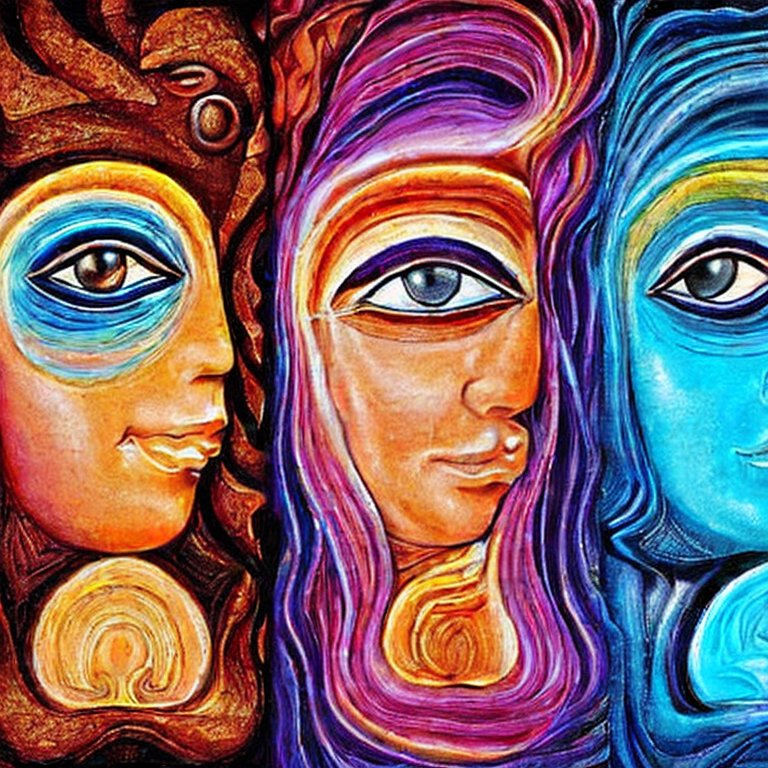
As we endeavour to understand the divine, let’s imagine sketching three different portraits of God, each revealing a unique aspect of the divine. These are the “Three Faces of God,” metaphorically spoken of as “I am That,” “Thou art,” and “It, the Ground of All Being.” Each face provides a different set of facial features, offering a new perspective and experience of the divine.
1. The First Portrait: “I am That”
Envision drawing the first portrait, where you sketch not with your hand, but with your consciousness. This portrait, entitled “I am That,” represents the divine as the reflection of our inner selves. The eyes in this portrait mirror our own, sparkling with the wisdom of unity and oneness. These eyes are windows into the soul, witnessing the divine within us and in everything around us.
The lips are sealed, symbolizing the silence that encapsulates the profound realization of this facet of divinity. It is a silence not born of absence but of completeness, tranquillity that resonates with the essence of existence. The serene countenance of this portrait is a silent affirmation of our inherent divinity.
2. The Second Portrait: “Thou Art”
Now, we turn to the second portrait, “Thou Art.” Here, the divine is perceived as the other, an entity separate from ourselves. In this image, the eyes are compassionate, gazing at us with empathy and understanding, reflecting a personal deity who knows us intimately, one who listens, guides, and protects.
The lips are gently curved into a comforting smile, a symbol of the divine’s eternal love and benevolence. This portrait embodies a divine entity that exists independently of us, yet is deeply connected in a loving and caring relationship.
3. The Third Portrait: “It, the Ground of All Being”
The third portrait, “It, the Ground of All Being,” is an abstract masterpiece. Instead of conventional facial features, it is an evolving canvas of colours, shapes, and patterns, capturing the unfathomable depths and dimensions of the divine as the fundamental essence of existence.
This image lacks eyes and lips because it symbolizes the impersonal aspect of the divine. It is the primordial backdrop from which all forms arise and into which they merge. This face does not interact or engage in the usual sense but is simply there, perpetually present, the immutable reality underlying all of existence.
Wrapping Up
This metaphorical exploration of the “Three Faces of God” is like an artful journey into divinity’s vast and varied landscapes. It encourages us to recognize the divine in our reflections, in a comforting gaze, and in the ever-changing canvas of existence.
Each of these faces, with its unique set of features, invites us to a different experience and understanding of God, enabling us to connect with the divine on multiple levels. It’s a contemplative journey that opens up possibilities for self-discovery and spiritual growth, enhancing our cosmic connection. In these divine portraits, we don’t just see different faces of God; we see reflections of our own quest for spiritual understanding and existential meaning.
Morgan O. Smith
Yinnergy Meditation & My Book, Bodhi in the Brain…Available Now!
Introduction: Just yesterday, I had the privilege of participating in a spirited and thoughtful dialogue as a guest speaker on “The Seekers Mind,” a distinguished forum on Clubhouse, renowned for its intellectual rigour and engaging discourse. The topic of this profound conversation was a thought-provoking question: “To Merge with The Divine – Can The Infinite and Finite Meet?” This insightful exploration brought together a multitude of perspectives, each contributing its own unique colour to the vibrant tapestry of thoughts and opinions. It served as a shared journey into the metaphysical depths of our understanding, a true meeting of minds seeking to grasp the essence of the divine.
In the vast landscape of the spiritual realm, teeming with a multiplicity of views and beliefs, the prospect of ‘merging with the divine’ often stirs up lively debates and discourses. As an absolute monist, I view these differing perspectives as individual facets of the divine itself, each one adding its own depth and dimension to the overall understanding. I recognize the importance of acknowledging various viewpoints, even those that assert a separation between the individual and the divine, considering them valid perspectives in this grand dialogue.
In this blog post, we delve deeper into the intriguing concept of merging with the divine, appreciating the richness of the diverse perspectives that emerged during our discussion. Our exploration is not limited to any one viewpoint but rather seeks to embrace the full spectrum of thought, providing an all-encompassing perspective on this profound topic.
The Absolute Monist’s View: As an absolute monist, I see a fundamental unity that pervades all existence. From this perspective, merging with the divine is a realization that the individual identity is an illusion, and there is a pre-existing oneness that transcends all apparent boundaries. It’s an epiphany that the divine and the individual are not two separate entities, but different expressions of the same ultimate reality, often called Brahman.
Inclusivity of Perspectives: While our discussion last night was thought-provoking, it could only touch on a limited range of perspectives. There are numerous other viewpoints often expressed in conversations about spirituality that I feel are crucial to mention. These perspectives stem from a myriad of beliefs, each born from individuals who perceive themselves as separate from the divine. Recognizing and acknowledging this multiplicity of viewpoints is a fundamental step in embracing the broad spectrum of beliefs in the realm of spirituality. Such acknowledgment lends to a comprehensive understanding of the various ways people interpret and experience the profound concept of merging with the divine. It’s this rich diversity that enriches our collective spiritual journey, offering a multifaceted understanding of our quest to connect with greater power.
Dualism and Separation: Some people adhere to dualistic beliefs, positing a fundamental separation between human and divine. They argue that absolute merging with the divine is impossible because of the inherent distinction between the two realms. From this perspective, practices and rituals serve as conduits to establish a connection with the divine, rather than as a means to achieve complete union.
Pantheism and Immanence: Pantheistic perspectives perceive divinity as immanent in all aspects of existence. Hence, the concept of merging with the divine may be deemed unnecessary as the divine is inherently present everywhere. In this belief system, recognizing the divine nature within oneself and the world can evoke a deep sense of unity and interconnectedness.
Theistic Religions and Union: Various theistic religions offer unique perspectives on merging with the divine. Some emphasize a personal relationship with a transcendent deity, where merging with the divine is interpreted as attaining union or closeness with the divine being. Devotion, surrender, and adherence to religious practices are seen as integral components in seeking this connection.
Agnosticism and Uncertainty: Agnostic viewpoints approach the idea of merging with the divine with skepticism, questioning the very knowability of the divine. They argue that human knowledge and experiences are limited, making it challenging to ascertain whether merging with the divine is a factual possibility. Agnostics often maintain an open-ended stance, acknowledging the limitations of human understanding.
Atheism and Rejection: Atheistic perspectives outrightly reject the existence of any divine entity. From this viewpoint, merging with the divine is considered irrelevant or illusory since there is no divine being to merge within the first place. Atheists often focus on personal growth, societal well-being, and ethical principles as their guiding values.
Philosophical Skepticism and Inquiry: Philosophical skeptics approach the idea of merging with the divine with a sense of inquiry and caution. They contend that such claims often hinge on subjective experiences or unverifiable beliefs, making it difficult to establish their truth. Skeptics advocate critical thinking and challenge unfounded assumptions.
Conclusion: The concept of merging with the divine invites profound contemplation and exploration. From an absolute monist’s standpoint, all beliefs and perspectives emanate from the divine, and is the divine, affirming the unity and interconnectedness of existence. I embrace the understanding that all views, including dualism, pantheism, theistic religions, agnosticism, atheism, and philosophical skepticism, are expressions of the divine exploring itself through different lenses.
In this journey of understanding and merging with the divine, we must approach each perspective with respect, curiosity, and a willingness to learn. By engaging in meaningful dialogue and embracing a diversity of beliefs, we can deepen our understanding of the human experience and the various paths by which people seek connection with the divine.
The question of merging with the divine may not have a definitive answer that satisfies all individuals or belief systems. It is an inherently personal and subjective exploration, shaped by cultural, religious, and spiritual backgrounds. However, the shared recognition of the inherent sacredness of existence and the desire to connect with something greater than ourselves is universally beautiful.
In the grand tapestry of existence, let us celebrate the multitude of perspectives, knowing they all contribute to our rich, ever-unfolding exploration of merging with the divine. Through open-mindedness, compassion, and a willingness to transcend individual identities, we may come closer to experiencing the underlying oneness that pervades all things.
May we continue our exploration in the spirit of unity and understanding, honouring the divine in ourselves and each other, while appreciating the vast tapestry of beliefs and experiences that comprise our collective journey toward merging with the divine.
Morgan O. Smith
Yinnergy Meditation & My Book, Bodhi in the Brain…Available Now!
A Journey Through Samsara and the Spiritual Peak Experience
Introduction:
Join us on a profound exploration into the deep reaches of the cosmic womb, where the universe perpetually recreates itself, moment by moment, hosting the limitless potentiality of creation. Our journey uncovers the spiritual apex of awareness, illuminating the eternal cycle of death and rebirth that defines the universe, referred to as Samsara. We draw a significant parallel between the process, pain, and labour involved in physical childbirth and this infinite cosmic evolution.
The Cosmic Pregnancy: The Dormant Potential of the Universe
The cosmic womb, in its vast, pregnant stillness, cradles all potential, representing the dormant stage of all shapes and forms. It is a condition of profound tranquillity preceding creation. Within this womb, the boundaries of possible and impossible blur, the probable and improbable coexist harmoniously. This cosmic pregnancy symbolizes the universe’s infinite potential, perpetually prepared to materialize into existence.
The Spiritual Apex: Understanding the Eternal Cycle of Samsara
The spiritual apex is a transcendent episode of profound realization when one becomes deeply aware of Samsara – the universal cycle of death and rebirth. This heightened consciousness provides a sneak peek into the cosmic womb and the incessant birthing process of the universe. At this pivotal moment, the seeker aligns with the intricate rhythm of creation and dissolution, recognizing the inherent interconnectedness of all entities.
The Pain and Labor: Cosmic Childbirth Mirroring the Dance of Samsara
Mirroring the agony and labour that a prospective mother endures during childbirth, the universe undergoes a similar process in cosmic birth. This cosmic labour reflects Samsara’s cycle, where the universe constantly perishes and revives. The suffering inherent in this process is integral to creation, enabling the universe’s continuous evolution and transformation.
The Moment of Birth: The Universe Taking Form
Each moment, the cosmic womb nurtures a new version of the universe. This manifestation is a divine act of creation, translating the dormant into the tangible, and the limitless potential of cosmic pregnancy into reality. This perpetual birth is an ongoing process, with the universe consistently unfolding and expanding into new dimensions and expressions.
Integrating the Spiritual Apex: Nurturing an Awareness of Samsara
To authentically incorporate the spiritual apex, the seeker must foster an awareness of Samsara’s eternal cycle. This involves acknowledging the transient nature of all entities and accepting the constant process of death and rebirth pervading the universe. Through this, the seeker can develop profound compassion, understanding, and connection with the entire existence.
Conclusion: Celebrating the Cosmic Rhythm of Samsara
The exploration into the cosmic womb and understanding of the perpetual cycle of Samsara endow the seeker with profound comprehension of the universe’s nature. By welcoming the spiritual apex and incorporating this consciousness into daily life, one can harmonize with the cosmic rhythm of creation and dissolution. In this state of interconnectedness, we can genuinely marvel at the universe’s beauty and mystery, actively participating in the infinite cycle of death and rebirth that shapes our existence.
Morgan O. Smith
Yinnergy Meditation&My book, Bodhi in the Brain…Available Now!




 Morgan O. Smith