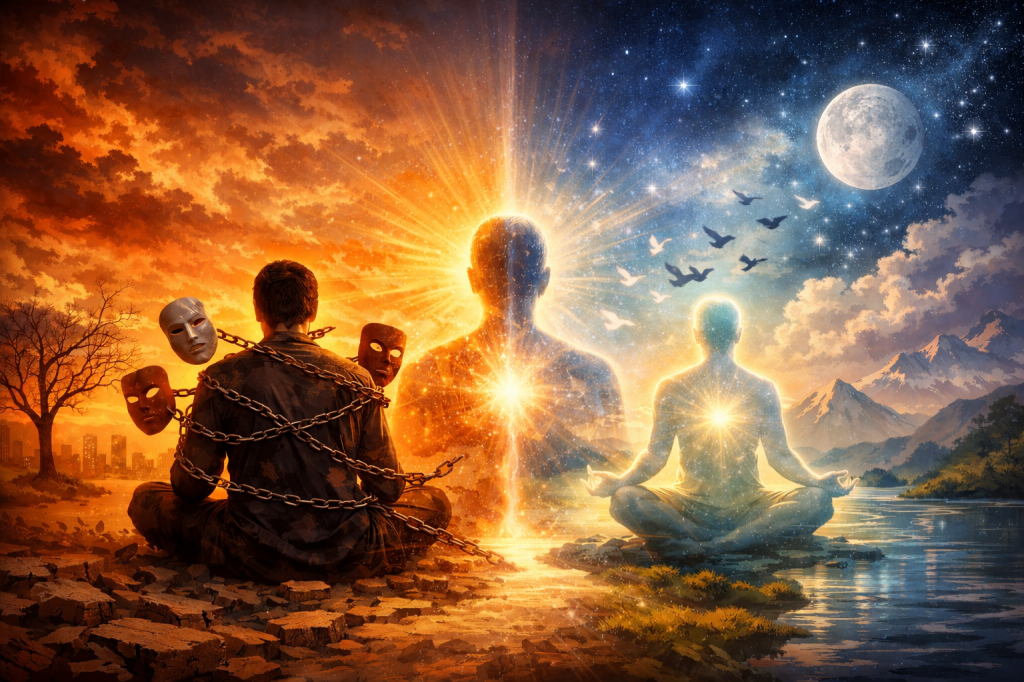
The Shadow of the Light

Spiritual maturity does not erase limitation.
It reveals it.

Many imagine awakening as a flawless state; permanent clarity, endless compassion, immunity to human contradiction. A polished saint who never stumbles. A mind without friction. A heart without ache.

Life has never worked that way.

Every illumination throws contrast. Every realization exposes what still sleeps. Awareness grows, and so does sensitivity to the places where conditioning remains. What once went unnoticed now becomes obvious.

Light does not cancel shadow.
Light makes shadow visible.

A person may taste boundless consciousness and still forget their keys.
May speak wisdom and still feel grief.
May rest as pure Being and still get irritated in traffic.

None of this contradicts awakening.

It confirms embodiment.

Human form carries edges. Biology, memory, culture, temperament, nervous system patterns—these do not dissolve simply because truth is recognized. Realization clarifies the sky; weather still moves through it.

Expecting perfection from enlightenment is another form of ego fantasy. A subtler one, dressed in spiritual language.

“Once I awaken, I will finally be beyond everything.”

Beyond what?

Beyond hunger?
Beyond fatigue?
Beyond old emotional reflexes surfacing now and then?

Even sages live inside gravity.

Consider the paradox: greater clarity often deepens humility. Seeing through the illusion of separateness does not produce superiority; it softens certainty. One recognizes how much of this life unfolds through forces far larger than personal will.

Brilliance and blind spots coexist.

The brighter the lamp, the sharper the outline behind it.

Shadow is not failure. Shadow is information.

Each reaction, each contraction, each moment of confusion points to another place where life invites integration. Nothing needs to be rejected. Everything becomes material for understanding.

Spiritual growth, then, is not a climb toward flawlessness.

It is a widening embrace.

Light without shadow would mean no depth, no dimension, no humanity. A perfectly even brightness reveals nothing. Contrast gives form to experience. Contrast allows learning. Contrast allows compassion.

Seeing your own limits makes you gentle with others.

When you know how easily fear arises in your own body, you stop judging someone else’s. When you recognize your own unfinished places, forgiveness becomes natural rather than moral.

This is maturity: not pretending to be spotless, but standing fully where you are.

Awareness shining. Conditioning still moving. Both allowed.

Nothing to fix. Nothing to hide.

Just this living interplay.

Radiance casting shape.

Human nature doing exactly what it has always done; expressing the infinite through a finite frame.

Morgan O. Smith

AI for Wellness and Spirituality Summit

February 9 & 10, 2026

https://aiforwellnessandspirituality.com/mosm

Ego Death Is Not a Metaphor

Ego death is often spoken about casually, yet nothing about it is casual. It is not a poetic phrase, nor a dramatic exaggeration. Something very specific occurs—precise, unmistakable, and irreversible at the level of insight.

This is not a biological event. The body remains alive. The brain continues to function. Memory does not disappear. Consciousness does not black out. What vanishes is the internal reference point that says, this is me. The structure that once organized experience around a personal center dissolves, and with it goes the assumption of separation.

No negotiation happens here. No partial surrender. No internal debate. Doubt does not survive the moment. The mind does not ask whether this is real. Verification becomes unnecessary because the one who would seek confirmation is no longer present.

Psychological death may sound abstract until it happens. When it does, the body reacts as though an actual death is occurring. Survival instincts flare. Meaning collapses. Familiar orientation fails. Yet awareness remains clear—perhaps clearer than it has ever been. This clarity is what distinguishes ego death from unconsciousness. Awareness does not dim. It expands beyond the need for identity.

Enlightenment does not occur after ego death. Enlightenment is what is revealed when the ego can no longer interfere. The ego cannot be refined into truth. It cannot be educated into realization. It must fall away entirely, because it is structurally incapable of holding what is uncovered.

At the causal level of realization, identity no longer rests in form, personality, history, or narrative. Cause and effect are no longer observed from the outside. They are known as oneself. Everything that arises is recognized as both originating from and resolving into the same source. Nothing stands apart. Nothing is accidental. Agency is no longer personal, yet responsibility is absolute.

Deeper still, even causality dissolves. Distinctions between origin and outcome lose meaning. What remains is not many things connected, but a single indivisible reality. This is what Advaita Vedanta names Absolute Monism; not a belief, not a concept, but a lived recognition.

Time no longer appears linear. Past, present, and future are not sequential events but simultaneous expressions. Every occurrence, across all scales and dimensions, is apprehended as one movement without edges. Beginning and ending collapse into the same point. Eternity ceases to be a duration and reveals itself as immediacy.

The ego cannot survive this recognition. It was never meant to. The ego exists to navigate relativity, not to comprehend totality. Asking it to grasp nonduality is like asking a shadow to contain light. The moment the ego loosens its grip, what remains is not annihilation, but the recognition that life and death were never opposites.

Ego death feels final because it ends the search forever. Nothing remains to achieve. Nothing remains to defend. What is discovered was never acquired. It was always present, waiting for the interference to stop.

This is why enlightenment is never uncertain. Anyone still asking whether it happened is still standing outside the threshold. When it occurs, the questioner disappears, and only knowing remains; silent, complete, and beyond reversal.

Morgan O. Smith

AI for Wellness and Spirituality Summit

February 9 & 10, 2026

https://aiforwellnessandspirituality.com/mosm

The Courage of Radical Openness

Seeing others as thyself is not a moral instruction. It is a perceptual shift. A reorientation of how reality is registered once the reflex to divide dissolves.

Eyes wide open does not mean naïve seeing. It means perception unclouded by projection. Faces are no longer screens for personal history, unmet needs, or inherited narratives. Another person appears as they are—complex, conditioned, luminous, conflicted—without being reduced to a role. Judgment loosens because clarity replaces assumption. Seeing becomes intimate without being invasive.

A heart wide open does not imply emotional excess or boundarylessness. It signals availability. The willingness to feel without selecting which feelings are permitted. Joy is allowed. Discomfort is allowed. Grief is allowed. Compassion emerges not as effort, but as resonance. Another’s pain is not absorbed as obligation, nor deflected as inconvenience. It is simply felt as part of the shared field of experience.

A mind wide open is not the absence of thought. It is freedom from fixation. Opinions lose their rigidity. Certainty softens. The need to be right gives way to the capacity to understand. This openness does not erase discernment; it refines it. Differences remain visible, but no longer threaten identity. Perspective becomes spacious enough to hold contradiction without collapse.

Seeing others as thyself does not blur individuality. It reveals its true context. Distinct lives, distinct stories, distinct expressions, arising within the same indivisible reality. Separation persists as appearance, not as truth. What dissolves is the belief that the boundary is absolute.

This way of seeing cannot be forced. Ethics alone cannot produce it. It unfolds naturally as identification loosens its grip on a singular point of view. The centre quietly falls away. What remains is not detachment, but intimacy without possession.

From this recognition, action changes. Speech becomes more careful, not from fear, but from sensitivity. Listening deepens because there is no urgency to defend a position. Even conflict transforms. Disagreement no longer requires dehumanization. Accountability no longer requires condemnation.

Seeing others as thyself is not about becoming better. It is about becoming honest. Honest about what has always been the case beneath habit and conditioning. No hierarchy of worth. No isolated self standing apart from the whole. Only different expressions of the same life, meeting itself again and again, through countless faces.

Morgan O. Smith

Get Your Free Copy of My Book, Bodhi in the Brain!

https://subscribepage.io/oTSZQu

When All Paths Become Transparent to Truth

At the super-integral level, perception no longer filters reality through allegiance. Vision widens beyond affiliation, beyond the need to defend a worldview or elevate one tradition over another. What becomes visible is not a synthesis manufactured by intellect, but a recognition born of depth: each religion, philosophy, system, culture, and tradition is responding to the same mystery from a different angle of approach.

Truth does not belong to any single framework. Frameworks belong to truth.

Each system carries a partial articulation shaped by time, language, geography, psychology, and collective need. When approached from within their own context, these systems often appear contradictory. When seen from depth, they are complementary gestures pointing toward what cannot be fully captured. Disagreement dissolves not because differences disappear, but because the compulsion to absolutize any one perspective falls away.

Super-integral awareness does not flatten distinctions. It clarifies them. Christianity speaks the language of incarnation and surrender. Buddhism articulates emptiness and liberation from grasping. Advaita reveals the non-separation of Self and reality. Indigenous traditions speak through land, ancestry, and cyclical intelligence. Science maps measurable patterns of the cosmos. Psychology explores the architecture of the inner world. Each is precise within its domain. None is sufficient alone.

At this level, conflict between systems is understood as a category error. Arguments arise when symbols are mistaken for the reality they reference. Beliefs are defended as ends rather than as lenses. Super-integral seeing restores humility to knowing. It recognizes that every map is provisional and every language incomplete.

What shifts most profoundly is identity. No longer rooted in belief structures, identity relaxes into presence itself. From there, one can enter any tradition without needing to convert, reject, or appropriate. A Christian prayer, a Sufi poem, a Zen koan, a Vedantic inquiry, or a scientific equation can all be met directly, without friction. Meaning reveals itself through resonance rather than comparison.

This level of seeing does not erase devotion. It deepens it. Devotion moves from loyalty to a form toward reverence for the source animating all forms. Practice becomes fluid, responsive, and contextual. Wisdom expresses itself through discernment rather than doctrine.

Super-integral awareness is not an achievement of accumulation. It arises through subtraction, through the gradual release of identification with position, certainty, and hierarchy. What remains is a capacity to listen deeply, to recognize truth wherever it appears, and to allow contradiction to coexist without collapse.

Here, unity is not an idea. It is a lived recognition that difference is how the infinite explores itself.

Morgan O. Smith

Get Your Free Copy of My Book, Bodhi in the Brain!

https://subscribepage.io/oTSZQu

Presence Does Not Come or Go

Presence does not arrive with birth, nor does it depart with death. It does not wait for time to pass or moments to accumulate. Presence is already here; before thought names it, before memory reaches backward, before imagination leans forward. Whatever appears does so within presence, not alongside it.

The past feels real only because it is remembered now. The future feels compelling only because it is anticipated now. Thought moves, images shift, emotions rise and fall, yet each movement occurs against the same unmoving fact: presence has never left. Even the idea of being elsewhere is something that appears here.

Bodies change. Identities dissolve and reform. Worlds expand and collapse. Physics tells us that matter and energy do not vanish; they transform. Even more striking, what we call matter accounts for only a fraction of what exists. The vast remainder: dark energy, dark matter, remains unseen, unnamed, yet undeniably present. Absence itself never escapes presence. Non-existence, if such a thing could be said to occur, would still be known as present.

Death, then, does not challenge presence. It only challenges continuity of form. If awareness continues, presence continues. If awareness ceases, the cessation itself is not outside presence. Nothing steps beyond it. Nothing escapes it. There is no edge where presence stops and something else begins.

Impermanence governs every form. Thoughts change. Bodies age. Stars burn out. Universes may even end. Yet impermanence depends on something that does not change. Change can only be noticed because presence remains steady enough to register it. Movement requires a stillness that is never lost.

Presence does not belong to you, yet nothing is more intimate. It is not located inside or outside. Those distinctions arise within it. Every attempt to grasp presence turns it into an object and misses it. Presence cannot be held because it is what is holding everything else.

Even the end of everything would not be an end of presence. It would simply be presence without form. No time. No matter. No universe. Still present.

Nothing needs to be added to this. Nothing needs to be resolved. Presence is not a conclusion; it is the condition that allows conclusions to appear and disappear.

And it has never not been here.

Morgan O. Smith

Get Your Free Copy of My Book, Bodhi in the Brain!

https://subscribepage.io/oTSZQu

Ego Death vs. Super-Ego Death

When individuality dissolves—and when the collective mask collapses

Ego death has become familiar language within spiritual circles. It often refers to the collapse of the personal story; the felt sense of “me” as a separate centre of control, identity, and continuity. Thoughts still arise, sensations still move, yet the claim of ownership quietly disappears. Experience continues without a narrator insisting it belongs to someone.

This event can feel absolute. Many report vastness, silence, love without an object, or a direct recognition of being awareness itself. The personal mask falls away, and with it the emotional gravity of self-protection, shame, pride, and comparison. Life continues, yet it is no longer filtered through the need to defend or improve a fictional self.

Still, something subtle often remains.

Beneath the personal ego sits another structure, far less discussed and far more persistent: the super-ego of the collective. This is not merely morality or social conditioning. It is the internalized voice of humanity itself; the inherited myths, hierarchies, spiritual ideals, political narratives, and cultural agreements that define what counts as real, good, awakened, successful, or worthy.

Ego death removes the personal actor. Super-ego death removes the stage.

Super-ego death is not about becoming rebellious or rejecting society. It is the dissolution of the unseen authority that claims reality must conform to shared agreements. This includes spiritual identities just as much as material ones. The enlightened persona, the wise teacher, the healed one, the awakened exemplar, all of these belong to the collective ego, even when the personal ego has already fallen.

This is why some awakenings still feel constrained. Freedom is tasted, yet behavior unconsciously bends to invisible rules. One no longer needs approval as an individual, yet still seeks legitimacy through lineage, doctrine, community, or role. Silence is known, yet language is chosen carefully to avoid exile from the group.

Super-ego death arrives when even the collective lens loses its authority.

No tradition holds the final word. No framework owns truth. No spiritual map is mistaken for the territory it points toward. Morality is no longer outsourced to consensus. Meaning no longer depends on agreement. What remains is not isolation, but radical intimacy; life meeting itself without mediation.

This does not produce chaos. It produces clarity.

Action becomes responsive rather than obedient. Compassion arises without ideology. Ethics emerge organically, shaped by direct contact rather than inherited commandments. One may still participate in society, teach, lead, love, and create, but without the invisible pressure to represent anything.

Personal ego death says, “I am not who I thought I was.”
Super-ego death says, “Reality is not what we collectively agreed it must be.”

Very few speak from this territory because it offers no badge. Nothing can be claimed. No position can be stabilized. Language points, then dissolves. Authority evaporates.

What remains cannot be organized, branded, or defended.

Life continues, unowned, unruled, uncontained, expressing itself freely, without asking permission from the individual or the crowd.

Morgan O. Smith

Get Your Free Copy of My Book, Bodhi in the Brain!

https://subscribepage.io/oTSZQu

The Greatest Expression

You’re Already Expressing the Greatest Expression and Don’t Even Know It

Nothing needs to be added to you. Nothing is missing. The most extraordinary expression possible is already happening, quietly, without effort, before any attempt to improve it.

Existence does not wait for permission to appear. It does not consult identity, achievement, or spiritual progress. It expresses itself as breath, sensation, perception, memory, confusion, clarity, longing, boredom, and awe, all without ever stepping outside itself. What you call you is one of its gestures, not its source.

Search often begins with the assumption that something essential has not yet arrived. That assumption creates movement, effort, discipline, and endless refinement. Yet the impulse to seek arises from the same field that is supposedly being sought. Awareness looks for awareness. Being attempts to arrive at being. The loop sustains itself through misunderstanding.

Existence is not something you perform well or poorly. It is not a role to master or a state to stabilize. It is already complete before thought comments on it. Every attempt to improve it belongs to the play of expression, not to a lack that needs correcting.

Notice how little effort is required to exist. Heartbeat continues without consultation. Sensations arise without rehearsal. Thoughts appear without being summoned. Even the sense of being a separate doer arrives spontaneously. None of this requires your management.

What feels ordinary carries no deficiency. The mundane is not a lesser version of reality waiting to become sacred. Washing dishes, forgetting names, feeling tired, feeling inspired, each appears from the same depth. Existence does not divide itself into meaningful and meaningless moments.

Awakening is not an upgrade layered onto life. It is the recognition that life never needed upgrading. What falls away is not existence, but the belief that existence must become something else to be valid.

Trying to express your “highest self” quietly assumes you are not already doing so. That belief fractures what is whole. The greatest expression cannot be improved because it is not a product. It is the fact of appearing at all.

Nothing needs to stop. Nothing needs to be transcended. Even misunderstanding belongs. Even confusion is permitted. Even the desire to arrive somewhere else is part of what is already complete.

The miracle hides in plain sight because it has never announced itself. Existence does not sparkle to prove its worth. It simply continues, endlessly creative, endlessly sufficient, endlessly itself, appearing as you, without asking whether you recognize it.

Morgan O. Smith

Get Your Free Copy of My Book, Bodhi in the Brain!

https://subscribepage.io/oTSZQu

Learning to Become the Whole Picture

A Meditation Exercise

Most of us move through life identified with a very small point of reference: this body, this role, this story. This blog explores a contemplative exercise that systematically expands perception from the smallest point imaginable to the largest conceivable whole. Step by step, it trains the mind to release its attachment to identity, scale, and centre. Practiced over time, this form of meditation prepares awareness for the possibility of non-separation, where the sense of being a separate observer gives way to experiencing reality as a single, undivided whole.

A dot appears.
Small. Definite. Easy to hold.

That dot rests on paper.
Paper rests on a desk.
Desk belongs to a room.
Room belongs to a house.
House stands on a street.
Street unfolds into a community.
Community expands into a city.
City into a province or state.
Province into a country.
Country into a planet.

The planet moves within a solar system.
The solar system turns within a galaxy.
The galaxy drifts among countless others.
The universe opens into immeasurable depth.
Depth gives way to the possibility of many universes.

Awareness keeps widening.

At some point, the exercise stops being imaginative.
Perspective shifts from accumulation to release.
Each expansion loosens attachment to the centre point, once called “me.”

Identity thins out.

Roles dissolve first.
Status follows.
History fades.
Gender, race, profession, success, failure, each quietly falls away.

No effort required.
Only patience and repetition.

What remains does not feel like loss.
What remains feels like scale.

Meditation, practiced this way, trains the nervous system to tolerate immensity.
Mind learns not to contract when boundaries disappear.
Attention becomes flexible enough to hold paradox without panic.

Something subtle happens over years.
The observer no longer stands apart from the observed.
The dot never vanished; it was never separate from the page, the desk, the room, or the universe.

When awakening arrives, should it arrive, the shock is not annihilation.
The shock is familiarity.

Nothing new appears.
Only the removal of a mistaken centre.

Preparation does not guarantee realization.
Preparation simply reduces resistance.

Five years of daily practice is not a demand.
Five years is a gesture of seriousness.
A declaration that truth matters more than comfort.

Eventually, there is no one imagining the multiverse.
The multiverse imagines itself; without edges, without names, without division.

Silence holds everything.

Morgan O. Smith

Get Your Free Copy of My Book, Bodhi in the Brain!

https://subscribepage.io/oTSZQu

All Perspectives, Held at Once

The mind is trained to move. It scans, compares, chooses, rejects. Such motion gives the impression that reality must be approached piece by piece, perspective by perspective, as though truth were a puzzle assembled over time. Yet there is another mode of knowing; one that does not move at all.

When awareness rests in itself, perspectives no longer compete for dominance. They appear simultaneously, without hierarchy. Subjective feeling, objective fact, cultural meaning, and systemic pattern are no longer separate lenses fighting for authority. Each arises as a facet of the same totality, already complete.

Grasping all perspectives at once does not require encyclopedic knowledge or intellectual speed. It requires the absence of contraction. The moment the need to stand somewhere collapses, the whole field becomes visible. No viewpoint is excluded because none is defended.

Contradiction dissolves here; not because differences vanish, but because opposition depends on identification. When awareness is no longer anchored to a single position, opposing views reveal themselves as complementary expressions of one indivisible reality. What once appeared irreconcilable is now seen as mutually arising.

This capacity does not belong to the personality. It is not a skill developed through effort or refinement. It emerges naturally when the sense of being a separate observer relaxes. What remains is a silent comprehension that does not argue, does not conclude, and does not seek resolution.

From this clarity, compassion becomes effortless. Every stance, every belief, every action is understood from its own internal logic. Judgment falls away, replaced by direct recognition. Even confusion is seen clearly, without resistance.

Such seeing does not flatten the world. It deepens it. Distinctions remain, yet none claim ownership of truth. The full spectrum of existence is held without strain, like light containing every colour without favouring one.

Nothing new is acquired here. Something false simply stops obscuring what was always present.

Morgan O. Smith

Get Your Free Copy of My Book, Bodhi in the Brain!

https://subscribepage.io/oTSZQu

Beyond the Lens of Devotion

How Presence Reveals Consciousness

Most people think of darshan as a moment where a seeker looks upon a teacher, saint, or deity. Yet something far more nuanced unfolds beneath that outward exchange. The gaze, the silence, the presence, each thread of the encounter shapes consciousness in ways that depend on the inner maturity of the one receiving it.

A childlike stage approaches darshan with awe charged by emotion. The world feels animated by invisible forces, and a teacher appears to hold the keys to destiny itself. Nothing is questioned; everything is absorbed. Power seems to live outside the self, radiating from the figure who stands upon the altar or sits upon the asana.

A more developed stage begins to untangle symbol from projection. Presence is recognized not as magic, but as psychology refined into ritual. A teacher’s gaze becomes a mirror through which hidden material rises. Nervous systems synchronize, emotions unravel, archetypes awaken. What once felt supernatural becomes profoundly human, yet no less sacred for being understood.

A deeper stage meets darshan without seeking a blessing at all. Awareness recognizes its own reflection across an imagined divide. The teacher’s presence becomes a steady flame, revealing the same light in the one who looks. The moment turns transparent; subject and object thin into a single field. No transmission is required because nothing is actually transferred. Consciousness simply stands revealed to itself.

Darshan, then, is not a singular practice but a spectrum. It can soothe fear, unlock psychological insight, or open the doorway into the unbounded. Each layer is valid. Each layer meets the seeker where they stand. The mystery lies in how the same ritual changes meaning as consciousness evolves.

Perhaps the most profound realization is this: the power of darshan has never been contained within the one who gives it. The power rests in the depth of the one who receives.

Morgan O. Smith

Get Your Free Copy of My Book, Bodhi in the Brain!

https://subscribepage.io/oTSZQu