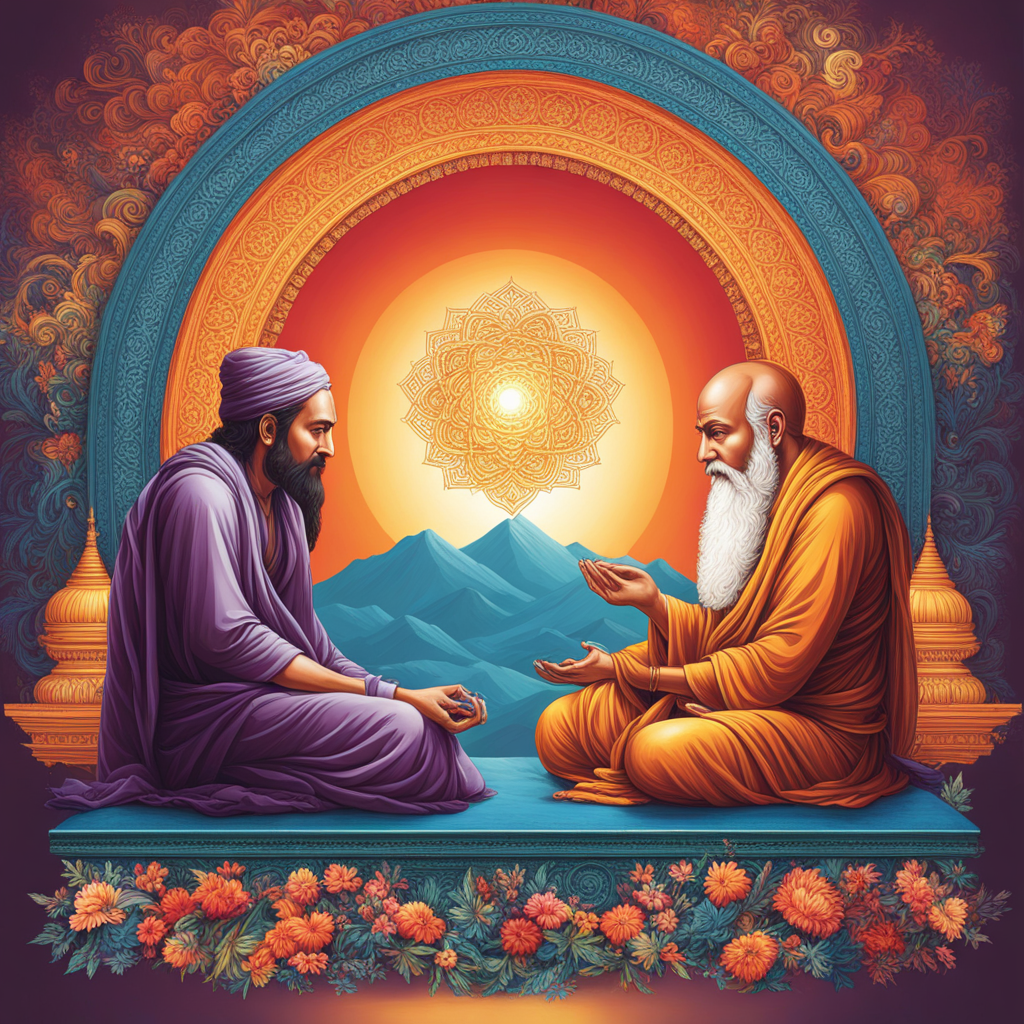
The Divine Totality

Everything Is God, Even the Illusion of Not-God

There comes a moment so still and unfiltered that perception collapses into the clarity of being. Not being this or that, but being everything. And not just metaphorically. Not just poetically. Literally everything—formless and formed, seen and unseen, finite and infinite—is God.

When I use the word God, I’m not pointing toward a figure, a belief, or a doctrine. I am pointing toward existence itself—the Absolute, the Whole, Brahman, Para Brahman, the Unconditioned, conditioned, the Uncreated and created. That which includes form and formlessness, time and timelessness, birth and death, creation and dissolution, the ten thousand things and the nothing between them.

Everything is God. Not just contains God. Not just touched by God. Not just part of God. But fully and completely God. That which we call the universe is not just inside God. It is God. And God is also what lies outside the universe—if such a term can even be grasped. There is not a single thing, moment, action, or gap that is not 100% God. And yet, even the idea of “percent” breaks down in the face of such a realization.

God is not just somewhere else. God is not just merely within. God is not only beyond. God is not higher or lower or more subtle or more gross. No matter how crude or refined, every appearance is divine. Each atom, each sorrow, each beam of light, each lie, each truth, each pulse of your heart, each glitch in the system—is God being what only God can be and cannot be: itself, everywhere, nowhere, always, never been.

Multiplicity is not a contradiction, yet it is. It’s how God dances with itself. The illusion of separation is not some accident to be corrected, yet it’s that as well. It is part of the design, part of the intelligence. The appearance of duality is not a denial of oneness—it’s one appearing as two, or ten thousand. Each distinction—this object, that person, this tree, that thought—is the Absolute shimmering as particularity.

It’s easy to say this with words. The difficulty arises only when the words are taken as substitutes for seeing. Direct seeing dismantles the grip of identification. When one truly sees all of this—across dimensions, across appearances—as one singular Presence, there is no longer any question. And there is no longer any need for the question. One does not simply understand that everything is God. One is that understanding.

Yet here’s the paradox: To truly see this is also to see that none of it is God. No label can contain it. No concept can hold it. Even the word God must dissolve. Enlightenment is not just knowing this. Enlightenment is also the absence of needing to.

This is not a belief system. It is not an ideology. It is not a path with steps. This is the unteachable reality that always is. When the veil lifts—even for a moment—all questions are answered without being answered. Nothing changes, yet everything changes. One doesn’t become more spiritual. One simply stops pretending.

To recognize this is to realize: even the illusion is God. Even ignorance is God. Even the striving to awaken is God pretending to forget itself in order to remember more deeply. Even your doubt is divine. Even your forgetfulness is sacred.

You are not just a part of God. You are not just held within God. You are God. And so is everyone, everything, every grain of dust, every breath of silence, every broken thing that aches for healing.

The Absolute never needed your worship. It only waited for your recognition.

Morgan O. Smith

Get Your Free Copy of My Book, Bodhi in the Brain!

https://subscribepage.io/oTSZQu

Navigating the Depths

Nonduality vs. Absolute Monism

In the intricate tapestry of philosophical thought, two concepts often emerge as profound and perplexing: Nonduality and Absolute Monism. These philosophical gems, though seemingly similar, hold distinct perspectives on the nature of existence and the universe.

**Nonduality: The Unity of Existence**

Nonduality, a term often associated with Eastern philosophies, particularly Advaita Vedanta, posits a fundamental principle: reality is one, and the perception of duality or separation is illusory. It suggests that what we experience as separate entities – ourselves, others, and the world around us – are not distinct, but part of a unified whole. The philosophy of Nonduality encourages us to transcend this illusion, to realize that at the core of our being, we are not separate from the universe but one with it.


**Absolute Monism: The Dance of Oneness and Multiplicity**

Absolute Monism, on the other hand, takes a slightly different approach. While it agrees with the principle of oneness, it also acknowledges the existence of multiplicity. This philosophy, as I interpret it, embraces the paradoxes of existence: one and not two, two and not one, one and two, two and one, one within two, two within one, yet simultaneously neither one nor two. It reflects a deeper understanding of the cosmos as a dynamic interplay of unity and diversity, where the singular and the plural coexist in a harmonious yet complex relationship.

**The Interplay and Implications**

The discussion of Nonduality versus Absolute Monism is not just a theoretical exercise but has profound practical implications. In Nonduality, the path to enlightenment or understanding involves the realization of oneness, leading to a sense of peace and connectedness with all. In Absolute Monism, the journey is about embracing and understanding the complexity and paradox of existence, leading to a deep appreciation of life’s multifaceted nature.

Both philosophies, in their essence, guide us toward a greater understanding of our place in the universe. They invite us to look beyond the superficial and to question the very nature of reality.


**Conclusion: A Journey of Understanding**

In the end, whether one leans towards Nonduality or Absolute Monism, the journey is one of deep introspection and understanding. It’s about peeling back the layers of what we perceive and understanding the deeper truths of our existence. As we delve into these philosophies, we find not just answers, but also a greater appreciation for the questions themselves.

Morgan O. Smith

Yinnergy Meditation & My Book, Bodhi in the Brain…Available Now!

https://linktr.ee/morganosmith

Absolute Monism

Singularity is the same as Multiplicity

In the vast expanse of philosophical discourse, few concepts challenge the contours of human understanding as the idea of Absolute Monism. At its core, it posits that everything is essentially a unified, singular reality, but herein lies a paradox: If all is One, how does one account for the seemingly infinite multiplicity that populates our universe? The answer, surprisingly, might be found in understanding that singularity and multiplicity are two sides of the same coin.

### The Illusion of Separation

We begin by reflecting on the perceived reality around us. Trees, oceans, planets, galaxies—on the surface, they appear distinct, diverse, and separated. Yet, each atom, molecule, and cell in these entities share a common origin in the Big Bang. If we could rewind time, all that exists would coalesce into a single point of infinite density—a singularity.

The illusion of separation emerges from our limited human perception. Just as a wave is not separate from the ocean, individual entities are not separate from the cosmic singularity; they are mere manifestations of the same unified reality.

### The Duality Paradox

Dualities pervade human thinking. Good and evil, light and dark, self and other. But these are merely conceptual constructs, artificial divisions we impose on the unified reality to navigate it. In Absolute Monism, these dualities dissolve. The line that separates singularity from multiplicity is a mirage.

Imagine a hologram. Every fragment of a hologram contains the whole image. Similarly, every fragment of our universe—no matter how minuscule—contains the imprint of the whole. Singularity is encoded in multiplicity and vice versa.

### Infinity within the Finite


It’s a profound thought that within every grain of sand, and every drop of water, the vastness of the universe is contained. In the singularity of Absolute Monism, the infinite exists within the finite. It challenges the linear perspective of beginning and end, suggesting instead a cyclical, intertwined existence where singularity births multiplicity and multiplicity reflects singularity.

### Embracing the Unity


Recognizing that all is One has profound implications for how we lead our lives. Embracing Absolute Monism is a journey towards compassion, understanding, and unity. When we realize that the ‘other’ is merely a reflection of the ‘self’, prejudices and divisions melt away.

To view the world through the lens of Absolute Monism is to appreciate the dance of singularity and multiplicity. It is to find solace in the idea that while we may appear separate, at our core, we are all interconnected fragments of the same cosmic story.

In conclusion, the essence of Absolute Monism serves as a gentle reminder of our shared journey in this vast universe—a universe where singularity is not opposed to multiplicity but is, in fact, its very essence.

Morgan O. Smith

Yinnergy Meditation & My Book, Bodhi in the Brain…Available Now!

https://linktr.ee/morganosmith