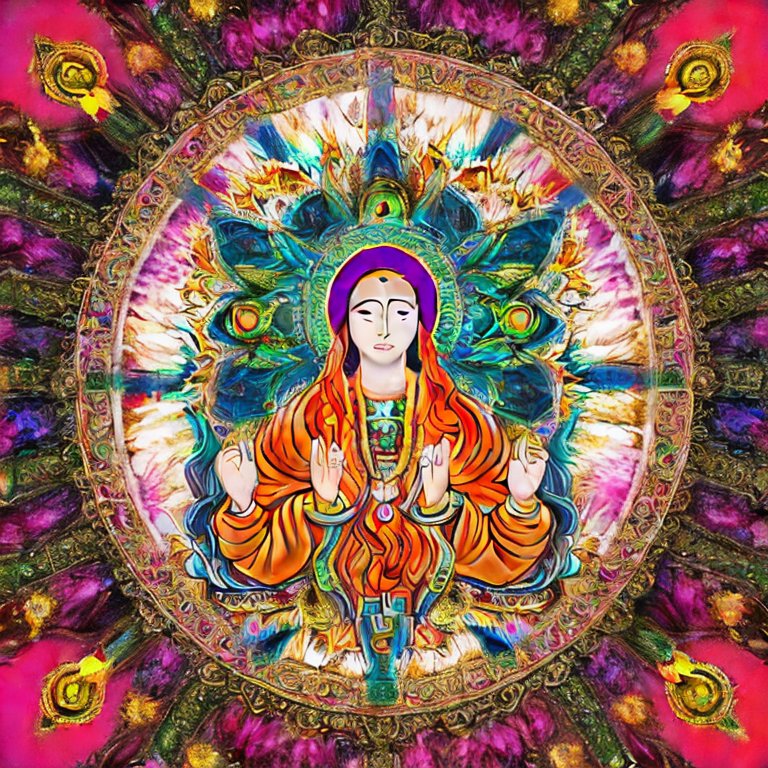
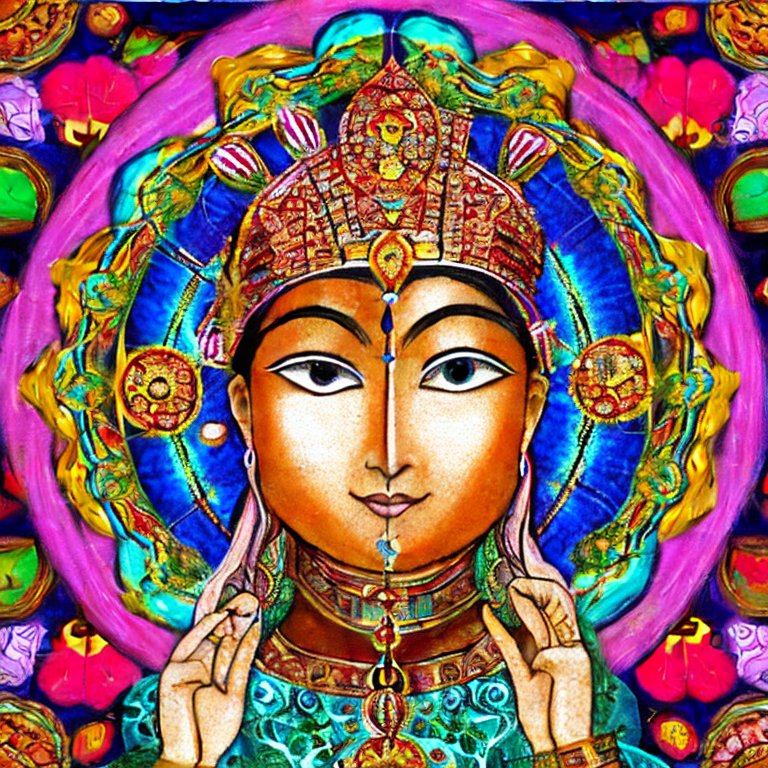
Moksha

The Universe in Liberation

As we traverse the intricate corridors of Hindu philosophy, a term that emerges as a beacon of liberation is ‘Moksha’. This concept, commonly associated with individual salvation from the cycle of birth, death, and rebirth, presents a spiritual zenith. However, what if we zoom out from the individual perspective and consider Moksha at a cosmic level? What if the Universe itself were to attain Moksha?

The Big Bang marked the birth of the Universe, setting forth an infinite dance of creation, preservation, and destruction. Stars were born, galaxies sculpted, and planets formed, only to one day succumb to the grand design of entropy. This cyclical nature bears a striking resemblance to the cycle of Samsara in Hindu thought, where souls are continuously born and reborn in different forms until Moksha is achieved.

If the Universe could experience Moksha, it would transcend its cycle of cosmic Samsara – from the Big Bang to the eventual Big Crunch or Heat Death, depending on which theoretical physicist you ask. This liberation would mean breaking free from the constraints of time, space, and causality, reaching a state of infinite, timeless existence.

So, what would this feel like for the Universe?

When we ponder this question, we must acknowledge that the Universe’s experience, in this context, is beyond human comprehension. But let’s indulge in the thought experiment. We could imagine this state as one of perfect harmony and unity. There would be no ‘other’, no ‘alien’, and no ‘external’. The galaxies, stars, planets, and even the tiniest quantum particles would exist in a state of interconnection and oneness.

From the perspective of sentient beings, this would mean a profound sense of unity with everything else. Distinctions that currently cause division – species, races, cultures, even life and non-life – would become irrelevant. All of existence, inanimate and animate, would be seen as expressions of the same cosmic consciousness.

And yet, paradoxically, this unified existence would also mean the cessation of experience as we know it. Experience implies a subject and an object, an experiencer and the experienced. But in the absolute unity of cosmic Moksha, these dualities would dissolve. Therefore, in a sense, the Universe would be in a state of ‘experiencing without an experiencer’ or ‘knowing without a knower’.

In the grand scheme of cosmic liberation, human Moksha could be seen as a fractal microcosm – a ripple that mirrors the pattern of the whole. Each being achieving liberation contributes to the whole Universe moving towards its own Moksha, its release from the cosmic cycle of birth and death. This profound realization places our spiritual quests in a broader context and imbues them with a universal significance.

However, the implications of this concept are not just metaphysical, but deeply ethical. Recognizing our shared journey toward liberation fosters compassion, humility, and a sense of stewardship for all of existence. Our actions, in this view, can either facilitate or hinder the Universe’s journey toward Moksha.

In conclusion, contemplating Moksha at a universal scale stretches the boundaries of our imagination and empathy. It invites us to view ourselves not as isolated entities but as integral parts of a grand cosmic dance seeking the ultimate liberation.

Morgan O. Smith

Yinnergy Meditation & My Book, Bodhi in the Brain…Available Now!
https://linktr.ee/morganosmith

The Multiverse Within

Exploring Chakras Beyond Our Perception

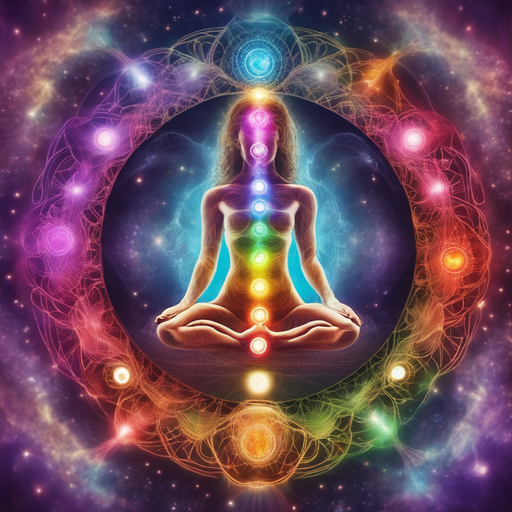
In the rich tapestry of Eastern philosophy and spirituality, the concept of chakras and kundalini awakening has long captivated the Western world. But a deeper, more expansive understanding of these ideas prompts us to transcend the traditional seven chakras in the human body and see them permeating the universe at every level – from the massive galaxies to the tiniest sub-atomic particles.

This perspective’s core is the belief that chakras are not exclusive to the gross or subtle human body. They are ubiquitous and omnipresent, extending their influence to every cell, every molecule, every atom, and even to the most infinitesimal particles. Just like each human has energy centers, these minuscule entities – bodies in their own right – are also believed to possess chakras.

This viewpoint is a confluence of spirituality and quantum physics. It suggests a microcosm-macrocosm principle where the patterns of the universe repeat themselves at different scales, connecting everything from the vastness of the cosmos to the smallest particles.

During a full-blown kundalini awakening, a transformative spiritual experience often depicted as the release of divine energy stored at the base of the spine, it is proposed that not only the individual’s chakras but also these infinitesimal chakras, in each ‘body’ within our physical body, come to life. It is a grand unison of consciousness awakening at all levels of existence, interconnecting every particle within and beyond us.

In such a profound event, each ‘body’, from cellular to atomic and sub-atomic levels, reaches a state of self-realization, comprehending that it is part of the ‘Brahman,’ the ultimate reality or absolute in Hindu philosophy. This concept equates to ‘The Ground of all Being,’ a term that mystics and spiritual teachers use to describe the deepest level of reality.

This fascinating belief presents an interconnected universe where the microcosm and macrocosm continually interact, affecting and reflecting each other. A place where every entity, regardless of size or subtlety, is a unique expression of the same energy, bound by a common cosmic rhythm and linked through an intricate network of chakras.

In conclusion, the belief in a kundalini awakening of not just the seven primary chakras, but countless others within every atom and sub-atomic particle, invites us to broaden our perception of reality. This concept urges us to look beyond the boundaries of our current understanding and explore the uncharted territories of consciousness that might hold the key to our oneness with the universe. It is a philosophy that doesn’t merely expand our knowledge of self and the universe; it transforms it.

Morgan O. Smith

Yinnergy Meditation & My Book, Bodhi in the Brain…Available Now!
https://linktr.ee/morganosmith

Drowning or Swimming? Decoding the Paradox of Mind Transcendence

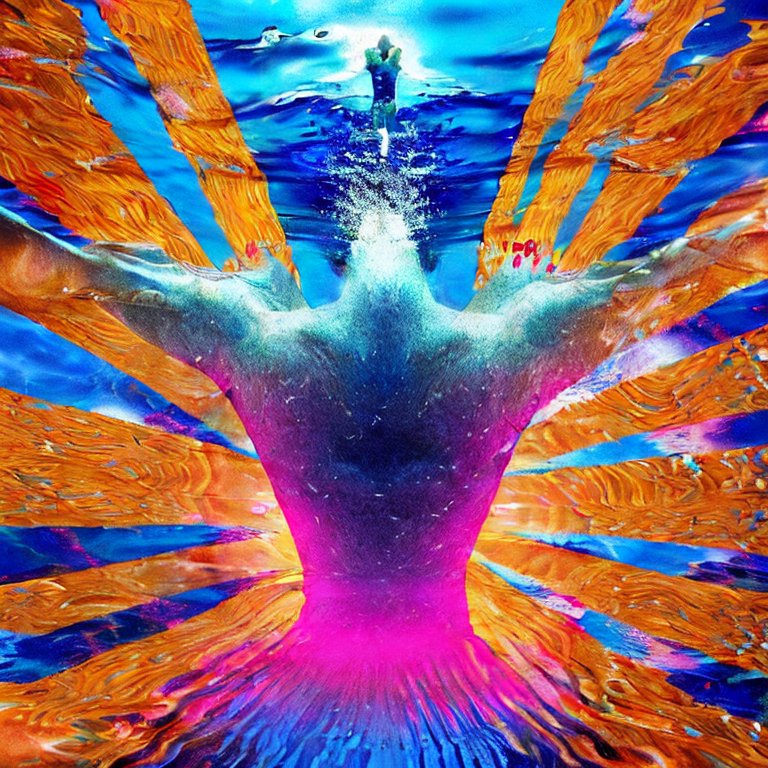
Joseph Campbell, a luminary in the realm of comparative mythology and religion, once penned a remarkably profound quote: “The psychotic drowns in the same waters in which the mystic swims with delight.” This sentence invokes an evocative imagery of two people submerged in the same waters, yet experiencing entirely different outcomes. As we unravel the layers behind this quote, we delve into the profound disparity between losing one’s mind and transcending it.

On the surface, the quote suggests a nuanced understanding of how two people can experience the same reality in starkly different ways. But it goes deeper than that. It’s about the fine line that separates self-destruction and self-actualization, the boundary between psychosis and mysticism. The “waters” in this quote can be seen as the metaphorical sea of consciousness – the vast, undefined, often unruly and chaotic realm of the mind.

For the psychotic, these waters are treacherous, overwhelming, and ultimately engulfing. This individual is at the mercy of their thoughts, emotions, and perceptions, succumbing to the unfiltered and uncontrollable tide of the mind’s creations. They ‘drown’ as they lose their ability to discern between their constructed thoughts and objective reality.

On the other hand, the mystic does not just survive but thrives in these waters. How so? They are those who have mastered the art of transcending the mind. They don’t seek to control or suppress their thoughts and feelings but rather learn to navigate them. By developing a keen awareness of their internal states, they can distance themselves from their thoughts, recognizing that they are not defined or confined by them. This detachment isn’t a rejection of the mind but a profound understanding of its place.

Does this mean transcending the mind is merely about survival? Not in the least. For the mystic, the sea of consciousness becomes a source of delight and wonder, a playground of existential exploration. The waters which are tumultuous for the psychotic become serene for the mystic. They can revel in the complexities and curiosities of the mind, but they never forget they are swimming – not sinking.

So, what distinguishes the drowning psychotic from the delightfully swimming mystic? It lies in the relationship each holds with their mind. The psychotic is subjugated by their mind, entangled in a brutal dance with their thoughts, leading to the loss of self. Conversely, the mystic views the mind as a tool, a companion in their quest for enlightenment, not a ruthless master.

We can argue that the art of swimming in these waters, as a mystic does, is accessible to us all. The question is whether we can cultivate mindfulness, detach from our thoughts without suppression, and remain open to the vast possibilities of human consciousness. After all, the goal isn’t to escape the waters but to learn to swim and ultimately delight in them.

Joseph Campbell’s metaphor presents a thought-provoking dichotomy between two extremes of human consciousness. It is a profound reminder that our relationship with our mind can either lead to our downfall or our enlightenment. It urges us to transcend rather than lose ourselves in the convoluted maze that is the human mind. The water, after all, is the same. It’s the swimmers who are different.

Morgan O. Smith

Yinnergy Meditation & My Book, Bodhi in the Brain…Available Now!

https://linktr.ee/morganosmith

Three Perspectives on Divinity

A Journey of Self-Discovery and Cosmic Connection

Every human being, at some point, grapples with the concept of divinity. How we perceive the divine greatly influences how we understand ourselves and our place in the cosmos. While there are many ways to envision divinity, let us ponder the “Three Faces of God” – “I am That,” “Thou art,” and “It, the Ground of All Being.” Each provides a distinct lens through which we may view and experience the divine.

1. Divine Within: The Face of “I am That”

“I am That” is a call to recognize the divine within us. It is not just a statement; it’s an acknowledgment of our inherent divinity. This perspective dissolves the illusion of separateness, helping us realize that we’re not merely fleeting existences in an indifferent universe, but integral fragments of a divine whole.

This face asks us to engage in deep introspection, to see beyond the veil of our mundane identities, and to understand that our true essence is not our transient ego, but the eternal spirit. Could it be that we’re more divine than we’ve ever imagined? This face prompts us to explore that possibility.

2. Divine As Other: The Face of “Thou Art”

The face of “Thou Art” offers a contrasting perspective. Here, the divine is seen as the ‘Other,’ an entity outside ourselves with whom we can establish a personal connection. This relationship with the divine, filled with reverence and love, is akin to the bond between a devotee and their deity.

In this model, God is the figure we pray to, seek comfort from, and surrender our troubles to. It’s a perspective that creates a powerful, intimate bond with the divine, letting us experience the divinity not as a part of us, but as a separate, caring, and guiding entity.

3. Divine As All: The Face of “It, the Ground of All Being”

The third face, “It, the Ground of All Being,” portrays God as an impersonal essence, the primal energy that permeates the cosmos. This face of divinity does not personify the divine but sees it as the raw material of existence. It is the unchanging reality amidst the ceaseless flux of the universe.

This view urges us to go beyond the traditional understandings of God and probe deeper into the mysteries of existence. Could it be that the divine is not just a deity or a spirit within, but also the very fabric of reality?

Wrapping Up

The Three Faces of God offer a multidimensional understanding of the divine, guiding us on our spiritual and philosophical quest. They propose different ways to connect with the divine, based on our personal inclinations and spiritual needs. More than a simple triad, they represent a spectrum of possibilities on our spiritual journey.

In acknowledging these perspectives, we can foster a richer understanding and experience of God, allowing us to discover the divine within ourselves, in an intimate relationship, and as the underlying reality of existence. Such an exploration can become a catalyst for personal growth and spiritual evolution, leading us to new levels of self-discovery and cosmic connection. After all, isn’t that what the quest for understanding divinity is all about?

Morgan O. Smith

Yinnergy Meditation & My Book, Bodhi in the Brain…Available Now!

https://linktr.ee/morganosmith

The Dawn of Syncretic Souls

A Harmonious Unveiling of Eastern and Western Spirituality

Introduction:
In the transcendent tapestry of human spirituality, East and West have often been seen as disparate threads. The West, with its logical rigour and scientific orientation, seems worlds apart from the East’s mystical, inward-focused spiritual traditions. However, in the heart of a spiritual awakening, a resplendent horizon emerges, revealing the unity and complementary nature of these spiritual worlds. This article explores this enigmatic integration, delving into how the confluence of Eastern and Western spirituality can offer a comprehensive and profound spiritual experience.

The Philosophical Underpinnings:
Eastern spirituality, rooted in traditions such as Hinduism, Buddhism, and Taoism, often emphasizes the notions of unity, interdependence, and the cyclical nature of existence. In contrast, Western spirituality, particularly in Abrahamic religions, has been more inclined toward linear progression, individual salvation, and a personal God. Notwithstanding these differences, both sides seek to understand the fundamental nature of existence and the path toward greater fulfillment and enlightenment.

The Awakening Confluence:
The moment of spiritual awakening can be likened to the dawn; the dark night of ignorance recedes as the sun of wisdom rises. In this pivotal moment, the dichotomies of East and West dissipate, as one comprehends the interwoven complexities of existence. The Eastern idea of interconnectedness suddenly harmonizes with the Western emphasis on individual worth, signifying that our individual journey has cosmic interconnected consequences.

Science and Mysticism:

One of the key avenues through which this integration is taking place is the dialogue between science (often associated with the West) and mysticism (a domain of the East). Through disciplines like quantum physics, Western science is beginning to echo Eastern concepts of interdependence and non-duality. The parallels between quantum entanglement and the interconnectedness emphasized in Eastern philosophies are a testament to this evolving synthesis.

A More Comprehensive Path:
By integrating Eastern and Western spirituality, individuals may find a more comprehensive and balanced path. For instance, the Western emphasis on social justice and activism can bolster the Eastern focus on inner peace and equanimity. Conversely, the Eastern practices of meditation and mindfulness can bring a sense of inner clarity and purpose to the Western pursuit of external achievements.

Conclusion:
As the human spirit continues to evolve, the integration of Eastern and Western spiritual perspectives offers a more holistic and enriched path. This synthesis, fully realized in the moment of spiritual awakening, acts as a bridge between dualities, fostering a deeper understanding of the self and the universe. Through this harmonious integration, humanity has the potential to weave a more intricate, compassionate, and enlightened tapestry of existence.

Morgan O. Smith

Yinnergy Meditation & My Book, Bodhi in the Brain…Available Now!
https://linktr.ee/morganosmith