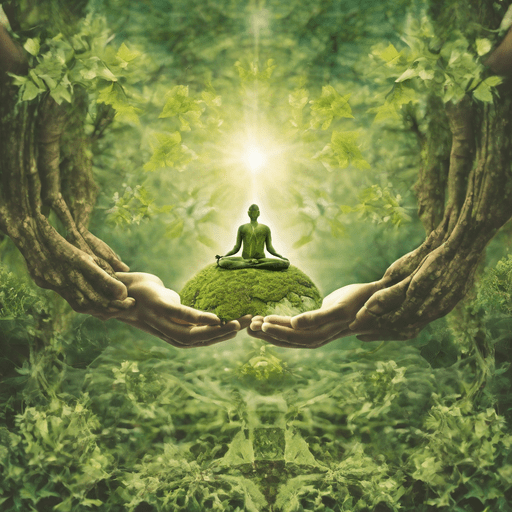
Nature’s Unyielding Dance

Embracing Evolution Beyond Acceptance

In the grand expanse of existence, nature is a paradoxical entity, embodying acceptance while relentlessly pursuing change. This duality offers a profound reflection on the nature of being and becoming, serving as a mirror to our spiritual journeys. Nature, in its essence, accepts its form and function with a serene equanimity that belies the tumultuous undercurrent of evolution. It is in this serene acceptance that the seed of transformation is sown, propelling existence toward an ever-unfolding destiny.

Nature’s acceptance is not of passivity but of an understanding that the present moment is perfect in its imperfection. It acknowledges that at this very instant, it is the culmination of countless cycles of change, yet it is but a waypoint on an infinite journey of becoming. This realization is key to unlocking the mysteries of our spiritual paths, where acceptance and change coexist in a delicate balance.

The process of evolution, both in the external world and within the realms of our inner landscapes, is nature’s testament to the perpetual quest for growth and transcendence. Just as the earth’s flora and fauna adapt to the ever-changing environment, so too must we embrace the evolution of our spiritual understanding and enlightenment. Each moment is an opportunity to transcend the limitations of our previous selves, spurred by the acceptance of our current state of being.


In this dance of existence, where acceptance and evolution move in harmony, lies the essence of true enlightenment. It is a journey that acknowledges the beauty of the now while striving for the potential of tomorrow. Much like nature’s ceaseless evolution, our spiritual paths are marked by an unending quest for deeper understanding, connection, and oneness with the universe.

This reflection on nature’s duality serves as a reminder that in our search for spiritual awakening, we must hold space for both acceptance and the desire for transformation. It is in the embrace of this paradox that we find the freedom to evolve, not despite nature’s acceptance, but because of it.


Through contemplating the unyielding dance of nature, we are invited to explore the depths of our being, challenging ourselves to grow and evolve while remaining grounded in the acceptance of our present reality. Let us, therefore, take inspiration from the world around us, recognizing that our journey towards enlightenment is a dynamic interplay between being and becoming, where the acceptance of what is served as the foundation for what we are yet to become.

Morgan O. Smith

Yinnergy Meditation, Spiritual Life Coaching & My Book, Bodhi in the Brain…Available Now!

https://linktr.ee/morganosmith

The Symphony of Creation

Unveiling the Genius Behind Existence

In the grand opera of the universe, each element, each particle, whispers the secrets of a brilliant design. Far beyond the mundane, there lies a realm where the extraordinary is the norm and where the mundane is but a shadow. It is in this realm that we find the enlightened mind, the architect of existence.

Consider the intricate dance of atoms, the harmonious order in chaos, and the delicate balance of ecosystems. These are not mere coincidences or the product of random happenstance. They are the signatures of a mind that transcends our understanding, an intelligence that weaves complexity and simplicity into a seamless whole.

This enlightened mind does not create with heavy hands but rather orchestrates with a subtlety that eludes our immediate perception. Its genius lies not in grandiose gestures but in the quiet unfolding of life, in the gentle progression of time, and in the silent nurturing of space.


To appreciate this, one must step beyond the boundaries of conventional thought. We must view the universe not as a mechanical system but as a dynamic, living entity. Every star, every grain of sand, and every beat of a heart is a note in a cosmic melody, a melody composed by the enlightened mind.

Our quest for understanding, our drive for knowledge, is perhaps the echo of this mind within us. As we unravel the mysteries of the cosmos, we are, in a sense, uncovering the thoughts of this universal intelligence. Each discovery, each breakthrough, is a step closer to comprehending the incomprehensible.


In conclusion, the enlightened mind is not a distant deity or an abstract concept. It is the very essence of existence, the core of reality. It is the artist, and the universe is its masterpiece. Recognizing this transforms our perception, turning every moment into an opportunity to witness the sublime artistry of existence.

Morgan O. Smith

Yinnergy Meditation, Spiritual Life Coaching & My Book, Bodhi in the Brain…Available Now!

https://linktr.ee/morganosmith

Embracing the Full Spectrum

A Deeper Understanding of Enlightenment

In our quest to understand enlightenment, we often envision it as perpetual positivity, a beacon of good virtues and admirable qualities. However, this view might be a simplistic interpretation of a concept far more profound and encompassing. To grasp the true essence of enlightenment, we must recognize it as the embodiment of nature in its entirety, not just its appealing aspects.

Enlightenment, in its deepest sense, is not limited to the display of positive attributes; it also encompasses the darker, less admired facets of nature. Nature, in its raw form, is an amalgamation of contrasts—beauty and destruction, calm and chaos. Similarly, an enlightened being embodies all these facets, including those we view negatively.

We often celebrate the sunlit parts of nature while disdaining its storms and upheavals. In parallel, enlightened beings, often idealized for their virtues, might also manifest traits or behaviours we consider negative. This doesn’t necessarily diminish their state of enlightenment; rather, it highlights that enlightenment transcends conventional moral dichotomies. It encompasses a full spectrum of qualities, mirroring the complexity and diversity of nature itself.

Perhaps, when an enlightened individual exhibits behaviours we perceive as negative, it’s not a regression to lower psychological states, but an expression of the entire range of human experience. This concept can be challenging to grasp, especially when viewed from the traditional perspective of enlightenment being a state of flawless virtue.

In essence, true enlightenment is beyond the dualities of good and bad, positive and negative. It is a comprehensive expression of nature in all its forms—the gentle breeze and the raging storm. Recognizing this holistic view of enlightenment invites us to expand our understanding and accept the full spectrum of experiences and traits that constitute the enlightened state.

In this light, enlightenment becomes a journey of embracing all aspects of existence, a voyage that transcends conventional wisdom and invites us to witness the universe in its full, unfiltered majesty.

Morgan O. Smith

Yinnergy Meditation, Spiritual Life Coaching & My Book, Bodhi in the Brain…Available Now!

https://linktr.ee/morganosmith

The Paradox of Stillness

Understanding the Dynamic Tranquility of a Tree Trunk

In the heart of nature’s serene expanse, one often overlooks the profound lessons embedded in the simplest of sights. Take, for instance, the trunk of a tree. At first glance, it epitomizes stillness, an unchanging pillar in a world constantly in flux. But this apparent stillness is a mosaic crafted from countless actions and interactions, a profound manifestation of what can be termed ‘absolute stillness’.

The Dynamic World of the Stationary

To truly appreciate the stillness of a tree trunk, we must delve into the bustling world it conceals. The trunk, standing unyielding, is a hub of relentless activity. Sap courses through its veins, carrying life-sustaining nutrients and water from the roots to the leaves. Though invisible to the naked eye, this flow is a ceaseless dance of molecular interactions, a symphony of life that sustains the tree.

Absolute Stillness: A Philosophical Paradox

The concept of absolute stillness arises as a philosophical paradox when we consider the incessant activity that constitutes the tree trunk’s stillness. This paradox nudges us to rethink our understanding of stillness. Is it merely the absence of visible motion, or is it a state achieved through a balance of forces, a harmonious interplay of elements that cancel each other out, resulting in what we perceive as stillness?

A Lesson in Equilibrium and Harmony

The tree trunk, in its majestic calmness, teaches us a vital lesson about equilibrium and harmony. Just as the actions and interactions within it maintain its stillness, our lives too are a constant balancing act. Emotions, thoughts, and actions intertwine, often leading us to a state of internal equilibrium that mirrors the stillness of the tree trunk.

Embracing the Stillness Within

In our fast-paced world, embracing stillness is often challenging. Yet, the tree trunk stands as a testament to the beauty and necessity of finding balance. It reminds us that stillness is not the absence of life or motion but a peaceful coexistence of dynamic forces.

In conclusion, the stillness of a tree trunk is not a mere absence of motion but a dynamic state of balance and harmony. It invites us to explore the depths of our being, find our equilibrium, and appreciate the profound tranquillity that lies in the heart of action.

Morgan O. Smith

Yinnergy Meditation, Spiritual Life Coaching & My Book, Bodhi in the Brain…Available Now!

https://linktr.ee/morganosmith

Blurring the Lines

Embracing the Unity of Nature and the Artificial

Everything that is considered unnatural or artificial is, in fact, part of nature’s expression. This idea, at first glance, might seem contradictory. How can something artificial, a creation of human ingenuity, be natural? But this is where we need to expand our understanding of what nature encompasses.

Nature, in its broadest definition, includes everything that exists in the universe. It’s not just the trees, rivers, mountains, and animals that are typically associated with the term “natural.” It’s everything that occupies the space and time of our universe, including human creations.


The natural flow, the natural order of all things, is a concept that recognizes the interconnectedness and interdependence of all forms of existence. When humans create something, be it a piece of technology, a work of art, or a sprawling city, they are using the resources, the laws of physics, and the intelligence that are all components of this natural world. Our creations are as much a part of the natural flow as a bird building a nest or a tree growing toward the sunlight.

This perspective invites us to look at human impact on the world in a different light. It’s not about segregating what’s natural from what’s artificial, but understanding how our creations align with or disrupt the natural flow. Sustainable development, ecological balance, and harmonious coexistence are key concepts in this narrative. They guide us toward a future where our innovations and advancements are in sync with the natural order, rather than at odds with it.


In embracing this view, we also embrace a deeper sense of responsibility. Recognizing our creations as part of nature’s expression means acknowledging that we are not outside of nature, manipulating it from afar. We are deeply embedded within it, and our actions have ripples that affect the whole system. This realization can empower us to make choices that are beneficial for humanity and all forms of life that share this planet with us.

In conclusion, the artificial is not separate from the natural. It is a continuation, an expansion of the natural world. By viewing our creations as part of the natural order, we can strive for a future where human ingenuity and nature’s wisdom coexist in harmony.

Morgan O. Smith

Yinnergy Meditation, Spiritual Life Coaching & My Book, Bodhi in the Brain…Available Now!

https://linktr.ee/morganosmith

The Environment’s Role in Spiritual Growth

Spiritual growth is an inward journey that involves deepening self-awareness, a connection to a higher purpose, and a pursuit of inner peace and enlightenment. Though one might perceive spiritual growth as purely internal, the environment plays an instrumental role in shaping this voyage.

**The Outer Reflects the Inner**:
Spirituality isn’t limited to the realm of meditation, prayers, or religious practices. It’s also about understanding oneself to the larger world. The environment serves as a mirror, reflecting the chaos or calm we feel within. A serene setting, like a tranquil forest or a quiet beach, can provide the space needed for introspection, while a tumultuous environment might challenge and refine our spiritual resilience.

**The Playground of Experiences**: Our experiences, heavily influenced by our environment, serve as lessons that guide our spiritual evolution. Facing economic hardships might teach us humility and gratitude while being in a nurturing emotional environment can facilitate feelings of love and empathy. Each environment, with its unique challenges and blessings, offers distinct lessons for our soul’s growth.

**Environmental Genetics and The Enlightened Individual**:
Modern scientific understanding acknowledges that both genes and the environment play roles in determining our characteristics. This interplay is also valid for spiritual inclinations. An individual with a genetic predisposition towards introspection and an environment that encourages self-reflection might have a smoother path toward enlightenment. Conversely, someone genetically predisposed to anxiety but raised in a supportive environment might learn to channel that anxiety into a deeper spiritual quest.

Yet, it’s crucial to remember that enlightenment isn’t a one-size-fits-all concept. The combination of genetics and environment produces a spectrum of enlightened individuals, each with unique strengths, perspectives, and wisdom to offer.

### Balancing Agency with Environmental Influences

While the environment significantly shapes us, spiritual growth also involves recognizing and exercising our agency. It’s about acknowledging environmental influences while taking proactive steps to seek experiences and environments that align with our spiritual goals.

For many, this might mean seeking spiritual communities, immersing oneself in nature, or actively creating a personal sanctuary that facilitates inner reflection and growth. For others, it might involve challenging and transforming their environments.

In conclusion, the environment isn’t just a backdrop against which the drama of life unfolds; it’s an active participant, a teacher, a mirror, and a guide on our spiritual journey. Recognizing its influence can empower us to harness its lessons, navigate its challenges, and embark on a more profound, fulfilling spiritual voyage.

Morgan O.  Smith

Yinnergy Meditation & My Book, Bodhi in the Brain…Available Now!

https://linktr.ee/morganosmith