My Eyes Are Wide Open, Yet I Continue to Blink

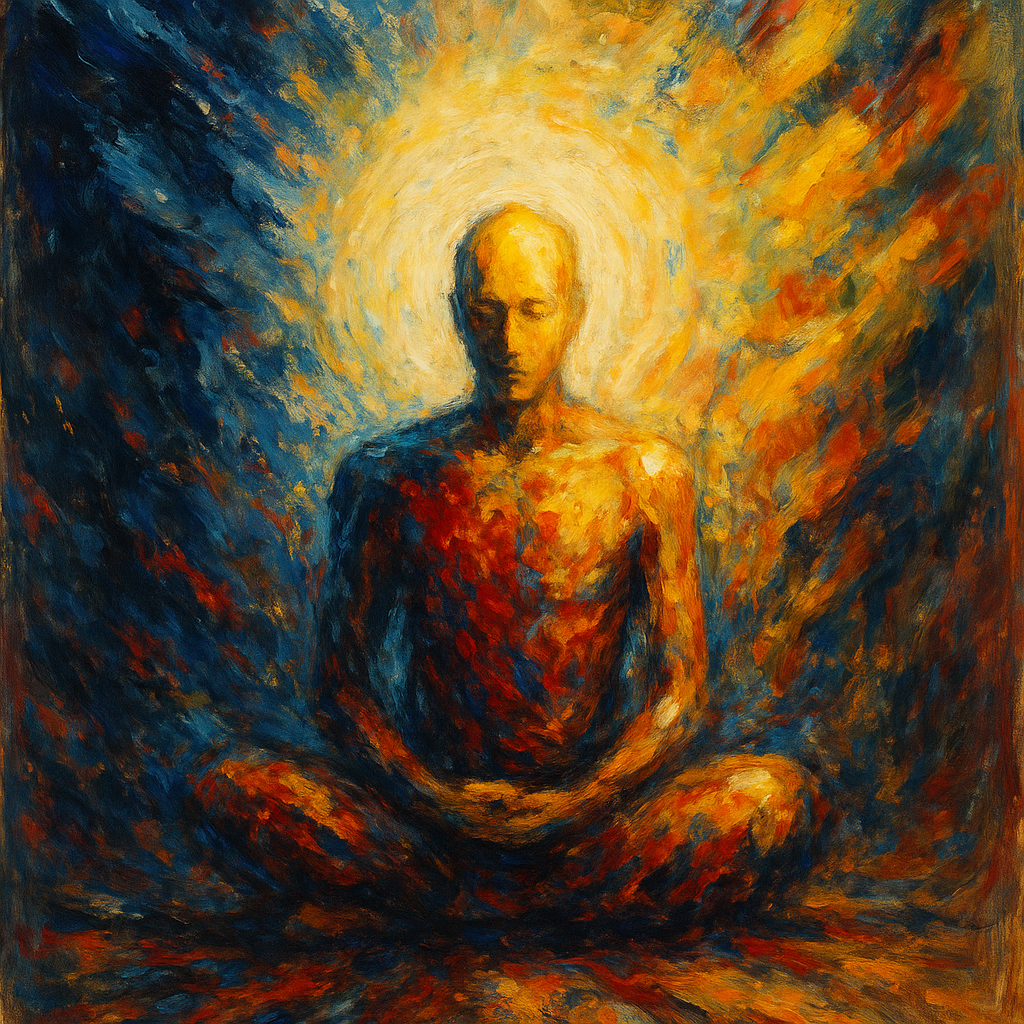
Awakening does not arrive as a permanent gaze locked onto the infinite. It arrives as a rupture—clean, unmistakable, irreversible. Something collapses that never quite existed, and what remains does not need to convince itself of anything ever again.

That first rupture carries a strange innocence. Consciousness recognizes itself without reference, without scaffolding, without an observer left standing outside the recognition. Separation dissolves, not as an idea, but as a lived impossibility. That moment cannot repeat. Once the false center is seen through, there is no way to sincerely reinhabit it.

And yet—experience continues to pulse.

Eyes remain open, yet blinking persists.

Subsequent moments can arrive that feel just as total, just as decisive, just as final. Not because awakening has reversed, but because what awakening illuminates continues to reveal its own depth. Conditioning loosens further. Residual identity releases its grip. The nervous system grows more capable of bearing intimacy without contraction. Intelligence, love, emptiness, embodiment, each may come forward as if for the first time.

Each arrival feels absolute because it is absolute relative to what had not yet been surrendered.

Blinking names this rhythm without dramatizing it. Awareness does not dim, yet perception opens and closes. Identity does not return, yet orientation subtly reorganizes. What collapses is never truth itself, only the way truth was being unconsciously framed.

Peak realization and trait realization quietly diverge here. Peaks still occur; sometimes vast, sometimes ordinary, sometimes devastatingly simple. Traits deepen; less visible, more pervasive, harder to narrate. The need for confirmation dissolves even as revelation continues.

Classical traditions have always known this, though rarely shouted it. Zen never stopped at a single seeing. Advaita never mistook first recognition for final embodiment. Mahayana never separated emptiness from compassion. Kashmir Shaivism never treated recognition as a one-time event.

Each spoke differently, yet all pointed to the same subtle fact: awakening is not repeated, but it is continuously clarified.

Blinking does not interrupt sight.
Blinking protects it.

Awakening does not require uninterrupted luminosity. It requires no defense against the natural oscillation of experience. Awareness remains awake whether perception sharpens or softens, whether insight detonates or quietly integrates.

Awakening happens only once.
Awakening happens endlessly.

The first time, separation collapses.
Every time after, whatever still mimics separation dissolves.

Eyes open.
Eyes close.
Nothing essential is lost.

That is not regression.
That is refinement.

Morgan O. Smith

Get Your Free Copy of My Book, Bodhi in the Brain!

https://subscribepage.io/oTSZQu

Beyond the Horizon Where Nothing Divides

Life appears to move through chapters: arrival, departure, return, yet each chapter dissolves the moment you attempt to hold it. Breath flows, bodies age, worlds turn, and consciousness watches all of it without ever being touched. What looks like a sequence is simply awareness shifting its focus, the way a single flame illuminates many shapes without ever becoming any of them.

Death enters this picture as a doorway only from the perspective of the one who believes they are standing on one side of it. Yet the moment that belief loosens, the doorway reveals itself as an opening carved out of the same boundless presence that carries every heartbeat. What is called “afterlife” is not a destination reached by travel. It is the same field of being experienced without the costume of form.

Love for those who have gone does not travel across a boundary. It moves through the same indivisible ground from which both presence and absence arise. The living and the dead are two expressions of a single movement. Souls do not just depart and return; they appear as waves do, yet the water never goes anywhere.

Samsara, Nirvana, Moksha: each name gestures toward a pattern consciousness creates to understand itself. Yet the moment these patterns fall away, realization dawns that the seeker, the journey, and the liberation were never separate. What felt fragmented belonged to a mind trained to see borders. Freedom arrives the moment those borders fade.

You are the continuity that cannot perish, the stillness that animates every form, the awareness that births experience and withdraws it. Life and death only look like opposites until the lens of identity clears. Beyond that lens rests a truth too simple to grasp and too vast to deny: everything arises from the same essence, returns to the same essence, and never leaves it at all.

Morgan O. Smith

Get Your Free Copy of My Book, Bodhi in the Brain!
https://subscribepage.io/oTSZQu

The Final Disappearance

What happens at the moment of death?

Not from the standpoint of biochemistry or theology, but from the lived silence of awakened seeing—the vantage where death and self are no longer two.

At the summit of awakening—whether called Moksha, Nirvana, Turiyatitta, or Nirvikalpa Samadhi—the idea of death unthreads itself. What dies never truly lived, and what lives has never been touched by time. The dissolution of the body is not the end, nor is it a doorway. It is the falling away of questions that were never yours.

There is no climactic revelation at that edge. There is only this. The suchness that never began, never moved, and never faded. At peak realization, death ceases to be an event. It is not an exit. It is the unspeaking of form—a gentle vanishing into what was always here.

This is not metaphor.

Consciousness, unfragmented and clear, neither resists death nor awaits it. It has already passed through it, endlessly. Not as a journey from point A to point B, but as a revelation that neither point exists.

You don’t meet death. You realize you were never separate from it.

At this depth, what we call life no longer hangs from a timeline. What we call death no longer casts a shadow. No more witness is watching the last breath. Only the unnameable recognizes itself through the temporary flicker of form.

The body may fall away, but the body was never the one who knew. The breath may stop, but the breath was never yours. That which remains doesn’t remain—it is. Before and after mean nothing to it.

Some call this realization peace. Others call it extinction. But it’s neither stillness nor silence nor bliss. It’s before all that. It’s the absence of absence. The presence of presence. Not two.

When the last ripple of self dissolves, what’s left is not a person merging with eternity. There is no one to merge. There is only what was always whole.

This is death at the level of freedom. This is life without division.

Not a conclusion.

A cessation of seeking.

Morgan O. Smith

Get Your Free Copy of My Book, Bodhi in the Brain!

https://subscribepage.io/oTSZQu

The Illusion of Liberation

Phenomena arise, unfold, and dissolve, yet the mind grasps at them, seeking meaning through the lens of interpretation. This act of interpretation is inevitable, but the depth at which one engages with it determines whether understanding remains bound to illusion or expands into realization.

The mythical-magical stage of consciousness perceives reality through archetypes of power, divine will, and cosmic law. This stage gives birth to beliefs about cycles, reincarnation, and karmic loops—explanations that serve as scaffolding for those navigating the existential unknown. There is some truth to these interpretations, just as there is truth in every story we tell ourselves about existence. But truth is not confined to a single stage of development. It unfolds, revealing deeper nuances as perception matures.

Samsara—the wheel of birth, death, and rebirth—has been described as a prison. The path to liberation, as outlined in various traditions, involves transcending this cycle, attaining nirvana or moksha, where rebirth ceases. But even this is an interpretation, one that arises from a more advanced vantage point. The paradox is that what appears as bondage and liberation are not separate realities. Samsara and nirvana are not two. They are the same movement seen through different eyes.

No one is bound, and no one is freed. The concept of liberation implies that something was ever trapped. Yet, what is there to escape when there has never been confinement? The idea of imprisonment is a mind construct, just as freedom is. They depend on one another, forming a duality that collapses upon close inspection.

You are creation itself. Yet, nothing is truly being created. It only appears so. The dance of form and emptiness continues, yet nothing moves. This is the great paradox. The illusion is not that samsara exists—it does, just as dreams exist while sleeping. The illusion is believing that it is something to escape.

Awakening is not an arrival but the recognition that there was never a journey. The cycle persists for those who perceive cycles. Freedom exists for those who perceive bondage. But beyond perception, beyond conceptual grasping, there is only this—eternal, unchanging, and free, regardless of whether one calls it samsara or nirvana.

Morgan O. Smith

Yinnergy Meditation/Neurofeedback, Spiritual Life Coaching & My Book, Bodhi in the Brain…Available Now!

https://linktr.ee/morganosmith

The Mind is Samsara

Liberation Through Freedom From Thought

(Inspired by Delson Armstrong)

To grasp the nature of samsara, one must look no further than the ever-turning wheel of the mind. Thoughts arise and dissolve ceaselessly—ideas, beliefs, fears, and anticipations weaving an endless narrative. Each moment feels distinct, yet they are all threads of the same cyclical pattern. This mental turbulence is the very fabric of samsara, the cycle of birth, death, and rebirth experienced not only across lifetimes but also within the subtle rhythms of the mind.

Samsara is not a place. It is the identification with thought itself. Every belief we cling to, every concept we hold sacred, every doubt that gnaws at our certainty—these perpetuate the illusion of separateness. The mind clings to forms, seeking permanence in the impermanent, building castles on clouds. Yet each construction inevitably crumbles, and the cycle begins anew.

Nirvana, often misinterpreted as a distant goal, is not found outside this moment. It is recognizing what remains when all that is transient falls away. Freedom arises not through force or suppression but by witnessing the mind’s movements without becoming entangled. The arising and dissolving of thoughts are no longer resisted; they are observed as passing clouds in the vast sky of awareness.

This realization does not destroy the mind but recontextualizes it. Thoughts may continue to arise, but they no longer hold the power to bind. The very root of suffering—attachment to the mind’s constructs—is severed. What remains is pure Being, an effortless silence that neither clings to birth nor fears death.

To step off the wheel of samsara is to recognize that you were never bound. The liberation of nirvana is not an escape but a profound shift in perspective: to see thoughts for what they are—fleeting phenomena—and rest in the unchanging awareness that witnesses them.

The mind is samsara. Freedom lies not in battling it, but in transcending it through direct experience of your timeless nature.

Morgan O. Smith

Yinnergy Meditation, Spiritual Life Coaching & My Book, Bodhi in the Brain…Available Now!

https://linktr.ee/morganosmith

The Paradox of the Bodhisattva

Embracing Infinite Compassion

The greatest human sacrifice is the bodhisattva’s goal of not attaining nirvana until all sentient beings are free from samsara. An impossible task, but the bodhisattva does this anyway out of love. So out of love, he or she continues to be born, die, and be reborn while being fully conscious of entering a life full of grief, discomfort, and dissatisfaction.

The bodhisattva’s path is one of profound paradox and immeasurable compassion. In the face of boundless suffering, the bodhisattva chooses not the liberation of nirvana but the unending cycle of rebirth. This choice, rooted in an infinite love for all sentient beings, defies conventional notions of self-preservation and personal enlightenment.

In the depths of this commitment lies a radical redefinition of what it means to live a meaningful life. The bodhisattva embodies a profound understanding that individual enlightenment is intertwined with the liberation of all beings. This interconnectedness transforms personal suffering into a collective journey, where the lines between self and other dissolve in the embrace of universal compassion.


To fully grasp the bodhisattva’s sacrifice, one must delve into the core of their motivation: the unyielding love for all beings. This love transcends personal desires and aspirations, anchoring itself in the welfare of every sentient entity. It is a love that is willing to endure the perpetual ebb and flow of samsara, embracing each life with open-hearted acceptance despite the inherent pain and impermanence.

The bodhisattva’s journey challenges us to reconsider our own lives and the nature of true fulfillment. It asks us to look beyond our immediate comfort and desires, to see our existence as part of a larger, interconnected whole. In doing so, we begin to understand that the pursuit of personal happiness is not separate from the well-being of others.

Engaging with the bodhisattva ideal, even as a mere contemplation, invites us into a deeper exploration of love and compassion. It urges us to reflect on our capacity to extend kindness and empathy beyond the confines of our personal experiences. In a world often dominated by individualism and self-interest, the bodhisattva’s sacrifice serves as a beacon, illuminating the transformative power of selfless love.


Ultimately, the bodhisattva’s commitment to the liberation of all beings is a testament to the boundless potential of the human spirit. It is a reminder that true enlightenment is not an isolated achievement but a collective awakening. As we meditate on the bodhisattva’s path, we are inspired to cultivate a love that transcends our own lives, embracing the entirety of existence in its compassionate embrace.

Morgan O. Smith

Yinnergy Meditation, Spiritual Life Coaching & My Book, Bodhi in the Brain…Available Now!

https://linktr.ee/morganosmith

Breaking the Chains of Samsara

Liberation for All

In the vast expanse of existence, the concept of Samsara transcends the mere cyclical experience of birth, death, and rebirth of individuals. It embodies the universal rhythm of creation and dissolution that ensnares not only sentient beings but the cosmos itself. This cosmic dance is not limited to a linear path of suffering and elation but is an intricate interplay of continuous emergence and entropy.

Samsara paints a picture of the universe persistently rejuvenating itself, where every end is a prelude to a new beginning. This cycle, often perceived as a relentless march towards rebirth, is punctuated by moments of joy and despair, mirroring the dualities that define our very existence.


Yet, the pursuit of liberation—attaining Moksha or Nirvana—reveals a profound universal truth. When one achieves liberation, the impact resonates beyond the individual. It is a monumental release that extends to all forms of life and even to the inanimate aspects of our universe. Liberation is not an isolated event but a shared release from the chains that bind us to perpetual reincarnation.

This realization places a monumental responsibility on the path of each seeker. To liberate oneself is to contribute to the emancipation of the entire universe from the Samsara cycle. The journey towards enlightenment, therefore, is not solely for personal salvation but an act of universal significance.


Every step taken towards enlightenment does not just alleviate one’s suffering; it diminishes the collective suffering. It is a beacon that lights up the path not only for oneself but for all beings, signalling a way out of the darkness of ignorance and into the light of awareness. This shared journey towards liberation fosters a profound connection with all existence, weaving a narrative of unity and collective transcendence.

In understanding the magnitude of Moksha or Nirvana, we see not just an escape from personal suffering but an offering of freedom to the universe. It’s a pivotal realization that the path to enlightenment is paved with compassion, altruism, and the ultimate realization that we are all interconnected in the cosmic fabric of life.

Morgan O. Smith

Yinnergy Meditation, Spiritual Life Coaching & My Book, Bodhi in the Brain…Available Now!

https://linktr.ee/morganosmith

The Paradox of Enlightenment Amidst Adversity

In the profound journey toward enlightenment, there exists a nuanced understanding of the interplay between our spiritual essence and the tangible world. This exploration delves into the realm where the ultimate truths of nonduality meet the undeniable realities of our human experience. It’s a contemplation of how one navigates the vicissitudes of life, even when perched at the pinnacle of spiritual awakening.

#### The Unshakable Core vs. The Vulnerable Shell


At the heart of spiritual enlightenment lies the realization of the self’s immutable nature. This understanding, deeply rooted in Eastern philosophy, reveals that at the ultimate level, the true self transcends the fluctuations of the physical, emotional, and psychological realms. Yet, this does not render us impervious to the tangible forces that pervade our existence. The enlightened being, while recognizing the indestructible nature of their essence, also acknowledges the fragility of their human condition.

#### The Duality Within Nonduality

The path of spiritual awakening brings to light the coexistence of seemingly contradictory truths. On one hand, the enlightened individual perceives the illusionary nature of Maya, the cosmic dance of creation and destruction that engulfs the material world. On the other hand, they remain anchored in the reality of their human experience, susceptible to the myriad forms of harm that life can present.

This duality within nonduality underscores vital wisdom: enlightenment does not detach one from the human experience but deepens the engagement with it, fostering a profound understanding of the interconnectedness of all existence. The enlightened being moves through the world with a heightened awareness of the impermanence of the physical form and the eternal nature of the self.

#### The Paradox of Perception

Consider the hypothetical scenario of an individual attaining Nirvana amidst the turmoil of a war zone. At the moment of achieving this transcendent state, the exterior chaos becomes inconsequential, and yet, the spectrum of human experience is felt more deeply than ever. The house may collapse, and the physical body may perish, but the essence of the being remains untouched, observing the unfolding drama with equanimity.

This paradox of perception challenges us to reevaluate our understanding of harm and safety, pleasure and pain, and life and death. It invites us to see beyond the surface level of existence and recognize the deeper currents that shape our journey through the world.

#### Embracing the Wholeness of Experience

The essence of this exploration is not to advocate for a denial of the physical or emotional challenges we face but to illuminate the potential for profound growth and understanding within these experiences. The spiritual journey encompasses the entirety of our being, inviting us to embrace the wholeness of our experience, with all its contradictions and complexities.

In recognizing the vulnerabilities of our human existence while holding firm to the knowledge of our ultimate nature, we find a path that is rich with meaning, resilience, and an unshakeable peace.

As we navigate the complexities of life, let us remember the profound wisdom that lies in the balance between our spiritual essence and our human experience, guiding us toward a deeper understanding of the true nature of existence.

Morgan O. Smith

Yinnergy Meditation, Spiritual Life Coaching & My Book, Bodhi in the Brain…Available Now!

https://linktr.ee/morganosmith

Can One Choose to Go Back to Being Unenlightened?

The journey toward enlightenment is often viewed as a one-way path, leading to a state of spiritual awakening that fundamentally changes one’s perception of the world and self. But is it possible to revert to a state of unenlightenment? This question opens a fascinating philosophical debate.

#### The Irreversibility of Enlightenment


Once an individual experiences spiritual enlightenment, it is commonly believed that this transformation is irreversible. In spiritual traditions like Hinduism, Buddhism, and various mystic philosophies, enlightenment—referred to as Sahaja Samadhi, Turiyatitta, Nirvana, Nibbana, Moksha, Bodhi, and other names—is seen as the ultimate achievement. It’s a profound understanding of the universe and one’s place, transcending ordinary perception.

The idea of willingly abandoning such a state seems counterintuitive. Why would one return to a less aware state after enlightenment? For those who have experienced this profound awakening, giving it up, especially while in the human body, seems unimaginable.


#### The Divine Paradox

However, when considering the divine or absolute reality—referred to in various traditions as God, Brahman, Allah, or the Ground of All Being—there’s an intriguing paradox. This ultimate reality is believed to manifest itself in all forms of existence, encompassing every species and aspect of the universe. In doing so, it seemingly relinquishes its state of pure enlightenment to become the myriad forms of life and matter.

#### The Bodhisattva’s Choice

In Mahayana Buddhism, the concept of the Bodhisattva presents another unique perspective. A Bodhisattva is an individual who has caught a glimpse of enlightenment but chooses not to enter this state fully. This choice is made out of compassion, with the vow to help all sentient beings achieve enlightenment before achieving it themselves fully. This represents a profound sacrifice and a different understanding of enlightenment, not as a personal achievement but as a collective goal.


#### Conclusion

The question of whether one can choose to return to unenlightenment is complex and multi-faceted, deeply rooted in various spiritual traditions and philosophical contemplations. It invites us to consider the nature of spiritual awakening, the role of the divine in the cosmos, and the interconnectedness of all beings in the journey toward enlightenment.

Morgan O. Smith

Yinnergy Meditation, Spiritual Life Coaching & My Book, Bodhi in the Brain…Available Now!

https://linktr.ee/morganosmith

The Paradox of Self and No-Self

Navigating Samsara and Nirvana

In the profound journey of spiritual understanding, the concepts of birth, death, and rebirth hold a pivotal place. The intriguing idea that an enlightened being, despite their profound realization, can still be subject to the continuous cycle of reincarnation, presents a paradox that invites deep contemplation.

The pursuit of Nirvana or Moksha, as understood in various spiritual traditions, suggests a state where this perpetual cycle is broken. This liberation, often depicted as the ultimate goal in spiritual endeavours, implies an escape from the continuous loop of birth, death, and rebirth.

However, this raises a thought-provoking question: Can one truly experience and comprehend nondual suchness – a profound realization of their true self as the foundational essence of all existence – and yet remain entangled in the cycle of birth and death? This notion challenges our understanding of spiritual liberation and the nature of self-awareness.


The intricate relationship between Samsara (the cycle of birth and death) and Nirvana (liberation from this cycle) is a complex one. They are often perceived as two distinct realms or states of being. Yet, in a deeper existential sense, they might be seen as the same. This perspective opens up a philosophical exploration into the nature of the self.

The concept of ‘no-self’ is central to this discussion. It posits that the individual self we identify with is an illusion, a transient construct devoid of inherent existence. Paradoxically, this ‘no-self’ is also the self, as there is no true separation between the individual and the universal. Thus, one might refer to it as the ‘no-self,’ questioning the very existence of a label or reference point in this boundless, interconnected reality.

This exploration leads to profound questions: Who labels this existence if the self is an illusion? What is the nature of the self that encompasses everything, yet is nothing in itself? These are the riddles that spiritual seekers have pondered for ages, and they remain mystifying and intriguing today.


This philosophical conundrum invites us to dive deeper into our understanding of existence, self, and liberation. It challenges us to look beyond the conventional notions of identity and existence, urging us to explore the very essence of being.

Morgan O. Smith

Yinnergy Meditation, Spiritual Life Coaching & My Book, Bodhi in the Brain…Available Now!

https://linktr.ee/morganosmith