Non-Attachment

Admiring Her Beauty Without the Need to Possess It

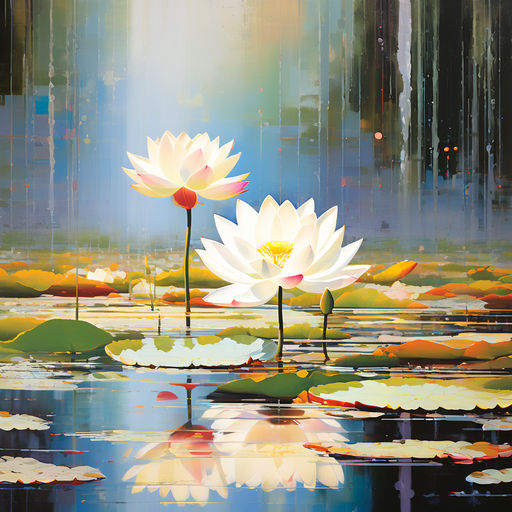
She stood before you—radiant, complete, untouched by your desire. You saw her beauty not as something to claim but something to witness. No attempt to preserve it. No hunger to prolong the moment. Just presence.

This is the essence of non-attachment. The ability to recognize the luminous without needing to make it yours. To love deeply without ownership. To appreciate fully without clinging. To admire, and then walk away—not because you don’t care, but because you’ve seen clearly.

Desire often masquerades as appreciation. It sneaks in, subtle at first, until the gaze becomes gripping. The mind begins to script stories: how it could be, how it should be, how it must be. But true seeing requires no continuation. It is complete in its own silence.

Beauty invites reverence, not possession. When you see her—whatever or whatever she is—truly see her. Let that moment be enough. Let the gaze be unpolluted by longing. Let the love be real because it is free.

To walk away isn’t abandonment. It is freedom for both the viewer and the viewed. There is no trace left behind. No emotional residue. Just the echo of a sacred glimpse, unbroken by need.

And isn’t that the deepest form of intimacy? To allow something or someone to remain what they are, without the distortion of your grasp?

Non-attachment does not dim the light of love; it refines it. It teaches the heart how to hold everything while clinging to nothing. It teaches the soul how to dance with impermanence, and still call it sacred.

Sometimes the most awakened gesture isn’t to stay, or to reach, or to take—but simply to witness beauty… and bow.

Morgan O. Smith

Get Your Free Copy of My Book, Bodhi in the Brain!

https://subscribepage.io/oTSZQu

The Mind is Samsara

Liberation Through Freedom From Thought

(Inspired by Delson Armstrong)

To grasp the nature of samsara, one must look no further than the ever-turning wheel of the mind. Thoughts arise and dissolve ceaselessly—ideas, beliefs, fears, and anticipations weaving an endless narrative. Each moment feels distinct, yet they are all threads of the same cyclical pattern. This mental turbulence is the very fabric of samsara, the cycle of birth, death, and rebirth experienced not only across lifetimes but also within the subtle rhythms of the mind.

Samsara is not a place. It is the identification with thought itself. Every belief we cling to, every concept we hold sacred, every doubt that gnaws at our certainty—these perpetuate the illusion of separateness. The mind clings to forms, seeking permanence in the impermanent, building castles on clouds. Yet each construction inevitably crumbles, and the cycle begins anew.

Nirvana, often misinterpreted as a distant goal, is not found outside this moment. It is recognizing what remains when all that is transient falls away. Freedom arises not through force or suppression but by witnessing the mind’s movements without becoming entangled. The arising and dissolving of thoughts are no longer resisted; they are observed as passing clouds in the vast sky of awareness.

This realization does not destroy the mind but recontextualizes it. Thoughts may continue to arise, but they no longer hold the power to bind. The very root of suffering—attachment to the mind’s constructs—is severed. What remains is pure Being, an effortless silence that neither clings to birth nor fears death.

To step off the wheel of samsara is to recognize that you were never bound. The liberation of nirvana is not an escape but a profound shift in perspective: to see thoughts for what they are—fleeting phenomena—and rest in the unchanging awareness that witnesses them.

The mind is samsara. Freedom lies not in battling it, but in transcending it through direct experience of your timeless nature.

Morgan O. Smith

Yinnergy Meditation, Spiritual Life Coaching & My Book, Bodhi in the Brain…Available Now!

https://linktr.ee/morganosmith

The Divine Dance of Non-Attachment

A Journey Beyond Self

In the quietude that envelops the soul’s journey, there lies a profound realization, a moment that transcends the confines of the self and ushers us into the boundless realm of non-attachment. This is not merely an act of letting go but a sublime embrace of a state of being where one is liberated from every iota of personal existence. It is a passage through the eye of the needle, where the constructs of selfishness that bind the cells of our being dissolve into the ether, revealing the essence of our true nature.

This selfishness, a primal force that ensures our survival, becomes the very shackle we must transcend to experience the oneness of the universe. It is the adhesive that moulds our sense of individuality, carving out a distinct self from the universal continuum. Yet, it is within this self-love, this instinct for preservation, that the seeds of separation are sown. And from these seeds sprout the illusion of duality—the belief in a self apart from the rest.

The decision to let go, to relinquish the grip on this ephemeral identity, is both a death and a rebirth. It is the shedding of old skin, not in rejection of existence, but as an offering to the infinite dance of life. In this sacred act of surrender, one does not disappear but merges into the fabric of everything, becoming indistinguishable from the cosmos itself. This is the essence of non-attachment: the realization that in letting go of what we are, we become what we always were—boundless, timeless, infinite.


This experience of becoming no-thing is not an annihilation but an expansion into all. It is to stand at the heart of existence and see with clear eyes that there is no ‘other,’ no separation between the self and the universe. It is to understand that the individual story we cling to is but a drop in the vast ocean of consciousness, significant not for its separateness but for its part in the whole.

At the pinnacle of non-attachment, we encounter a paradox: in surrendering the idea of life as something to be clutched with desperate hands, we discover true life. This is not a life bounded by the narrow confines of personal gain or loss but a life that flows with the unbounded rhythm of existence itself. It is a state of being that nourishes all creation, not from a place of selfish intent but from the profound realization of our interconnectedness.


In this divine state, we find ourselves not by looking inward but by dissolving into the vastness of everything. We become a mirror reflecting the infinite, a conduit for the universal energy that animates all life. This is the ultimate freedom, the liberation from the self-imposed prison of identity. Here, in the embrace of non-attachment, we come home to our true selves—not as separate entities struggling against the tide of existence but as integral threads woven into the fabric of all that is.

Morgan O. Smith

Yinnergy Meditation, Spiritual Life Coaching & My Book, Bodhi in the Brain…Available Now!

https://linktr.ee/morganosmith

Embracing the Ethereal

The Journey Beyond Attachments

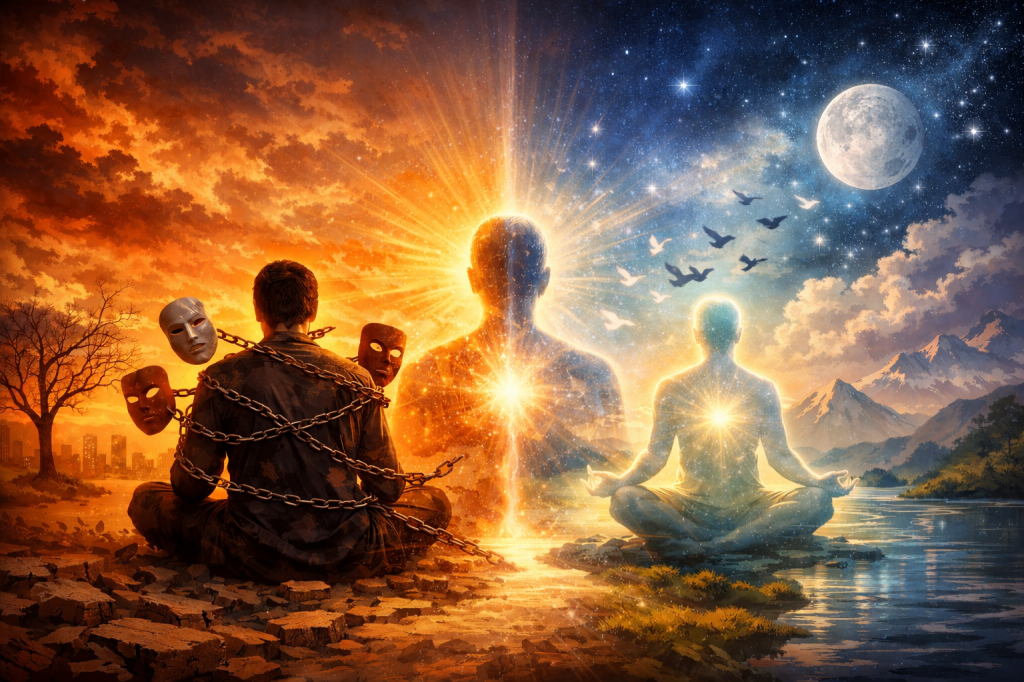
In the boundless quest for spiritual awakening, we often encounter the concept of ‘freedom’—a term that resonates deeply within the chambers of the soul. Yet, what is this freedom that spiritual traditions speak of with reverence? It is not the liberty of movement or choice as perceived in our physical world, but rather, an emancipation from the very chains that bind our consciousness: attachments.

Attachments, in their myriad forms, are akin to anchors that tether our spirits to the transient. These may manifest as material possessions, relationships, or even intangible ideologies. Clinging to these creates a false sense of security, an illusionary comfort that veils our perception of the ultimate truth.

The essence of spiritual liberation lies in the realization that our true nature is not confined by these attachments. It’s a journey inward, where one discovers that we are but pure consciousness, unshackled and expansive at the core. This realization is profound, for it illuminates the path to absolute freedom.

This freedom is not a destination but an ongoing process of shedding layers of conditioning. It requires vigilance and introspection, challenging us to look beyond our perceived needs and desires. As we embark on this journey, we begin to experience life in its purest form—unfiltered and unbounded.

The practice of detachment does not imply a life devoid of relationships or possessions. Rather, it encourages a relationship with the external that is not governed by dependency or craving. It teaches us to appreciate and engage with the world without being enslaved by its allure.

As we cultivate a state of non-attachment, we find ourselves more present, and more attuned to the subtleties of life. We experience a profound peace, knowing that our inner sanctum remains untouched by the ebb and flow of external circumstances.

This path to ultimate freedom is not devoid of challenges. It confronts the very foundations upon which we have built our understanding of self and the world. Yet, it is in this confrontation that we find the opportunity for true growth and enlightenment.

In embracing this ethereal freedom, we become witnesses to the dance of existence, participating fully yet not lost in its rhythm. We become like the lotus, rooted in the mud but untouched by the water.


The journey beyond attachments is an invitation to experience life in its unadulterated essence, to witness the unfolding of consciousness in its majestic expanse. It is a call to embrace the ethereal freedom that lies within each of us, waiting to be discovered.

Morgan O. Smith

Yinnergy Meditation, Spiritual Life Coaching & My Book, Bodhi in the Brain…Available Now!

https://linktr.ee/morganosmith

Beyond Happiness

Embracing Non-Attachment and Eternal Bliss through Meditation

Creating a state of non-attachment and achieving contentment in life is a journey that many strive for. The key to this profound state of being lies in the practice of meditation, a tool that has been revered for centuries across various cultures for its transformative powers.

### The Illusion of Happiness


Happiness, as we often perceive it, is a fleeting emotion, a temporary state influenced by external circumstances. It’s like chasing the wind – always shifting and changing. This chase can often lead to a cycle of highs and lows, leaving us feeling more drained than fulfilled.

### Embracing Non-Attachment

Non-attachment, on the other hand, is a more stable state. It’s about finding peace and contentment regardless of the situation. This doesn’t mean becoming indifferent or emotionless. Rather, it’s about observing life’s ebbs and flows without being mentally and emotionally consumed.


### The Role of Meditation

Meditation is the bridge that leads us to non-attachment. Through consistent practice, meditation allows us to observe our thoughts and feelings without getting entangled in them. It’s like watching clouds pass by in the sky – they come and go, but the sky remains unchanged. This detachment from our transient thoughts and emotions reveals a deeper truth about our existence.

### Realization of the Self

As one delves deeper into meditation, a realization dawns – that we are the ground of all being. This profound understanding shows us that our true nature is not bound by the transient nature of worldly experiences. We are something more substantial, more permanent.

### Eternal Bliss

This realization paves the way for bliss, which is different from happiness. Bliss is a state of eternal contentment, unshaken by the changing tides of life. It’s a deep, internal fulfillment that does not depend on external factors.


### Conclusion

Non-attachment and bliss are states that can be realized through the practice of meditation. By observing our thoughts and emotions without attachment, we can discover the unchanging truth of our existence, leading to a life of deep contentment and eternal bliss.

 Morgan O. Smith

Yinnergy Meditation & My Book, Bodhi in the Brain…Available Now!

https://linktr.ee/morganosmith