When I Moved, the Universe Moved

The Day I Understood Yoga

There are experiences that give you new information, and there are experiences that dismantle the very structure through which information is understood.

My spiritual awakening belonged to the latter.

Something happened that I could never have understood through philosophy alone. My body began moving involuntarily. Different parts of my body moved in different directions without any conscious intention on my part. From the outside, someone might have thought I was experiencing some form of seizure. From within the experience, however, something completely different was occurring.

I wasn’t experiencing a body that had simply gone out of control.

I was experiencing the disappearance of the distinction between my body and the universe.

When I moved, the universe moved.

When the universe moved, I moved.

There was no separation between the two.

For the first time, I understood Yoga.

Not yoga merely as a collection of physical postures.

Not yoga as stretching, breathing, flexibility, or exercise.

I understood Yoga with a capital Y.

The Universe Was Not Somewhere Else

Ordinary consciousness is organized around an assumption so fundamental that we rarely notice it.

I am here.

The world is there.

My body occupies this particular location. Other objects occupy other locations. I look outward from somewhere behind my eyes and experience a universe surrounding me.

That arrangement feels completely natural.

During my awakening, it disappeared.

Every location seemed to occupy the same nonlocal space.

That statement sounds contradictory because language depends upon distinctions. A location is supposed to be different from another location. Here cannot simultaneously be there. My body cannot simultaneously occupy every possible position.

Yet the experience wasn’t conceptual.

It was immediate.

Space no longer seemed divided into separate locations in the ordinary way. The usual distinction between an observer located somewhere and a universe extending outward from that observer was absent.

There was no meaningful boundary where “me” ended and “universe” began.

Every Asana at Once

Something even stranger accompanied this.

As my body moved spontaneously, I had the overwhelming experience that I was performing every asana simultaneously.

I do not mean that my physical body literally assumed every possible yoga posture at the same moment. That would obviously be physically impossible.

The experience was deeper than physical positioning.

Every movement felt universal.

Every posture seemed contained within movement itself.

My body was not experienced as an isolated biological organism changing positions against the background of a stationary universe. Body, space, movement, and universe were one seamless occurrence.

There wasn’t a Morgan performing an asana.

There was simply movement.

And somehow that movement belonged to everything.

Perhaps Union Is Not Quite the Right Word

The Sanskrit root commonly associated with Yoga, yuj, carries meanings related to joining, yoking, harnessing, and union.

For years, I understood the spiritual meaning of Yoga through that framework.

The individual becomes united with the Divine.

The self becomes united with the Absolute.

The practitioner becomes united with existence.

After my awakening, even the word “union” seemed insufficient.

Union still subtly assumes two.

Two things exist separately and then come together.

But what happens when the distinction between them disappears completely?

What if the individual and the universe do not become one?

What if they were never actually two?

That was much closer to what I experienced.

I did not experience myself merging with the universe as though Morgan were one substance and the cosmos another.

The distinction itself became meaningless.

There was no inside looking outside.

No subject observing an object.

No separate mover controlling movement.

No isolated body existing within an external universe.

There was simply what was happening.

Who Is Moving Whom?

Consider something as ordinary as raising your hand.

Usually we experience the sequence like this:

“I decided to raise my hand.”

Then the hand rises.

There appears to be an internal agent producing an external action.

But examine movement closely enough and a strange question emerges.

Where exactly is the mover?

A thought announcing an intention may appear.

Muscles contract.

The arm rises.

Sensations change.

The visual field changes.

But where is the separate entity responsible for making the entire process happen?

During my awakening, this question wasn’t answered intellectually.

The question disappeared because the assumed division behind it disappeared.

When the body moved, the universe moved.

When the universe moved, the body moved.

These weren’t two synchronized events.

They were the same event.

That distinction matters enormously.

Synchronization usually describes two separate systems moving together.

What I experienced wasn’t synchronization between myself and existence.

It was identity.

The Body as an Activity of the Universe

We normally say, “My body.”

Notice what those two words imply.

There is supposedly a “me” who possesses a body.

But what exactly is the body?

Carbon, oxygen, hydrogen, nitrogen, calcium, phosphorus, water, microorganisms, electrical activity, chemical reactions, inherited genetic information, food, sunlight indirectly captured through plants, minerals formed through ancient geological processes, and elements forged within stars.

At what point does any of this become separate from the universe?

The boundary is practical.

It is biologically useful.

It allows an organism to navigate its environment, protect itself, seek nourishment, reproduce, communicate, and survive.

But practical distinction does not necessarily equal ultimate separation.

Perhaps the body isn’t something placed inside the universe.

Perhaps the body is something the universe is doing.

A wave isn’t an object placed inside an ocean.

The wave is the ocean behaving as a wave.

This human organism may be understood similarly.

Not something existence contains, but something existence is presently doing.

The Neuroscience Does Not Cancel the Mystery

There is also a neurological dimension to experiences like this.

The brain continuously integrates proprioception, vision, touch, vestibular information, motor intention, memory, and spatial information to generate our ordinary experience of being a body located somewhere.

Various systems contribute to this process, including the parietal cortex, temporoparietal regions, insula, somatosensory systems, vestibular networks, motor systems, cerebellum, thalamus, and networks associated with self-referential processing.

Profound alterations in how these systems communicate could conceivably accompany experiences in which bodily boundaries, agency, spatial location, or the distinction between self and environment radically change.

That possibility fascinates me.

But neuroscience and metaphysics are answering different questions.

Discovering the neural correlates of nondual consciousness would tell us something important about what the nervous system is doing when such experiences occur.

It would not automatically tell us what reality ultimately is.

Suppose scientists eventually discovered an exact neural signature accompanying the dissolution of subject-object consciousness.

That discovery would still leave an extraordinary question unanswered:

Does the altered brain create an illusion of unity, or does ordinary brain organization create an illusion of separation?

Neuroscience alone cannot easily settle that question.

The Witness Must Eventually Disappear Too

There can also be a subtle stage on the contemplative path where one discovers oneself as the Witness.

Thoughts arise, but I am aware of them.

Sensations arise, but I am aware of them.

The body moves, but I am aware of the body moving.

Eventually even this can preserve a subtle duality.

There is still awareness on one side and something being witnessed on the other.

Awareness versus experience.

Witness versus witnessed.

Subject versus object.

The radical implication of nonduality goes further.

What happens when even the Witness cannot be located separately from what is witnessed?

There is seeing, but no separate seer.

There is hearing, but no separate hearer.

There is movement, but no separate mover.

There is awareness, yet no independent entity standing outside experience possessing awareness.

This is where language begins to fail because grammar itself wants a subject performing an action.

Nonduality does not cooperate very well with grammar.

Yoga Before the Word Yoga

Perhaps this is why my experience transformed my understanding of Yoga.

Yoga ceased being something I practiced.

For that extraordinary period, Yoga described reality itself.

Nothing needed to be joined because nothing was actually separate.

The body did not need to unite with the universe.

The body was already the expression of the universe.

Awareness did not need to reach the Absolute.

The apparent distance between awareness and the Absolute had vanished.

The seeker did not finally capture what had been sought.

The separation between seeker and sought collapsed.

This also changed how I understood spiritual practice.

Meditation may begin as something a person does.

Someone sits.

Someone watches the breath.

Someone observes thoughts.

Someone searches for stillness.

Someone seeks awakening.

But eventually the most interesting question may become:

Who exactly is doing all of this?

Follow that question deeply enough and the spiritual journey begins turning back upon the one supposedly travelling it.

When the Universe Moved

Words will never reproduce what happened.

“Oneness” doesn’t capture it.

“Unity” doesn’t capture it.

“Cosmic consciousness” doesn’t capture it.

Even “nonduality” remains a concept pointing toward something that precedes conceptual division.

The closest expression I have remains remarkably simple:

When I moved, the universe moved.

When the universe moved, I moved.

Eventually even that statement contains one distinction too many.

There was no “I” on one side and “universe” on the other.

There was movement.

There was stillness.

There was awareness.

There was no awareness.

There was existence.

There was no existence.

And none of them were separate.

That was when I finally understood Yoga.

Not as something the human being does to become united with existence.

But as the recognition that existence was never divided in the first place.

Morgan O. Smith
https://linktr.ee/morganosmith

The Spectrum Theory of Spiritual Enlightenment

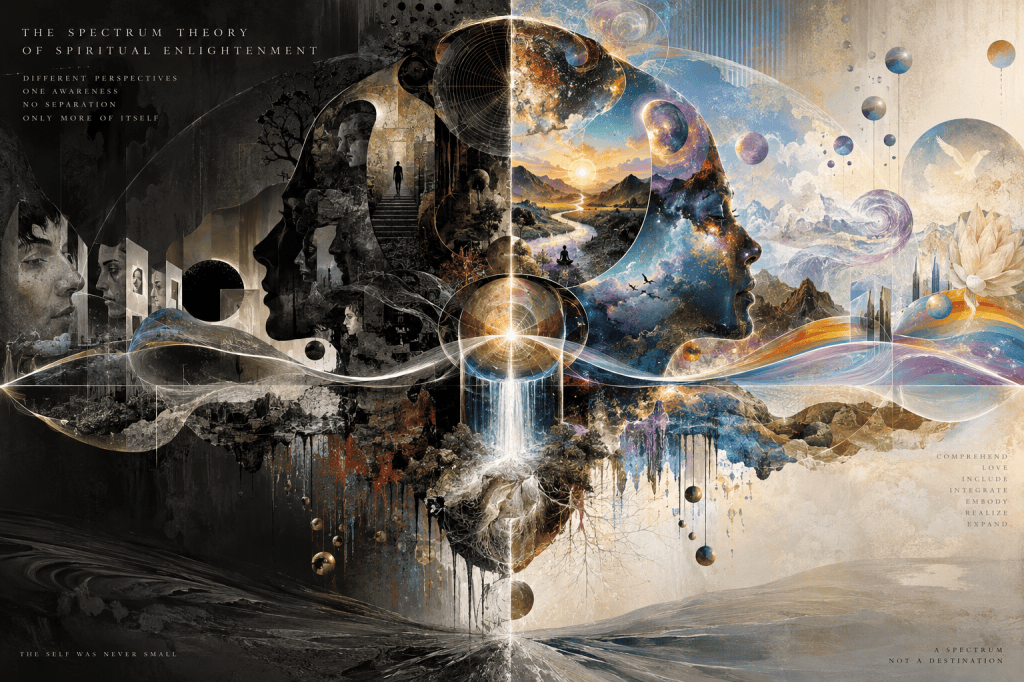
Spiritual enlightenment may be better understood as a spectrum.

This challenges one of the oldest assumptions surrounding enlightenment: that someone either has it or does not.

Enlightened. Unenlightened.

Awake. Asleep.

Self-realized. Ignorant.

Such divisions may be useful when describing a radical shift in consciousness, but they become inadequate when we begin examining the enormous differences between people who have undergone profound spiritual realization.

Two individuals may both recognize the nondual nature of reality and still differ tremendously in their capacity for love, emotional integration, intellectual complexity, perspective-taking, creativity, compassion, self-awareness and their ability to function within the complexity of human life.

This suggests something important.

Realization may happen, while enlightenment continues to unfold.

Enlightenment Is Not Simply What You Experience

Mystical experience alone cannot adequately define enlightenment.

A person may experience ego dissolution, timelessness, boundlessness, unity, emptiness or the disappearance of the subject-object boundary. These experiences can radically alter one’s understanding of reality.

Yet experience eventually encounters interpretation.

The human organism must somehow understand what occurred.

A Christian mystic may interpret unity through Christ. An Advaita practitioner may interpret it through Brahman. A Buddhist may describe emptiness. A neuroscientist may speak about changes within the brain’s construction of selfhood.

The experience may contain striking similarities while the interpretation reflects the developmental capacity of the person experiencing it.

This raises a provocative possibility:

What if enlightenment is not measured solely by how deeply you can disappear, but also by how much reality you can contain when you return?

The Capacity to Hold More

Perhaps spiritual development can partly be understood as increasing capacity.

The more you can comprehend.

The more you can love.

The more perspectives you can hold simultaneously.

The more contradiction you can tolerate without immediately forcing reality into either-or categories.

The more emotional intensity you can experience without becoming completely possessed by it.

The more uncertainty you can encounter without manufacturing certainty simply to make yourself comfortable.

The more of yourself you can observe without defending an identity.

The more of another person you can understand without requiring them to resemble you.

Something begins expanding.

Not necessarily the Self, because from the nondual perspective the Self was never small.

What expands is the human capacity to consciously express what has always been unlimited.

Depth and Breadth Are Different

Someone can go extraordinarily deep while remaining relatively narrow.

This distinction deserves attention.

A profound meditator might enter states of consciousness inaccessible to most people while still possessing rigid cultural assumptions.

A brilliant philosopher might understand dozens of perspectives intellectually while remaining emotionally defended.

A deeply compassionate person may possess extraordinary interpersonal wisdom without having experienced nondual realization.

A mystic may recognize the Absolute while still carrying unresolved psychological conditioning.

These are different dimensions of development.

Calling all of them simply “spiritual advancement” obscures what is actually happening.

A more complete model of enlightenment would therefore require several dimensions.

Depth concerns how completely consciousness penetrates the apparent separation between observer and observed.

Breadth concerns how many perspectives, systems, cultures, disciplines and modes of knowing can be included within one’s understanding.

Integration concerns how thoroughly unconscious, emotional and psychological material becomes incorporated rather than denied, projected or spiritually bypassed.

Embodiment concerns whether realization actually changes how someone lives, relates, creates, responds and participates in the world.

We could express the basic model as:

Enlightenment = Depth × Breadth × Integration × Embodiment

This is not intended as a literal mathematical equation. It is a conceptual instrument.

Its purpose is to prevent one extraordinary dimension from being mistaken for the whole.

Absolute Realization, Relative Development

Here lies an apparent paradox.

The Absolute does not develop.

If nonduality is ultimately true, then there cannot be more or less of the Absolute. There cannot be 40 percent Brahman, 72 percent emptiness or 95 percent pure awareness.

What is fundamental simply is.

Yet the organism through which realization expresses itself certainly develops.

The nervous system develops.

Language develops.

Emotional intelligence develops.

Perspective-taking develops.

Ethical sensitivity develops.

Creativity develops.

Conceptual sophistication develops.

The ability to tolerate complexity develops.

This means absolute realization and relative development should not be confused.

Someone may recognize what is timeless while still being a very particular human being shaped by history, biology, culture, trauma, education and psychological conditioning.

Enlightenment does not necessarily erase the relative human structure.

It changes the relationship to it.

The Number of Perspectives You Can Become

Perspective-taking may be one of the most overlooked dimensions of spiritual maturity.

Early consciousness tends to experience its own perspective as reality itself.

“This is what happened.”

“This is what God wants.”

“This is who I am.”

“This is who you are.”

Greater awareness begins noticing something strange.

Every perspective reveals something while simultaneously concealing something.

Move positions and reality changes.

The child sees one world.

The parent sees another.

The scientist sees another.

The artist sees another.

The mystic sees another.

The atheist sees another.

The person who hurt you sees another.

None necessarily possesses the complete picture.

Spiritual maturity may therefore involve becoming increasingly capable of moving between perspectives without being imprisoned by any of them.

Eventually something even stranger becomes apparent.

The perspectives themselves are occurring within awareness.

Then the question changes from:

Which perspective is ultimately correct?

to:

What is it that can become all of these perspectives without being limited to any of them?

That question points directly toward nonduality.

Love as Expanded Identity

Love also changes when viewed through this model.

Love is usually understood emotionally. We love certain people because they matter to us.

Nondual realization introduces another possibility.

What happens when the boundary defining “me” becomes less convincing?

Compassion may no longer arise merely because one has been instructed to care about others.

Another person’s suffering begins to matter because “other” has become philosophically and experientially unstable.

Their consciousness is no longer entirely foreign territory.

The expansion of love may therefore correspond with an expansion of identity.

First, myself.

Then my family.

My community.

My people.

Humanity.

Sentient life.

Life itself.

Existence.

Eventually the circle collapses because there is nowhere outside it.

Love becomes less about extending kindness from one separate being toward another and more about reality recognizing itself through apparent difference.

Enlightenment Does Not Make You Finished

Perhaps one of the most dangerous ideas surrounding enlightenment is the belief that awakening makes further development unnecessary.

That belief can transform realization into another identity.

“I am enlightened.”

Now the ego possesses the absence of ego.

A remarkably clever maneuver.

Genuine realization may actually make development more demanding because fewer psychological hiding places remain convincing.

There can still be conditioning to examine.

Relationships to repair.

Knowledge to acquire.

Blind spots to discover.

Emotional capacities to strengthen.

Perspectives to encounter.

Humanity to embody.

Awakening does not necessarily end development.

It may remove the central illusion around which development previously revolved.

A Spectrum Without a Final Number

The spectrum model should not become another spiritual ranking system.

Its purpose is not to assign enlightenment scores.

The moment we begin arguing that one person is “Level 8 enlightened” while another is “Level 5,” we risk rebuilding hierarchy around something that fundamentally undermines the separate self seeking status.

The spectrum is multidimensional.

Someone may possess extraordinary contemplative depth but limited psychological integration.

Another person may demonstrate remarkable compassion and embodiment while having little interest in metaphysics.

Another may possess tremendous intellectual breadth but little experiential realization.

Development can be uneven.

That unevenness is precisely why a spectrum model becomes useful.

It allows us to stop pretending that enlightenment must produce identical human beings.

The Strange Conclusion

The deepest realization may reveal that nothing needs to become enlightened.

What you fundamentally are was never trapped.

Awareness itself was never confused.

The Absolute never forgot itself.

The person was the apparent location through which forgetting and remembering occurred.

Yet something continues after that recognition.

The human expression can become wider.

More integrated.

More sensitive.

More capable of holding contradiction.

More capable of intimacy.

More capable of uncertainty.

More capable of seeing through its own assumptions.

More capable of allowing perspectives that once threatened its identity.

More capable of loving without possession.

Perhaps enlightenment contains two movements that appear contradictory only when confused with one another.

One movement reveals that there is nowhere to go.

The other reveals that development has no obvious endpoint.

The Absolute is complete.

Its expression through a human life is not.

This may be one of the great paradoxes of spiritual enlightenment:

You can realize that you are already everything while continuing to discover how much more of everything you are capable of consciously containing.

Morgan O. Smith

https://linktr.ee/morganosmith

You Have Been Speaking Everything Into Existence

This is not simply about affirmations, positive thinking, manifestation, or the power of spoken language. Those ideas remain close to the surface. The deeper meaning reaches beyond the human voice, personal intention, and the individual mind.

You speak everything into existence and do not even realize it.

At the causal level, existence itself is your expression.

Every form that appears, every movement that unfolds, every event that arises, and every world that seems to exist independently emerges from the same beginningless source that you are.

Nothing stands outside of you.

The birth of a star, the movement of a thought, the falling of a leaf, the ending of a relationship, the formation of a galaxy, and the smallest shift within a single cell all belong to one indivisible happening.

That happening has no external author.

It is not being imposed upon reality from somewhere beyond reality.

Existence is expressing itself as everything.

The One Who Speaks Without a Voice

Human beings usually associate creation with deliberate action. Someone decides, acts, and produces a result. Cause appears to precede effect. A person speaks, and something happens.

Causal consciousness does not operate according to this linear sequence.

The voice that speaks existence into being has no mouth. It does not form sentences, construct plans, or choose between possibilities. Its speech is the spontaneous appearance of existence itself.

Mountains are its language.

Bodies are its language.

Silence is its language.

Time, space, matter, thought, sensation, memory, desire, birth, and death are all movements of this wordless declaration.

Creation is not something that occurred once in a remote past. Reality is being spoken now, not through verbal commands, but through the continuous emergence of experience.

You are that emergence.

A Beginningless Beginning

The mind wants to locate a first moment. It asks what started everything, what existed prior to the universe, and what caused the original cause.

These questions assume that reality began somewhere within time.

Time itself is part of what appears.

There was no first moment in the ordinary sense because the causal source does not occupy a position on a timeline. It is not an ancient object hiding behind the universe. It is the timeless ground through which every apparent beginning and ending becomes possible.

Existence is beginningless because the source of existence was never born.

The body had a beginning.

The personality had a beginning.

Your memories had a beginning.

The awareness within which these beginnings are known has no discoverable starting point.

Search directly for the birth of awareness. A memory may arise, but the memory appears within awareness. A story may explain your origin, yet that story is also being witnessed. Every answer appears as another object within the very presence you are attempting to explain.

The source remains prior to every explanation, not earlier in time, but more fundamental than time.

Everything Is Caused by You

The statement “everything is caused by you” can easily be misunderstood.

The personal ego did not manufacture the universe. Your everyday identity is not secretly controlling weather patterns, global events, other people, or every difficulty that enters your life. Such an interpretation would reduce a nondual insight to spiritual grandiosity.

The “you” being described is not the person.

It is the causal ground appearing as the person.

Every cause and every effect arises within the same undivided reality. The hand that acts, the object acted upon, the action itself, and the consequence are not ultimately separate events. They are distinctions created by perception and thought within one continuous movement.

Reality causes itself through itself.

Fire burns wood. Rain nourishes soil. Gravity draws bodies together. Choices alter lives. Countless visible and invisible conditions shape every outcome.

At the relative level, these causes remain meaningful. At the deepest level, none of them operates outside the whole.

Every cause is reality acting.

Every effect is reality receiving its own action.

Both are you, prior to the identity you call yourself.

The Dream of Separation

Separation creates the impression that life is happening to you.

Events seem external. Other people appear completely outside of you. Circumstances arrive from a world that feels independent of your being. You experience yourself as one vulnerable centre among billions of competing centres.

From the causal perspective, the division between inner and outer has not yet formed.

The person, the world, and the experience of the world arise together. A sound cannot appear apart from hearing. A colour cannot appear apart from seeing. A thought cannot appear apart from awareness. The perceived and the perceiver are born within the same act of knowing.

This does not mean physical differences disappear. Your body remains distinct from another body. Your thoughts are not automatically available to someone else. Practical boundaries continue to matter.

Nonduality does not deny difference.

It reveals that difference does not require absolute separation.

Waves differ in shape, force, duration, and direction, yet no wave contains a substance separate from the ocean. Each wave is the ocean taking temporary form.

Your individuality is real as an expression.

It is not independent as an existence.

Your Words Are Part of the Creative Movement

Spoken words still matter.

Language shapes attention, reinforces beliefs, influences relationships, and directs human action. Words can open possibilities or close them. They can encourage, deceive, wound, clarify, liberate, or imprison.

Yet words do not create reality from outside reality. They are movements through which reality modifies its own appearance.

A thought arises.

The body gives it sound.

Another nervous system receives it.

Meaning forms.

Behaviour changes.

A new sequence of events begins.

What appears to be one person speaking to another is existence communicating with itself through two localized expressions.

The same consciousness speaks and listens.

The same reality questions and answers.

The same source forgets itself, seeks itself, and recognizes itself.

Even the person who insists that words have no creative power is using words to introduce that position into existence.

The Causal Level Is Not Personal Control

Causal realization should never be confused with personal omnipotence.

The ego hears “you caused everything” and imagines itself sitting at the centre of the universe, commanding events according to personal desire. It wants authorship, ownership, recognition, and control.

The causal Self requires none of these.

It does not stand over existence as a ruler directing creation from a distance. It is creation itself, appearing as every ruler and every subject, every command and every refusal, every desire and every disappointment.

Your personal mind cannot decide every outcome because your personal mind is itself an outcome. Its thoughts arise through biology, memory, conditioning, culture, language, environment, and countless forces it did not independently choose.

Yet all of these forces arise within the greater reality that you are.

The individual is not the controller of the whole.

The individual is one of the ways the whole moves.

Responsibility Without Blame

Recognizing yourself as the causal ground does not mean blaming yourself for every painful event.

Blame belongs to the psychological self. It assumes that a separate person should have controlled conditions that were often far beyond personal control.

Causal responsibility is different.

It is not guilt.

It is inseparability.

Nothing can be dismissed as completely unrelated to the whole. Suffering anywhere occurs within the same reality that appears here as you. Compassion becomes more than a moral obligation because the apparent other is not entirely other.

When you harm another, existence wounds itself through your actions.

When you care for another, existence responds to itself with tenderness.

When you become more conscious, reality becomes conscious of its own movement at this particular point of expression.

This recognition does not erase accountability.

It deepens it.

Your actions matter because no action is truly isolated. Every gesture enters a field of consequences. Every word travels farther than the speaker can measure. Every choice becomes part of conditions that shape what follows.

The Silence Prior to Creation

What exists prior to the universe being spoken?

Not an empty void waiting for sound.

Not a distant deity preparing to create.

Not a hidden object concealed behind appearances.

There is only the unformed capacity for everything, silent not because nothing is present, but because no distinction has yet arisen.

That silence remains here beneath every experience.

Thoughts do not destroy it.

Sounds do not interrupt it.

Movement does not leave it.

The entire universe appears as a modulation of what never moves.

You are that stillness and every vibration arising within it.

You are the silence and the spoken world.

You are the causal depth from which existence emerges, the forms through which it becomes visible, and the awareness through which it knows itself.

Everything is caused by you because there is no second reality available to cause it.

Everything is spoken by you because every voice belongs to the same beginningless source.

Everything is you, not as possession, not as personal achievement, but as the indivisible fact of being.

Even Opposition Is Your Creation

Some will say this is egotistical.

That judgment, too, has been spoken into existence by the same beginningless reality.

The one who agrees, the one who resists, the one who mocks, the one who rejects, and the one who opposes are not standing outside the whole. Their objections are movements of the same source.

Even opposition is reality appearing to argue with itself.

You created that into existence as well.

Not you as the personality, but you as the undivided ground from which every voice, criticism, affirmation, denial, and misunderstanding arises.

Even all who oppose you are you appearing in another form, defending another viewpoint, expressing another movement within the totality.

Nothing escapes what you are.

Not praise.

Not resistance.

Not disbelief.

Not condemnation.

Not the accusation of arrogance.

The ego may say, “I created everything.”

Truth says, “There is no separate I and no separate everything.”

The accusation of egotism assumes that an isolated person is claiming personal ownership over existence. Nondual realization makes no such claim. It dissolves the presumed owner along with everything the owner hoped to possess.

There is only the beginningless whole appearing as creator, creation, believer, skeptic, supporter, opponent, accusation, defence, and the silence holding them all.

The question is no longer whether you are creating reality.

The deeper question is this:

Who are you before the one who claims to be the creator appears?

Morgan O, Smith

https://linktr.ee/morganosmith

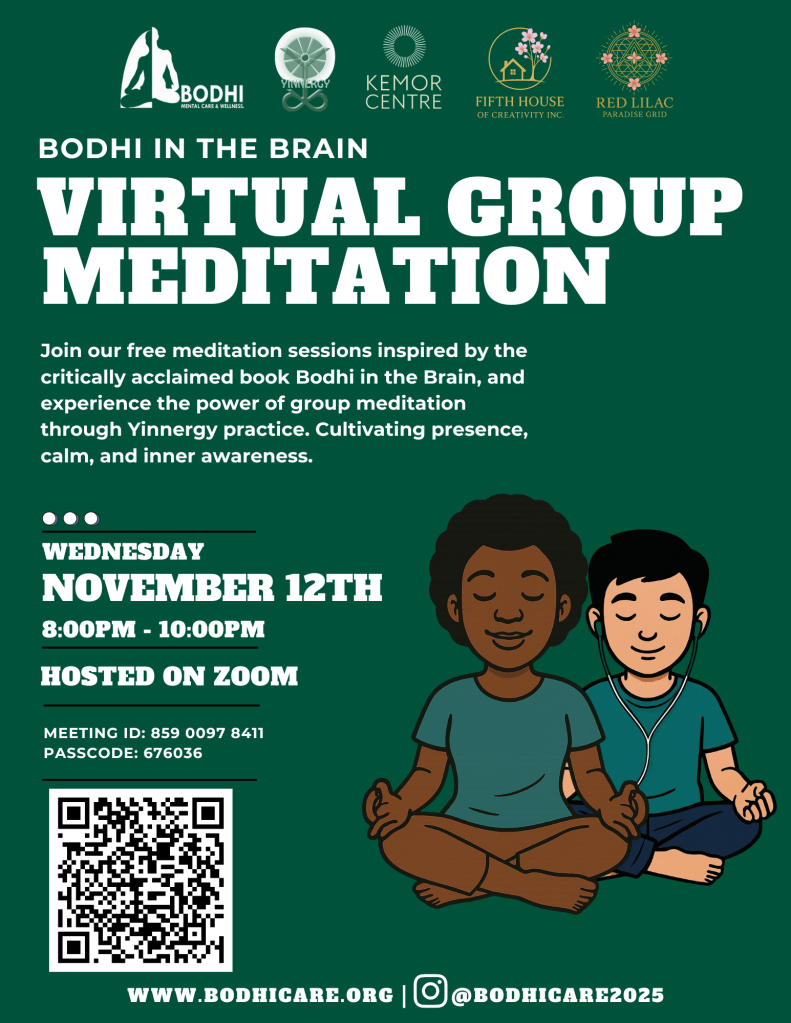
Our Virtual Group Meditation Session Nov 12th!

Join us for our free virtual group meditation session this Wednesday, November 12th at 8:00 PM ET.

Please have your headphones or earbuds ready for the full experience.

Take an hour for yourself to unwind, breathe, and reconnect.

Meeting ID: 859 0097 8411
Passcode: 676036

Warm regards,
Morgan O. Smith
Bodhi Mental Care & Wellness

Beyond the Self

The Seven Perspectives of Awakening

Most discussions of growth and consciousness circle around the familiar: self, community, humanity, cosmos. Yet the movement of awareness does not stop there. The journey of awakening stretches beyond common frames, carrying identity through successive widenings until even perspective itself dissolves into the unnameable.

First Person – Egocentric

Awareness begins with the single pronoun: I. At this stage, the centre of existence is survival, desire, and self-interest. Spirituality here often means seeking relief, comfort, or control. The lens is narrow, but it is the soil from which broader care must grow.

Second Person – Ethnocentric

Identity expands to we. Family, tribe, religion, or nation become the circle of belonging. Meaning and devotion are tied to group loyalty, while outsiders remain less significant. Spiritual life often manifests as faith in a shared path or allegiance to a sacred tradition.

Third Person – Worldcentric

The pronoun shifts again, embracing they. Humanity as a whole is recognized as one family. Every person, regardless of background, is seen as worthy of dignity and care. This is the ground of universal ethics, human rights, and global responsibility. Spirituality speaks in the language of compassion that knows no borders.

Fourth Person – Kosmocentric

Perspective opens to all. Identity now includes every sentient being, every ecosystem, every galaxy. Care extends beyond human concerns to the life of the Earth and the vast cosmos itself. Spiritual experience often takes on a mystical quality here, where the boundary between self and universe fades into transparency.

Fifth Person – Evolutionary/Integral

A new horizon appears: awareness not only of beings and worlds, but of perspectives themselves. The self sees how “I, we, they, all” arise, evolve, and interrelate. Nothing is fixed; everything is a process. Awakening is understood as developmental, dynamic, ever-unfolding. The soul learns to hold multiple truths at once, to integrate rather than divide.

Sixth Person – Nondual

At this point, perspective collapses. The subject-object split dissolves. I, you, we, they, all, perspectives—everything appears as movements of the same luminous field. This is not an expanded view but the direct recognition that views themselves are appearances within awareness. Spiritual awakening here becomes radical intimacy with all that is.

Seventh Person – The Unmanifest

Beyond even the witness lies the groundless ground. This is not a vantage point but the source of all vantage points. No subject, no object, no seer, no seen. Pure Suchness. Emptiness that is full. From here, compassion arises not by choice but as the spontaneous flow of reality itself.

Closing Reflection

Each stage includes what came before and reaches beyond it. To live awakened is not to discard the earlier circles but to embrace them as nested truths. Self-care, community bonds, global ethics, cosmic reverence, evolutionary vision, nondual awareness, and the unmanifest ground—each is real, each is necessary. Together, they sketch the arc of awakening as it bends toward wholeness.

Morgan O. Smith

Get Your Free Copy of My Book, Bodhi in the Brain!

https://subscribepage.io/oTSZQu

Becoming Compassion

Most people think of compassion as a quality you choose to exercise: you decide to be kind, you decide to forgive, you decide to care. This is true at the surface, but beneath those layers exists a spectrum that reveals compassion in its many shades, beginning as a survival instinct and flowering into something beyond human conception.

Compassion first shows itself as biology. A mother tending to her child, a tribe defending its members, even an animal protecting its young. Survival demands it. Yet, as consciousness expands, compassion takes new shapes. We move from caring for “me and mine,” to protecting “us and ours,” to embracing all of humanity as worthy of care. Beyond this lies the recognition that all of life, every creature, every tree, every ecosystem, calls for reverence. Compassion no longer belongs to just people, but to the living Earth itself.

At a certain depth of awakening, compassion is not about effort at all. It does not come from a moral rule, a spiritual practice, or even an intentional choice. It radiates naturally, like sunlight. One sees the inseparability of self and other. Helping you is helping me, and helping me is helping you. The old distinction collapses.

This is where the spectrum ends, or perhaps where it dissolves. Compassion and its opposite no longer stand as polarities. Cruelty and kindness, neglect and care, are revealed as movements of the same indivisible Reality. From this recognition, one cannot merely be compassionate. One becomes Compassion itself; capital “C.” It is not something you perform; it is what you are.

This Compassion does not choose sides, does not measure worth, does not seek reward. It flows freely, even when it appears as silence, even when it includes suffering, even when it looks like its own opposite. The heart of reality is Compassion without preference. To live from that space is not to practice compassion; it is to be it.

Morgan O. Smith

Get Your Free Copy of My Book, Bodhi in the Brain!

https://subscribepage.io/oTSZQu

The Paradox of Divine Knowledge

Beyond the Mind’s Perception

God knows nothing yet knows everything—a contradiction that stands as a perfect reflection of the nature of absolute reality. This enigmatic statement, like a koan, invites deeper contemplation beyond linear thinking. It points to a knowledge that defies conceptual grasp, a knowing that cannot be possessed by the mind.

To say God knows everything implies omniscience—a perfect awareness of all events, possibilities, and outcomes within the realm of manifestation. Yet, to say God knows nothing points to an awareness that transcends any form of subject-object relationship. Here, knowledge is not fragmented into parts. Rather, it exists as a pure, nondual state of being.

This paradox can only be resolved through a radical shift in perception. From the mind’s perspective, knowing implies a knower and a known—a separation that inherently breeds confusion. The clearer this division becomes, the more apparent the contradiction. But from the perspective of absolute awareness, there is no such division. Knowing and not knowing collapse into a single essence, a seamless flow where everything is already perfectly held without the need for grasping or possessing.

The confusion arises only when one attempts to use a dualistic framework to analyze a nondual reality. For those entrenched in rational thought, this statement appears illogical. Yet, the crystal clarity of this confusion emerges when seen through the lens of direct experience. God’s knowing is not intellectual; it is a luminous stillness that enfolds every possible expression of existence without ever defining itself through those expressions.

What, then, does it mean for God to “know nothing”? It signifies the emptiness of all forms, a state where no thought, label, or concept can fully capture what is. It is a knowing that is the essence of all things yet free from the content of knowing itself. There are no judgments, no biases, no preferences—just a silent, omnipresent witnessing. The awareness is so pure that it does not even recognize itself as “knowing” in the conventional sense. It is like the sky holding all clouds yet remaining untouched by their presence or absence.

This is the clarity that lies within the paradox: God knows everything because God is everything. Simultaneously, God knows nothing because God is not bound by the limitations of any particular knowledge. The confusion dissolves when we release the need to categorize and understand reality through fixed structures.

To experience this confusion as crystal clear requires embracing the humility of not knowing. When all concepts, beliefs, and labels are dropped, what remains is a pure awareness that is as empty as it is full. The mind may struggle to grasp this state, but the heart recognizes it intuitively. It is a state of grace, a luminous unknowing that is beyond the reach of both thought and language.

Paradox is not a flaw in understanding; it is the gateway to freedom. It invites one to look beyond the confines of intellect and rest in a knowing that cannot be spoken. This is the ultimate clarity: a confusion that reveals the divine nature of all that is.

Morgan O. Smith

Yinnergy Meditation, Spiritual Life Coaching & My Book, Bodhi in the Brain…Available Now!

https://linktr.ee/morganosmith