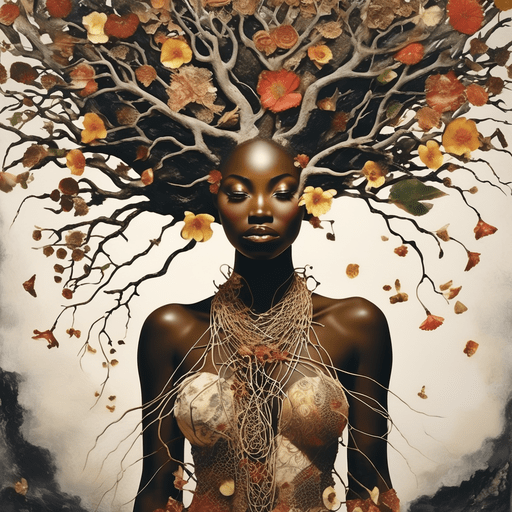
Embracing Roots

A Journey Through Ancestry and Spiritual Enlightenment

In the heart of Black History Month, a period steeped in reflection and celebration, as a born Jamaican, I embarked on a deeply personal exploration into the labyrinth of my lineage. The unveiling of my genetic heritage—spanning Nigeria, Benin-Togo, Congo-Western Bantu, Ghana, Senegal, and a surprising touch of Sweden-Denmark—initiated a profound contemplation on the spiritual practices that once thrived in these regions, long before the erasure and transformation brought by the slave trade.

The spiritual landscapes of my ancestors were rich with diversity, each culture nurturing a unique relationship with the divine, the natural world, and the community. From the Orishas of Nigeria to the ancestral veneration in the Congo, and from the rhythmic ceremonies of Vodun in Benin-Togo to the profound Serer spirituality of Senegal, these practices were rooted in a deep understanding of interconnectedness. In Ghana, the harmonious balance between the physical and spiritual realms underscored the essence of existence.

The advent of the slave trade and the subsequent imposition of Christianity introduced a seismic shift in the spiritual orientation of many African descendants. This convergence of beliefs, however, did not obliterate the ancestral wisdom but rather embedded it deeper into the collective consciousness of those who were forcibly displaced. Christianity, with its narrative of suffering, redemption, and salvation, offered a new lens through which the spiritual heritage of my ancestors could be reinterpreted.

My spiritual journey, influenced by the intricate web of my genealogy, has been a testament to the resilience and adaptability of faith. It led me to the profound awakening of Nondual Suchness—an understanding that transcends the binary oppositions and dualities that often confine our perception. This realization, that everything is interconnected and every part of the universe is contained within me, has been a transformative experience. It signifies not just a return to the spiritual practices of my ancestors but an evolution of those beliefs into a holistic understanding of existence where everything is included within the gross body of my DNA.

This journey through my ancestral spiritual practices to the enlightenment of Nondual Suchness underscores the notion that we are not merely products of our immediate culture but are deeply connected to a rich historical and spiritual lineage. It highlights how the imposition of a new spiritual system can act as a catalyst for deeper spiritual exploration, leading to a more encompassing awareness that honours both the diversity and unity of our existence.

As we celebrate Black History Month, let us remember the spiritual legacies of our ancestors. Their wisdom, resilience, and spiritual insights continue to guide us, offering a beacon of light as we navigate our paths to understanding and enlightenment. In embracing our roots, we find the strength to transcend and include all that we are, forging a path toward a future where the past is not forgotten but honoured as the foundation of our spiritual growth.

Morgan O. Smith

Yinnergy Meditation, Spiritual Life Coaching & My Book, Bodhi in the Brain…Available Now!

https://linktr.ee/morganosmith


The Paradox of Self and No-Self

Navigating Samsara and Nirvana

In the profound journey of spiritual understanding, the concepts of birth, death, and rebirth hold a pivotal place. The intriguing idea that an enlightened being, despite their profound realization, can still be subject to the continuous cycle of reincarnation, presents a paradox that invites deep contemplation.

The pursuit of Nirvana or Moksha, as understood in various spiritual traditions, suggests a state where this perpetual cycle is broken. This liberation, often depicted as the ultimate goal in spiritual endeavours, implies an escape from the continuous loop of birth, death, and rebirth.

However, this raises a thought-provoking question: Can one truly experience and comprehend nondual suchness – a profound realization of their true self as the foundational essence of all existence – and yet remain entangled in the cycle of birth and death? This notion challenges our understanding of spiritual liberation and the nature of self-awareness.


The intricate relationship between Samsara (the cycle of birth and death) and Nirvana (liberation from this cycle) is a complex one. They are often perceived as two distinct realms or states of being. Yet, in a deeper existential sense, they might be seen as the same. This perspective opens up a philosophical exploration into the nature of the self.

The concept of ‘no-self’ is central to this discussion. It posits that the individual self we identify with is an illusion, a transient construct devoid of inherent existence. Paradoxically, this ‘no-self’ is also the self, as there is no true separation between the individual and the universal. Thus, one might refer to it as the ‘no-self,’ questioning the very existence of a label or reference point in this boundless, interconnected reality.

This exploration leads to profound questions: Who labels this existence if the self is an illusion? What is the nature of the self that encompasses everything, yet is nothing in itself? These are the riddles that spiritual seekers have pondered for ages, and they remain mystifying and intriguing today.


This philosophical conundrum invites us to dive deeper into our understanding of existence, self, and liberation. It challenges us to look beyond the conventional notions of identity and existence, urging us to explore the very essence of being.

Morgan O. Smith

Yinnergy Meditation, Spiritual Life Coaching & My Book, Bodhi in the Brain…Available Now!

https://linktr.ee/morganosmith
Surrendering to Nondual Suchness

A Journey Beyond the Self

In spiritual exploration, the concept of surrendering to nondual suchness presents a profound and thought-provoking journey. This journey transcends the confines of the individual self, leading one into the embrace of a universal consciousness.

At the heart of this process is the realization that the sense of a separate ‘you’ is an illusion. In nondual suchness, the distinction between self and other dissolves, revealing a state of being where everything is interconnected and unified. This realization is not an intellectual one; it’s an experiential awakening to the true nature of existence.


When we talk about surrendering in this context, it’s not the conventional notion of giving up or admitting defeat. Instead, it’s a letting go of the ego, the false sense of separateness that keeps us entangled in a web of individuality and personal narratives. It’s a release into the flow of life, an unclenching of the fists that hold tightly to personal identity and desires.

This surrender is not an act done by an individual to something greater. Rather, it’s a recognition that the individual self is an integral part of the greater whole. It’s the ‘all that is’ surrendering to itself. In this space, there’s no doer; there’s just the unfolding of life in its myriad forms, a dance of cosmic consciousness.

This understanding brings about a profound sense of peace and freedom. It’s a liberation from the burdens of the self, a release from the relentless pursuit of personal gain, and an end to the suffering caused by attachment and aversion. In this state, one experiences life in its purest form, unfiltered by the ego’s desires and fears.


Surrendering to nondual suchness is a journey that challenges our deepest-held beliefs and perceptions. It invites us to look beyond the surface of things, to see the interconnectedness of all life, and to experience the world not as a collection of separate entities but as a unified whole.

As we embark on this journey, we find that the path is not always easy. It requires a willingness to let go, to trust in the natural flow of life, and to open ourselves to a reality that transcends the personal. But for those who dare to take this path, the rewards are immeasurable: a sense of oneness with all that is, a deep and abiding peace, and an unshakeable joy that comes from being in harmony with the true nature of existence.

 Morgan O. Smith

Yinnergy Meditation, Spiritual Life Coaching & My Book, Bodhi in the Brain…Available Now!

https://linktr.ee/morganosmith

The Journey Within Embracing Nondual Suchness

In my spiritual explorations, I have come to embrace what the few would call “Nondual Suchness.” This concept represents a transformative journey of consciousness, one that transcends the need for external recognition or validation. It is a path that leads inward, towards a deep, unshakeable peace and a profound realization of universal interconnectedness.

This journey is not about reaching outward for validation or acknowledgment. Instead, it’s about turning inward for self-discovery and self-acceptance. It is here, in the quietude of our inner being, that we encounter the true essence of our existence. This exploration reveals the intrinsic rewards of our inner journey – rewards that are not given by the world but are discovered within the depths of our consciousness.


Embracing Nondual Suchness is about recognizing the interconnected fabric of all existence. It’s about understanding that every thought, every action, and every moment is intrinsically linked to the whole, simultaneously being the whole. This realization brings with it a profound sense of peace, as we begin to see ourselves not as isolated beings, but as integral parts of a larger, harmonious whole.

This path of self-discovery and self-acceptance is an invitation to all. It is a call to delve into the depths of our being, to uncover the peace and understanding that lie within. It is a journey that transforms not just our perception of ourselves, but our perception of the world around us. In embracing Nondual Suchness, we find not just peace, but a deep and abiding joy in the simple act of being.


Morgan O. Smith

Yinnergy Meditation & My Book, Bodhi in the Brain…Available Now!

https://linktr.ee/morganosmith

Moksha and Nirvana

Two Sides of the Same Coin in Nondual Suchness

In the realm of spiritual philosophy, the concepts of Moksha and Nirvana often emerge as distinct paths toward spiritual liberation. Moksha, a term deeply rooted in Hindu philosophy, represents liberation from the cycle of birth and rebirth (Samsara), a release from the constraints of worldly existence. On the other hand, Nirvana, central to Buddhist thought, is the state of being free from suffering and the cycle of rebirth, a culmination of enlightenment.

At the surface, these two concepts might appear as separate paths, guiding the individual through distinct spiritual journeys. However, when explored at the ultimate level of nondual suchness, a profound realization emerges: Moksha and Nirvana are, in essence, two sides of the same coin.


Nondual suchness refers to a state of consciousness where dualities and distinctions dissolve. In this state, the separation between self and other, between one spiritual goal and another, ceases to exist. It is here, in this realm of nondual awareness, that Moksha and Nirvana converge, revealing their inherent unity.

This realization transcends the apparent differences imposed by linguistic and cultural contexts. While Moksha speaks a language of liberation from the cycle of rebirth, and Nirvana talks of extinguishing the flames of desire and suffering, at their core, they both aim towards the same ultimate truth – freedom from the limitations of human existence and a reuniting with the absolute, the infinite, or the void.


Understanding Moksha and Nirvana as interconnected aspects of the same spiritual truth offers a more inclusive and comprehensive perspective on the journey toward enlightenment. It encourages a deeper exploration beyond the boundaries of religious doctrines and invites a unifying experience of spiritual awakening.

In this light, the journey towards Moksha or Nirvana is not about choosing one path over the other but about realizing the underlying unity that they both represent. It is about transcending the ego, dissolving the illusions of separation, and embracing the wholeness of existence.

In conclusion, the ultimate level of nondual suchness opens the door to a profound understanding where Moksha and Nirvana are no longer seen as separate goals but as harmonious expressions of the same ultimate reality. This realization is a pivotal moment in the spiritual journey, marking a transition from a path of seeking to a state of being, from a pursuit of liberation to the realization of inherent freedom.

Morgan O. Smith

Yinnergy Meditation & My Book, Bodhi in the Brain…Available Now!

https://linktr.ee/morganosmith
Embracing the Self-Evidence of Nondual Suchness

An Encounter Beyond Validation

We often journey through life seeking validation. The drive to achieve approval, to fit within the bounds of societal constructs, and to be seen through the eyes of others often influences our experiences and perspectives. However, there’s a profound, transformational shift when one comes into direct contact with the pure essence of Nondual Suchness, a concept rooted deeply in Eastern philosophy and spirituality.

Nondual Suchness refers to the fundamental reality beyond the realm of conceptualization, differentiation, and duality. It encompasses the realization of an interconnected, all-encompassing, unchanging ‘oneness.’ This ‘oneness’ transcends the illusion of separateness created by our conscious minds and provides a doorway to an understanding that transcends cognitive comprehension.

Engaging with this ultimate truth in its purest form, the self-evident nature of Nondual Suchness becomes apparent. It is akin to seeing a new colour for the first time, hearing an unheard melody, or feeling an emotion you never knew existed. It is something so profoundly intrinsic and natural that it requires no external validation.

Coming into direct contact with this self-evident truth, one finds a sense of freedom from the need for external validation. The realization arises that the validation we seek from others is often just a reflection of our own internal reality. It prompts the realization that we are not just part of the universe, but the universe itself, experiencing itself through individual perspectives.

When we live in the space of Nondual Suchness, our outlook towards life undergoes a fundamental shift. We start recognizing the universe within us, and us within the universe, unveiling the interconnected web of existence. With this realization, we no longer yearn for external affirmation because our perspective is not determined by the reflections of others, but is instead deeply rooted in the unchangeable truth of our inherent oneness.

Embracing Nondual Suchness is an invitation to transform one’s consciousness. This path, while profound and enlightening, does not demand external recognition or validation. Its rewards are intrinsic, providing a deep and unshakeable peace that cannot be given or taken away by others. It’s a journey of self-discovery, self-acceptance, and a profound realization of universal interconnectedness.

In conclusion, the pure, self-evident Nondual Suchness, once encountered, becomes an internal beacon of truth and authenticity. It frees us from the burden of seeking external validation, allowing us to dwell in an enduring peace that is both the journey and the destination in the beautiful tapestry of existence.

Morgan O. Smith

Yinnergy Meditation & My Book, Bodhi in the Brain…Available Now!

https://linktr.ee/morganosmith