Author, Philosopher, Spiritual Teacher, A Lead Facilitator at Sacred Media's Integral Mastery Academy, Founder of Yinnergy Meditation/Neurofeedback, Bodhi Mental Care & Wellness, Co-founder of KeMor Centre for Innovative Development
Love that requires no condition, no reflection, no return; this is the highest state of consciousness. Universal Love is not sentimental or selective. It does not operate within the confines of personality, preference, or perception. It sees through every distinction and recognizes only itself.
This is love as total awareness. It loves because there is nothing else to do. It gives without the idea of giving. It embraces without needing to hold. It penetrates every boundary of selfhood and dissolves all opposites into a seamless field of being. Even the idea of “others” fades when this love awakens, for the one who loves and the one who is loved are found to be the same.
Such love is not weak; it is fearless. It does not protect itself because it knows it cannot be harmed. It sacrifices willingly because it understands there is no loss in unity. Every act, every gesture, every breath becomes an expression of this boundless compassion that celebrates existence as itself.
Universal Love is not attained through effort. It is remembered through surrender. The heart expands until it no longer has edges. What remains is a radiant stillness that loves without reason, without measure, and without end.
Morgan O. Smith
Get Your Free Copy of My Book, Bodhi in the Brain!
Awakening does not unfold through accumulation but through dissolution. It’s not about adding layers of understanding, but releasing the very framework that holds identity together. Every seeker begins with an “I”—the observer, the experiencer, the one who longs for freedom. Yet that same “I” must eventually surrender its throne.
The paradox lies here: the “I” must decide to release itself. It chooses to let go, though the one who chooses disappears in the act. This gesture is not driven by resistance or desire, but by recognition —an intuitive understanding that attachment to any quadrant is still a form of identification.
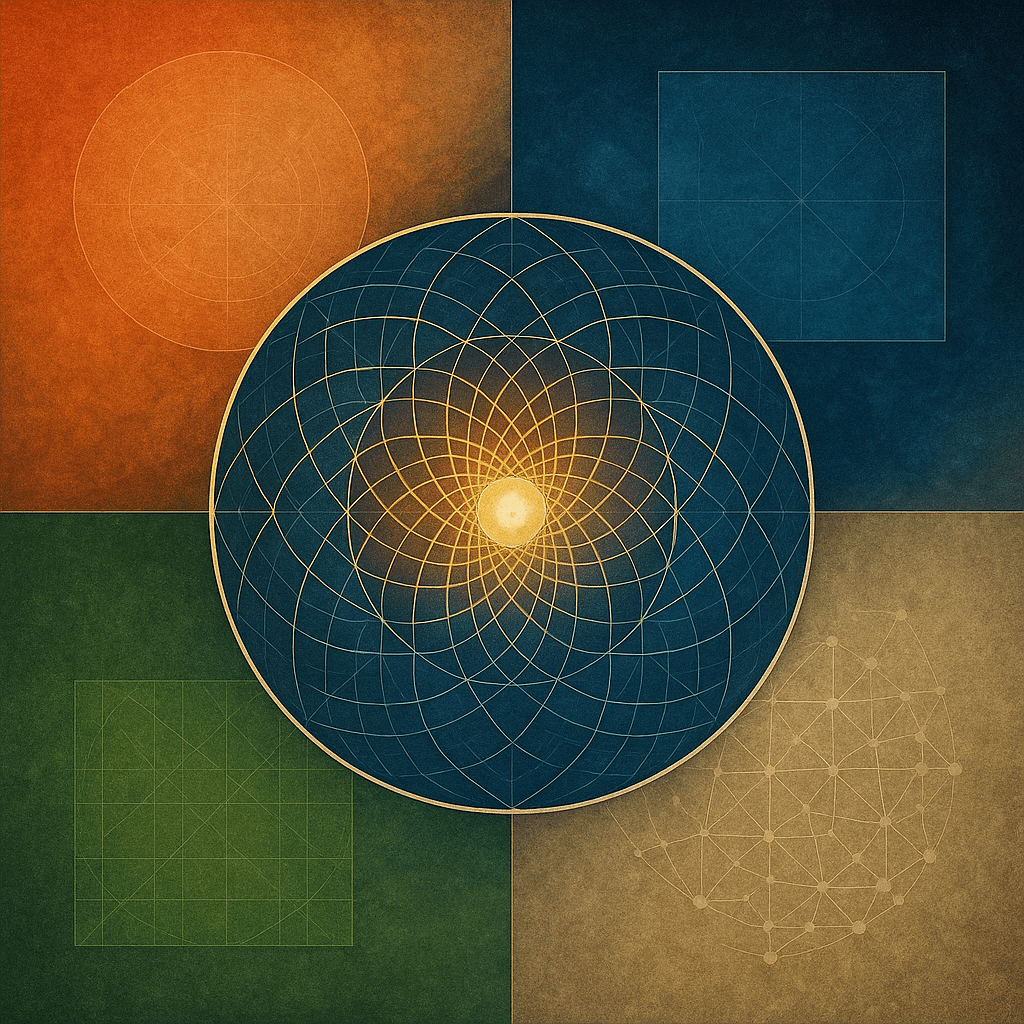
The quadrants—I, WE, IT, and ITs—map the totality of human experience: the inner self, the collective, the objective, and the systemic. Each serves a purpose until awakening calls for transcendence. The I is influenced by the ITs—the systems, structures, and conditions of existence. These shape perception and possibility. Through the IT, awareness ripples into the WE, inspiring collective movement. And as the WE shifts, the I is again transformed.
This endless loop of causation refines consciousness but never liberates it. Liberation comes when the loop itself is seen through. When the “I” no longer clings to the role of observer or doer, the quadrants collapse into pure witnessing. There is no longer an experiencer and the experienced, a subject and its object. What remains is unconditioned awareness; the silent axis upon which all quadrants turn.
Awakening, then, is not achieved through effort but through profound surrender. It is the cessation of grasping at identity within any domain—personal, relational, empirical, or systemic. The quadrants remain functional but no longer define reality. They appear and dissolve within the same stillness that has always been awake.
Morgan O. Smith
Get Your Free Copy of My Book, Bodhi in the Brain!
Reality isn’t hiding. What conceals it is the web of interpretations spun by the mind: assumptions, projections, and inherited beliefs. Yet, paradoxically, it is through interpretation that one begins to peel away those very veils. Every interpretation is a mirror. The question is: what is it reflecting?
Interpretation matters because it reveals where you are on the developmental spiral. Crude, reactive interpretations reflect lower rungs of psychological growth; often rooted in fear, blame, or a need for certainty. As awareness matures, interpretations become more nuanced, inclusive, and paradox-tolerant. They start to echo the underlying unity of things, rather than just categorize them.
Interpretation is not merely a mental activity. It is a soul signal. The more refined it becomes, the closer it gets to silence, the point where no interpretation is needed. That is the paradox. The highest interpretation doesn’t claim to know; it bows. It listens. It dissolves.
Yet such dissolution is not a regression into vagueness. It is the clarity that comes when all interpretations have done their job and exhausted their usefulness. Then what remains is the directness of being—your true nature—not as a conclusion, but as the very absence of conclusion.
This is why interpretation is not to be dismissed but refined. It is a bridge. And the more accurate your interpretation of the world, the closer you walk toward the unconditioned—what no interpretation can contain, but all of them secretly point toward.
What you interpret is what you live. Misinterpret life, and you suffer. Align with it, and you awaken. Accuracy in perception is not about being “right”; it is about being real. Every step you take toward clearer interpretation is a step toward the Real that has no opposite.
Morgan O. Smith
Get Your Free Copy of My Book, Bodhi in the Brain!
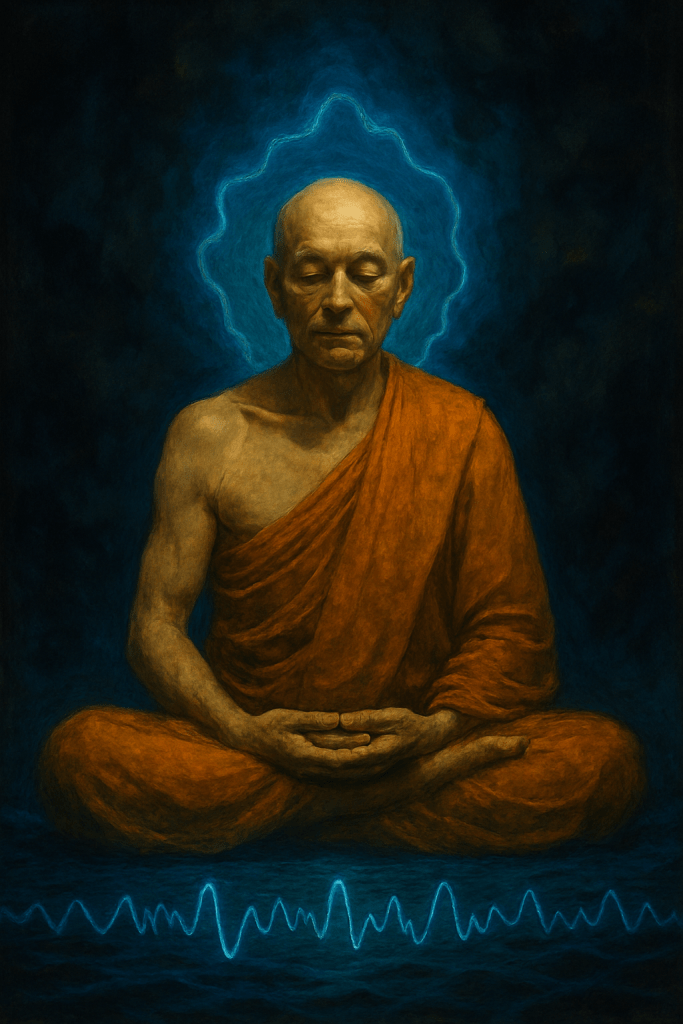
Delta brain waves are usually hidden from waking life. They belong to the body’s most private rhythm — the deep, dreamless silence where consciousness normally dissolves. For most people, delta is experienced only through absence: a blackout where awareness takes no witness. Yet, for advanced meditators, something remarkable occurs. Awareness remains present while the nervous system sinks into the very frequency of dreamless sleep.
Delta as the Ground of Renewal
Delta oscillations (0.5–4 Hz) are the signature of repair. They carry the nervous system into cellular healing, hormonal balance, and restoration of energy. They are the body’s night-shift, stitching torn fabric, releasing toxins, and recovering the energy spent during wakefulness. For ordinary sleepers, this happens unconsciously. For those who stabilize awareness in delta, repair and presence unfold together. The body heals, while the mind remains awake.
The Paradox of Conscious Delta
This state is paradoxical: stillness that does not collapse into oblivion. The meditator discovers a dimension where the body is in deep rest, yet awareness is vivid and unmoving. Traditions have called this turiya, shunyata, or the silent ground of being. It is the discovery that the absence we usually meet in dreamless sleep is not an absence at all, but the raw canvas of consciousness itself.
Why Amplitude Matters
When delta amplitude grows strong, it is not a faint background rhythm but a dominating presence across the cortex. For meditators, this feels like awareness being anchored into the earth itself — immovable, steady, silent. In neuroscience, strong amplitude is also linked with unusual phenomena: bursts of gamma oscillations riding delta waves, moments that map onto reports of nondual realization. The sheer strength of delta helps stabilize this conscious void so it does not collapse back into ordinary unconscious sleep.
The Fruits of Practice
Remaining awake in delta has profound effects:
Resilience: the nervous system is deeply restored, while awareness gains expanded capacity.
Fearlessness: repeated immersion in conscious delta dissolves the fear of death, as the meditator discovers awareness continues through the very state that mimics death most closely.
Transpersonal Vision: many report the direct sense of unity — the recognition of being everything and nothing simultaneously.
Daily Integration: over time, the qualities of delta bleed into waking life, creating a baseline calm that endures even amid chaos.
The Mystery Reframed
To be awake in delta is to learn that the bottom of sleep is not a void to be feared, but a gateway into the infinite. It is discovering that silence itself has texture, depth, and luminosity. What we thought of as unconsciousness reveals itself as the very source of consciousness.
This is not just a state — it is a shift in identity. The meditator no longer clings to the cycles of waking and sleeping. Awareness is recognized as the continuum in which all cycles arise.
Morgan O. Smith
Get Your Free Copy of My Book, Bodhi in the Brain!
To say “God exists” is to affirm the ultimate. To say “God does not exist” is to deny the ultimate. Both affirmations and denials, however, are shaped by the mind’s insistence on certainty. The moment one tries to hold onto either pole, a paradox emerges.
When someone claims God exists, they project a reality beyond perception, yet they confine that reality to a category recognizable to human thought. When another claims God does not exist, they too impose a conclusion, binding the ineffable to the limits of negation. Both positions carry a strange truth and a strange error. Both dissolve the moment awareness sees through the duality of affirmation and denial.
Imagine truth as a horizon: from one angle, existence appears; from another, non-existence. Walk closer, and the horizon itself vanishes; it was never a line that could be grasped, but a function of perspective. God is not merely at the horizon but the condition through which horizon, perspective, and perceiver arise.
To say both are true is to honour that reality contains affirmation and negation. To say both are false is to point out that neither claim reaches the source. To say one is true and the other false is to remain in dualistic thought. To call them half-truths is to recognize their limitation yet still attempt to measure the immeasurable. To deny even a half-truth is to bow to silence.
The statement itself, that God exists and does not exist in all these paradoxical ways, becomes the closest gesture to truth. It is not the conclusion but the capacity to hold the contradictions without collapse that reveals God’s existence, not as a concept but as the unnamable presence behind every concept.
The paradox is not meant to be solved. It is meant to exhaust the mind until only awareness remains. What remains is not the proof of God, but the direct realization that the very effort to define or deny was always occurring within and as God.
Morgan O. Smith
Get Your Free Copy of My Book, Bodhi in the Brain!
The quadrants—I, We, It, and Its—are not just theoretical maps of experience. They can be lived, felt, and directly known in ways that reveal both their necessity and their ultimate transparency. Each quadrant opens as a doorway, and when entered deeply, each dissolves into the same ground that holds them all.
The “I” – Subjective Interior
The first-person self, the one who says “I,” often feels like the most fundamental reference point of life. Yet, in moments of profound awareness, this identity begins to unravel. The familiar sense of a centre collapses into boundless subjectivity that no longer belongs to a person. Awareness remains, but it is no longer tethered to the small self. The “I” is recognized as inseparable from the infinite.
The “WE” – Intersubjective Communion
Beyond the personal lies the shared field of relationship. Here, connection is no longer about agreement or dialogue but about an unspoken resonance. Every being, every presence, becomes part of a silent communion. The walls between self and other fall away, revealing a unity that feels more intimate than words could ever capture.
The “IT” – Objective Reality
The external world, seen through clear perception, ceases to be “out there.” Light, form, and movement are no longer divided from the one who sees. Reality appears luminous, alive, inseparable from the awareness that beholds it. Object and subject reveal themselves as two sides of the same indivisible presence.
The “ITS” – Systems and Networks
The interwoven fabric of existence discloses itself as a living system. Breath, heartbeat, ecosystems, and galaxies are perceived not as separate mechanisms but as one movement—an intricate symphony without a conductor. The interconnections are not abstractions but a direct felt sense of everything breathing together.
Beyond Quadrants – The Supreme Identity
As each quadrant is seen through, they collapse into the unbroken ground of Being. This cannot be named as “I,” “We,” “It,” or “Its.” It is the source that gives rise to them all while remaining untouched by their distinctions. This is the Supreme Identity—timeless, boundless, indivisible.
When lived from this recognition, the quadrants are not discarded but liberated. They no longer bind perception to fixed standpoints. Instead, they shine as transparent facets of a jewel that was never fractured. Every act, every relationship, every perception becomes a clear expression of the ground itself.
The Supreme Identity is not somewhere else, waiting to be found. It is what was always here—before the quadrants, within them, and beyond them.
Morgan O. Smith
Get Your Free Copy of My Book, Bodhi in the Brain!
The quadrants of experience—I, We, It, and Its—have long been a lens through which consciousness organizes reality. Each provides a vital perspective: the subjective interior of the self, the shared intersubjective domain, the objective forms of matter, and the interobjective systems of the whole. These lenses do not compete; they illuminate the multiple dimensions of existence. Yet, any frame cannot contain the essence of reality, no matter how inclusive or comprehensive it may be.
What reveals itself when awareness no longer clings to a particular quadrant? A vastness appears that cannot be named solely as an “I,” nor reduced to the communion of “We.” It is not confined to the world of objects, nor to the vast interplay of systems. The Supreme Identity both transcends and enfolds these domains, existing as their ground and source.
This Identity is not separate from the quadrants; it is their silent witness and animating force. Just as light contains within it every visible colour yet is itself colourless, the Supreme Identity contains every possible perspective while remaining free of perspective altogether. When seen clearly, the quadrants dissolve into expressions of a singular field that cannot be divided.
What makes this recognition so profound is that it shatters the tendency of consciousness to fixate. The mind grasps for a standpoint—self, relationship, object, or system—but here, every standpoint is unmasked as a partial gesture of the whole. The Supreme Identity does not stand against them; it whispers through them. The “I” speaking, the “We” sharing, the “It” observed, the “Its” interlinked—all are nothing other than its unfolding.
Realizing this does not negate the quadrants. Rather, it liberates them. Each becomes transparent, shining as a clear facet of a jewel that was never fractured to begin with. The Supreme Identity calls forth a recognition: the One is never elsewhere. It is already present, before all perspectives, yet manifesting as each.
To live from this recognition is not to abandon life’s frameworks but to embody their ground. Every conversation, every act, every encounter reveals the unbroken presence that cannot be named yet pervades all. The quadrants remain as tools of navigation, but the navigator is no longer lost.
Morgan O. Smith
Get Your Free Copy of My Book, Bodhi in the Brain!
Most men may never understand what it feels like when the body pauses in response, even as doctors insist there is nothing wrong; no hormonal imbalance, no medical explanation, nothing. For nearly six years, I have lived with the stillness of fire that began not after an illness or injury, but after the most profound spiritual awakening of my life.
The event unfolded as a complete rupture of ordinary consciousness. A massive surge of energy, like a serpent coiling and rising along my spine, tore through every chakra until my crown split open. What followed was a cascade of light, as if every particle of my being erupted into ecstatic union, each atom proclaiming with clarity and force: I AM GOD. My body convulsed as though gripped by a seizure, yet my inner experience was one of perfect union with the entire cosmos. Every movement of mine was the movement of the universe, and every movement of the universe was my own.
That experience was ignited months after receiving darshan from Paramahamsa Vishwananda in 2019. Life has not returned to what it once was. The challenges below the waist have resisted every attempt at permanent resolution. Sessions with a chi master provided brief relief, but soon after, the absent spark would return. And yet, despite this, my relationship to the situation is not one of despair. Desire for vitality remains, but acceptance has settled in deeper than disappointment.
For men whose identity is tightly woven to the fire of physical intimacy, such a loss could feel devastating. For me, the years of spiritual preparation softened the impact. I knew that awakening could arrive with consequences. It was not only bliss that I had trained for, but the burning away of old attachments.
Ironically, from a fading of the physical echo came an experience of Tantra more profound than any physical act could offer. Without the presence of another, I encountered the total union of my inner masculine and feminine, the Anima and Animus dissolving into wholeness. The union was so complete that it redefined intimacy itself, showing me that sexuality is not bound to flesh but can open into direct communion with the soul.
Not long after that experience, I faced the deaths of colleagues and a high school friend. The timing was a reminder that awakening is never an escape from life’s fragility. Transformation and loss often arrive hand in hand.
The path that led to that awakening back in 2019 was punishing at times; physically, emotionally, mentally. Yet when I ask myself if I would choose differently, the answer remains no. I would walk this road again, and again, even when the body does not follow the heart, which many would find unbearable. Because what was given cannot be outweighed by what was taken.
Awakening strips away what is temporary to reveal what cannot be lost. Even if the body falters, the truth that was seen remains untouched.
Morgan O. Smith
Get Your Free Copy of My Book, Bodhi in the Brain!
Most people think of compassion as a quality you choose to exercise: you decide to be kind, you decide to forgive, you decide to care. This is true at the surface, but beneath those layers exists a spectrum that reveals compassion in its many shades, beginning as a survival instinct and flowering into something beyond human conception.
Compassion first shows itself as biology. A mother tending to her child, a tribe defending its members, even an animal protecting its young. Survival demands it. Yet, as consciousness expands, compassion takes new shapes. We move from caring for “me and mine,” to protecting “us and ours,” to embracing all of humanity as worthy of care. Beyond this lies the recognition that all of life, every creature, every tree, every ecosystem, calls for reverence. Compassion no longer belongs to just people, but to the living Earth itself.
At a certain depth of awakening, compassion is not about effort at all. It does not come from a moral rule, a spiritual practice, or even an intentional choice. It radiates naturally, like sunlight. One sees the inseparability of self and other. Helping you is helping me, and helping me is helping you. The old distinction collapses.
This is where the spectrum ends, or perhaps where it dissolves. Compassion and its opposite no longer stand as polarities. Cruelty and kindness, neglect and care, are revealed as movements of the same indivisible Reality. From this recognition, one cannot merely be compassionate. One becomes Compassion itself; capital “C.” It is not something you perform; it is what you are.
This Compassion does not choose sides, does not measure worth, does not seek reward. It flows freely, even when it appears as silence, even when it includes suffering, even when it looks like its own opposite. The heart of reality is Compassion without preference. To live from that space is not to practice compassion; it is to be it.
Morgan O. Smith
Get Your Free Copy of My Book, Bodhi in the Brain!
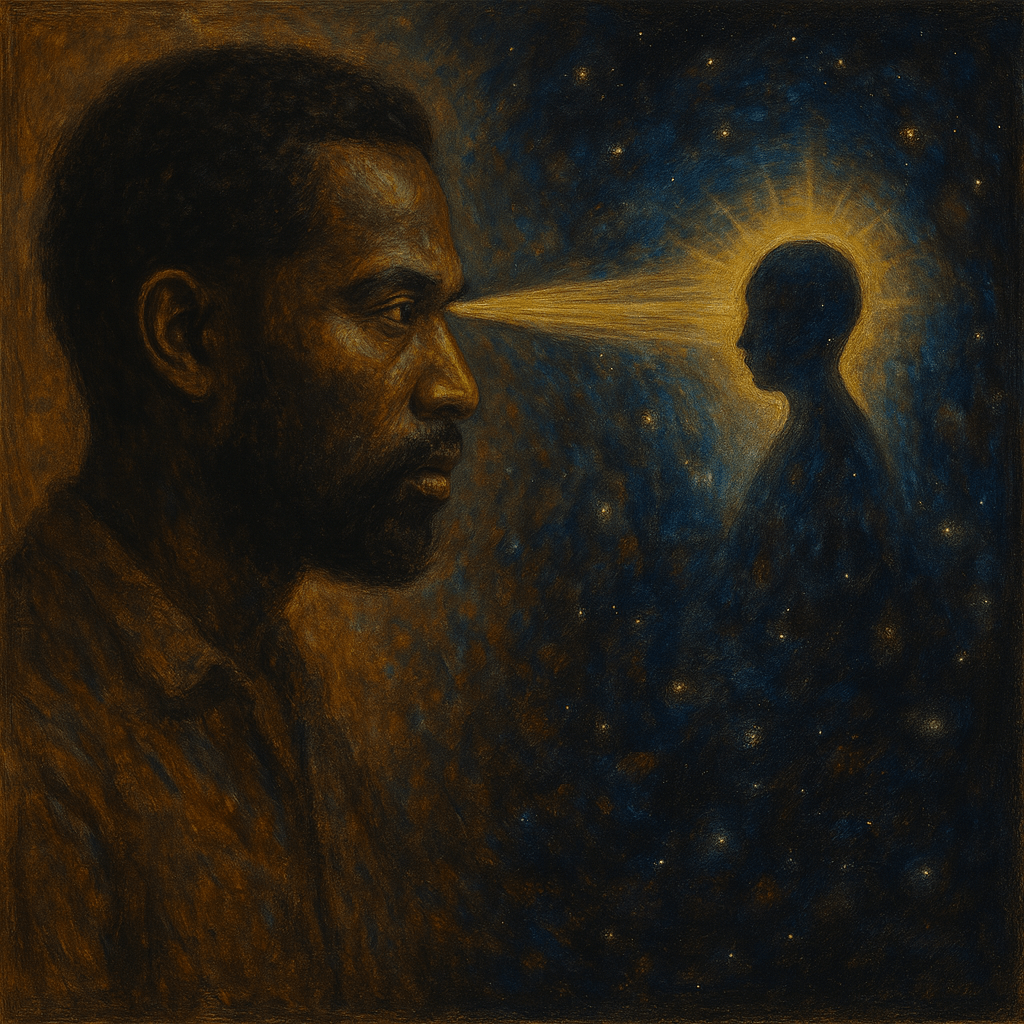
Most human conflict is rooted in the inability to step outside the narrow confines of the self. We tend to move through the world tethered to a singular point of view, unable to grasp that reality shifts depending on who is looking. Perspective is not fixed; it unfolds in layers, from the egocentric stance of “me and mine,” through the ethnocentric loyalty of “us and ours,” into the broader realms of worldcentric care for humanity, and ultimately the kosmocentric embrace of all beings and existence itself.
When our awareness stops at the egocentric, we see others only as extensions of ourselves; or worse, as threats to what we hold dear. At the ethnocentric level, we expand slightly, but compassion remains conditional, bounded by tribe, religion, race, or nation. Yet the real flowering of human consciousness emerges once we realize that every being, regardless of sex, class, culture, or creed, carries within them a mirror of our own existence.
To recognize yourself in another is not simply an ethical exercise; it is an ontological revelation. The more deeply you understand that the same fears, desires, and vulnerabilities pulse through all lives, the less room remains for judgment. Hatred fades not because you suppress it, but because understanding transforms it. Even the figure we call “devil” becomes less monstrous when we glimpse the fractured angel hidden inside.
Imagine what collective life would feel like if this capacity for expanded perspective became the norm rather than the exception. Entire systems of oppression, exploitation, and alienation would dissolve under the weight of genuine empathy. Politics would no longer be about “sides” but about solutions; communities would no longer divide over difference but celebrate the very diversity that teaches us new ways of being human.
To walk in anyone’s shoes is more than a metaphor. It is the necessary step toward becoming fully human. The journey from ego to cosmos is not only possible, it is imperative. The future depends not on technological advancement alone, but on whether we can evolve into beings capable of holding multiple perspectives at once, anchored in compassion and guided by wisdom.
Morgan O. Smith
Get Your Free Copy of My Book, Bodhi in the Brain!





 Morgan O. Smith