When Every Worldview Is True

What if they are all true?

Atheistic, theistic, monotheistic, polytheistic, pantheistic, panentheistic, dualistic, and nondualistic. Each of these appears to contradict the others. Each claims to describe reality from a different standpoint. Each attracts devoted followers who often believe their view excludes the rest.

The contradiction exists only while the mind insists on separation. Every philosophy arises from a particular level of perception, development, experience, or realization. Each reveals something genuine, yet none can contain the whole.

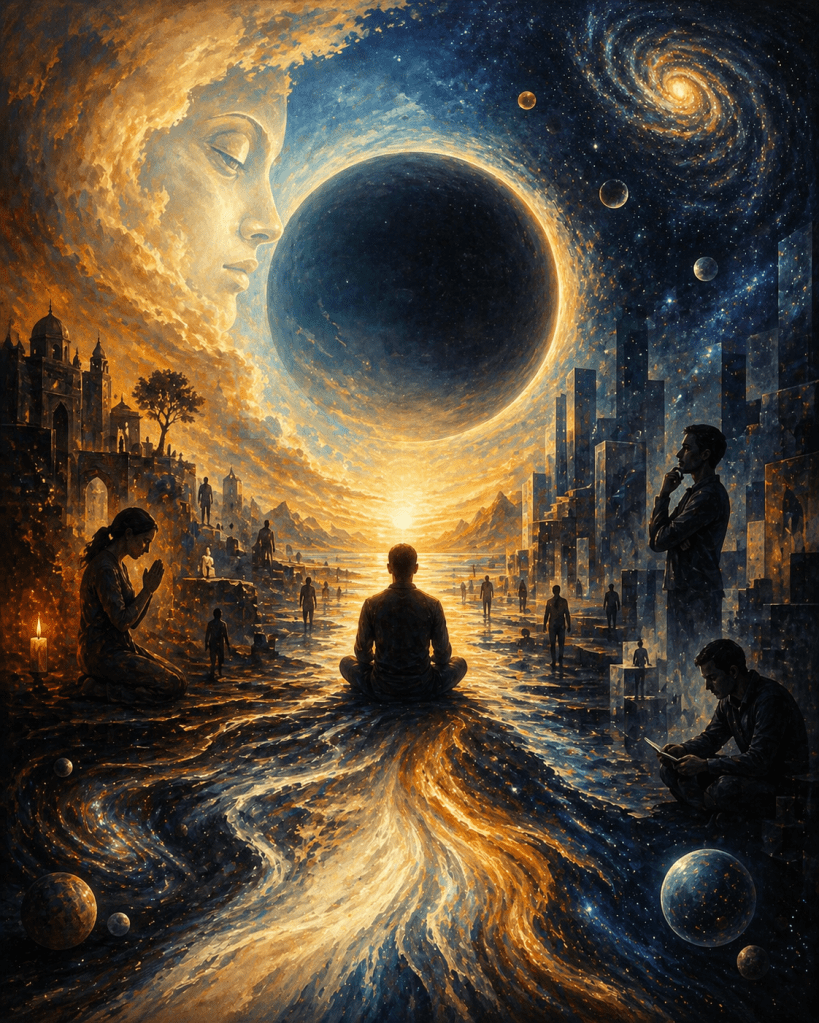
The atheist may reject a personal God while recognizing the lawful order of existence. The theist experiences a living relationship with the Divine. The monotheist discovers unity through one supreme source. The polytheist encounters the many faces of the sacred. The pantheist sees God as the universe itself. The panentheist recognizes that the universe exists within God, while God also transcends it. The dualist experiences an apparent distinction between self and reality. The nondualist awakens to the absence of all separation.

None of these perspectives are necessarily false. They become limiting only when they declare themselves to be the final word.

Reality has an extraordinary capacity to express itself through countless perspectives without ever becoming divided. Like light passing through different lenses, the same truth appears in different forms depending on the conditions through which it is perceived.

Absolute Monism does not choose one worldview over another. It includes them all without becoming confined by any of them.

At that level, every distinction dissolves. The categories no longer compete because the awareness that created the categories has been recognized as prior to them. The question is no longer which philosophy is correct. The question becomes, what remains when every concept, every belief, every religion, every denial, and every affirmation are seen as movements within the same indivisible reality?

That recognition is not another philosophy. It is the end of needing one.

The ultimate truth is not found by defending a position. It is found when every position is seen as an expression of the One that has never been divided.

Morgan O. Smith
https://linktr.ee/morganosmith

God Without Belief

A curious statement arises: God is an atheist. Not as denial, but as a revelation of what cannot be confined to belief. Belief requires distance; someone who believes, and something believed in. That distance dissolves at the level of the Absolute.

God, understood as the ground of all being, does not stand apart from existence. No position can be taken outside of what already is. Theism proclaims devotion toward a divine presence. Pantheism recognizes divinity within all forms. Panentheism holds both transcendence and immanence. Agnosticism suspends certainty. Atheism rejects the claim altogether. Each appears to oppose the other, yet all emerge from the same source.

A wave arguing with another wave about the existence of the ocean misses the quiet truth beneath the motion. The ocean never needs to assert itself. No defense is required. No belief is necessary. Presence alone is sufficient.

God, in this sense, cannot be a theist, because there is nothing separate to believe in. God cannot be an atheist either, in the conventional sense, because nothing exists outside of that totality to deny. Yet from the human vantage point, the Absolute appears as both belief and disbelief, devotion and rejection, clarity and doubt.

Atheism becomes one expression of the divine refusing to objectify itself. The refusal to project an external deity is not always a rejection of truth; sometimes it is an unconscious recognition that truth cannot be turned into an object at all. What is rejected is often a concept, not the living reality prior to concepts.

The ground of being remains untouched by every conclusion formed about it. Arguments unfold within it, philosophies rise and fall within it, identities shape themselves and dissolve within it. Nothing stands outside to validate or invalidate what already includes everything.

Silence reveals more than assertion here. That silence does not belong to any religion or ideology. It is the same stillness present before belief forms and after it fades.

What, then, is left?

A direct knowing without position. A presence without identity. A reality that does not require agreement to be what it is.

God, as the Absolute, holds space for the believer kneeling in prayer and the skeptic dismantling every claim. Both movements are gestures within the same indivisible whole. Neither completes it. Neither threatens it.

Seeing this does not demand adopting a new belief. It invites the collapse of the need to hold one at all.

And what remains cannot be called belief or disbelief; only what is, prior to both.

Morgan O. Smith