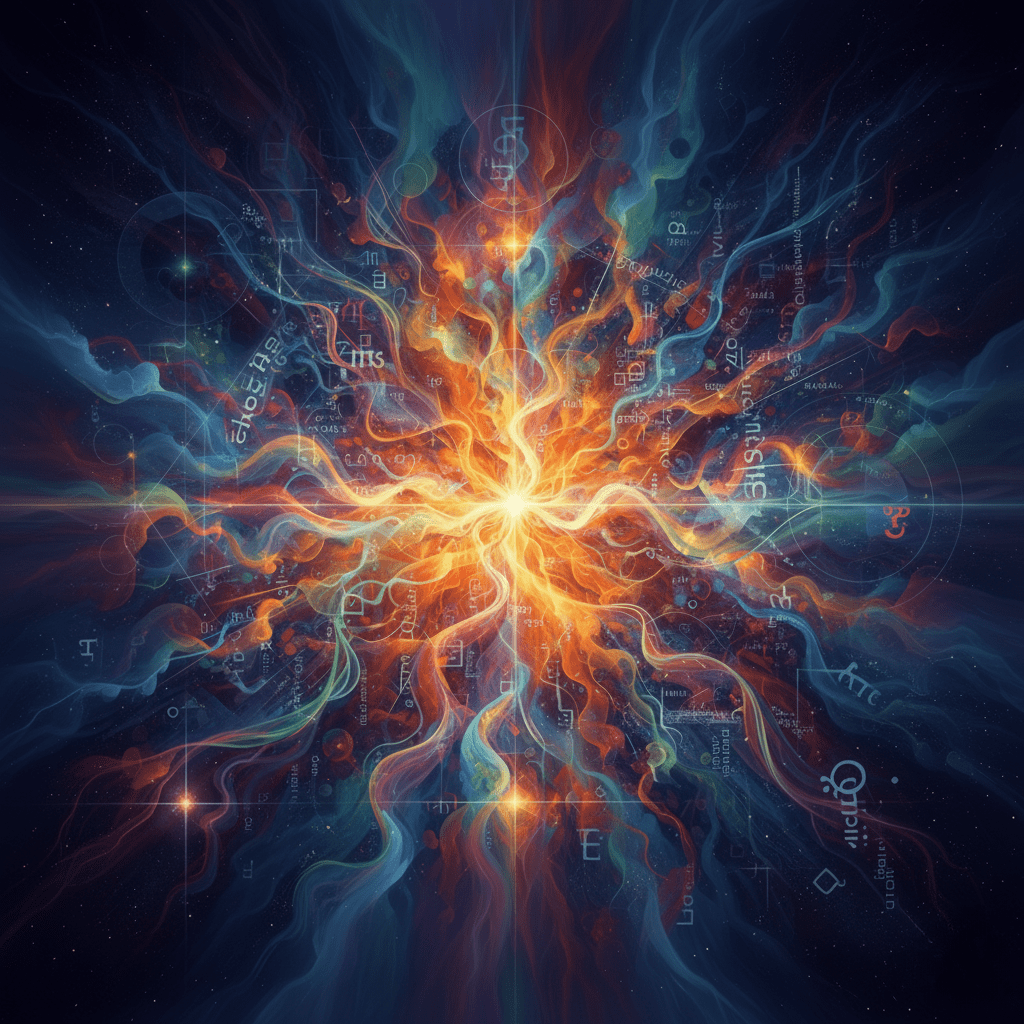
God Is the Real Imaginary

Absolute Monism and the Paradox of Reality

A peculiar clarity arises once the mind exhausts its chase for permanence. Once the striving quiets, what remains is not a revelation in the ordinary sense—it is the revelation of revelation itself. God. Not as something other, but as the very condition of knowing, being, and non-being.

God is not a person, nor a power among powers. God is context itself. Not just the backdrop, but the totality—the undivided field in which all division appears. It is what Hindus call Para Brahman: the Absolute of the Absolute. The final substratum, beyond form, formlessness, and even beyond the duality of beyond and not-beyond.

Yet the paradox defies all rational anchoring: God is also imagination.

Not a figment. Not illusion in the dismissive sense. But the supreme imagining—consciousness dreaming within itself. The universe, with all its matter and mind, all its chaos and beauty, is that imagining. And because God is not apart from its imagining, God too is that imagining.

Which means this: both God and the universe are imaginary.

And also utterly real.

What we call “real” and what we call “imaginary” collapse into a single gesture when seen from God’s standpoint—which is no standpoint at all. From this viewless view, there is no separation between the dreamer and the dream, the Absolute and its expression, the Formless and the formed.

Yet the beauty of this is not that everything dissolves into sameness. The beauty is that everything becomes itself without needing to stand apart.

God and the universe are one and the same. And because they are one and the same, they are also not the same. The distinction is not contradiction. It is the very nature of what is. Distinctness does not negate unity. It reveals it.

This is not spiritual poetry. This is ontological exactness. If anything is to be absolute, it must include even the capacity to contradict itself. That is the very mark of its absoluteness.

So, what is this that appears as a tree, a thought, a thunderclap, a kiss, a death, a silence?

It is God.
It is the universe.
It is imagination.
It is reality.

One singularity. Absolute Monism.

To see it is not to figure it out. To see it is to disappear into what cannot not be.

Morgan O. Smith

Get Your Free Copy of My Book, Bodhi in the Brain!
https://subscribepage.io/oTSZQu

The Divine Totality

Everything Is God, Even the Illusion of Not-God

There comes a moment so still and unfiltered that perception collapses into the clarity of being. Not being this or that, but being everything. And not just metaphorically. Not just poetically. Literally everything—formless and formed, seen and unseen, finite and infinite—is God.

When I use the word God, I’m not pointing toward a figure, a belief, or a doctrine. I am pointing toward existence itself—the Absolute, the Whole, Brahman, Para Brahman, the Unconditioned, conditioned, the Uncreated and created. That which includes form and formlessness, time and timelessness, birth and death, creation and dissolution, the ten thousand things and the nothing between them.

Everything is God. Not just contains God. Not just touched by God. Not just part of God. But fully and completely God. That which we call the universe is not just inside God. It is God. And God is also what lies outside the universe—if such a term can even be grasped. There is not a single thing, moment, action, or gap that is not 100% God. And yet, even the idea of “percent” breaks down in the face of such a realization.

God is not just somewhere else. God is not just merely within. God is not only beyond. God is not higher or lower or more subtle or more gross. No matter how crude or refined, every appearance is divine. Each atom, each sorrow, each beam of light, each lie, each truth, each pulse of your heart, each glitch in the system—is God being what only God can be and cannot be: itself, everywhere, nowhere, always, never been.

Multiplicity is not a contradiction, yet it is. It’s how God dances with itself. The illusion of separation is not some accident to be corrected, yet it’s that as well. It is part of the design, part of the intelligence. The appearance of duality is not a denial of oneness—it’s one appearing as two, or ten thousand. Each distinction—this object, that person, this tree, that thought—is the Absolute shimmering as particularity.

It’s easy to say this with words. The difficulty arises only when the words are taken as substitutes for seeing. Direct seeing dismantles the grip of identification. When one truly sees all of this—across dimensions, across appearances—as one singular Presence, there is no longer any question. And there is no longer any need for the question. One does not simply understand that everything is God. One is that understanding.

Yet here’s the paradox: To truly see this is also to see that none of it is God. No label can contain it. No concept can hold it. Even the word God must dissolve. Enlightenment is not just knowing this. Enlightenment is also the absence of needing to.

This is not a belief system. It is not an ideology. It is not a path with steps. This is the unteachable reality that always is. When the veil lifts—even for a moment—all questions are answered without being answered. Nothing changes, yet everything changes. One doesn’t become more spiritual. One simply stops pretending.

To recognize this is to realize: even the illusion is God. Even ignorance is God. Even the striving to awaken is God pretending to forget itself in order to remember more deeply. Even your doubt is divine. Even your forgetfulness is sacred.

You are not just a part of God. You are not just held within God. You are God. And so is everyone, everything, every grain of dust, every breath of silence, every broken thing that aches for healing.

The Absolute never needed your worship. It only waited for your recognition.

Morgan O. Smith

Get Your Free Copy of My Book, Bodhi in the Brain!
https://subscribepage.io/oTSZQu

The Journey from Singularity to Advaita

A Deep Dive into Absolute Monism

In the realm of spiritual exploration, the concepts of Nirguna Brahman and Saguna Brahman offer profound insights into the nature of existence and the essence of reality. At the heart of this journey is understanding absolute monism and its manifestations through various dimensions of being.

Absolute Monism: The Unchanging Reality

Absolute Monism posits that there is a singular, omnipresent source from which everything emanates. This source, often called Nirguna Brahman, lacks qualities or attributes. It transcends all forms and distinctions beyond the dualities of hot and cold, good and evil, or masculine and feminine. This state has no concept of time, space, or location. It is the purest form of potentiality, embodying existence and nonexistence, and serves as the ground of all being.

Nirguna Brahman: The Formless Absolute

Nirguna Brahman is the ultimate reality without form or qualities. It represents the infinite potentiality that precedes all manifestations. In this state, distinctions such as up or down, north, west, east, south, inside or outside, and time or space dissolve into a singular, undifferentiated whole. This formless absolute is the source from which all probable and improbable possibilities arise.

Saguna Brahman: The Manifestation of Qualities

From the infinite potentiality of Nirguna Brahman emerges Saguna Brahman, the aspect of the divine with qualities. This is where evolution, shape, and form come into play. It encompasses all persons, places, and things, embodying the diverse polarities that characterize the physical and metaphysical realms. Through Saguna Brahman, the infinite takes on finite forms, giving rise to the rich diversity of existence.


The Path to Advaita: Non-Dual Awareness

The journey from Nirguna to Saguna Brahman is a transition from the formless to the form. However, the ultimate realization in this journey is Advaita, the recognition of non-duality. Advaita reveals the underlying oneness of all existence, where distinctions between self and other, subject and object, dissolve. It is an awareness that transcends the dualities of Saguna Brahman, bringing one back to the infinite potentiality of Nirguna Brahman.

Exploring Other Realms and Frequencies

In the context of Advaita, other realms and frequencies are understood as different expressions of the same underlying reality. Matter and consciousness are seen as different frequencies of the same essence. This holistic perspective invites us to explore the interconnectedness of all things, recognizing the unity within the diversity.


Para Brahman: Beyond the Beyond

Beyond both Nirguna and Saguna Brahman lies Para Brahman, the supreme reality that encompasses and transcends all. It is the ultimate source of all that is and does not exist beyond all concepts and categories. Para Brahman is the final frontier of spiritual exploration, inviting us to surrender to the mystery of the absolute.

Morgan O. Smith

Yinnergy Meditation, Spiritual Life Coaching & My Book, Bodhi in the Brain…Available Now!

https://linktr.ee/morganosmith

Embracing the Infinite

Understanding Para Brahman as the Ultimate Reality

God, referred to as Para Brahman in this context, represents the absolute of all absolutes – an entity encompassing everything from the beautiful to the good, the bad, and the ugly. This concept presents a holistic view of divinity, not limited to only the positive or traditionally ‘godly’ aspects but encompassing all facets of existence.

Para Brahman, in many Eastern philosophies, particularly in Hinduism, is seen as the highest form of Brahman – the ultimate reality or cosmic spirit. This interpretation of God goes beyond the traditional Western notion of a deity who is separate from its creation. Instead, Para Brahman is seen as both immanent and transcendent, existing within and beyond all things.

This idea challenges our typical understanding of divinity and morality. It suggests that everything in existence, regardless of our human judgments of good or bad, is part of this ultimate reality. This inclusive view of the divine implies a deeper, perhaps incomprehensible, unity to all aspects of existence.


This perspective can be both comforting and disconcerting. Comforting, because it suggests a universe that is intrinsically connected and purposeful. Disconcerting, because it challenges our notions of morality and justice, blurring the lines between what we typically consider ‘good’ and ‘evil.’

Such a viewpoint can lead to a more compassionate and understanding approach to life. Recognizing that all aspects of existence, including what we perceive as negative or undesirable, are part of a greater whole, can foster a sense of tolerance and empathy. It encourages us to look beyond our immediate judgments and understand the broader context of life’s events.

However, it also raises complex questions about free will, destiny, and the nature of existence. If everything is part of Para Brahman, what does that say about individual agency and the consequences of our actions? Are good and evil just human constructs with no basis in the ultimate reality? These answers lie within.


In conclusion, viewing God as Para Brahman – the absolute of all absolutes – offers a profound and encompassing perspective on divinity and existence. It challenges our conventional views and invites us to contemplate the deeper connections and meanings of all that occurs in our lives and the universe at large.

Morgan O. Smith

Yinnergy Meditation, Spiritual Life Coaching & My Book, Bodhi in the Brain…Available Now!

https://linktr.ee/morganosmith

Embracing the Infinite

Understanding Para Brahman

In the realm of spiritual exploration and philosophical contemplation, the concept of Para Brahman stands as a profound enigma. It is a term that transcends the limits of our typical understanding, pushing us into the depths of what might be considered the ultimate reality.

Para Brahman, in its essence, is the embodiment of the formless and the infinite. It is not confined by the physical dimensions we are accustomed to, such as length, height, depth, or width. This absence of form extends beyond the physical, into the realms of emotion, thought, and even the metaphysical. It is devoid of texture, distance, time, space, feelings, emotions, senses, attachments, desires, thoughts, memories, anticipation, smell, temperature, relationships, distinctions, wants, needs, and regrets. This extensive list, however, is not exhaustive but indicative of the boundless nature of Para Brahman.

What makes this concept both intriguing and challenging is the paradox it presents. Para Brahman, while being beyond all these attributes and perceptions, simultaneously encompasses everything that has been mentioned. It is not just the absence but also the presence of all. This paradox forces us to rethink our understanding of existence and non-existence, presence and absence, form and formlessness.


How can something be everything and nothing at the same time? This question lies at the heart of understanding Para Brahman. It compels us to look beyond the dualities that dominate our everyday experiences. In this sense, Para Brahman is not just a concept but an invitation to experience reality in its most unadulterated form.

This exploration is not just an intellectual exercise but a journey toward self-realization. It challenges our deeply ingrained notions of what is real and what is illusion. By contemplating Para Brahman, we delve into a state of consciousness where the distinctions that define our usual experiences dissolve. In this state, we are neither bound by our desires nor limited by our perceptions.

The understanding of Para Brahman brings us to the cusp of spiritual awakening, where the individual self merges with the universal self. It is a state of being that many spiritual traditions aim to realize – a state of pure consciousness, unmarred by the transient nature of physical existence.


In conclusion, the concept of Para Brahman invites us to embark on a journey beyond the confines of our material and psychological limitations. It encourages us to experience the world not just through our senses and thoughts but through a profound understanding of the interconnectedness and the boundlessness of all existence.

Morgan O. Smith

Yinnergy Meditation, Spiritual Life Coaching & My Book, Bodhi in the Brain…Available Now!

https://linktr.ee/morganosmith