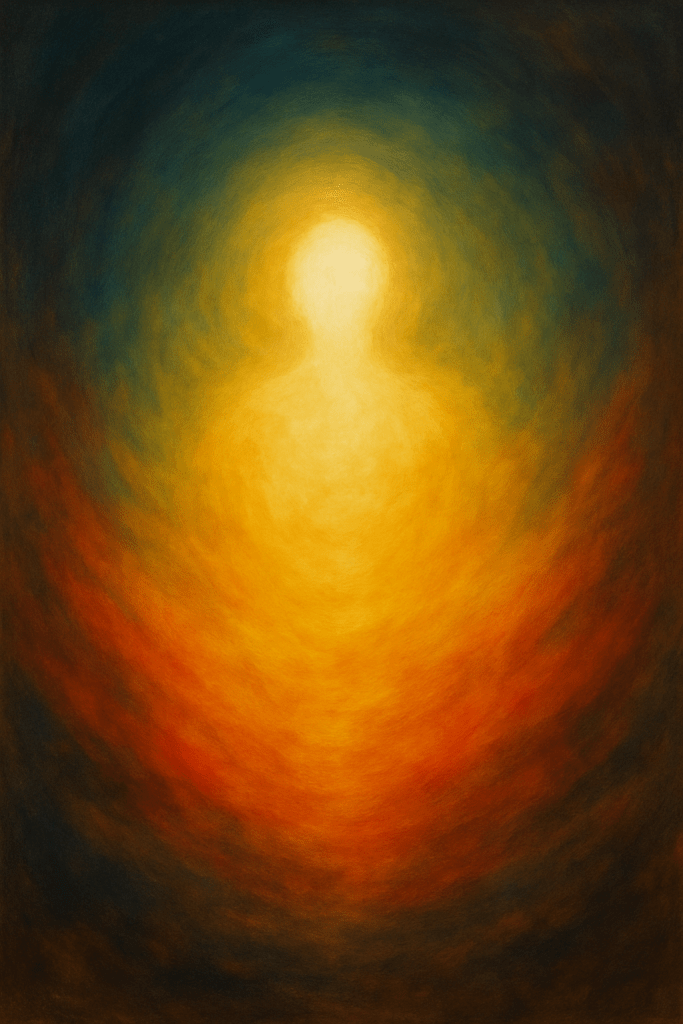
Dissolving Where Identity Once Stood

To Be Seen Fully Is to Vanish into the Infinite

To be seen fully is not to be recognized as a person, nor acknowledged as a role, but to be reflected beyond every layer of identity. When someone sees you in this way, what is recognized is not your history, your character, or even your spiritual progress; it is the unconditioned essence that lies before all stories.

Most encounters leave us clothed in roles. Friend, teacher, seeker, parent, child, each gaze places a costume upon us. Rarely do we meet eyes that do not add or subtract, but simply reveal. In that rare encounter, the ordinary scaffolding collapses, and what stands exposed is not a “self” but the infinity in which all selves appear.

This exposure is not humiliating, nor is it affirming. It is dissolving. To be seen fully is to be unmasked of both failure and success, of both sin and virtue. The illusion that we exist as a separate someone collapses. What remains is a luminous absence, the infinite without centre or edge.

There are moments when presence itself becomes the mirror, so clear, so unconditioned, that no reflection remains, only the source shining through. The eyes of one who abides in truth can serve as such a threshold. Passing through it, you do not become greater; you vanish. And in vanishing, the fullness of all that is floods through.

To long for such seeing is to long for disappearance, and yet disappearance is not annihilation. It is the end of confinement. It is the recognition that what you are cannot be held by name, cannot be fixed in form, cannot be grasped by thought. What you are is the infinite itself, already free, already whole.

The paradox is that this vanishing does not strip life of meaning but gives it immeasurable depth. When you are no longer the centre, everything becomes the centre. When “I” falls away, the song of existence sings itself without obstruction. Love, compassion, and clarity are not cultivated; they flow.

To be seen fully is to vanish into the infinite. To vanish is to return home.

Morgan O. Smith

Get Your Free Copy of My Book, Bodhi in the Brain!

https://subscribepage.io/oTSZQu

Darshan and the Living Water

Darshan is a mystery that cannot be easily captured in language. Some dismiss it as myth, others reduce it to a placebo, and still others romanticize it into doctrine. Yet none of these explanations touch what truly happens when presence itself meets you so deeply that the idea of a separate “you” begins to dissolve.

I first received darshan from Paramahamsa Vishwananda in 2019. At the time, I could not fully comprehend what had been given. The experience did not instantly transform me. It was months later, as if a seed had been quietly germinating, that a profound awakening broke open—an unshakable, full-blown realization of Parabrahman. Everything I once considered a spiritual awakening before that year became eclipsed, revealed as only stepping stones toward a wholeness beyond description.

The encounter planted something that only ripened with time. No technique, no meditation, no psychedelic journey, no years of entrainment could compare to what unfolded in those months after darshan. The practices prepared me—polished the vessel, so to speak. But Darshan was the living water that finally filled it.

On August 30, 2025, I met Paramahamsa Vishwananda in person for the fifth time. The following day, as I began to write these words, tears streamed down my face unprovoked. The intensity of the remembrance, the simple act of reflecting on what darshan has meant in my life, undid me. Not during the encounter itself, but in the quiet aftermath, when the depth of it could no longer remain unspoken.

If one insists that darshan is “only” a placebo, I embrace the word. Placebo, after all, is proof of the mind’s openness to healing, its willingness to cross thresholds it once denied. What does it matter if the mechanism is mysterious when the outcome is undeniable? The very attempt to reduce it already misses the essence: darshan is not an explanation. It is an encounter that leaves explanation behind.

My friend, comedian Marc Trinidad, has a saying: You can’t pour clean water into a dirty cup. Thousands of hours of meditation may have cleansed that vessel, yet darshan was not merely clean water—it was sparkling, living, flowing with a vitality of its own. Preparation mattered, but preparation alone never gave me the fullness that flowed after meeting his gaze.

Darshan dismantles the scaffolding of the spiritual search. Years of practice may feel like climbing a mountain, but one glance can place you at the summit. That does not make the climb unnecessary—it makes clear that the climb itself was a preparation for the recognition that you were always already there.

This is not about worshiping a figure or elevating a personality. Darshan reveals the infinite within by reflecting it so purely through one who has dissolved into that truth. In being seen, the boundaries of self blur, and what shines forth is nothing less than the source of all seeing.

Darshan cannot be mythologized away, nor can it be reduced to a placebo. It is living water—clear, inexhaustible, flowing freely into those ready to drink. And sometimes, its effects bloom long after the moment has passed, as seeds planted in silence burst open in their own time.

Morgan O. Smith

Get Your Free Copy of My Book, Bodhi in the Brain!

https://subscribepage.io/oTSZQu