Most people eventually outgrow their childhood ideas about almost everything.
Our tastes in food become more refined. Our understanding of relationships deepens. Our appreciation for music changes. Fashion evolves. Culture shifts. Even our political, moral, and philosophical views often undergo profound transformation as life teaches us new lessons.
Yet there is one idea that frequently remains frozen in time.
Paradise.
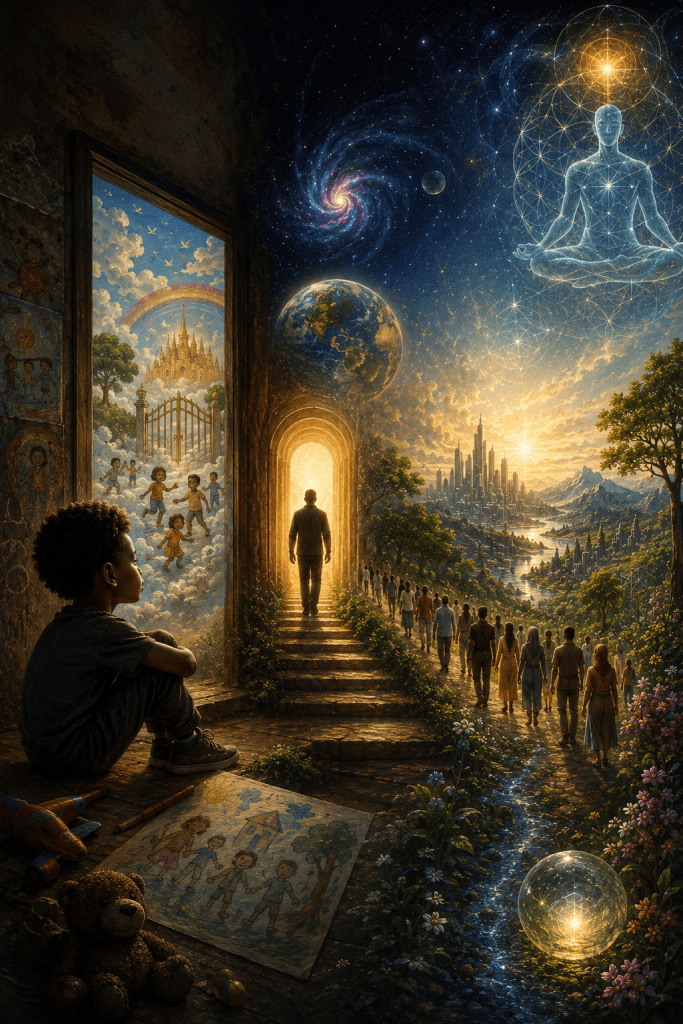
For many adults, heaven still resembles the picture they accepted as children. A beautiful place somewhere above the clouds where good people are rewarded, reunited with loved ones, and live happily forever. Although our understanding of nearly every other aspect of life matures, our image of paradise often remains untouched.
Why?
The answer may have less to do with religion than with psychological development.
Paradise Grows as Consciousness Grows
Every stage of psychological development interprets reality according to its own capacity. Paradise is no exception.
The earliest stage is concerned only with survival. Paradise simply means warmth, food, shelter, and freedom from danger.
As tribal consciousness develops, paradise becomes reunion with ancestors, spirits, and one’s people. Belonging is eternal.
The egocentric stage imagines paradise as limitless pleasure, power, success, and personal fulfillment. Heaven exists for the individual.
The mythic stage transforms paradise into a divine kingdom governed by justice. Those who obey are rewarded. Those who reject divine law are excluded. This is where many traditional religious images of heaven take shape.
The rational stage begins questioning whether heaven exists at all. Paradise may become symbolic, psychological, or simply an unanswered mystery.
The pluralistic stage opens paradise to everyone. Love replaces exclusivity. Compassion becomes more important than belief. Humanity itself becomes the family.
Integral consciousness recognizes that every previous view reflects a particular stage of development rather than an absolute truth. Paradise is increasingly understood as a way of being rather than merely a destination.
Finally, holistic consciousness dissolves the distinction altogether. Paradise is not somewhere else. Reality itself is recognized as the living expression of the Absolute.
The Expanding Circle of Identity
Our understanding of paradise also changes according to the size of our identity.
The egocentric perspective asks:
“How do I get into heaven?”
The ethnocentric perspective asks:
“Which group is chosen?”
The worldcentric perspective asks:
“How can everyone be included?”
The Kosmocentric perspective asks something entirely different.
“Who is it that seeks paradise in the first place?”
Here, the search begins to collapse.
The seeker, the destination, and the journey are all recognized as appearances within one indivisible reality.
Why Do We Stay Attached to Childhood Images?
Children require certainty.
Simple stories offer comfort in the face of death and uncertainty. Those early images become emotionally rooted long before critical thinking fully develops.
Unlike our opinions about careers, relationships, or politics, our beliefs about paradise are rarely revisited with the same willingness to question them. Religious traditions often preserve these images because they provide stability, identity, and hope.
There is nothing inherently wrong with that.
Every stage serves an important purpose.
Problems arise only when we assume that the understanding which comforted us at age five must also satisfy us at age fifty.
The Ultimate Shift
The greatest transformation may not involve discovering a better description of heaven.
It may involve recognizing that paradise was never meant to describe a location.
Perhaps heaven is a symbol pointing toward a realization.
A realization that nothing has ever existed outside the infinite.
A realization that separation was never ultimately real.
A realization that the very awareness reading these words is not traveling toward paradise.
It is the ground from which every idea of paradise has always appeared.
Perhaps the deepest question is not whether heaven exists after death.
Perhaps the deeper question is whether consciousness can awaken enough to recognize paradise before death.
If consciousness itself is the Absolute, then paradise is no longer a promise waiting in the future.
It is reality, seen without the illusion of separation.
Morgan O. Smith