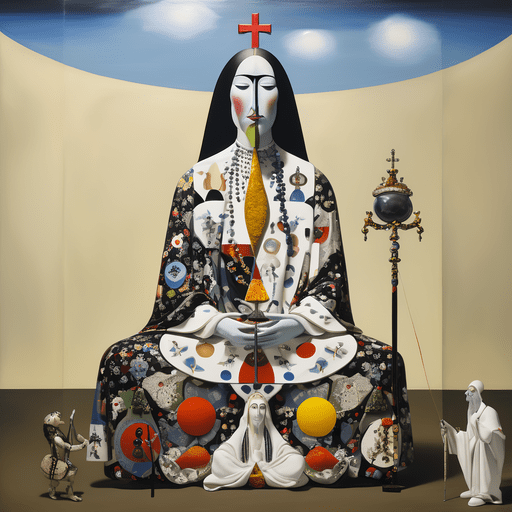
The Divine Fraud

The Hidden Reality Behind Spiritual Leaders

In the realm of spirituality, there exists a profound paradox. We often elevate spiritual gurus, admiring them from afar, or aspiring to emulate them. However, there’s a hidden truth behind these figures, one that challenges our conventional understanding of enlightenment and spiritual wisdom.

At the heart of this paradox lies the notion that these spiritual leaders are not entirely what they appear to be. Rather than being purely enlightened beings, they are, in fact, individuals who have reached a heightened state of awareness but choose to present themselves in a manner that is palatable to the masses. This disguise is not a deception borne out of malice, but rather a necessary adaptation. It stems from the understanding that the true nature of their enlightenment is beyond the grasp of the average individual, whose comprehension is bounded by societal norms and limited perspectives.

These spiritual figures have embraced a role – a caricature of what society accepts as ‘divine’. They mirror the layman’s archetype of enlightenment, embodying concepts of goodness, truth, and beauty that are digestible and appealing to the general public. This role-playing is not a sign of their failure to embody true enlightenment, but rather a testament to their deep understanding of the human psyche and the limitations of societal acceptance.


In this grand act, the enlightened beings find joy. They are not shackled by their roles but rather play them with purpose and hope. Their ultimate aspiration is not to perpetuate the illusion but to guide others to a realization – that enlightenment is not about fitting into a preconceived mould of divinity, but about understanding and transcending the limitations of our perceptions.

The divine fraud, thus, is not a deceit but a necessary guise. It is a bridge between the incomprehensible realm of true enlightenment and the tangible world in which we live. The hope is that one day, each of us will see beyond this facade, not with a sense of betrayal, but with an understanding that enlightenment is a deeply personal journey, one that transcends the need for external validation and societal acceptance.

In conclusion, the journey toward spiritual enlightenment is not about emulating a perceived ideal but about realizing the limitations of our understanding. It is about peeling back the layers of societal norms and personal biases to uncover a truth that is uniquely our own. As we navigate this path, we must remember that the spiritual guides we look up to are not just torchbearers of enlightenment but also skilled actors playing a role necessary for our journey.

Morgan O. Smith

Yinnergy Meditation, Spiritual Life Coaching & My Book, Bodhi in the Brain…Available Now!

https://linktr.ee/morganosmith

Beyond Labels

A Journey Through the Essence of Nonduality

In a world quick to cast judgment and affix labels, my exploration of nonduality has often been met with skepticism and disdain. Accusations of being “crazy,” “insane,” and “delusional” are hurled at me through social media, texts, and even face-to-face encounters. Yet, such reactions prompt me to question the very foundation of belief and perception in our society.

Consider for a moment the myriad of beliefs that have shaped human history and consciousness. How many individuals hold steadfast to the notion that the earth was crafted in seven days? Or that Eve emerged from Adam’s rib? Legends of Moses parting the Red Sea, Elijah ascending to heaven in a chariot of fire, Jonah’s survival within a whale, and the virgin birth and resurrection of Jesus Christ are not merely stories but are cornerstones of faith for countless people. These narratives, alongside the belief in entities like Satan or the practice of praying to an unseen force, might seem irrational or imaginary to some, yet they are deeply ingrained in the spiritual fabric of many cultures.


The juxtaposition of such beliefs against the skepticism faced by nonduality advocates raises a compelling question: Who, indeed, is the “crazy” one? This is not to disparage or belittle any set of beliefs but to highlight the subjective nature of sanity and rationality in the context of spiritual understanding. Nonduality, at its core, transcends the dichotomies of belief and disbelief, inviting a profound engagement with the essence of existence beyond the confines of conventional narratives.

Nonduality does not seek to undermine or replace traditional religious beliefs; instead, it offers a lens through which we might perceive unity in apparent diversity, seeing the interconnectedness of all things beyond the superficial separations imposed by language, culture, and individual perspective. It beckons us to explore the depth of our being, to recognize the intrinsic nature that we share with the universe itself.


The resistance faced by nondual perspectives is not a sign of their invalidity but a testament to their power to challenge and expand our understanding of reality. It is an invitation to dialogue, to introspection, and ultimately, to a more inclusive comprehension of the spiritual journey that encompasses all of humanity.

In embracing nonduality, we are not discarding the richness of diverse spiritual traditions but are deepening our engagement with the mystery that lies at the heart of existence. We are invited to witness the unfolding of life with an openness that transcends labels and judgments, recognizing that the true essence of spirituality cannot be confined to words or concepts.

So, as we navigate the waters of belief and skepticism, let us do so with a sense of curiosity and wonder, acknowledging that the quest for understanding is a path shared by all, regardless of the labels we may encounter along the way.

Morgan O. Smith

Yinnergy Meditation, Spiritual Life Coaching & My Book, Bodhi in the Brain…Available Now!

https://linktr.ee/morganosmith

Unveiling Reality

The Journey from Illusion to Truth

In our journey through life, we often come across what we call “illusions.” These are perceptions or beliefs that appear to be real but are not. However, the most profound realization is that these illusions are not mere deceptions; they are, in fact, Truth in disguise.

### The Nature of Illusion

An illusion, by its very nature, is something that deceives the senses or mind. It’s like a mirage in the desert – you see water, but as you approach, it vanishes, leaving you in the stark reality of the desert heat. Similarly, in life, we encounter situations that seem to be one thing but turn out to be another.

But here’s where it gets interesting. These illusions are not just errors or misperceptions. They are gateways to a deeper understanding of reality. When we delve into the nature of an illusion, we begin to uncover the layers of truth that it conceals.

### The Grand Illusion

The concept of the “Grand Illusion” takes this idea a step further. It suggests that our entire perception of reality might be an illusion. This is a theme explored in various philosophical and spiritual traditions. In Hinduism, for instance, Maya is the illusion that veils the true nature of the universe. In Western philosophy, Plato’s allegory of the cave talks about shadows on a wall that we take for reality.

The Grand Illusion is not just a deception; it is a representation of the ultimate truth, albeit in a form that we can’t immediately recognize. This truth is not something that can be easily explained or understood through conventional means. It is something that must be experienced and felt.

### Unveiling the Truth

So, how do we unveil the truth hidden behind these illusions? It begins with questioning our perceptions and beliefs. We need to look beyond what is immediately visible and ask ourselves what lies beneath. This process of inquiry and introspection leads us to a more profound understanding of ourselves and the world around us.

As we peel back the layers of illusion, we start to see the truth in its purest form. This truth might not be comfortable or easy to accept, but it is liberating. It frees us from the confines of our limited perceptions and opens us up to a universe of possibilities.


### Conclusion

The journey from illusion to truth is not a straightforward path. It’s a winding road filled with challenges and revelations. But it is a journey worth taking. For in understanding the Grand Illusion, we come closer to understanding the true nature of our existence and the universe we inhabit.

Morgan O. Smith

Yinnergy Meditation, Spiritual Life Coaching & My Book, Bodhi in the Brain…Available Now!

https://linktr.ee/morganosmith

Transcending the Mind

A Journey into the Realms of True Reality

In the labyrinth of human existence, there lies a profound truth that often remains hidden beneath layers of perception and thought: the essence of reality as it truly is, unfiltered and pure. This realization dawns only when the mind transcends its boundaries, stepping beyond the constraints of its conditioned patterns and habitual ways of thinking.

The mind, a magnificent tool for navigation in the physical world, is often shackled by its creations – thoughts, beliefs, and assumptions. These mental constructs, while useful, can also act as barriers, filtering and altering reality as it presents itself to us. The journey towards understanding true reality thus begins with a paradoxical task: using the mind to transcend the mind.

In this transcendence, one experiences a shift in perspective. What was once seen as absolute may reveal its relativity. The solid ground of ‘facts’ might turn into a dance of possibilities. This isn’t a disavowal of logic or reason, but an expansion of them. It’s an acknowledgment that reality, in its vastness, cannot be fully contained within the confines of human thought.

What emerges from this transcendental experience is a sense of profound connection. The boundaries that separate the self from the universe begin to blur. In this state, one doesn’t just observe reality; one becomes a part of it, engaged in a harmonious dance where the distinction between the observer and the observed diminishes. It’s a state where the ego dissolves, and in its place arises a sense of unity with all existence.

This journey is not about acquiring new knowledge but about unlearning what obstructs the vision of reality. It’s about silencing the incessant chatter of the mind to listen to the silence that speaks volumes. In this silence, reality reveals itself not as a concept to be grasped but as an experience to be lived.

As we embark on this journey of transcending the mind, we open ourselves to a reality that is more vivid, more alive, and infinitely more profound than our habitual ways of seeing can allow. It’s a journey from the illusion of knowing to the wisdom of understanding, from the confinement of the mind to the liberation of consciousness.

In this exploration, we find not just the essence of reality but also the essence of ourselves, as beings intrinsically connected to the vast, intricate tapestry of existence. We discover that in transcending the mind, we don’t lose ourselves; we find ourselves in everything.

Morgan O. Smith

Yinnergy Meditation, Spiritual Life Coaching & My Book, Bodhi in the Brain…Available Now!

https://linktr.ee/morganosmith


Snow as Sand

The Sahaja Perspective on Finding Paradise in the Everyday

In our spiritual journey, the quest for enlightenment often leads us down paths of deep contemplation and profound realizations. One such metaphor that encapsulates this journey is the concept of seeing snow from a blizzard as sand from a tropical paradise, a core principle of Sahaja, an ancient philosophy rooted in the pursuit of natural simplicity and spontaneous spiritual awareness.

Sahaja teaches us that the world around us, often perceived through the lenses of our preconceived notions and cultural conditioning, holds a deeper, more intrinsic beauty that is akin to paradise. This metaphor, seeing snow as sand, is not about the physical transformation of elements but a radical shift in perception. Just as snow and sand are vastly different in their physical properties, they can represent the dualities of our life experiences – cold and warm, transient and permanent, harsh and soft. However, Sahaja invites us to look beyond these dualities and see the underlying essence, which is pure, unchanging, and blissful.


This transformative perception is not an overnight occurrence but a gradual awakening. As we embark on our spiritual quest, we learn to peel away the layers of our conditioned views, much like shedding winter clothes to feel the warmth of the sun on our skin. The snow, with its cold and aloof nature, symbolizes the challenges and hardships we face in life. In contrast, sand, warm and inviting, represents the ultimate state of contentment and joy. Through Sahaja, we learn to embrace both with equanimity, understanding that paradise is not a distant land to be reached but a state of mind to be realized.

In essence, the philosophy of Sahaja teaches us that paradise is all around us, waiting to be discovered in the mundane, the ordinary, and even in the challenges. It is in the laughter of a child, the quietude of a snowy night, the resilience of a blooming flower in the desert, and the vastness of a starlit sky. It reminds us that every moment is an opportunity to experience the divine, to see the extraordinary in the ordinary.


As we journey through life, let us remember that the snow is also sand, and in every grain of our experiences, paradise awaits. This realization is the essence of Sahaja – seeing the world not as it appears, but as it truly is, an endless expanse of beauty, joy, and peace.

Morgan O. Smith

Yinnergy Meditation, Spiritual Life Coaching & My Book, Bodhi in the Brain…Available Now!

https://linktr.ee/morganosmith

Mirrors of the Self

Seeing the Divine in All

In the vast expanse of existence, each entity and every moment is a reflective surface, giving us a glimpse of our deepest selves. When we peer into the world, what we encounter is not just matter arranged in space but a mosaic of mirrors, each offering a unique reflection of who we are. The idea that everything we perceive is a reflection of our face is not just a poetic sentiment but a profound philosophical proposition that invites introspection about the nature of self and the universe.

The reflections we see are not literal but abstract, distilling our essence in the myriad forms and phenomena around us. This abstraction is where the beauty of perception lies; it is a canvas where the mind can project its inner workings—its hopes, fears, and dreams. The world outside becomes a screen for the drama of the self to unfold, the grand play of consciousness where every actor wears a mask that resembles something within us.

In this grand reflection, if we are to see the face of God, then it must be understood that this divine visage is not an entity separate from us but interwoven into our being. The divine reflection is the totality of the cosmos itself, a unity where every face is indeed an aspect of a greater countenance. If we are made in the image of the divine, as many traditions suggest, then it follows that the divine is also made in the countless images reflected to us.

Every interaction, every glance at nature, every piece of art, and every human invention is a facet of this divine reflection. We are constantly in dialogue with the divine through the medium of our experiences. In recognizing this, we might come to treat each moment with reverence, understanding that in the act of observation, we are participating in a sacred exchange.

As we walk through the world, let us consider that the beauty, the ugliness, the sublime, and the mundane are all part of the same tapestry, woven with threads of the divine. It is not just in the extraordinary that we can glimpse the face of God, but in the ordinary, the overlooked, and the understated. By recognizing the divine reflections in all that we encounter, we open ourselves to a more profound sense of connection and purpose.

In the end, the philosophy that everything is a reflection of our face does not isolate us in solipsism but connects us to a greater whole. It offers a vision of unity, where the self is not an isolated entity but a vibrant echo of the universe, a reflection of the divine face in the mirror of existence.

Morgan O.  Smith

Yinnergy Meditation & My Book, Bodhi in the Brain…Available Now!

https://linktr.ee/morganosmith

The Perfect Symphony of the Universe

There’s a profound beauty in pondering the vastness of the universe and all that it encompasses. The stars, the galaxies, the black holes, the planets, and everything in between – all orchestrated in an unfathomable cosmic dance. Closer to home, even the simple rustling of leaves or the intricate patterns of relationships and human behaviours are a part of this grand tapestry. But what if every single occurrence, no matter how significant or inconsequential it seems, is exactly as it should be?

Imagine a world where every event, every interaction, every impulse, and every action has its place and purpose. No occurrence is out of place; everything fits. There is a certain harmony, an intrinsic order in this idea. Even the most chaotic and seemingly random events play their part in this universal symphony.

It’s easy to look at experiences that cause us pain or challenge our perceptions and label them as ‘bad’ or ‘wrong’. However, by doing so, are we not resisting the natural flow of the universe? If we embrace the belief that everything is as it should be, we free ourselves from the constraints of judgment, regret, and resistance. Instead, we can find peace in acceptance, growth in challenges, and a deeper understanding of the intricate balance of life.

This perspective also brings forth a realization about our role in this vast cosmos. We are not mere spectators; we too are playing our part perfectly. Whether we’re undergoing personal growth, facing challenges, or simply experiencing the highs and lows of life, each of our actions and decisions is a note in the universal song.

It’s not about labelling events as ‘good’ or ‘bad’ but rather seeing the bigger picture. Understanding that pain might lead to growth, challenges can result in strength, and every experience is a lesson in disguise. It’s about trusting that the universe, with its boundless wisdom, is unfolding exactly as it should, with every piece, no matter how big or small, contributing to its magnificent design.

In closing, consider this: If everything in the universe is as it should be, then every moment is an opportunity. An opportunity to learn, to grow, to love, and to embrace the perfect imperfections of this cosmic journey.

Morgan O.  Smith

Yinnergy Meditation & My Book, Bodhi in the Brain…Available Now!
https://linktr.ee/morganosmith

The Paradox of Perfection

Ground of All Being and Maya

The universe, in its vastness and complexity, brings forth a myriad of questions that have perplexed thinkers across generations. One of the most profound concepts to grapple with is the nature of reality itself. Within the philosophical tapestry, two concepts emerge with force and subtlety: the “Ground of All Being” and “Maya”.

**Ground of All Being**

The Ground of All Being is an abstract principle suggesting that there exists an ultimate foundation or source for everything in existence. This ground isn’t a tangible thing but a concept – the idea that there’s an underpinning, unchangeable reality beneath the mutable surface of life. This can be likened to the depths of an ocean where calmness reigns, contrasting with the choppy waves on the surface.

**Maya: The Illusion**

Hailing primarily from Eastern traditions, particularly Hinduism, Maya is the term that describes the world as we see it: a world of illusion, impermanence, and change. Maya doesn’t suggest that the world is fake, but that our perceptions and understandings are limited, sometimes deceiving us from the true nature of reality.

**The Paradox of Perfection**

At a glance, it seems paradoxical: How can a universe so perfect birth what is perceived as imperfection? The beauty of this conundrum is that perfection and imperfection are inherently subjective, shaped by our limited human perceptions and conditioned understandings.

Perhaps the universe is so intricately and impeccably designed that it incorporates imperfection as part of its perfection. Much like a symphony that uses dissonance to make the harmonious notes shine brighter. The imperfections, the fleeting moments, the transient joys and sorrows – they all serve a purpose. They make the canvas of life more prosperous, pushing us to question, seek, and understand.

Imperfections are not flaws but opportunities: windows into deeper layers of understanding, growth, and realization. When we confront Maya, we’re not battling falsehoods but navigating layers of reality, slowly inching closer to the Ground of All Being.

**In Conclusion**

The journey from Maya’s illusion to the Ground of All Being isn’t a path of renunciation, but one of realization. Realizing that the imperfections we see, feel, and experience are not mere aberrations, but intrinsic facets of a grand design. They challenge us, shape us, and push us closer to understanding the paradoxical nature of existence: that within perfection lies imperfection and within imperfection, an underlying, unchanging perfection.

Morgan O. Smith

Yinnergy Meditation & My Book, Bodhi in the Brain…Available Now!

https://linktr.ee/morganosmith

The Dance of Consciousness

How Traits and States Influence Each Other

Introduction:
In the realm of philosophy and neuroscience, the nature of consciousness has long been a subject of intense scrutiny. As we delve into the complex interplay between traits of consciousness and states of consciousness, we embark on a thought-provoking journey that explores how these facets of our mind shape and are shaped by each other.

Part I: The Essence of Traits of Consciousness
Traits of consciousness refer to the enduring qualities and patterns that define an individual’s cognitive, emotional, and behavioural makeup. These traits form the bedrock of one’s personality, shaping how they perceive the world, process information, and interact with others. From introversion to openness, resilience to empathy, traits of consciousness provide a unique lens through which individuals experience their existence.

Part II: Unraveling States of Consciousness
States of consciousness, on the other hand, are transient and ever-changing mental conditions. These states can range from heightened awareness during moments of meditation or creative inspiration to altered states induced by substances or intense emotional experiences. States of consciousness are like ripples on the surface of a vast ocean, reflecting our immediate perceptions and inner states.

Part III: The Bidirectional Influence

At first glance, it might appear that traits and states of consciousness operate independently. However, upon closer examination, we discover the profound bidirectional influence they exert on each other.

1. Traits Shaping States:

Our enduring traits of consciousness lay the foundation for how we perceive and react to various states. For instance, a highly empathetic individual might experience deeper connections with others during states of heightened compassion or love. Similarly, a person with a predisposition to anxiety may be more prone to states of distress during challenging situations.

2. States Shaping Traits:

The fluidity of consciousness states can leave lasting imprints on our traits. Profound transformative experiences, such as spiritual awakenings or near-death encounters, can lead to significant shifts in an individual’s personality and worldview. Moreover, states like mindfulness and meditation can foster positive traits like patience and self-awareness.

Part IV: The Dance of Consciousness
As the dance unfolds, we realize that consciousness is not static but rather a dynamic process, constantly in flux. Traits and states intertwine, shaping and reshaping one another in an intricate and evolving dance.

Conclusion:
The relationship between traits and states of consciousness is a fascinating exploration of the human mind’s complexity. Acknowledging this interconnectedness can empower us to cultivate positive traits while embracing the ebb and flow of transient states. As we embrace the intricacies of our consciousness, we embark on a journey of self-discovery, leading us to a deeper understanding of ourselves and the world around us. Remember, we are not merely passive observers of our consciousness; we are active participants in its unfolding story.

Morgan O. Smith

Yinnergy Meditation & My Book, Bodhi in the Brain…Available Now!

https://linktr.ee/morganosmith

The Unfolding Symphony

Embracing Life through an Open Heart

Introduction: In the grand theatre of existence, our hearts play a central role in the symphony of human experience. To navigate the depths of life’s mysteries, we must learn the art of keeping our hearts open. A profound approach to achieving this lies in the act of wholeheartedly accepting and embracing everything we encounter – the sights, sounds, scents, flavours, and textures – as intrinsic aspects of ourselves. This philosophical journey explores the transformative power of openness, inviting us to delve into the essence of existence and cultivate a profound connection with the world around us.

  1. Embracing the Multitude of Perspectives: To keep the heart open, we must acknowledge the multitude of perspectives that shape our reality. Each experience we encounter is coloured by our unique perceptions, and no two individuals experience the world in exactly the same way. By embracing the diversity of viewpoints, we unlock the potential for genuine empathy and understanding, fostering an inclusive and compassionate society.
  2. Surrendering to the Flow of Life: Life’s tapestry weaves an intricate pattern of joy and sorrow, triumph and defeat. Embracing an open heart requires us to surrender to the natural ebb and flow of existence without resistance. When we stop trying to control or manipulate life’s course, we find solace in the understanding that every experience is a teacher, guiding us towards growth and self-discovery.
  3. Liberating the Self from Ego: The ego often entangles our hearts in a web of desires, fears, and judgments. To truly embrace life as an extension of ourselves, we must transcend the ego’s limitations and recognize the interconnection between all living beings. Letting go of the attachment to the “self” allows us to dissolve the illusion of separateness and discover a profound sense of unity with the universe.
  4. Cultivating Radical Acceptance: Radical acceptance is the key to unlocking the transformative power of an open heart. By embracing everything we encounter – the pleasant and the challenging, the familiar and the unfamiliar – as essential aspects of our journey, we learn to dance gracefully with life’s ever-changing rhythms. Embracing all facets of existence deepens our capacity for resilience and enriches our human experience.
  5. Living with Gratitude: Gratitude is a sacred gateway that opens our hearts to the splendour of life. Embracing a sense of profound gratitude for each moment, we begin to see life’s wonders with fresh eyes and a receptive heart. Gratitude is the beacon that leads us to treasure even the seemingly mundane, unveiling the beauty hidden within the folds of everyday life.

Conclusion: Keeping the heart open is an ethereal quest that unravels the essence of our existence. By accepting and embracing every encounter, we transcend the boundaries of self and connect with the universal tapestry of life. Embracing diverse perspectives, surrendering to life’s flow, and liberating ourselves from the ego’s grasp elevate us to a higher plane of consciousness. Through radical acceptance and gratitude, we find profound meaning in the ordinary and glimpse the extraordinary in the ordinary. Let us embark on this philosophical journey, keeping our hearts open to the wonders that life has to offer, and savouring the grand symphony of existence in all its magnificence.

Morgan O. Smith

Yinnergy Meditation & My Book, Bodhi in the Brain…Available Now!

https://linktr.ee/morganosmith