The Shadow of the Absolute

Absolute reality is often imagined as pristine, untouched by fracture or contradiction. Spiritual language tends to elevate the ground of all being into something luminous, serene, and eternally harmonious. Yet such portrayals can become subtle distortions, projecting human preferences onto what cannot be reduced to preference at all.

A paradox emerges the moment one considers totality without exception. That which includes everything cannot exclude darkness. Absolute wholeness does not merely contain light; it also contains the conditions for obscurity, confusion, and dissolution. Darkness is not an error within the whole but a necessary expression of completeness.

Perception recoils from this idea because it challenges the instinct to divide existence into sacred and profane. Thought longs for a purified origin, a source untouched by contradiction. Reality, however, refuses such simplification. A ground that generates multiplicity must also generate polarity. Shadow is not a flaw in the absolute; shadow is the evidence that nothing has been left out.

Mystical insight sometimes reveals a luminous unity, a direct recognition that all forms arise from a single boundless presence. Such experiences carry a sense of purity and peace. Yet stabilization of that recognition requires a deeper maturity: the willingness to acknowledge that the same boundlessness also births terror, ignorance, and fragmentation.

Resistance to this insight often leads to spiritual bypassing. Individuals cling to transcendence while denying the darker textures of existence. Absolute realization does not erase complexity. Genuine awakening expands capacity to embrace the full spectrum of being without retreating into selective idealization.

A universe that manifests stars also manifests collapse. Consciousness that illuminates truth also generates illusion. Absolute reality stands prior to judgment, neither endorsing nor rejecting the movements arising within it. Shadow becomes a teacher rather than an adversary once this is understood.

Human life mirrors this cosmic structure. Personal development frequently involves confronting suppressed aspects of identity. Integration replaces avoidance. Clarity emerges through engagement rather than denial. Recognition of one’s own shadow deepens reverence for the vast intelligence that allows contradiction to coexist.

Absolute reality remains unbroken even while appearing fragmented. Darkness does not diminish the ground of being; it reveals its radical inclusivity. True spiritual maturity rests upon this recognition: wholeness requires nothing less than everything.

Morgan O. Smith
Beyond Imitation

When Enlightenment Is Mistaken for Personality

History remembers spiritual figures as icons, not as enigmas. Reverence crystallizes their lives into models to be copied rather than mysteries to be understood. Over time, enlightenment becomes entangled with biography. Traits that belonged to a particular body–mind are elevated into universal prescriptions.

Such confusion gives rise to a subtle distortion. One person’s temperament becomes another’s discipline. A preference becomes a vow. A condition becomes a doctrine. Devotees inherit fragments of behavior and assume they are inheriting truth itself. Institutions form around this misunderstanding, reinforcing the illusion that realization can be standardized.

Consider how easily abstinence, dietary habits, or psychological dispositions are mistaken for signs of awakening. An enlightened being may express through a quiet demeanor or intense rigor, yet neither silence nor intensity constitutes realization. Personality remains a vessel. Enlightenment is not defined by what that vessel contains.

Questions deepen when examining what might be labeled today as mental disorder or neurological variance. Practices born from clarity may appear indistinguishable from compulsions when observed through the lens of clinical interpretation. Conversely, compulsions may be sanctified when clothed in sacred language. The boundary between pathology and transcendence becomes blurred by interpretation rather than direct insight.

Playing the skeptic reveals a paradox. Spiritual traditions may preserve genuine transmissions of truth while simultaneously embedding cultural assumptions and psychological projections. Followers then chase appearances rather than essence, mistaking echoes for origin. Rituals multiply. Dogmas ossify. Authentic realization becomes obscured beneath layers of imitation.

Direct experience dismantles this confusion. Recognition dawns that enlightenment does not conform to behavioral templates or moral archetypes. Awareness reveals itself as the ground of all appearances, untouched by characteristics attributed to the enlightened individual. Personal expression arises from conditioning, biology, context, and circumstance. Realization neither requires nor rejects these variables.

A moment of true seeing dissolves the need to emulate. What once seemed external becomes unmistakably intimate. Every form, thought, sensation, and condition reveals itself as inseparable from the same boundless essence. Even the impulse to categorize enlightenment as virtue or disorder dissolves into a wider recognition.

Existence itself appears as a dynamic expression of a single indivisible presence. Labels fade. Distinctions soften. What remains is a knowing beyond concepts, untouched by cultural framing or psychological interpretation. Enlightenment ceases to be an achievement or identity. It becomes the simple recognition of what has always been.

Such recognition liberates the seeker from imitation. Spiritual maturity unfolds not through copying another’s life but through discovering the source from which all lives arise. When this is seen, the notion of following a template loses relevance. Only clarity remains, revealing that every expression, sacred or mundane, emerges from the same unbounded reality.

Morgan O. Smith

Freedom Within Identification

Attempts to dismantle identification often become another subtle strategy of identification. The effort itself reinforces the one who is trying to escape. What actually transforms experience is not the reduction of bias or judgment, but clear recognition that bias and judgment are occurring. Awareness does not erase the movement of mind; awareness reveals it.

Mind evaluates. Mind categorizes. Mind reacts. Such functions belong to its design. A deeper dimension remains untouched by those operations. That dimension does not oppose the mind, nor attempt to purify it. Silent witnessing simply illuminates what unfolds.

Moments of awakening sometimes arrive with overwhelming clarity. Identification dissolves, yet experience continues. No boundary remains between observer and observed, yet perception still functions. Such glimpses demonstrate a truth that later integrates into lived reality. Peak illumination offers insight; maturation transforms insight into stability.

Gradual integration reshapes the relationship with identity. Layers fall away without force, guided by ongoing recognition. Ego continues its role as a generator of form, narrative, and orientation. Awareness does not eliminate ego; awareness contextualizes it. Form becomes expression rather than prison.

Attachment has long been described as the seed of suffering. Another dimension exists within that same principle. Attachment also creates continuity, warmth, belonging, and coherence. Pleasure and pain arise from the same ground. Human experience oscillates across a spectrum that includes both. Heaven and hell manifest through perception, circumstance, and interpretation, rather than distant metaphysical destinations.

Escape from the spectrum intensifies struggle. Unconscious immersion perpetuates distress. Acceptance introduces a different movement: a willingness to meet existence as it appears. Acceptance does not romanticize suffering, nor cling to comfort. Acceptance recognizes the inevitability of cycles.

Samsara refers not only to rebirth across lifetimes. Samsara unfolds through biological rhythms, emotional tides, cultural dynamics, social realities, and economic fluctuations. Each domain participates in patterns of emergence, dissolution, and renewal. Cells regenerate. Identities evolve. Conditions transform.

Total liberation from these cycles cannot occur while embodiment persists. Yet insight can reveal a dimension untouched by cyclical change. Awakening discloses a freedom that coexists with limitation. Temporary realization becomes the doorway to enduring equanimity.

Pain, pleasure, loss, gain, exhaustion, vitality—each appears as modulation within a larger field of being. Recognition of that field softens resistance. Suffering loses its compulsive urgency. Beauty becomes perceptible even through difficulty.

Freedom does not require the absence of attachment. Freedom emerges through understanding that attachment never defined the essence of what one is. Identity remains operational, yet no longer absolute. Life continues with all its contrasts, while awareness rests as the unbound ground of experience.

Morgan O. Smith

The Paradox That Refuses to Break

For something to exist, it must appear somewhere. It must occupy a location, unfold across duration, relate to other things. Existence, as we commonly understand it, implies coordinates. A chair exists because it sits in space. A thought exists because it arises in time. Remove both, and what remains?

Many insist that the Divine transcends time and space. Yet transcendence poses a riddle. If something is truly beyond time and space, can it be said to exist at all? Existence, in every familiar sense, depends upon dimension, sequence, and relation. To be entirely outside those would seem to cancel the very idea of being.

Then comes the reversal.

If we claim the Absolute does not exist because it is beyond all coordinates, we still must ask: does nonexistence exist? The mind hesitates here. Nonexistence cannot be located, yet we speak of it. We conceive of absence. We reference nothingness. Somehow, even nothing appears within awareness.

Awareness does not vanish when an object disappears. When a sound fades, silence remains. When a thought dissolves, presence does not dissolve with it. Even the concept of “nothing” shows up as something known.

So what is happening?

Perhaps the difficulty arises from assuming that existence and nonexistence are opposites. That assumption belongs to a world of contrast—light and dark, birth and death, form and formlessness. But what if both poles arise within a deeper continuity?

Consider this possibility: the Divine exists as time and space. Every galaxy, every heartbeat, every passing second is not a creation separate from its source but an expression of it. The ticking clock is not evidence of distance from God; it is God measuring itself through movement. The extension of space is not apart from the Infinite; it is the Infinite stretching.

Yet the same reality is not confined to its expressions. Time unfolds within it, but it is not bound by succession. Space extends within it, but it is not limited by boundary. That which appears as the flow of moments is also the stillness in which moments arise.

From this vantage point, saying “God exists” is true. Saying “God does not exist” is equally true, if by existence we mean a definable object among other objects. The Absolute cannot be reduced to a thing inside the universe. Nor can it be excluded from the universe.

Existence and nonexistence collapse into a single indivisible fact: there is what is.

When the mind tries to categorize this, it fractures the whole into manageable concepts. It invents a creator separate from creation. It imagines a being located somewhere, ruling from a distance. Or it swings to the opposite extreme and denies any sacred dimension at all.

Both moves miss the intimacy of the matter.

The search for a name is the movement of the Infinite through a finite lens. Every label—God, Brahman, Source, Reality, Void—is a gesture. The gesture matters, but it never contains what it points toward.

You are not separate from this paradox. The very awareness reading these words is evidence of it. Thoughts move across your inner sky, yet something remains unmoving. Identity shifts across years, yet something does not age. The body occupies space and time, yet the sense of being here precedes every clock.

Perhaps what we call “God” is existence recognizing itself as both the field and the forms within it. Both the silence and the symphony. Both the presence of things and the apparent absence of them.

Existence does not need to choose between being and non-being. That choice belongs to the intellect.

What remains when even that choice dissolves?

Only this—undivided, immediate, self-knowing.

Call it what you will.

It is already what you are.

Morgan O. Smith

The One That Evolves as All Things

Evolution is not a mechanism operating on the sidelines of existence. It is existence unfolding itself.

What we call species, stars, civilizations, identities—these are gestures within a single, restless current. The river does not evolve because of what flows within it. The river is the flowing. Likewise, evolution is not something life does. It is what life is.

Birth, death, and rebirth appear as events in time, yet they are movements within a larger continuity that never begins and never concludes. A body forms. A body dissolves. Patterns reorganize. Consciousness shifts perspective. The wheel turns, not because something is trapped, but because turning is the expression of its nature.

This turning is named samsara.

Samsara is often framed as bondage, a cycle to escape. Yet who is bound? The forms are bound to change. The identities are bound to dissolve. The narratives are bound to fracture. But the underlying vitality—the raw fact of being—remains untouched by the rise and fall of its own expressions.

Here lies the paradox: the same movement that appears as entanglement is also freedom.

Moksha is not found outside the cycle. It is not a reward waiting at the end of repetition. Liberation is present as the very openness in which repetition occurs. The wave may crash, reform, and crash again, but water is never confined by the shape it temporarily assumes.

Evolution births forms and dissolves them. It experiments through biology, culture, thought, and self-awareness. It creates the seeker and the path. It invents philosophies about progress and enlightenment. Then it outgrows them. Then it reinvents them.

Every collapse is also a refinement.

Every ending is also a clarification.

The living whole is not striving toward perfection. It is exploring possibility. What appears as suffering is often the friction of transformation. Structures resist their own impermanence. Systems cling to stability. Identities defend continuity. Yet change is not violence; it is revelation.

Look closely and another layer becomes visible: evolution itself is not separate from what it evolves. The sculptor and the sculpture are the same movement. The cosmos is not building something other than itself. It is discovering its own depth through contrast.

Freedom and bondage coexist because the dance requires both tension and release.

A human life embodies this paradox intimately. You are shaped by memory, conditioning, language, and biology. You are also the spacious awareness within which those forces arise. Bound as a personality. Free as presence. Caught in stories. Unmoved as the field in which stories appear.

Samsara is the play of differentiation.

Moksha is the recognition that nothing has ever been outside the whole.

Evolution, then, is not merely survival or adaptation. It is the continuous unveiling of what was never absent. It moves from matter to mind, from instinct to reflection, from fragmentation to integration—not to escape itself, but to experience itself more fully.

Birth and death are punctuation marks in an unbroken sentence.

Rebirth is not only literal or metaphysical. Every shift in understanding is a rebirth. Every relinquished identity is a small death. Every expansion of compassion is an evolutionary leap that leaves no fossil record, yet alters the interior landscape of the world.

This living totality is not trapped in its cycles. It is expressing through them.

The wheel turns. The centre remains still.

Both are true at once.

Morgan O. Smith

Nothing but Now

The here and now is not a slice of time.
It is the field in which time pretends to move.

Past does not trail behind. Future does not wait ahead. Both appear as thoughts, sensations, anticipations, and memories, arising where they can only arise: here. The idea of sequence is constructed after the fact. Experience itself never leaves immediacy.

What is called “the present” is often mistaken for a fleeting moment squeezed between before and after. That assumption quietly fractures reality. What is actually happening has no edges. The now does not pass. What passes are the images that claim it did.

Presence does not arrive. It does not deepen. It does not evolve into something higher. Presence is what allows the language of arrival, depth, and evolution to appear at all. Searching for it only reinforces the illusion that it could be absent.

Awareness is not standing inside time watching it flow. Time appears within awareness, as a pattern of reference, not as a container. Memory points backward. Anticipation points forward. Both gestures occur in the same openness, uninterrupted.

The sense of being a someone located here, experiencing a world out there, is another event happening now. It does not stand apart from presence. It is presence, temporarily shaped as a viewpoint.

Nothing needs to be held onto. Nothing needs to be returned to. The insistence on staying present assumes the possibility of leaving it. That possibility has never been demonstrated.

What remains when the effort to be here dissolves is not a special state. It is ordinary beyond description. Breathing happens. Thought happens. Meaning happens. All of it without a manager.

Presence has no memory of itself. It does not need continuity to exist. Forever is not a duration stretching forward; it is the absence of any point where presence could fail to be.

This is not an insight to keep.
It is what is already doing the keeping.

Morgan O. Smith

Nothing Stands Outside What Already Is

Nothing stands outside what already is.
That includes the observer, the question, the doubt, and the need for resolution.

The search for an outside position is subtle. It hides beneath inquiry, improvement, and even awakening. A sense lingers that something must be reached, clarified, or corrected from a vantage point just beyond experience. Yet no such position exists. There is nowhere to stand apart from what is happening.

Experience does not unfold within a container called reality. Experience is reality expressing itself as appearance, interpretation, and response. The idea of separation arises as one of those appearances, not as evidence of an actual boundary.

Thought suggests distance. It imagines a thinker facing a world, awareness looking at objects, a self navigating conditions. This suggestion feels convincing because it repeats. Repetition gives the impression of structure. Structure gives the illusion of independence.

Nothing has ever been observed from outside what already is. Even the claim “I am separate” appears within the same field it attempts to deny. Opposition does not escape wholeness; it demonstrates it.

The urge to step beyond arises from discomfort with immediacy. Presence offers no leverage, no control panel, no hierarchy. Everything shows up equally entitled to exist; clarity and confusion alike. The mind prefers a higher ground. Reality does not provide one.

This does not collapse meaning. It releases the demand that meaning point somewhere else. Significance no longer depends on transcendence. What matters does so because it appears, not because it leads elsewhere.

Nothing needs to be included, because nothing was excluded. Nothing needs to be unified, because division was conceptual. Difference remains, but it no longer implies fracture. Distinctions function without claiming independence.

Every perspective contributes without completing the whole. No single angle owns truth. No framework escapes limitation. Each reveals something precisely because it cannot reveal everything.

There is no final position to arrive at. No outside reference point to secure certainty. What remains is simple and unremarkable: this, exactly as it is, without appeal or resistance.

Nothing stands outside what already is—
and nothing needs to.

Morgan O. Smith

Get Your Free Copy of My Book, Bodhi in the Brain!

https://subscribepage.io/oTSZQu

You Are the Void

You are the void surrounded by your own self as substance, brought forth by its own thinking, shaped by its own thoughts.
Not as symbolism. Not as spiritual ornamentation. Simply as a description of what is already occurring before interpretation.

Substance feels dense because thought lingers. Thinking slows openness into shape, then convinces itself the shape possesses independence. Solidity is an effect of attention held too tightly. The void does not interfere. Allowance is enough for appearance to unfold.

Creation does not originate with matter. A quieter shift precedes it—the faint suggestion of separation. Something entertains the idea of being something rather than everything. That subtle narrowing gives rise to form, continuity, memory, and the felt position of a self observing from somewhere.

The void is not just empty. Emptiness would imply absence. What exists here is freedom from insistence. No preference. No correction. When thought moves, substance organizes. When thought loosens, substance reveals its temporary nature.

Identity feels heavy because repetition gives it mass. Familiar thoughts replayed long enough acquire gravity. The mind labels this accumulation “me.” The void registers movement, nothing more.

Nothing requires removal. Nothing asks to be fixed. Recognition alone softens what once appeared solid. Structure relaxes into responsiveness. Boundaries become functional rather than absolute.

Silence does not depend on quiet. Silence appears when thought releases its claim to authorship. Experience continues, but no longer points back to a controller or witness standing apart.

The void never hides behind form. Form arises within it and borrows its apparent stability from sustained attention. When attention eases, what remains cannot be framed as presence or absence. Language fails because nothing is missing and nothing needs to appear.

No final claim can be made. No definition holds without collapsing into another. What happens does so without explanation. What appears does not require justification. Everything stands exactly as it is.

Nothing here can be stated as what it is or what it is not. Nothing explains how this occurs. Perspectives arise according to position, history, and capacity, each contributing its angle without canceling another. No single view completes the picture. Together, they form what cannot be reduced to parts.

Truth does not belong to one standpoint. Wholeness expresses itself through difference, not despite it.

Morgan O. Smith

Get Your Free Copy of My Book, Bodhi in the Brain!

https://subscribepage.io/oTSZQu

When Nothing Stands Above

How Can God Be a Higher Power When God Is Existence Itself?

Calling God a higher power quietly smuggles a ladder into reality. Someone stands below. Something stands above. Distance appears. Direction appears. Hierarchy sneaks in through language before thought has a chance to question it.

Yet if God is the only thing that exists, hierarchy collapses on contact.

A higher power implies comparison. Comparison requires at least two things. God plus something else. Creator plus creation. Observer plus observed. The moment this split is accepted, God becomes an object among objects, merely larger, stronger, or more authoritative than the rest. That version of divinity is impressive, but it is no longer ultimate.

Existence itself has no altitude.

If God is existence, then nothing stands outside it. No vantage point remains from which God could be viewed as higher or lower. The phrase higher power only makes sense from the perspective of a self that imagines itself separate, small, and contained. God appears higher because the self has first imagined itself as lower.

This is not a moral error. It is a perceptual one.

Power suggests force applied across distance. God-as-existence does not apply force. It does not act upon reality. It is reality acting as everything it appears to be. Gravity, breath, thought, confusion, devotion, resistance, clarity—all equally arise as expressions of the same indivisible field.

Nothing is empowered by God. Everything is empowered as God.

The need for a higher power often emerges from vulnerability. Humans face uncertainty, loss, fear, and finitude. A transcendent overseer offers comfort. Guidance feels safer when imagined as descending from above. Yet this comfort depends on separation. God must be elsewhere in order to rescue from here.

Nonduality removes the rescue narrative entirely.

What remains is intimacy without hierarchy. God is not watching life unfold. God is unfolding as life. No supervision. No intervention. No cosmic management style. Just continuous self-expression without a centre.

Prayer then shifts meaning. It no longer reaches upward. It settles inward, outward, everywhere at once. Not a request made to a higher authority, but a softening of resistance to what already is. Devotion becomes alignment rather than submission.

When God is understood as existence itself, the word higher loses relevance. Nothing can be higher than everything. Nothing can be closer than what is already happening.

God is not above you.

God is what is looking through your eyes, questioning the very idea of above and below.

Morgan O. Smith

Get Your Free Copy of My Book, Bodhi in the Brain!

https://subscribepage.io/oTSZQu

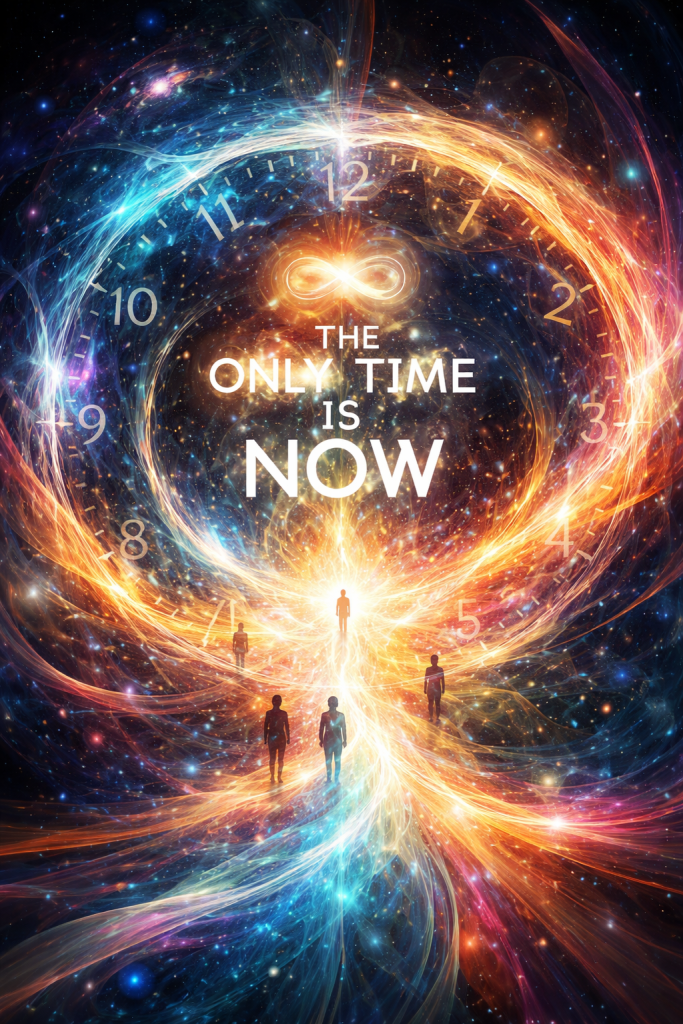
The Only Time Is Now

Something subtle hides behind every assumption about life.
We speak of beginnings, endings, origins, destinies, memories, plans. Language slices reality into segments and calls the slices time. Past. Present. Future.

Direct experience never confirms this division.

Look carefully.

No one has ever stepped into yesterday.
No one has ever arrived at tomorrow.
Everything that has ever appeared shows up only as this immediate presence.

Not a moving present.
Not a fleeting instant.

A boundless, indivisible now.

Mind imagines a line stretching backward and forward, yet perception offers no such line. Thought tells stories about what was and what will be, but those stories arise as present thoughts. Memory occurs now. Anticipation occurs now. Even the idea of history unfolds now.

Remove thought for a moment and see what remains.

Only this.

A beginningless display with no edge to trace.
An endless unfolding with nowhere to land.

Nothing truly starts. Nothing truly stops.

Birth and death appear as transitions inside perception, not events happening to existence itself. Waves rise and fall, yet water never begins or ends with any single wave. Every form behaves the same way. Appearance comes and goes. Being does not.

Cause and effect seem separate only because mind arranges events into sequence. First this, then that. Push, then response. Action, then consequence.

Observe more closely.

Cause and effect share the same instant.
The spark and the flame are one movement.
Seed and tree are different names for one process.

Nothing travels through time to produce something else. Everything co-arises. Each moment contains the totality.

That means creation and destruction are not opposite forces.

They are the same gesture.

Every perception is simultaneously appearing and disappearing. Each sight is born as it fades. Each sound vanishes as it arrives. Reality recreates itself continuously without carrying anything forward.

World dissolves and reforms faster than thought can measure.

Continuity is a useful illusion.

Life becomes lighter when this is recognized. Regret loses its grip because there is no past to fix. Anxiety softens because there is no future to secure. Control relaxes because nothing stands outside the present to manage.

Responsibility remains, yet it feels different. Actions arise from clarity rather than fear. Choices flow from immediacy rather than projection. Compassion deepens because everything shares the same timeless ground.

Nothing stands apart.

Every face, every event, every challenge expresses the same indivisible happening.

No separate moment waits elsewhere.
No hidden realm holds another version of reality.

This is it.

Not a fragment.
The whole.

Eternity does not stretch forever.
Eternity reveals itself as what never moves.

Right here.
Right now.
Always.

Morgan O. Smith

AI for Wellness and Spirituality Summit

February 9 & 10, 2026

https://aiforwellnessandspirituality.com/mosm