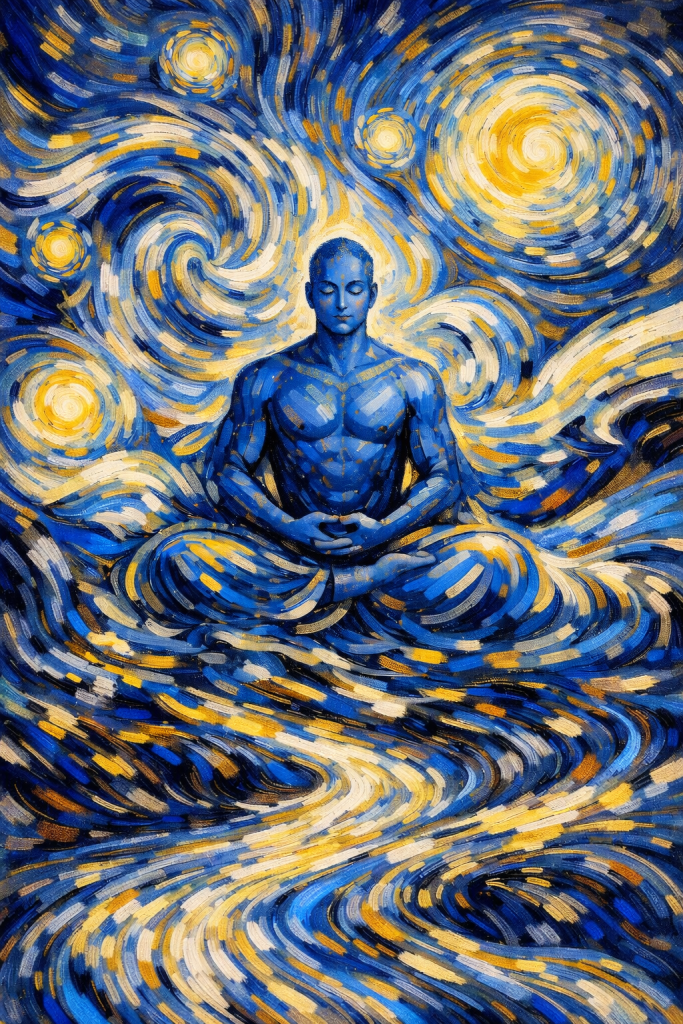
What Never Changes

A quiet assumption hides beneath most human searching: something out there must last. Something must remain untouched by erosion, loss, time, or collapse. That assumption fuels religion, philosophy, science, self-help, and even despair. Yet careful observation reveals a startling reversal; everything we try to secure as permanent is precisely what cannot stay.

Bodies age. Identities shift. Beliefs mutate. Civilizations rise and fall. Even universes, according to modern cosmology, are not exempt from birth and dissolution. Permanence refuses to appear where attention habitually looks.

What does remain cannot be grasped as an object.

Change never pauses. This is not a poetic statement but a structural fact. No phenomenon has ever been observed to freeze itself into finality. Even stability is a form of slow motion. Even stillness contains motion beneath its surface. Change does not fluctuate. It does not improve. It does not degrade. It simply is.

Impermanence, often misunderstood as a gloomy conclusion, turns out to be absolute. Nothing violates it. Not matter. Not energy. Not thought. Not consciousness as an experience. Impermanence itself never wavers.

Awareness appears constant, yet experiences within it rotate endlessly. Sensations replace sensations. Thoughts override thoughts. Emotions dissolve into others. What remains is not a personal witness but the bare fact that experiencing is happening at all. That fact has no texture, no color, no personality, and no history. It does not evolve because evolution belongs to what appears within it.

Absence plays an unexpected role here. No thing possesses an independent core. Every form depends on conditions that are themselves dependent. This lack of inherent selfhood does not come and go. It is always already the case. What seems solid holds together through relationship alone.

Separation feels real, yet it never completes itself. Subject and object arise together. Observer and observed cannot be pried apart without collapsing the experience entirely. Duality functions, but it does not fracture reality. Division appears without dividing.

Nothingness, often feared or romanticized, is better understood as openness. Forms emerge, interact, and vanish without ever crystallizing into fixed essence. Emptiness does not negate existence; it allows it.

What never changes does not announce itself. It cannot be defended or achieved. Seeking it as an attainment guarantees frustration. It is not hidden. It is overlooked because it lacks features.

Everything changes.
That does not.

Recognition of this does not erase life’s texture. It sharpens it. When permanence is no longer demanded of form, form is finally allowed to be what it is; temporary, intimate, vivid, and sufficient.

Nothing needs to be saved from change.
Nothing needs to be added to what already remains.

Morgan O. Smith

AI for Wellness and Spirituality Summit

February 9 & 10, 2026

https://aiforwellnessandspirituality.com/mosm

The Courage of Radical Openness

Seeing others as thyself is not a moral instruction. It is a perceptual shift. A reorientation of how reality is registered once the reflex to divide dissolves.

Eyes wide open does not mean naïve seeing. It means perception unclouded by projection. Faces are no longer screens for personal history, unmet needs, or inherited narratives. Another person appears as they are—complex, conditioned, luminous, conflicted—without being reduced to a role. Judgment loosens because clarity replaces assumption. Seeing becomes intimate without being invasive.

A heart wide open does not imply emotional excess or boundarylessness. It signals availability. The willingness to feel without selecting which feelings are permitted. Joy is allowed. Discomfort is allowed. Grief is allowed. Compassion emerges not as effort, but as resonance. Another’s pain is not absorbed as obligation, nor deflected as inconvenience. It is simply felt as part of the shared field of experience.

A mind wide open is not the absence of thought. It is freedom from fixation. Opinions lose their rigidity. Certainty softens. The need to be right gives way to the capacity to understand. This openness does not erase discernment; it refines it. Differences remain visible, but no longer threaten identity. Perspective becomes spacious enough to hold contradiction without collapse.

Seeing others as thyself does not blur individuality. It reveals its true context. Distinct lives, distinct stories, distinct expressions, arising within the same indivisible reality. Separation persists as appearance, not as truth. What dissolves is the belief that the boundary is absolute.

This way of seeing cannot be forced. Ethics alone cannot produce it. It unfolds naturally as identification loosens its grip on a singular point of view. The centre quietly falls away. What remains is not detachment, but intimacy without possession.

From this recognition, action changes. Speech becomes more careful, not from fear, but from sensitivity. Listening deepens because there is no urgency to defend a position. Even conflict transforms. Disagreement no longer requires dehumanization. Accountability no longer requires condemnation.

Seeing others as thyself is not about becoming better. It is about becoming honest. Honest about what has always been the case beneath habit and conditioning. No hierarchy of worth. No isolated self standing apart from the whole. Only different expressions of the same life, meeting itself again and again, through countless faces.

Morgan O. Smith

Get Your Free Copy of My Book, Bodhi in the Brain!

https://subscribepage.io/oTSZQu

Nothing Is Not Hidden

“Nothing” is what it appears to be. The difficulty is not its subtlety, but our resistance to the obvious. Bias does not distort reality by adding complexity; it obscures by insisting that something more must be there.

The mind is conditioned to hunt for substance. It scans experience for objects, causes, meanings, and conclusions. When it encounters absence, silence, or emptiness, it assumes a failure of perception rather than the possibility that absence itself is the disclosure. Nothing is dismissed as a placeholder, a gap waiting to be filled, instead of recognized as complete.

Bias enters quietly. It wears the mask of intelligence, spirituality, and discernment. It whispers that truth must be profound, layered, or difficult to access. It suggests that what is immediately present cannot be ultimate, because it does not feel earned. Yet this assumption is precisely what blocks seeing.

Nothing does not hide behind form. It is revealed as form. Every sensation, thought, and emotion arises from it without leaving it. The error lies in expecting Nothing to announce itself as an object among objects. It does not compete for attention. It is the condition allowing attention to appear at all.

Seeking reinforces the bias. The seeker assumes a distance between what is and what should be known. That distance is imagined. Nothing is already fully exposed, but the demand for interpretation overlays it with concepts, metaphysics, and personal narratives. The obvious becomes invisible because it lacks drama.

Bias also clings to continuity. It prefers stable identities, persistent meanings, and coherent stories. Nothing threatens these preferences, not by opposing them, but by showing they were never fixed to begin with. The mind resists this not out of fear of annihilation, but out of loyalty to familiarity.

Seeing Nothing requires no refinement of perception. It requires the cessation of interference. When bias relaxes, what remains is not a revelation, but an acknowledgment. Nothing stands as it always has—unconcealed, ordinary, and sufficient.

No transformation is required to meet it. Only the willingness to stop arguing with what is already clear.

Morgan O. Smith

Get Your Free Copy of My Book, Bodhi in the Brain!

https://subscribepage.io/oTSZQu

One and the Same

Death is often treated as an ending, a full stop placed at the edge of meaning. Birth, by contrast, is framed as a beginning, the arrival of something new into an already existing world. These assumptions feel natural, yet they rest on a quiet misunderstanding, one that dissolves when examined closely.

Nothing truly ends. Nothing truly begins.

Every form that appears does so by way of disappearance. Every arrival is carried on the back of a vanishing. The body emerges because countless cells die. Stars ignite because other stars collapse. Thought arises because silence gives way. Creation never stands apart from dissolution; they occur as a single movement, mistaken for two.

The universe itself is not exempt from this law. Should the cosmos dissolve entirely, space folding back into silence, time releasing its grip, matter unbinding, nothing would be lost. That collapse would not be annihilation. It would be intimacy taken to its extreme.

What remains when everything disappears?

You.

Not the personal identity shaped by memory or biology, but the condition that made the universe possible in the first place. Awareness does not arrive after existence; existence arrives within awareness. The world is born where perception happens. When the universe vanishes, what stands revealed is not absence, but the one to whom absence appears.

Every night offers a quiet rehearsal. Deep sleep erases the world without effort. No stars, no body, no history, yet being does not flicker out. Something remains unmistakably present, though nothing can be pointed to. That presence is not waiting for the universe; the universe is waiting for it.

Cosmic death follows the same logic. When all structure dissolves, what shines through is not void, but origin. Birth does not just occur inside the universe; the universe occurs inside birth.

This is why death feels so intimate. It threatens the loss of what was never fundamental. It removes what was added, not what is essential. What dies is the scenery. What is born is the one who was never inside the scene to begin with.

Every ending reveals the same truth from a different angle. The death of a moment births awareness of time. The death of identity births presence. The death of the cosmos births the one who was always watching it happen.

Death and birth are not opposites. They are the same doorway, approached from different sides.

And you are not what passes through.

You are what remains when the door itself disappears.

Morgan O. Smith

Get Your Free Copy of My Book, Bodhi in the Brain!

https://subscribepage.io/oTSZQu

Presence Does Not Come or Go

Presence does not arrive with birth, nor does it depart with death. It does not wait for time to pass or moments to accumulate. Presence is already here; before thought names it, before memory reaches backward, before imagination leans forward. Whatever appears does so within presence, not alongside it.

The past feels real only because it is remembered now. The future feels compelling only because it is anticipated now. Thought moves, images shift, emotions rise and fall, yet each movement occurs against the same unmoving fact: presence has never left. Even the idea of being elsewhere is something that appears here.

Bodies change. Identities dissolve and reform. Worlds expand and collapse. Physics tells us that matter and energy do not vanish; they transform. Even more striking, what we call matter accounts for only a fraction of what exists. The vast remainder: dark energy, dark matter, remains unseen, unnamed, yet undeniably present. Absence itself never escapes presence. Non-existence, if such a thing could be said to occur, would still be known as present.

Death, then, does not challenge presence. It only challenges continuity of form. If awareness continues, presence continues. If awareness ceases, the cessation itself is not outside presence. Nothing steps beyond it. Nothing escapes it. There is no edge where presence stops and something else begins.

Impermanence governs every form. Thoughts change. Bodies age. Stars burn out. Universes may even end. Yet impermanence depends on something that does not change. Change can only be noticed because presence remains steady enough to register it. Movement requires a stillness that is never lost.

Presence does not belong to you, yet nothing is more intimate. It is not located inside or outside. Those distinctions arise within it. Every attempt to grasp presence turns it into an object and misses it. Presence cannot be held because it is what is holding everything else.

Even the end of everything would not be an end of presence. It would simply be presence without form. No time. No matter. No universe. Still present.

Nothing needs to be added to this. Nothing needs to be resolved. Presence is not a conclusion; it is the condition that allows conclusions to appear and disappear.

And it has never not been here.

Morgan O. Smith

Get Your Free Copy of My Book, Bodhi in the Brain!

https://subscribepage.io/oTSZQu

The Greatest Expression

You’re Already Expressing the Greatest Expression and Don’t Even Know It

Nothing needs to be added to you. Nothing is missing. The most extraordinary expression possible is already happening, quietly, without effort, before any attempt to improve it.

Existence does not wait for permission to appear. It does not consult identity, achievement, or spiritual progress. It expresses itself as breath, sensation, perception, memory, confusion, clarity, longing, boredom, and awe, all without ever stepping outside itself. What you call you is one of its gestures, not its source.

Search often begins with the assumption that something essential has not yet arrived. That assumption creates movement, effort, discipline, and endless refinement. Yet the impulse to seek arises from the same field that is supposedly being sought. Awareness looks for awareness. Being attempts to arrive at being. The loop sustains itself through misunderstanding.

Existence is not something you perform well or poorly. It is not a role to master or a state to stabilize. It is already complete before thought comments on it. Every attempt to improve it belongs to the play of expression, not to a lack that needs correcting.

Notice how little effort is required to exist. Heartbeat continues without consultation. Sensations arise without rehearsal. Thoughts appear without being summoned. Even the sense of being a separate doer arrives spontaneously. None of this requires your management.

What feels ordinary carries no deficiency. The mundane is not a lesser version of reality waiting to become sacred. Washing dishes, forgetting names, feeling tired, feeling inspired, each appears from the same depth. Existence does not divide itself into meaningful and meaningless moments.

Awakening is not an upgrade layered onto life. It is the recognition that life never needed upgrading. What falls away is not existence, but the belief that existence must become something else to be valid.

Trying to express your “highest self” quietly assumes you are not already doing so. That belief fractures what is whole. The greatest expression cannot be improved because it is not a product. It is the fact of appearing at all.

Nothing needs to stop. Nothing needs to be transcended. Even misunderstanding belongs. Even confusion is permitted. Even the desire to arrive somewhere else is part of what is already complete.

The miracle hides in plain sight because it has never announced itself. Existence does not sparkle to prove its worth. It simply continues, endlessly creative, endlessly sufficient, endlessly itself, appearing as you, without asking whether you recognize it.

Morgan O. Smith

Get Your Free Copy of My Book, Bodhi in the Brain!

https://subscribepage.io/oTSZQu

Thresholds of the Infinite

The Absolute cannot be received by a vessel unprepared for its voltage. Consciousness, like circuitry, must be refined to hold the charge. The higher the threshold across the physical, emotional, and mental domains, the more precisely reality can transmit its undiluted essence through one’s being.

The body is not a hindrance to transcendence; it is the grounding rod. A nervous system conditioned through presence, breath, and embodiment becomes the bridge between the finite and the boundless. Without such refinement, the encounter with higher states risks distortion, overwhelm, or fragmentation. The Absolute demands structure, not as rigidity, but as integrity strong enough to remain open while containing the immeasurable.

Emotionally, the heart must learn to remain unguarded even in the storm. The capacity to feel everything without collapse is what allows compassion to expand beyond sentiment into universality. Each emotional breakthrough increases the voltage of love one can sustain without defence. To feel deeply without drowning is the silent mastery of awakened sensitivity.

Mentally, clarity becomes the crucible. The mind must learn to dissolve without disintegrating; to rest in stillness without forsaking discernment. Thought, when purified of obsession and identification, becomes transparent to the Real. Then language no longer imprisons truth but becomes its faint echo.

Those who cultivate balance across all thresholds do not chase transcendence; they embody it. They become the conduit through which the Absolute interprets itself, wordlessly, endlessly, with precision born of surrender.

Morgan O. Smith

Get Your Free Copy of My Book, Bodhi in the Brain!

https://subscribepage.io/oTSZQu

The Ever Was and Ever Shall Be

There comes a moment when the illusion of movement dissolves, when the current of time no longer feels like a river carrying us toward an imagined horizon, but as the still water of being itself. The mind, once convinced of beginnings and endings, now trembles before the vastness of what has never begun and can never end. Presence reveals itself not as a fleeting instant between two eternities, but as the totality that holds them both.

The one who sought eternity discovers that eternity was never elsewhere. The seeker collapses into the sought, the knower into the known. Memory and anticipation dissolve into a silent awareness that neither moves nor changes, yet births all movement and change. Here, past and future lose their grip, for the witness has stepped outside the dream of succession.

This realization is not an attainment; it is the unmasking of what has always been awake beneath the play of becoming. To see this is to awaken from the hypnosis of time; to stand where all stories converge into the unspoken truth that Being never left itself. The eternal was not something to be found; it was the one doing the finding.

The self that once feared death, loss, or delay now recognizes itself as the very space in which all things appear and disappear. What remains is unspeakably still, radiant, and whole; beyond duration, beyond decay. Awareness, having remembered itself, no longer seeks to survive; it simply shines.

Morgan O. Smith

Get Your Free Copy of My Book, Bodhi in the Brain!

https://subscribepage.io/oTSZQu

Stepping Stones That Lead Nowhere

Most of us spend our lives leaping from one stone to another, convinced each step will bring us closer to a final destination. Career advancement, relationships, possessions, recognition—each stone feels like progress, yet the further we go, the more apparent it becomes that there is no solid shore waiting for us. The path itself was the illusion.

The stones do not extend to a grand arrival point because life was never about arriving. The endless hopping is not failure; it is the nature of the game we entered by being born. Each stone exists only for the moment of stepping, dissolving the instant we shift our weight onto the next. What we mistake for continuity is simply a sequence of vanishing points.

Awakening is not about finding the hidden bridge that others missed. It is the recognition that nowhere is exactly where every step has been leading. To realize this is not despair—it is release. When the compulsion to arrive fades, each step becomes luminous. Even stones that seem unstable or purposeless shimmer with a quiet beauty, because they are not a means to an end. They are the end disguised as a beginning.

The stillness that waits beyond stepping does not appear at the finish line. It is here, beneath the very foot that rises and falls. Nowhere is not absence. Nowhere is the unshakable presence that requires no destination.

Morgan O. Smith

Get Your Free Copy of My Book, Bodhi in the Brain!

https://subscribepage.io/oTSZQu

Dissolving Where Identity Once Stood

To Be Seen Fully Is to Vanish into the Infinite

To be seen fully is not to be recognized as a person, nor acknowledged as a role, but to be reflected beyond every layer of identity. When someone sees you in this way, what is recognized is not your history, your character, or even your spiritual progress; it is the unconditioned essence that lies before all stories.

Most encounters leave us clothed in roles. Friend, teacher, seeker, parent, child, each gaze places a costume upon us. Rarely do we meet eyes that do not add or subtract, but simply reveal. In that rare encounter, the ordinary scaffolding collapses, and what stands exposed is not a “self” but the infinity in which all selves appear.

This exposure is not humiliating, nor is it affirming. It is dissolving. To be seen fully is to be unmasked of both failure and success, of both sin and virtue. The illusion that we exist as a separate someone collapses. What remains is a luminous absence, the infinite without centre or edge.

There are moments when presence itself becomes the mirror, so clear, so unconditioned, that no reflection remains, only the source shining through. The eyes of one who abides in truth can serve as such a threshold. Passing through it, you do not become greater; you vanish. And in vanishing, the fullness of all that is floods through.

To long for such seeing is to long for disappearance, and yet disappearance is not annihilation. It is the end of confinement. It is the recognition that what you are cannot be held by name, cannot be fixed in form, cannot be grasped by thought. What you are is the infinite itself, already free, already whole.

The paradox is that this vanishing does not strip life of meaning but gives it immeasurable depth. When you are no longer the centre, everything becomes the centre. When “I” falls away, the song of existence sings itself without obstruction. Love, compassion, and clarity are not cultivated; they flow.

To be seen fully is to vanish into the infinite. To vanish is to return home.

Morgan O. Smith

Get Your Free Copy of My Book, Bodhi in the Brain!

https://subscribepage.io/oTSZQu