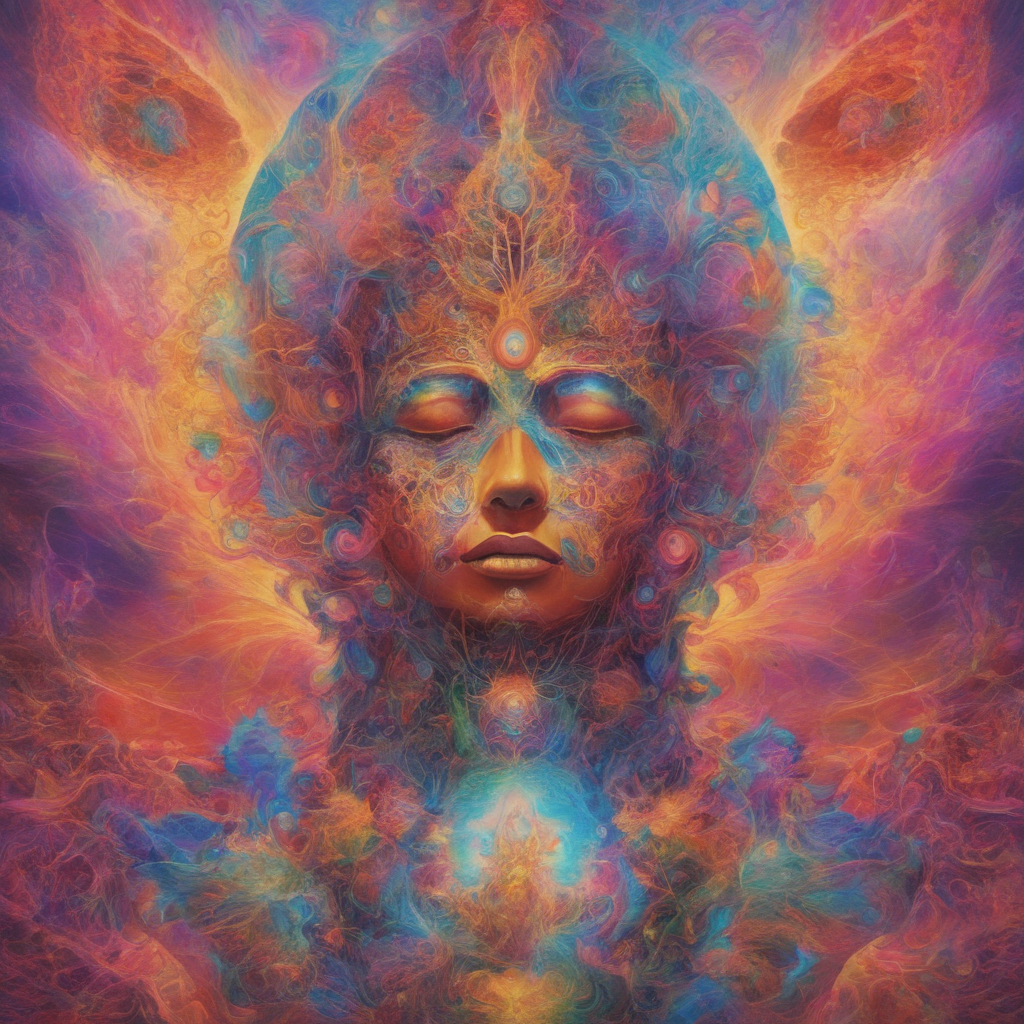
Darshan and the Living Water

Darshan is a mystery that cannot be easily captured in language. Some dismiss it as myth, others reduce it to a placebo, and still others romanticize it into doctrine. Yet none of these explanations touch what truly happens when presence itself meets you so deeply that the idea of a separate “you” begins to dissolve.

I first received darshan from Paramahamsa Vishwananda in 2019. At the time, I could not fully comprehend what had been given. The experience did not instantly transform me. It was months later, as if a seed had been quietly germinating, that a profound awakening broke open—an unshakable, full-blown realization of Parabrahman. Everything I once considered a spiritual awakening before that year became eclipsed, revealed as only stepping stones toward a wholeness beyond description.

The encounter planted something that only ripened with time. No technique, no meditation, no psychedelic journey, no years of entrainment could compare to what unfolded in those months after darshan. The practices prepared me—polished the vessel, so to speak. But Darshan was the living water that finally filled it.

On August 30, 2025, I met Paramahamsa Vishwananda in person for the fifth time. The following day, as I began to write these words, tears streamed down my face unprovoked. The intensity of the remembrance, the simple act of reflecting on what darshan has meant in my life, undid me. Not during the encounter itself, but in the quiet aftermath, when the depth of it could no longer remain unspoken.

If one insists that darshan is “only” a placebo, I embrace the word. Placebo, after all, is proof of the mind’s openness to healing, its willingness to cross thresholds it once denied. What does it matter if the mechanism is mysterious when the outcome is undeniable? The very attempt to reduce it already misses the essence: darshan is not an explanation. It is an encounter that leaves explanation behind.

My friend, comedian Marc Trinidad, has a saying: You can’t pour clean water into a dirty cup. Thousands of hours of meditation may have cleansed that vessel, yet darshan was not merely clean water—it was sparkling, living, flowing with a vitality of its own. Preparation mattered, but preparation alone never gave me the fullness that flowed after meeting his gaze.

Darshan dismantles the scaffolding of the spiritual search. Years of practice may feel like climbing a mountain, but one glance can place you at the summit. That does not make the climb unnecessary—it makes clear that the climb itself was a preparation for the recognition that you were always already there.

This is not about worshiping a figure or elevating a personality. Darshan reveals the infinite within by reflecting it so purely through one who has dissolved into that truth. In being seen, the boundaries of self blur, and what shines forth is nothing less than the source of all seeing.

Darshan cannot be mythologized away, nor can it be reduced to a placebo. It is living water—clear, inexhaustible, flowing freely into those ready to drink. And sometimes, its effects bloom long after the moment has passed, as seeds planted in silence burst open in their own time.

Morgan O. Smith

Get Your Free Copy of My Book, Bodhi in the Brain!

https://subscribepage.io/oTSZQu

The Subtle Distinction

Peak Experiences vs. Spiritual Awakening

The landscape of spiritual growth is vast and often misunderstood. Many conflate spiritual peak experiences with spiritual awakening, yet these are distinct phenomena. A spiritual peak experience, whether catalyzed by meditation, psychedelics, or moments of profound awe, is an intense, fleeting encounter with an elevated state of consciousness. While these moments can feel transformative, they are often temporary and lack the enduring shift in perception that characterizes a true awakening.

A spiritual awakening, in contrast, is a fundamental reorientation of one’s inner world. It is not simply about feeling interconnected or glimpsing higher states of being—it is about a deep, unshakeable realization that dissolves the boundaries of self, often leaving the individual profoundly changed. This shift is challenging to articulate and even harder to cultivate intentionally.

When someone describes an extraordinary experience induced by psychedelics, they are often recounting a peak experience. These moments may break through the ordinary, offering glimpses of unity or clarity, yet they seldom transcend into awakening. Psychedelics can open doors, but walking through them—truly integrating the lessons into a lasting transformation—is a rarer and more demanding process.

True awakening can occur with or without external aids, but it is exceedingly rare. It arrives unbidden, often accompanied by profound shifts in understanding and perception. Unlike peak experiences, awakening isn’t just a momentary insight—it is an enduring transformation of consciousness. Moreover, even fewer awakenings culminate in spiritual enlightenment, a state of being that transcends duality entirely.

Enlightenment, often romanticized, is not an experience but the dissolution of the experiencer. It is the culmination of awakening, where the distinction between self and other evaporates, and one rests fully in the infinite. However, reaching this state requires not only grace but profound surrender and integration over time.

The journey between peak experiences, awakening, and enlightenment is a spectrum. Each step has value and serves a purpose, yet conflating these stages can obscure the nuances of spiritual growth. Understanding these distinctions invites us to approach the path with humility and clarity, appreciating the profound while striving for the transcendent.

Morgan O. Smith

Yinnergy Meditation, Spiritual Life Coaching & My Book, Bodhi in the Brain…Available Now!

https://linktr.ee/morganosmith

Ego Death

A Symphony of Sense and Surrender into the Nondual Existence

The ego, a fortress of our individuality, a custodian of our senses, crumbles during a profound psychological event termed ego death. This process, which is akin to crossing the Rubicon of our minds, signifies the temporary dissolution of our self-identity, the fading of our senses, and the surfacing of a cosmic oneness often linked to deep meditative states, transcendental experiences, or psychedelic journeys.

Neurologically, ego death presents an intriguing event. Our brain’s default mode network (DMN), which curates our self-narrative and sets us apart from others, shows a marked decrease in activity. We can compare it to a maestro leaving the stage, silencing the orchestra of our everyday consciousness that incessantly plays symphonies of thoughts, memories, and future projections.

In the ensuing stillness, our senses embark on an incredible transformation. The self-nonself dichotomy wavers, and feelings of oneness and interconnectedness seep in.

The conventional five senses, along with lesser-known ones such as proprioception (spatial orientation of our body parts), and thermoception (sense of temperature), recede, rendering the self imperceptible. Even the sense of agency – the consciousness of controlling one’s actions – seems to dissolve.

In place of the sensory absence comes the phenomena of nonduality – the essence of existence, unblemished by ego-driven distortions. Here, the biological reality of our senses converges with an intense metaphysical experience.

Kundalini rising – a sensation akin to a large serpent ascending the spine, activating each energy center or ‘chakra’ – might manifest in this transformative journey. Biologically, it could be perceived as a surge in nervous energy influencing neural circuits, engendering a radical alteration in perception.

The dissolution of our sense of time – chronoception – engulfs us in a timeless realm. Our sense of spatial orientation capitulates, inducing a feeling of non-locality, a state where one’s existence feels omnipresent.

This whole process might seem like an experiential validation of ‘absolute monism’ – a philosophical school of thought propounding the universe’s oneness, discrediting any duality between the individual and the world.

Yet, ego death is not an end; it’s a transformative beginning. The insights gleaned about the interconnectedness of all life forms and the illusory separateness sculpted by our ego can significantly reshape our lives.

From a wider perspective, ego death can be seen as a philosophical odyssey leading to an experiential understanding of consciousness, the essence of selfhood, and the nature of reality. The unravelling of our senses and ego sheds light on our inherent unity, nurturing a profound sense of compassion that percolates into every aspect of our existence.

Ego death’s exploration and its impact on our senses offer an avenue to challenge our conventional ways of perceiving, question our established sense of being, and dive deeper into the mysteries of our inner and outer universe. It’s not merely a psychological event but a spiritual expedition and a philosophical exploration that propels us toward a truer understanding of existence.

Morgan O. Smith

Yinnergy Meditation & My Book, Bodhi in the Brain…Available Now!

https://linktr.ee/morganosmith