Beyond the Horizon Where Nothing Divides

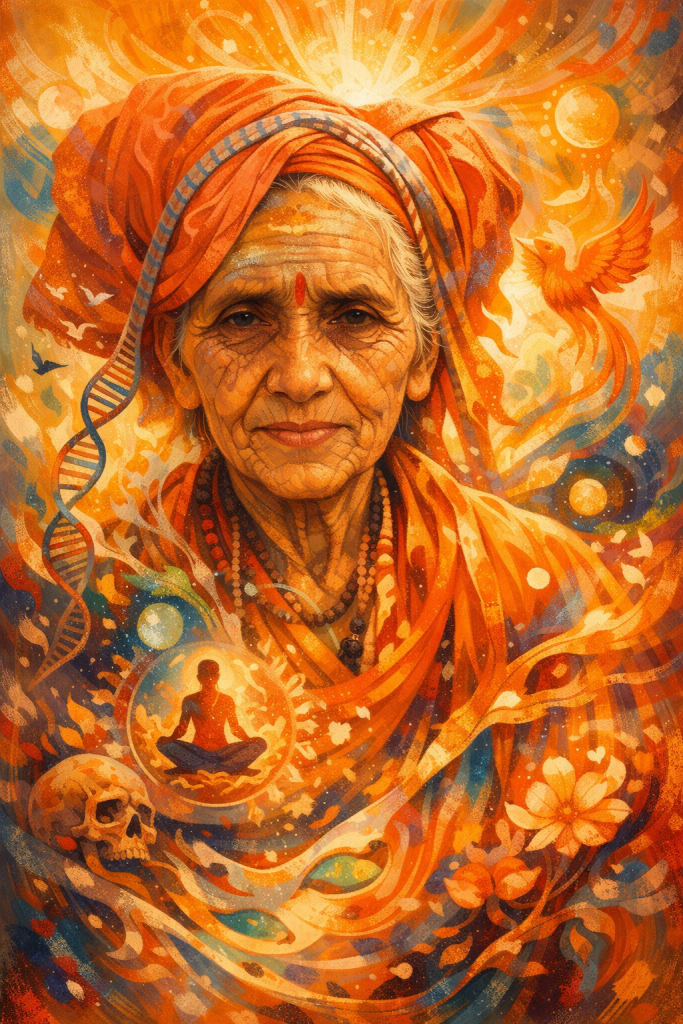
Life appears to move through chapters: arrival, departure, return, yet each chapter dissolves the moment you attempt to hold it. Breath flows, bodies age, worlds turn, and consciousness watches all of it without ever being touched. What looks like a sequence is simply awareness shifting its focus, the way a single flame illuminates many shapes without ever becoming any of them.

Death enters this picture as a doorway only from the perspective of the one who believes they are standing on one side of it. Yet the moment that belief loosens, the doorway reveals itself as an opening carved out of the same boundless presence that carries every heartbeat. What is called “afterlife” is not a destination reached by travel. It is the same field of being experienced without the costume of form.

Love for those who have gone does not travel across a boundary. It moves through the same indivisible ground from which both presence and absence arise. The living and the dead are two expressions of a single movement. Souls do not just depart and return; they appear as waves do, yet the water never goes anywhere.

Samsara, Nirvana, Moksha: each name gestures toward a pattern consciousness creates to understand itself. Yet the moment these patterns fall away, realization dawns that the seeker, the journey, and the liberation were never separate. What felt fragmented belonged to a mind trained to see borders. Freedom arrives the moment those borders fade.

You are the continuity that cannot perish, the stillness that animates every form, the awareness that births experience and withdraws it. Life and death only look like opposites until the lens of identity clears. Beyond that lens rests a truth too simple to grasp and too vast to deny: everything arises from the same essence, returns to the same essence, and never leaves it at all.

Morgan O. Smith

Get Your Free Copy of My Book, Bodhi in the Brain!

https://subscribepage.io/oTSZQu

The Illusion of Liberation

Phenomena arise, unfold, and dissolve, yet the mind grasps at them, seeking meaning through the lens of interpretation. This act of interpretation is inevitable, but the depth at which one engages with it determines whether understanding remains bound to illusion or expands into realization.

The mythical-magical stage of consciousness perceives reality through archetypes of power, divine will, and cosmic law. This stage gives birth to beliefs about cycles, reincarnation, and karmic loops—explanations that serve as scaffolding for those navigating the existential unknown. There is some truth to these interpretations, just as there is truth in every story we tell ourselves about existence. But truth is not confined to a single stage of development. It unfolds, revealing deeper nuances as perception matures.

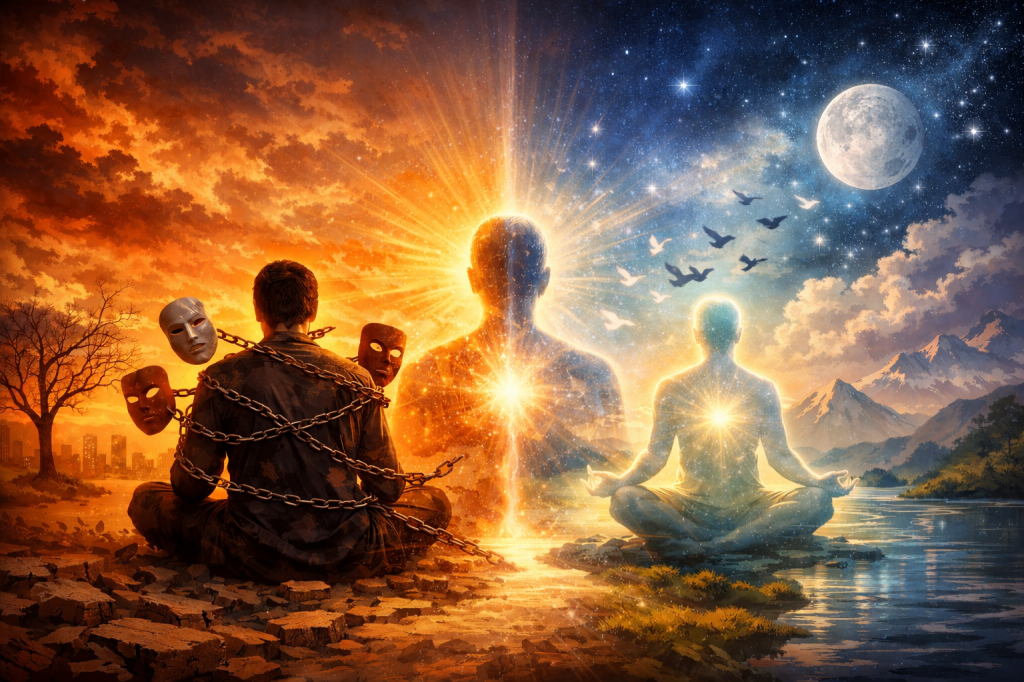
Samsara—the wheel of birth, death, and rebirth—has been described as a prison. The path to liberation, as outlined in various traditions, involves transcending this cycle, attaining nirvana or moksha, where rebirth ceases. But even this is an interpretation, one that arises from a more advanced vantage point. The paradox is that what appears as bondage and liberation are not separate realities. Samsara and nirvana are not two. They are the same movement seen through different eyes.

No one is bound, and no one is freed. The concept of liberation implies that something was ever trapped. Yet, what is there to escape when there has never been confinement? The idea of imprisonment is a mind construct, just as freedom is. They depend on one another, forming a duality that collapses upon close inspection.

You are creation itself. Yet, nothing is truly being created. It only appears so. The dance of form and emptiness continues, yet nothing moves. This is the great paradox. The illusion is not that samsara exists—it does, just as dreams exist while sleeping. The illusion is believing that it is something to escape.

Awakening is not an arrival but the recognition that there was never a journey. The cycle persists for those who perceive cycles. Freedom exists for those who perceive bondage. But beyond perception, beyond conceptual grasping, there is only this—eternal, unchanging, and free, regardless of whether one calls it samsara or nirvana.

Morgan O. Smith

Yinnergy Meditation/Neurofeedback, Spiritual Life Coaching & My Book, Bodhi in the Brain…Available Now!

https://linktr.ee/morganosmith

The Mind is Samsara

Liberation Through Freedom From Thought

(Inspired by Delson Armstrong)

To grasp the nature of samsara, one must look no further than the ever-turning wheel of the mind. Thoughts arise and dissolve ceaselessly—ideas, beliefs, fears, and anticipations weaving an endless narrative. Each moment feels distinct, yet they are all threads of the same cyclical pattern. This mental turbulence is the very fabric of samsara, the cycle of birth, death, and rebirth experienced not only across lifetimes but also within the subtle rhythms of the mind.

Samsara is not a place. It is the identification with thought itself. Every belief we cling to, every concept we hold sacred, every doubt that gnaws at our certainty—these perpetuate the illusion of separateness. The mind clings to forms, seeking permanence in the impermanent, building castles on clouds. Yet each construction inevitably crumbles, and the cycle begins anew.

Nirvana, often misinterpreted as a distant goal, is not found outside this moment. It is recognizing what remains when all that is transient falls away. Freedom arises not through force or suppression but by witnessing the mind’s movements without becoming entangled. The arising and dissolving of thoughts are no longer resisted; they are observed as passing clouds in the vast sky of awareness.

This realization does not destroy the mind but recontextualizes it. Thoughts may continue to arise, but they no longer hold the power to bind. The very root of suffering—attachment to the mind’s constructs—is severed. What remains is pure Being, an effortless silence that neither clings to birth nor fears death.

To step off the wheel of samsara is to recognize that you were never bound. The liberation of nirvana is not an escape but a profound shift in perspective: to see thoughts for what they are—fleeting phenomena—and rest in the unchanging awareness that witnesses them.

The mind is samsara. Freedom lies not in battling it, but in transcending it through direct experience of your timeless nature.

Morgan O. Smith

Yinnergy Meditation, Spiritual Life Coaching & My Book, Bodhi in the Brain…Available Now!

https://linktr.ee/morganosmith

The Grand Cycle of Cosmic Renewal

The universe, a magnificent dance of birth, death, and rebirth, mirrors the cycles of life from the smallest of organisms to the grandest of galaxies. At the heart of this cosmic rhythm lies a profound phenomenon: the black hole. Here, in these enigmatic cosmic centres, the renewal of the universe unfolds, echoing the ancient concept of Samsara.

In the vast expanse of the cosmos, our universe is perpetually in flux, ceaselessly evolving through cycles of creation and dissolution. Each iteration of this cosmic cycle marks a step towards a higher state of development. As the universe experiences these cycles, it evolves, fostering more sustainable life forms with each rebirth. This evolutionary process is not merely an incidental aspect of the universe but an intrinsic feature of its very nature.

The concept of Samsara, the cycle of birth, death, and rebirth, is as ancient as the stars themselves. It is a cycle that propels the human soul and the cosmos toward greater levels of consciousness and existence. Every cycle brings the universe closer to a state where life can flourish in every corner, where the seeds of existence can take root and blossom.

This journey towards universal vitality is a profound one. As the universe evolves, the black holes, often perceived as destructive forces, serve as catalysts for this grand transformation. They are the crucibles where the old is dismantled to give way to the new, where the remnants of dying stars are recycled into the building blocks of new celestial bodies.

The black hole, however, is only one part of this cosmic equation. Its counterpart, the white hole, is believed to be responsible for the Big Bang—the ever-continuous moment of awakening. The white hole represents the cosmic breath of creation, the outpouring of energy and matter that initiates the birth of the universe. This interplay between black and white holes symbolizes the dynamic balance of destruction and creation, contraction and expansion.

Once the universe reaches a state where life is omnipresent and self-sustaining, it will strive towards moksha—a liberation from the cyclical nature of Samsara. This state of cosmic enlightenment is not an end but a new beginning. The universe, now free from attachments and the perpetual cycle of renewal, will embark on a journey of liberation, perpetuating a cycle of existence that is free, whole, and unbound.

Interestingly, this grand cosmic cycle is not confined to the universe at large. It is echoed in the myriad smaller black holes scattered throughout the cosmos. Each black hole, in its domain, participates in this dance of renewal and liberation, contributing to the overall evolution of the universe.

In this way, the universe mirrors the spiritual journey of the soul. It evolves, seeks liberation, and strives towards a state of higher consciousness and freedom. This cosmic dance invites us to reflect on our journeys of growth and liberation, encouraging us to embrace the cycles of life with a sense of awe and reverence.

Morgan O. Smith

Yinnergy Meditation, Spiritual Life Coaching & My Book, Bodhi in the Brain…Available Now!

https://linktr.ee/morganosmith

The Paradox of the Bodhisattva

Embracing Infinite Compassion

The greatest human sacrifice is the bodhisattva’s goal of not attaining nirvana until all sentient beings are free from samsara. An impossible task, but the bodhisattva does this anyway out of love. So out of love, he or she continues to be born, die, and be reborn while being fully conscious of entering a life full of grief, discomfort, and dissatisfaction.

The bodhisattva’s path is one of profound paradox and immeasurable compassion. In the face of boundless suffering, the bodhisattva chooses not the liberation of nirvana but the unending cycle of rebirth. This choice, rooted in an infinite love for all sentient beings, defies conventional notions of self-preservation and personal enlightenment.

In the depths of this commitment lies a radical redefinition of what it means to live a meaningful life. The bodhisattva embodies a profound understanding that individual enlightenment is intertwined with the liberation of all beings. This interconnectedness transforms personal suffering into a collective journey, where the lines between self and other dissolve in the embrace of universal compassion.


To fully grasp the bodhisattva’s sacrifice, one must delve into the core of their motivation: the unyielding love for all beings. This love transcends personal desires and aspirations, anchoring itself in the welfare of every sentient entity. It is a love that is willing to endure the perpetual ebb and flow of samsara, embracing each life with open-hearted acceptance despite the inherent pain and impermanence.

The bodhisattva’s journey challenges us to reconsider our own lives and the nature of true fulfillment. It asks us to look beyond our immediate comfort and desires, to see our existence as part of a larger, interconnected whole. In doing so, we begin to understand that the pursuit of personal happiness is not separate from the well-being of others.

Engaging with the bodhisattva ideal, even as a mere contemplation, invites us into a deeper exploration of love and compassion. It urges us to reflect on our capacity to extend kindness and empathy beyond the confines of our personal experiences. In a world often dominated by individualism and self-interest, the bodhisattva’s sacrifice serves as a beacon, illuminating the transformative power of selfless love.


Ultimately, the bodhisattva’s commitment to the liberation of all beings is a testament to the boundless potential of the human spirit. It is a reminder that true enlightenment is not an isolated achievement but a collective awakening. As we meditate on the bodhisattva’s path, we are inspired to cultivate a love that transcends our own lives, embracing the entirety of existence in its compassionate embrace.

Morgan O. Smith

Yinnergy Meditation, Spiritual Life Coaching & My Book, Bodhi in the Brain…Available Now!

https://linktr.ee/morganosmith

Breaking the Chains of Samsara

Liberation for All

In the vast expanse of existence, the concept of Samsara transcends the mere cyclical experience of birth, death, and rebirth of individuals. It embodies the universal rhythm of creation and dissolution that ensnares not only sentient beings but the cosmos itself. This cosmic dance is not limited to a linear path of suffering and elation but is an intricate interplay of continuous emergence and entropy.

Samsara paints a picture of the universe persistently rejuvenating itself, where every end is a prelude to a new beginning. This cycle, often perceived as a relentless march towards rebirth, is punctuated by moments of joy and despair, mirroring the dualities that define our very existence.


Yet, the pursuit of liberation—attaining Moksha or Nirvana—reveals a profound universal truth. When one achieves liberation, the impact resonates beyond the individual. It is a monumental release that extends to all forms of life and even to the inanimate aspects of our universe. Liberation is not an isolated event but a shared release from the chains that bind us to perpetual reincarnation.

This realization places a monumental responsibility on the path of each seeker. To liberate oneself is to contribute to the emancipation of the entire universe from the Samsara cycle. The journey towards enlightenment, therefore, is not solely for personal salvation but an act of universal significance.


Every step taken towards enlightenment does not just alleviate one’s suffering; it diminishes the collective suffering. It is a beacon that lights up the path not only for oneself but for all beings, signalling a way out of the darkness of ignorance and into the light of awareness. This shared journey towards liberation fosters a profound connection with all existence, weaving a narrative of unity and collective transcendence.

In understanding the magnitude of Moksha or Nirvana, we see not just an escape from personal suffering but an offering of freedom to the universe. It’s a pivotal realization that the path to enlightenment is paved with compassion, altruism, and the ultimate realization that we are all interconnected in the cosmic fabric of life.

Morgan O. Smith

Yinnergy Meditation, Spiritual Life Coaching & My Book, Bodhi in the Brain…Available Now!

https://linktr.ee/morganosmith

The Dual Nature of Ego

Obstacle and Catalyst in the Quest for Enlightenment

In our quest for spiritual awakening, the concept of the ego plays a paradoxical role. On one hand, it is often seen as the primary hindrance on the path to enlightenment. On the other, it can serve as a vital instrument propelling us toward this very goal. This duality presents a fascinating aspect of our spiritual journey, inviting us to explore the ego not just as an adversary, but also as an ally.

In its most basic form, the ego is our sense of self. It’s the ‘I’ or ‘me’ that navigates through the world. In many Eastern philosophies, the ego is perceived as the root of suffering and illusion. It’s this ego that clings to desires, fears, and identities, trapping us in a cycle of samsara – the continuous loop of birth, life, and death. From this viewpoint, enlightenment is about transcending this limited self and recognizing our true nature, which is unbounded and interconnected with the entire cosmos.


However, this is only one facet of the ego’s role in our spiritual evolution. Consider the idea that the ego can also be a vehicle for growth. It is, after all, the ego that initially sparks the desire for enlightenment. Though rooted in the individual self, this desire can lead us toward a deeper understanding and a broader perspective. The ego drives us to seek, question, and yearn for something beyond our current state. In this sense, it can be seen as a necessary step in our spiritual evolution.

Moreover, confronting and understanding the ego is a vital part of spiritual practice. It’s through this process that we gain insight into our true nature. The ego’s patterns, attachments, and fears are not just obstacles to be removed but also mirrors reflecting our deeper truths. By engaging with our ego, we learn about the constructs of our identity, the nature of our minds, and the illusions we hold. This understanding is a crucial milestone in the journey toward enlightenment.

In this complex dance, the ego is both the veil that conceals the truth and the force that urges us to seek it. As seekers, we must navigate this paradox with awareness and discernment. The goal is not to annihilate the ego but to understand its nature and role in our spiritual development. By doing so, we can transform our relationship with the ego, seeing it not just as a barrier to overcome, but as a teacher guiding us towards greater awareness and unity with the all-encompassing truth.


In conclusion, the ego’s dual nature as both a barrier and a catalyst in the journey toward enlightenment offers a profound lesson. It reminds us that every aspect of our being, including those we perceive as limitations, can contribute to our spiritual growth. The path to enlightenment is not about rejecting parts of ourselves but understanding them in a way that leads to a deeper realization of our true essence.

Morgan O. Smith

Yinnergy Meditation, Spiritual Life Coaching & My Book, Bodhi in the Brain…Available Now!

https://linktr.ee/morganosmith

The Paradox of Self and No-Self

Navigating Samsara and Nirvana

In the profound journey of spiritual understanding, the concepts of birth, death, and rebirth hold a pivotal place. The intriguing idea that an enlightened being, despite their profound realization, can still be subject to the continuous cycle of reincarnation, presents a paradox that invites deep contemplation.

The pursuit of Nirvana or Moksha, as understood in various spiritual traditions, suggests a state where this perpetual cycle is broken. This liberation, often depicted as the ultimate goal in spiritual endeavours, implies an escape from the continuous loop of birth, death, and rebirth.

However, this raises a thought-provoking question: Can one truly experience and comprehend nondual suchness – a profound realization of their true self as the foundational essence of all existence – and yet remain entangled in the cycle of birth and death? This notion challenges our understanding of spiritual liberation and the nature of self-awareness.


The intricate relationship between Samsara (the cycle of birth and death) and Nirvana (liberation from this cycle) is a complex one. They are often perceived as two distinct realms or states of being. Yet, in a deeper existential sense, they might be seen as the same. This perspective opens up a philosophical exploration into the nature of the self.

The concept of ‘no-self’ is central to this discussion. It posits that the individual self we identify with is an illusion, a transient construct devoid of inherent existence. Paradoxically, this ‘no-self’ is also the self, as there is no true separation between the individual and the universal. Thus, one might refer to it as the ‘no-self,’ questioning the very existence of a label or reference point in this boundless, interconnected reality.

This exploration leads to profound questions: Who labels this existence if the self is an illusion? What is the nature of the self that encompasses everything, yet is nothing in itself? These are the riddles that spiritual seekers have pondered for ages, and they remain mystifying and intriguing today.


This philosophical conundrum invites us to dive deeper into our understanding of existence, self, and liberation. It challenges us to look beyond the conventional notions of identity and existence, urging us to explore the very essence of being.

Morgan O. Smith

Yinnergy Meditation, Spiritual Life Coaching & My Book, Bodhi in the Brain…Available Now!

https://linktr.ee/morganosmith

Understanding Spiritual Enlightenment and Nirvana

A Journey Beyond Words

The quest for spiritual enlightenment is a journey that transcends mere words and enters the realm of profound inner transformation. In the West, enlightenment is often equated with a comprehensive understanding of one’s true nature. This interpretation focuses on the illumination of the self, its intricacies, and its connection to the larger universe. It’s a state of comprehension, where the veils of ignorance are lifted, revealing the true essence of being.

In Eastern traditions, particularly Buddhism and Advaita Vedanta, enlightenment takes on a different hue. Here, it’s synonymous with Nirvana or Moksha – the liberation from the endless cycle of birth, death, and rebirth, known as samsara. This liberation is not just an intellectual understanding but a profound realization that leads to the dissolution of the self. In Buddhism, this is conceptualized as Anatta or no-self, a realization that the self is an illusion and liberation lies in transcending it.


Similarly, in Hinduism, Moksha aligns with the concept of Brahman – the ultimate reality or universal self. While seemingly different, both Nirvana and Moksha converge on the same endpoint: liberation from all forms of suffering and the cycle of samsara.

However, there’s a subtle yet significant distinction to be made. One can achieve spiritual enlightenment – a deep comprehension of their nature and the nature of reality – yet still be bound by the chains of samsara. It’s a state of awakening, an important step on the path, but not the culmination. True liberation, as seen in the concepts of Nirvana and Moksha, involves not just comprehension but also a complete surrendering of the self, a realization of its illusory nature, and ultimately, liberation from the cycle of existence.


Thus, while spiritual enlightenment and Nirvana (or Moksha) are often used interchangeably, their meanings diverge significantly based on cultural and philosophical contexts. In the West, enlightenment is primarily about understanding, while in Eastern philosophies, it’s about liberation. Only when the facets of comprehension, surrendering, realization, and liberation are all present can we step beyond spiritual awakening into the realm of true spiritual enlightenment.

Morgan O. Smith

Yinnergy Meditation, Spiritual Life Coaching & My Book, Bodhi in the Brain…Available Now!

https://linktr.ee/morganosmith

Illumination of the Soul

Spiritual Enlightenment and Moksha

As seekers on the path of inner wisdom, we often encounter the concepts of spiritual enlightenment and moksha. Both are beacons that promise to guide us out of the darkness of ignorance, yet they are not the same.

Spiritual Enlightenment is a term that has found its roots in the West, heavily influenced by the philosophies and meditative practices of the East. It implies an awakening to a reality that transcends our ordinary experience of self and the universe. The enlightened being sees the interconnectivity of all life, perceives the illusion of the ego, and often experiences profound peace and understanding of the present moment. It’s an expansive realization of consciousness, often accompanied by a deep compassion for all beings.

Moksha, on the other hand, is a Sanskrit word that originates from ancient Indian philosophy and is integral to spiritual traditions like Hinduism, Buddhism, and Jainism. Moksha goes beyond the realization of interconnectedness; it represents the ultimate release from the cycle of birth, death, and rebirth — the wheel of samsara. It is not merely an enlightenment of the mind but a liberation of the soul from the karmic ties that bind it to the physical plane.

The distinction lies in their ultimate goals and the pathways to reach them. Spiritual enlightenment is often seen as a milestone, a significant spiritual awakening that may happen time and again, deepening one’s insight and wisdom. Moksha, however, is the final destination — a state of eternal bliss and cessation of all suffering.

To consider enlightenment and moksha is to dance with the profound mysteries of existence. Are they two different peaks or simply different paths up the same mountain? Perhaps the journey is less about the distinctions and more about the profound transformation each individual undergoes in their quest for the ultimate truth.

In our modern age, where the material often overshadows the spiritual, revisiting these ancient concepts might offer a lens to reevaluate our lives purpose. Whether we seek enlightenment or moksha, the essence of our search is a testament to the human spirit’s unyielding quest for the absolute.

And so, we continue to explore, meditate, and live virtuously, with the hope that whether through enlightenment or moksha, we may all find our way to that which we most deeply yearn for — peace, understanding, and liberation.

Morgan O.  Smith

Yinnergy Meditation & My Book, Bodhi in the Brain…Available Now!

https://linktr.ee/morganosmith