Author, Philosopher, Spiritual Teacher, A Lead Facilitator at Sacred Media's Integral Mastery Academy, Founder of Yinnergy Meditation/Neurofeedback, Bodhi Mental Care & Wellness, Co-founder of KeMor Centre for Innovative Development
The quest for spiritual enlightenment is a journey that transcends mere words and enters the realm of profound inner transformation. In the West, enlightenment is often equated with a comprehensive understanding of one’s true nature. This interpretation focuses on the illumination of the self, its intricacies, and its connection to the larger universe. It’s a state of comprehension, where the veils of ignorance are lifted, revealing the true essence of being.
In Eastern traditions, particularly Buddhism and Advaita Vedanta, enlightenment takes on a different hue. Here, it’s synonymous with Nirvana or Moksha – the liberation from the endless cycle of birth, death, and rebirth, known as samsara. This liberation is not just an intellectual understanding but a profound realization that leads to the dissolution of the self. In Buddhism, this is conceptualized as Anatta or no-self, a realization that the self is an illusion and liberation lies in transcending it.
Similarly, in Hinduism, Moksha aligns with the concept of Brahman – the ultimate reality or universal self. While seemingly different, both Nirvana and Moksha converge on the same endpoint: liberation from all forms of suffering and the cycle of samsara.
However, there’s a subtle yet significant distinction to be made. One can achieve spiritual enlightenment – a deep comprehension of their nature and the nature of reality – yet still be bound by the chains of samsara. It’s a state of awakening, an important step on the path, but not the culmination. True liberation, as seen in the concepts of Nirvana and Moksha, involves not just comprehension but also a complete surrendering of the self, a realization of its illusory nature, and ultimately, liberation from the cycle of existence.
Thus, while spiritual enlightenment and Nirvana (or Moksha) are often used interchangeably, their meanings diverge significantly based on cultural and philosophical contexts. In the West, enlightenment is primarily about understanding, while in Eastern philosophies, it’s about liberation. Only when the facets of comprehension, surrendering, realization, and liberation are all present can we step beyond spiritual awakening into the realm of true spiritual enlightenment.
Morgan O. Smith
Yinnergy Meditation, Spiritual Life Coaching & My Book, Bodhi in the Brain…Available Now!
As seekers on the path of inner wisdom, we often encounter the concepts of spiritual enlightenment and moksha. Both are beacons that promise to guide us out of the darkness of ignorance, yet they are not the same.
Spiritual Enlightenment is a term that has found its roots in the West, heavily influenced by the philosophies and meditative practices of the East. It implies an awakening to a reality that transcends our ordinary experience of self and the universe. The enlightened being sees the interconnectivity of all life, perceives the illusion of the ego, and often experiences profound peace and understanding of the present moment. It’s an expansive realization of consciousness, often accompanied by a deep compassion for all beings.
Moksha, on the other hand, is a Sanskrit word that originates from ancient Indian philosophy and is integral to spiritual traditions like Hinduism, Buddhism, and Jainism. Moksha goes beyond the realization of interconnectedness; it represents the ultimate release from the cycle of birth, death, and rebirth — the wheel of samsara. It is not merely an enlightenment of the mind but a liberation of the soul from the karmic ties that bind it to the physical plane.
The distinction lies in their ultimate goals and the pathways to reach them. Spiritual enlightenment is often seen as a milestone, a significant spiritual awakening that may happen time and again, deepening one’s insight and wisdom. Moksha, however, is the final destination — a state of eternal bliss and cessation of all suffering.
To consider enlightenment and moksha is to dance with the profound mysteries of existence. Are they two different peaks or simply different paths up the same mountain? Perhaps the journey is less about the distinctions and more about the profound transformation each individual undergoes in their quest for the ultimate truth.
In our modern age, where the material often overshadows the spiritual, revisiting these ancient concepts might offer a lens to reevaluate our lives purpose. Whether we seek enlightenment or moksha, the essence of our search is a testament to the human spirit’s unyielding quest for the absolute.
And so, we continue to explore, meditate, and live virtuously, with the hope that whether through enlightenment or moksha, we may all find our way to that which we most deeply yearn for — peace, understanding, and liberation.
Morgan O. Smith
Yinnergy Meditation & My Book, Bodhi in the Brain…Available Now!
The universe is filled with symbols that describe the cyclical nature of existence. One of the most captivating is the concept of ‘Samsara’ from Eastern traditions and ‘Ouroboros’ from ancient civilizations. While they emerge from different cultural contexts, they bear striking resemblances, encapsulating the endless cycle of birth, death, and rebirth and the continuous loop of life-consuming itself.
### Samsara: The Wheel of Existence
Samsara, derived from Sanskrit, signifies the cyclical process of birth, death, and rebirth. It’s a fundamental concept in Buddhism, Hinduism, and Jainism. Many Eastern spiritual practices aim to break free from this relentless cycle and attain enlightenment or Moksha. Why? Because Samsara is not just about rebirth – it’s about suffering. Every birth brings with it aging, sickness, and ultimately, death. The attachments, desires, and ignorance in life lead to actions (karma) that bind us to this wheel, causing endless suffering. ### Ouroboros: The Eternal Circle
The Ouroboros is an ancient symbol depicting a serpent or dragon eating its own tail. Found in many cultures, from ancient Egypt to the indigenous traditions of the Americas, it’s emblematic of the eternal cyclical nature of the universe. Creation out of destruction, life out of death. Just as the snake sheds its skin only to be reborn, life continually renews itself even as it ends. ### Biting One’s Tail: The Self-Caused Suffering
The fascinating aspect of the Ouroboros is the act of the snake biting its own tail. It’s a voluntary act of self-consumption, symbolizing self-reflection and the cyclical nature of things. But what if we viewed this act as a representation of self-inflicted suffering, much like the karmic traps in Samsara?
Every time we hold onto grudges, indulge in harmful habits, or remain ignorant of our true nature, we bite our own tail. We become both the cause and the recipient of our suffering. And just like the snake cannot see beyond its circular path, we often find it challenging to envision a life beyond our self-inflicted pain.
### Breaking the Cycle
While these symbols might paint a bleak picture of existence, they also offer hope. Just as the cycle of Samsara can be broken through enlightenment, the Ouroboros signifies rebirth and renewal. But this requires self-awareness.
By recognizing the patterns of our actions, understanding the roots of our desires, and embracing self-reflection, we can begin to release our grip on our own tails. This doesn’t mean the cessation of life’s challenges, but rather an enlightened approach to them, devoid of self-inflicted suffering.
In conclusion, Samsara and the Ouroboros serve as profound reminders of the cyclical nature of existence and the potential pitfalls of living unconsciously. They beckon us to awaken, to understand our role in our suffering, and to seek paths that transcend these ancient cycles. As we navigate the journey of life, may we always strive to understand the deeper meaning behind these symbols and find the courage to let go of our tail.
Morgan O. Smith
Yinnergy Meditation & My Book, Bodhi in the Brain…Available Now!
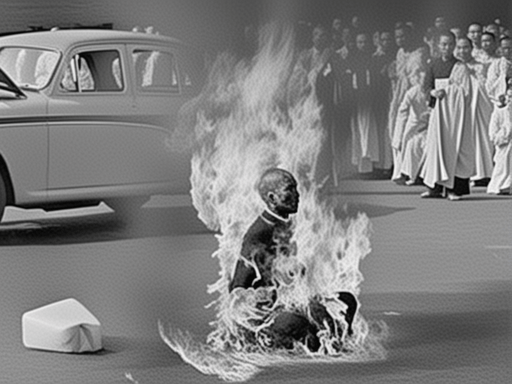
In the vast annals of human history, few images stand as starkly haunting as that of Thích Quảng Đức, a Vietnamese monk who, in a profound act of protest, set himself ablaze on a Saigon street in 1963. While the flames consumed his physical form, Quảng Đức remained motionless, embodying the epitome of tranquillity and peace. As if this act was not profound enough, an even more astonishing testament to his spirit was the heart that remained unburned, not only in the initial act but even upon re-cremation.
**The Unyielding Heart**
What does it mean to have a heart that does not burn? In the literal sense, it defies the expectations of nature and science. But on a more profound level, the heart of Thích Quảng Đức symbolizes the ultimate emblem of pure, unyielding compassion. In a world often ruled by tumultuous fires of hate, prejudice, and indifference, Quảng Đức’s heart serves as a poignant reminder that true compassion is unassailable. It can neither be burned nor extinguished.
**Compassion Amidst Chaos**
The metaphorical imagery of a heart that remains intact, even amidst the raging fires, is a testament to the enduring nature of compassion. The flames that consumed Quảng Đức were not merely physical; they represented the societal and political upheavals of his time. Yet, his heart, like his spirit, stood resolute, undeterred, and most importantly, compassionate.
In the face of adversity, many of us allow our hearts to be overtaken by the metaphorical fires of anger, resentment, or apathy. Yet, Thích Quảng Đức’s heart is a beacon, calling upon us to rise above the flames of malice and to foster a heart that, metaphorically speaking, can never burn.
**A Legacy Beyond the Flames**
Today, housed in a glass chalice at Xá Lợi Pagoda, Thích Quảng Đức’s heart serves as a perpetual reminder of his teachings and spirit. To the Vietnamese Buddhists and many others across the globe, he is revered as Bồ Tát Thích Quảng Đức, a bodhisattva. A being filled with such boundless compassion that he chose to remain in the cycle of samsara to help others attain enlightenment.
This unburned heart serves as a testament not just to the man, but to the idea that compassion, when deeply rooted in one’s being, can transcend even the most harrowing circumstances. It challenges each of us to reflect on the state of our hearts. Do we nurture a heart that is impenetrable to the flames of hatred, bitterness, and indifference? **In Conclusion**
The legacy of Thích Quảng Đức is not simply about the act of self-immolation. It’s about a heart—a pure, compassionate heart that remained untouched despite the circumstances. As we traverse through our trials and tribulations, may we strive to cultivate such a heart, a heart that remains compassionate, resilient, and most of all, unburned.
Morgan O. Smith
Yinnergy Meditation & My Book, Bodhi in the Brain…Available Now!
Sculpted by ancient wisdom and breathed into existence by mystic philosophies, the idea of reincarnation challenges our perception of reality, questioning the depth of life, death, and the realms that extend beyond our comprehension. It’s an intriguing path leading to a fascinating panorama of eternal becoming, a ceaseless cycle of birth, death, and rebirth that we often term ‘Samsara’. Delving deeper into this concept, a theory emerges, where the omnipresent Spirit, or the Ground of all Being, embarks on a journey to experience life from an individual standpoint.
The Spirit, in its omnipotent and omniscient state, voluntarily decides to fragment its infiniteness into a finite form, breathing life into an individual self. But why does this transition occur? Could it be that the Spirit seeks to experience, understand, and embrace the existential dynamics from the individual lens? To dive into the chaotic beauty of life, to suffer, to joy, to yearn, and to discover? We can only speculate.
The interaction between the Spirit and its earthly existence forms an intricate dance, a dance that eventually leads to the enrichment of the Spirit. Each incarnation, each dance, is an opportunity for the Spirit to learn, grow, and evolve. If Nirvana or Moksha, the state of absolute liberation, isn’t attained in a single lifetime, the Spirit continues its journey through subsequent lifetimes, circling the samsara wheel.
In this theory, one might imagine each cycle of Samsara to be equivalent to a full rotation of 360 degrees. Each degree of rotation represents the lived experiences, the struggles and victories, the heartaches and joys, and the insights and awakenings that shape the individual soul’s evolution. Upon completing this 360-degree cycle, the Spirit transitions to a new plane of existence, a higher level of consciousness, armed with the wisdom and enlightenment accumulated from its previous journey.
This continuum is profound. It’s a cosmic design that instills a sense of awe and wonder, presenting the possibility of existence in planes beyond our material world. It grants our life a transcendent purpose, a grandeur that transcends the limitations of a single life span.
Reincarnation, as visualized in this theory, leads us to reconsider the significance of our lives. It encourages us to perceive every event, every interaction, as an opportunity for the Spirit to learn and evolve. Furthermore, it nudges us to view ourselves not merely as transient beings but as vessels for the Spirit’s journey toward the absolute.
In conclusion, the philosophical discourse on reincarnation paints a vivid picture of the Spirit’s quest. It traverses from the individual standpoint to the Ground of all Being, from the mortal realm to the absolute. In each cycle, in each dance, in each 360-degree turn, we find the Spirit growing, understanding, and inching closer to its final destination: a state of total enlightenment and liberation. As seekers on this journey, may we live mindfully, learn incessantly, and evolve steadily. After all, aren’t we the Spirit’s manifestation seeking its way back home?
Morgan O. Smith
Yinnergy Meditation & My Book, Bodhi in the Brain…Available Now!
As we traverse the intricate corridors of Hindu philosophy, a term that emerges as a beacon of liberation is ‘Moksha’. This concept, commonly associated with individual salvation from the cycle of birth, death, and rebirth, presents a spiritual zenith. However, what if we zoom out from the individual perspective and consider Moksha at a cosmic level? What if the Universe itself were to attain Moksha?
The Big Bang marked the birth of the Universe, setting forth an infinite dance of creation, preservation, and destruction. Stars were born, galaxies sculpted, and planets formed, only to one day succumb to the grand design of entropy. This cyclical nature bears a striking resemblance to the cycle of Samsara in Hindu thought, where souls are continuously born and reborn in different forms until Moksha is achieved.
If the Universe could experience Moksha, it would transcend its cycle of cosmic Samsara – from the Big Bang to the eventual Big Crunch or Heat Death, depending on which theoretical physicist you ask. This liberation would mean breaking free from the constraints of time, space, and causality, reaching a state of infinite, timeless existence.
So, what would this feel like for the Universe?
When we ponder this question, we must acknowledge that the Universe’s experience, in this context, is beyond human comprehension. But let’s indulge in the thought experiment. We could imagine this state as one of perfect harmony and unity. There would be no ‘other’, no ‘alien’, and no ‘external’. The galaxies, stars, planets, and even the tiniest quantum particles would exist in a state of interconnection and oneness.
From the perspective of sentient beings, this would mean a profound sense of unity with everything else. Distinctions that currently cause division – species, races, cultures, even life and non-life – would become irrelevant. All of existence, inanimate and animate, would be seen as expressions of the same cosmic consciousness.
And yet, paradoxically, this unified existence would also mean the cessation of experience as we know it. Experience implies a subject and an object, an experiencer and the experienced. But in the absolute unity of cosmic Moksha, these dualities would dissolve. Therefore, in a sense, the Universe would be in a state of ‘experiencing without an experiencer’ or ‘knowing without a knower’.
In the grand scheme of cosmic liberation, human Moksha could be seen as a fractal microcosm – a ripple that mirrors the pattern of the whole. Each being achieving liberation contributes to the whole Universe moving towards its own Moksha, its release from the cosmic cycle of birth and death. This profound realization places our spiritual quests in a broader context and imbues them with a universal significance.
However, the implications of this concept are not just metaphysical, but deeply ethical. Recognizing our shared journey toward liberation fosters compassion, humility, and a sense of stewardship for all of existence. Our actions, in this view, can either facilitate or hinder the Universe’s journey toward Moksha.
In conclusion, contemplating Moksha at a universal scale stretches the boundaries of our imagination and empathy. It invites us to view ourselves not as isolated entities but as integral parts of a grand cosmic dance seeking the ultimate liberation.
Morgan O. Smith
Yinnergy Meditation & My Book, Bodhi in the Brain…Available Now!
Introduction: In the endless expanse of the cosmos, we often find solace in spirituality, contemplating the enigmatic existence of a higher power. Let us explore a profound conception of God, not as a divine figure, but as an infinite and cyclical process encompassing all creation.
The Acronym: One remarkable interpretation is to perceive God as an acronym, G.O.D., standing for Generator, Operator, and Destroyer. This denotes the three fundamental processes in the universe: creation, sustenance, and dissolution.
The Infinite Loop: However, the magnitude and essence of G.O.D. transcend finite boundaries. Imagine an unending chain, G.O.D.G.O.D.G.O.D… stretching into infinity. This portrays G.O.D. as an eternal cycle in which these processes are not linear, but intertwined and simultaneous.
The Higher Harmony: At an elevated plane of existence, Generator, Operator, and Destroyer are not distinct entities but an indivisible whole. Each facet melds into the next, like a symphony where every note is vital. The Generator gives rise to the Operator, which in turn is enveloped by the Destroyer, only to be reborn anew.
Beyond Time and Space: As G.O.D. is unbounded, it exists beyond the constraints of time and space. In this domain, silence speaks volumes, and a blank page is rich with meaning. Here, G.O.D. is akin to the vastness of the cosmos, infinitely expanding yet infinitely dense with possibilities.
Samsara: G.O.D. also represents the universal cycle of renewal known as Samsara. This is not merely a recycling of cosmic material but an all-encompassing cycle that includes the continual renewal of individual lives through death and rebirth. Nirvana: In contrast, G.O.D. is also associated with Nirvana – the ultimate liberation from the cyclical nature of existence. It is emancipation from the endless loop, the attainment of a state that is beyond the limitations of the physical realm.
Conclusion: G.O.D., as the eternal symphony of Generator, Operator, and Destroyer, portrays an intricate tapestry of the universe. It is the rhythm of existence, a dance of creation, sustenance, and dissolution that is ceaseless and boundless. Through understanding and embracing this concept, we may find deeper connections to the universe and perhaps to our own spirit.
Morgan O. Smith
Yinnergy Meditation & My Book, Bodhi in the Brain…Available Now!
Introduction: In the realm of profound philosophical inquiry, few concepts have captivated human minds as powerfully as the notion of nonduality. It beckons us to delve deeper into the nature of existence, challenging our preconceived notions and inviting us to explore the uncharted territories of paradox. Yet, amidst the vast expanse of literature and discourse on the subject, there lies an untrodden path, a unique perspective awaiting discovery. In this thought-provoking blog, we embark on a journey to unravel the tapestry of nonduality, weaving together the threads of seemingly opposing concepts in a way that illuminates the unexplored corners of our understanding.
Section 1: Subject-Object Wholeness: The Mirage of Separation Traditionally, nonduality has been described as the dissolution of the boundary between subject and object. But what if we were to consider that this boundary is not merely an illusion to be dissolved, but rather a fundamental aspect of the interconnected whole? By embracing the paradoxical nature of subject and object, we transcend the notion of a binary relationship and uncover a rich tapestry where both unity and diversity dance in harmony. Section 2: The Dance of Infinity and Finitude: An Eternal Synchrony Infinity and finitude have long been viewed as opposites, forever in conflict. However, a fresh perspective emerges when we recognize that infinity does not exist apart from the finite, but rather encompasses it. Just as a droplet of water contains the essence of the vast ocean, the finite contains within it the spark of infinity. In this revelation, we discover an eternal synchrony where the boundaries between the two dissolve, revealing a profound interplay of expansion and limitation.
Section 3: Embracing the Yin and Yang: The Alchemy of Dualities Within the realm of nonduality, the interplay of positive and negative transcends mere opposition. Rather than negating each other, they fuse together in a cosmic dance, giving rise to the intricate tapestry of existence. By reframing our perspective, we find that positivity and negativity are two essential forces that co-create the symphony of life, providing contrasting hues that bring depth and richness to our human experience.
Section 4: The Timeless Now: Eternity and Temporality Unveiled Eternity and time often appear as irreconcilable opposites, with eternity representing a timeless realm and time embodying the ephemeral. However, what if we were to explore the idea that eternity is not separate from time, but rather encompasses it? In the ever-present now, the eternal reveals itself as the foundation from which time emerges. As we attune ourselves to this perspective, we can embrace the cyclical dance of birth, growth, decay, and renewal, while remaining anchored in the timeless essence.
Section 5: The Nondual Kaleidoscope: Beyond Samsara and Nirvana Samsara and nirvana, often considered opposing states, are entwined in the fabric of nonduality. The transformative potential lies not in escaping samsara for a transcendent nirvana, but in recognizing that both exist within the same spectrum of experience. By embracing the paradoxical nature of these concepts, we open ourselves to the possibility of finding liberation amidst the cycles of existence, fostering a profound integration of the sacred and mundane.
Conclusion: As we conclude our exploration into the uncharted realms of nonduality, we find that the fabric of existence is a tapestry of paradox, where unity and diversity, finitude and infinity, positive and negative, eternity and time, samsara and nirvana, ultimate and relative, spirit and matter, one and many, Atman and Brahman, form and emptiness, merge and interweave in a dance of cosmic significance. This unique perspective on nonduality challenges us to embrace the complexity and interplay of seemingly opposing concepts, inviting us to transcend our limited understanding and explore the profound depths of existence.
In this exploration, we are called to relinquish the impulse to categorize and label, to move beyond the constraints of linear thinking, and to embrace the boundless potential that arises when we hold paradox with reverence. It is within these liminal spaces that our consciousness expands, allowing us to perceive the interconnectedness of all things and the underlying unity that permeates the fabric of reality.
By contemplating this unique perspective on nonduality, we can cultivate a transformative shift in our perception of the world. We begin to see the inherent beauty in the interplay of opposites, recognizing that it is through the harmonization of these apparent contradictions that we can truly embrace the totality of our existence.
As we navigate the complexities of life, let us remember that the paradoxes we encounter are not obstacles to be overcome but gateways to profound insight and understanding. By embracing the intricate dance of nonduality, we embark on a journey of self-discovery and interconnectedness, transcending the limitations of our individual perspectives and merging with the vast cosmic tapestry of existence.
In this grand symphony of paradox, we are invited to become active participants, co-creators of our own reality. By engaging with the multifaceted nature of existence, we can honour the unity within diversity, find solace in the ever-present now, and discover the profound interconnectedness that weaves through all aspects of life.
So, let us venture forth with open hearts and curious minds, ready to explore the uncharted territories of nonduality. Let us embrace the unique perspective that transcends the boundaries of verbal expression and literature, and in doing so, may we awaken to the awe-inspiring beauty of the paradoxical tapestry that lies beyond the veil.
Morgan O. Smith
Yinnergy Meditation & My Book, Bodhi in the Brain…Available Now!









 Morgan O. Smith