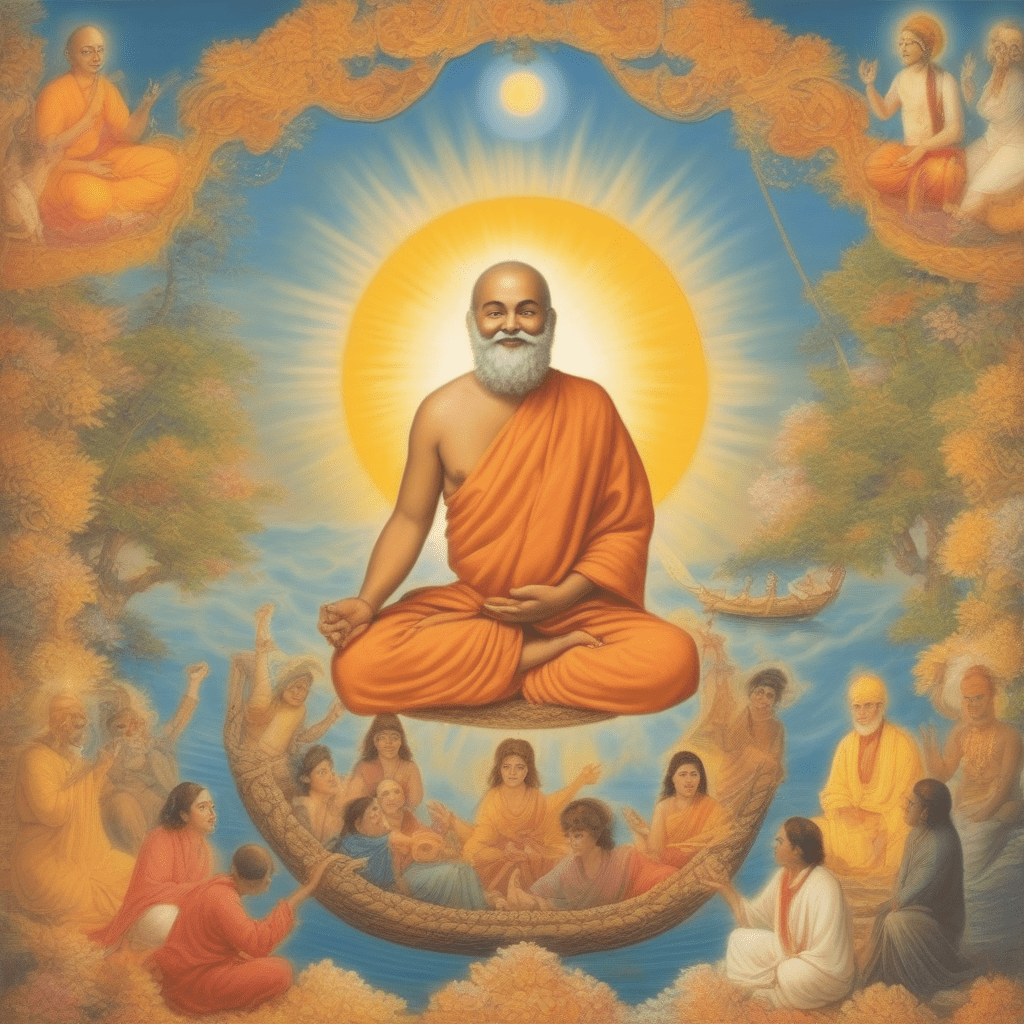
Satcitananda

The Voyage from Happiness to Bliss

In the pursuit of well-being, human beings have often conflated happiness with bliss, treating them as interchangeable states. However, the ancient concept of Satcitananda, a Sanskrit term embodying the essence of ultimate reality offers a profound distinction between these two.

Happiness is a fleeting emotion, a reaction to external stimuli, tethered to the temporal and the material. It is as changeable as the weather, reliant on circumstances, people, possessions, and places. Happiness is the surface-level response to life’s favourable events and acquisitions, tied to the sensory and the transient.

Bliss, or Ananda, in contrast, represents a state beyond the physical or emotional. It is not contingent on the external but is the intrinsic nature of being, untouched by the vicissitudes of life’s ever-changing landscape. Bliss is the deep, unshakable contentment that comes not from what happens to us but from what we are at our core. It is a realization of one’s true nature, a state of being where one exists in complete harmony with the universe.

Satcitananda breaks down into ‘Sat’, ‘Chit’, and ‘Ananda’. ‘Sat’ refers to truth or existence itself, ‘Chit’ to consciousness or knowledge, and ‘Ananda’ to bliss. These are not mere attributes but the very fabric of the ultimate reality, the Brahman. To realize Satcitananda is to awaken to the truth that our own deepest self is not separate from this reality.

The journey from happiness to bliss is a transformational process of expanding one’s understanding from the finite to the infinite, from a state of doing to a state of being. Where happiness might be thought of as a single note in a symphony, bliss is the symphony itself. It is the silent space between notes, as integral to the music as the sound, offering a depth that is both immanent and transcendent.

To chase happiness is to chase the shadows of what we believe we lack, while to embrace bliss is to step into the light of our divine nature, which lacks nothing. It is a shift from seeking satisfaction from the external world to discovering the inexhaustible joy within.

In Satcitananda, one finds the key to unlocking a truth that spiritual traditions have whispered for millennia: that what we seek outside has always been within. As we navigate the shifting tides of life, the realization that we are not merely chasing fleeting happiness but are embodiments of eternal bliss can transform our entire way of being.

Thus, Satcitananda is not merely a philosophical concept; it is an invitation to a way of life, a reminder that beneath the ephemeral dance of happiness and sorrow lies a profound peace and joy, waiting to be realized.

Morgan O.  Smith

Yinnergy Meditation & My Book, Bodhi in the Brain…Available Now!

https://linktr.ee/morganosmith

A Serendipitous Encounter with Ken Wilber

Journeying Beyond the Veil of Reality

In the soft blush of dawn, I stirred awake at 5:40, surrendering to an hour of Yinnergy meditation before nestling back into slumber’s embrace. In my dream, I found myself standing amidst the familiar halls of a school with which I shared a work/community partnership. The peculiar morning sunlight bathed the main foyer where I found myself, the uncertainty of my presence there simmering in my mind—I had supposedly called in sick.

Attempting a swift, unseen exit, I brushed past the main entrance only to discover a quaint store tucked to the left. It served as my temporary refuge before I ventured forth into the daylight. To my amazement, the school’s parking lot had morphed into a sprawling mall parking, and my vehicle seemed to have vanished into thin air. A click on the car remote yielded a chirping sound, yet my car remained unseen. The chirps echoed eerily through the boundless maze of parked vehicles.

With resolve waning, I traced my steps back to the school. However, the once familiar school interior now sprawled before me as a vast complex, a labyrinth with countless sections awaiting exploration. As I delved deeper, descending a flight of stairs, I chanced upon a woman. In the realms of the waking, she was a librarian at the public library under another community partnership. But here, she had aged, her eyes lacking the spark of recognition. As I endeavoured to slip past unnoticed, our eyes met, casting a fleeting veil of fear over her face. The eerie thought of her calling the authorities hastened my escape down another stairwell.

There, I stumbled upon a colleague of mine, her lips spewing venom over the phone about another. The stark contrast between this avatar and her workplace demeanour was startling. I whisked myself away, leaving her unembarrassed in her secret slander.

The surreal escapade led me outside and then back into a stairwell, where fate unveiled a harrowing scene—a young mother, perhaps a teenager, with a newborn, suffered the misfortune of dropping her baby down the stairs. Accusations and exasperations filled the air, yet miraculously, the baby remained unscathed. The young mother’s stoic face stood as a testament to the resilience ingrained in the fabric of life.

The quest for my car resumed, turning futile until a gentle stranger extended his hand to aid in my search. Though unsuccessful, his kind gesture steered my way back to the library—a sanctuary that bore a resemblance to the one in my waking world.

In the quiet sanctum, I was warmly greeted by a former love. Our chatter soon took a magical turn as Ken Wilber, the revered philosopher, graced us with his presence. Recently, I completed a spiritually illuminating program under his guidance, hence his arrival felt serendipitous.

Our banter cascaded from the mundane to the mystical. With each shared thought, a strange familiarity wrapped around us. He voiced concerns about my serious demeanour, urging a smile. His inquiry into my spiritual saga met my story of awakening in 2008, which unfolded into the miraculous narrative of my life. Ken’s skepticism gradually crumbled, paving the way for a profound moment of connection.

With a gentle grasp, I held his face, our eyes serving as the conduit for the ethereal. An explosion of divine love, compassion, empathy, and bliss erupted within and around us, a phenomenon often described as satcitananda in ancient texts. The heavenly vibrations resonated through the library, igniting a flame of consciousness between Ken and me.

He sank to his knees, tears of profound realization streaming down his cheeks, echoing the eternal phrase “Aham Brahmasmi” – I am Brahman. His tears met mine as our cries of liberation filled the sacred space. This was an unveiling, a transcendence beyond the ordinary perception of reality.

As the new dawn caressed my waking eyes, my body curled into a ball, the reverberations of divine love still ringing through every cell. Tears of joy coursed down, without a drop to spare, as a celestial peace enveloped my being. Though bound within the ephemeral embrace of a dream, the profound spiritual dialogue orchestrated in that serendipitous encounter resonated through the ether, awakening a sublime reality nestled between the realms of the waking and the dream.

Morgan O. Smith

Yinnergy Meditation & My Book, Bodhi in the Brain…Available Now!

https://linktr.ee/morganosmith

The Nuances of Bliss and Happiness

Satcitananda Explored

In our perpetual quest for joy, most people often use the terms ‘bliss’ and ‘happiness’ interchangeably. Yet, when we delve deep into philosophical and spiritual terrains, subtle distinctions emerge, making it imperative to comprehend their intricacies. One such profound concept from Eastern philosophy is ‘Satcitananda’ – an amalgamation of three Sanskrit words: Sat (existence), Chit (consciousness), and Ananda (bliss). This triune not only illuminates the differences between bliss and happiness but also offers a deeper understanding of our true nature.

**Happiness: The Fleeting Emotion**

Happiness is an emotion, an ephemeral state dependent on external stimuli. It’s reactive – linked to achievements, possessions, or relationships. As circumstances change, so does our state of happiness. This transitory nature often leaves individuals in a constant chase, forever seeking the next source of joy.

**Bliss: The Intrinsic State of Being**

Satcitananda, on the other hand, represents a state of bliss that is non-reactive and intrinsic. It’s an inherent part of our spiritual existence, unaffected by the ebb and flow of life’s experiences. This bliss isn’t about elation or a surge of positive feelings, but a profound peace and contentment stemming from the realization of one’s true self.

**Satcitananda: The Bridge to Understanding**

When we disentangle Satcitananda:
– **Sat** reminds us of our eternal nature, transcending the physical world.
– **Chit** points to the consciousness or awareness, urging us to be observant and reflective.
– **Ananda** is the culmination – the state of supreme bliss derived from understanding and embracing the first two.

In essence, while happiness is an ever-shifting emotional state predicated on external factors, Satcitananda represents the immutable core of our being, where we find true bliss.

The journey from happiness to bliss involves moving beyond the physical and the fleeting, to recognizing and embracing our eternal and conscious essence. It’s not about denying happiness or its value, but about recognizing a deeper, more sustainable form of joy.

In conclusion, as we navigate life’s tapestry, it’s beneficial to not just seek moments of happiness but to strive for the ever-present bliss encapsulated in Satcitananda. It’s a call to explore beyond the surface, to discover joy that isn’t just an emotion, but a state of being.

Morgan O. Smith

Yinnergy Meditation & My Book, Bodhi in the Brain…Available Now!
https://linktr.ee/morganosmith