Why Is Nothingness Referred to as Nothingness?

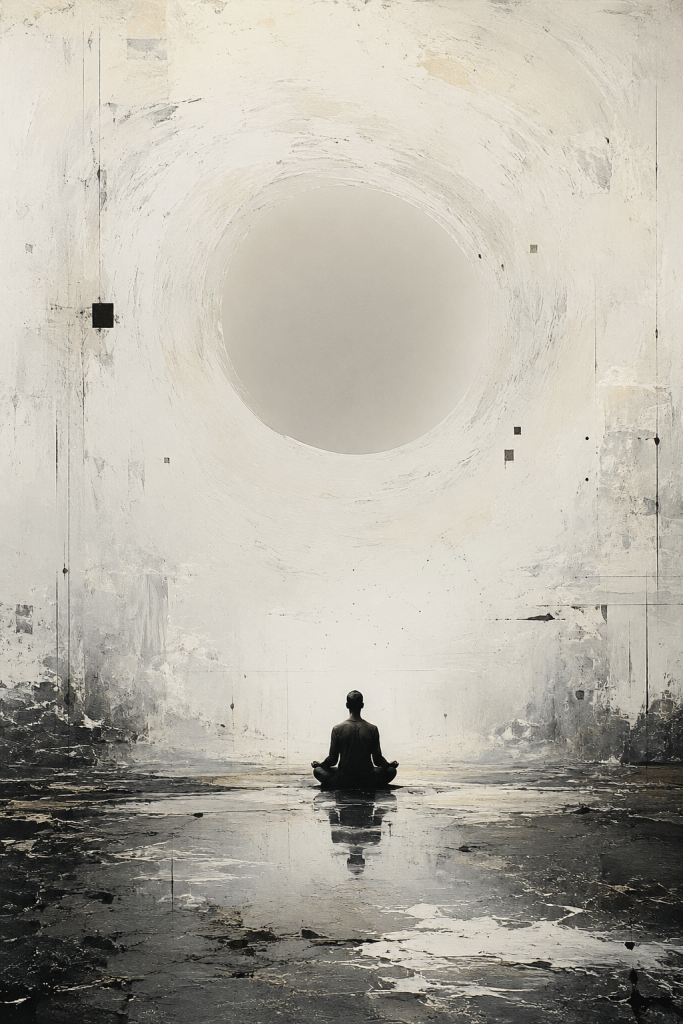
Language faces an impossible task when attempting to speak about what precedes all appearances.

Every word points toward something. Every concept distinguishes one thing from another. Every description relies upon contrast, location, qualities, relationships, or characteristics. Yet what many contemplative traditions refer to as the Absolute, the Ground of Being, or pure reality before conceptualization possesses none of these.

Nothingness is not called nothingness because it is empty in the ordinary sense.

An empty room still contains space. A vacant lot still exists somewhere. Even darkness can be perceived. Ordinary emptiness remains something that can be identified, experienced, or described.

Nothingness, in its deepest philosophical and mystical meaning, points toward that which cannot be located, measured, conceptualized, perceived as an object, or distinguished from anything else.

Location cannot be assigned to it because location itself appears within it.

Time cannot contain it because time arises within experience.

Attributes cannot be given to it because attributes create distinctions.

Existence and nonexistence cannot adequately describe it because both are conceptual categories.

This creates a paradox.

The moment a reference is made, the reference becomes something. The moment a concept is formed, a boundary appears. The moment a description is offered, what is described has already been transformed into an object of thought.

Nothingness is therefore not a description. It is a linguistic surrender.

The word functions less as a definition and more as an admission that thought has reached its limit.

Mystics throughout history have encountered this difficulty. Some called it Brahman. Others called it Sunyata. Some referred to it as the Tao. Others spoke of the Godhead, the Absolute, the Unborn, or the Nameless.

Each term points toward the same problem.

Whatever is being indicated cannot actually be captured by the indication.

A finger pointing toward the moon is not the moon.

A concept pointing toward reality is not reality.

A word pointing toward nothingness is not nothingness.

From a nondual perspective, even calling it nothingness can be misleading. The term may suggest absence, voidness, or negation. Yet what is being pointed toward is not the absence of reality. It is reality prior to division into existence and nonexistence.

Thought asks, “What is it?”

Direct realization reveals that the question itself cannot reach it.

The mind searches for an object and finds none.

It searches for a location and finds none.

It searches for a boundary and finds none.

It searches for a reference point and finds none.

Because no reference can be established, language falls silent.

What remains is called nothingness.

Not because it is literally nothing.

Because every attempt to make it something fails.

Morgan O. Smith

https://linktr.ee/morganosmith

The Architecture of Wholeness

Isolation shrinks perception.

Wholeness expands it.

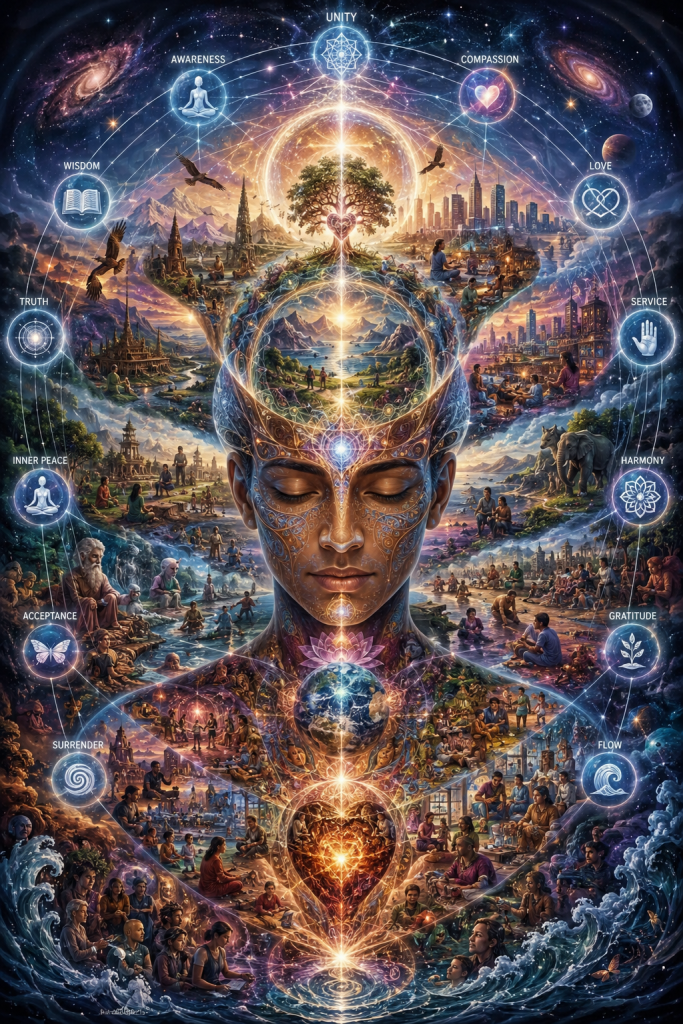
Every relationship you form with people, ideas, environments, challenges, and even suffering becomes part of your inner architecture. Nothing exists independently. Each connection enlarges the field through which life recognizes itself. What many call “growth” is often the gradual dissolution of false separation.

An integral human being does not merely collect information or experiences. They become increasingly interconnected with existence itself.

The more integral you become, the more relationships emerge naturally. Those relationships are not limited to human interaction. A relationship can exist between you and music, silence, nature, philosophy, responsibility, creativity, discipline, grief, or stillness. Every authentic connection widens consciousness.

Expanded relationship leads to expanded inheritance.

Inheritance is not only financial. It includes wisdom, opportunity, insight, support, emotional intelligence, resilience, creativity, intuition, and access to dimensions of reality that remain hidden to fragmented awareness. A disconnected mind sees scarcity because it perceives itself as separate from the whole. An integrated mind begins to recognize that life is constantly offering resources through connection.

Access creates abundance.

Abundance is frequently misunderstood as accumulation. Real abundance is access. Access to insight. Access to support. Access to clarity. Access to meaningful relationships. Access to inner stability. Access to possibility.

A person with few inner or outer connections may possess money yet still feel impoverished. Another person may possess little materially yet move through life with deep richness because they are profoundly connected to existence.

Connection multiplies options.

Options reduce limitation.

Limitation often originates less from external circumstance and more from contracted identity. When consciousness identifies itself as isolated, separate, or incomplete, possibilities narrow. Fear increases. Defensiveness grows. Rigidity forms.

As awareness expands through relationship, identity softens. The walls separating “self” from “other” begin to weaken. Life no longer appears as a battlefield of competing fragments but as an interconnected movement expressing itself through countless forms.

This movement gradually reveals The Self.

Not the egoic self built from memory and social conditioning, but the deeper Self prior to division. The Self that exists before identity becomes trapped inside labels, roles, status, beliefs, or psychological boundaries.

Realizing The Self reduces distinction.

Distinction is necessary within functional reality, yet psychological separation creates suffering. The mind continuously divides existence into categories: mine and yours, success and failure, worthy and unworthy, sacred and ordinary.

Awareness beyond fragmentation begins to perceive unity without erasing diversity. Differences still exist, but hostility toward difference dissolves. Separation loosens its grip.

As separation fades, love ceases to be an emotion directed toward selected objects.

Love becomes the natural condition of unobstructed consciousness.

Not sentimental love.

Not transactional love.

Not possessive love.

A deeper form emerges when the illusion of absolute separateness begins to collapse. That love expresses itself through compassion, patience, understanding, generosity, listening, forgiveness, and presence. It does not arise because reality becomes perfect. It arises because resistance to reality weakens.

Integral living is therefore not simply a developmental achievement.

It is participation in wholeness.

Every meaningful relationship becomes a doorway beyond limitation.

Every moment of genuine connection becomes a form of remembrance.

Every dissolution of separation reveals more of what has always been here.

Love was never absent.

Only obscured by fragmentation.

Morgan O. Smith

No Definition Can Hold the Infinite Whole

Human beings are addicted to definition.

We define nations, identities, emotions, philosophies, and even the boundaries of the cosmos itself. The mind survives through categorization. Without labels, ordinary navigation becomes difficult. Language organizes perception into manageable fragments, allowing consciousness to interpret experience through patterns and distinctions.

Yet something extraordinary happens when the mind attempts to define the infinite.

It fails.

Not because the infinite is irrational, but because definition itself depends upon limitation. To define something means to separate it from what it is not. A tree is not the sky. Water is not stone. The body is not the chair. Every definition creates borders.

The infinite has no border.

This creates a profound paradox. The moment the infinite is defined, it becomes psychologically reduced into an object of thought rather than the living totality from which thought itself emerges.

People speak about God, consciousness, enlightenment, emptiness, Brahman, Tao, or ultimate reality as though these words contain what they point toward. But words are symbols, not the living actuality itself. A menu is not a meal. A map is not the terrain. Spiritual language often becomes mistaken for realization.

Concepts can inspire awakening.
They cannot replace it.

A person may memorize every sacred text ever written and still remain trapped within mental abstraction. Another person may sit silently beneath a tree, beyond philosophy and doctrine, and directly encounter a depth untouched by conceptual thought.

Reality does not require intellectual permission to exist.

The mind struggles with this because it seeks stability through certainty. Certainty creates psychological comfort. Ambiguity threatens identity. This is why people cling to rigid ideologies, religious systems, or philosophical conclusions. Definitions provide the illusion of control over existence.

But existence refuses confinement.

Life continuously overflows the structures created to contain it. Every scientific breakthrough revises older assumptions. Every spiritual revelation dissolves previous certainty. Every profound mystical experience shatters the mental boundaries once believed to be absolute.

The infinite remains untouched by every framework attempting to grasp it.

Ancient sages understood this deeply. Lao Tzu opened the Tao Te Ching by warning that the Tao which can be spoken is not the eternal Tao. Advaita Vedanta points toward neti neti — “not this, not that” — stripping away every conceptual identification. Zen dismantles attachment to intellectual understanding through direct experience and paradox.

These traditions are not anti-intellectual.
They simply recognize the limits of conceptual thought.

Thought is a tool. A remarkable one. But a tool should not be mistaken for the source of reality itself.

Awareness exists before thought comments on it.

Silence exists before language interprets it.

Being exists before identity claims ownership over it.

This recognition changes the entire spiritual journey. Seeking shifts from accumulating beliefs to dissolving false certainty. One no longer attempts to imprison truth inside definitions but instead becomes available to direct experience without resistance.

The infinite cannot be possessed mentally because the mind itself appears within the infinite.

A wave cannot contain the ocean from which it rises.

Perhaps this is why the deepest realizations often arrive with humility rather than triumph. The closer one moves toward ultimate reality, the more obvious it becomes that existence exceeds every philosophical system ever created.

No final sentence survives there.

Only openness.
Only presence.
Only this immeasurable reality appearing as everything.

Morgan O. Smith

Nothing Stands Outside What Already Is

Nothing stands outside what already is.
That includes the observer, the question, the doubt, and the need for resolution.

The search for an outside position is subtle. It hides beneath inquiry, improvement, and even awakening. A sense lingers that something must be reached, clarified, or corrected from a vantage point just beyond experience. Yet no such position exists. There is nowhere to stand apart from what is happening.

Experience does not unfold within a container called reality. Experience is reality expressing itself as appearance, interpretation, and response. The idea of separation arises as one of those appearances, not as evidence of an actual boundary.

Thought suggests distance. It imagines a thinker facing a world, awareness looking at objects, a self navigating conditions. This suggestion feels convincing because it repeats. Repetition gives the impression of structure. Structure gives the illusion of independence.

Nothing has ever been observed from outside what already is. Even the claim “I am separate” appears within the same field it attempts to deny. Opposition does not escape wholeness; it demonstrates it.

The urge to step beyond arises from discomfort with immediacy. Presence offers no leverage, no control panel, no hierarchy. Everything shows up equally entitled to exist; clarity and confusion alike. The mind prefers a higher ground. Reality does not provide one.

This does not collapse meaning. It releases the demand that meaning point somewhere else. Significance no longer depends on transcendence. What matters does so because it appears, not because it leads elsewhere.

Nothing needs to be included, because nothing was excluded. Nothing needs to be unified, because division was conceptual. Difference remains, but it no longer implies fracture. Distinctions function without claiming independence.

Every perspective contributes without completing the whole. No single angle owns truth. No framework escapes limitation. Each reveals something precisely because it cannot reveal everything.

There is no final position to arrive at. No outside reference point to secure certainty. What remains is simple and unremarkable: this, exactly as it is, without appeal or resistance.

Nothing stands outside what already is—
and nothing needs to.

Morgan O. Smith

Get Your Free Copy of My Book, Bodhi in the Brain!

https://subscribepage.io/oTSZQu

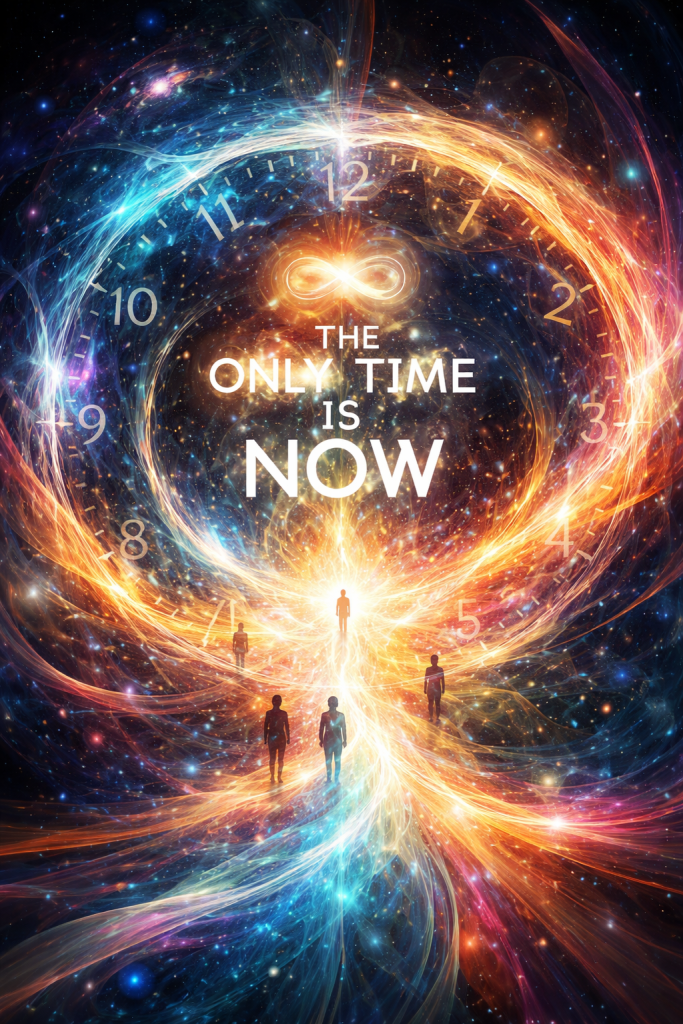
The Only Time Is Now

Something subtle hides behind every assumption about life.
We speak of beginnings, endings, origins, destinies, memories, plans. Language slices reality into segments and calls the slices time. Past. Present. Future.

Direct experience never confirms this division.

Look carefully.

No one has ever stepped into yesterday.
No one has ever arrived at tomorrow.
Everything that has ever appeared shows up only as this immediate presence.

Not a moving present.
Not a fleeting instant.

A boundless, indivisible now.

Mind imagines a line stretching backward and forward, yet perception offers no such line. Thought tells stories about what was and what will be, but those stories arise as present thoughts. Memory occurs now. Anticipation occurs now. Even the idea of history unfolds now.

Remove thought for a moment and see what remains.

Only this.

A beginningless display with no edge to trace.
An endless unfolding with nowhere to land.

Nothing truly starts. Nothing truly stops.

Birth and death appear as transitions inside perception, not events happening to existence itself. Waves rise and fall, yet water never begins or ends with any single wave. Every form behaves the same way. Appearance comes and goes. Being does not.

Cause and effect seem separate only because mind arranges events into sequence. First this, then that. Push, then response. Action, then consequence.

Observe more closely.

Cause and effect share the same instant.
The spark and the flame are one movement.
Seed and tree are different names for one process.

Nothing travels through time to produce something else. Everything co-arises. Each moment contains the totality.

That means creation and destruction are not opposite forces.

They are the same gesture.

Every perception is simultaneously appearing and disappearing. Each sight is born as it fades. Each sound vanishes as it arrives. Reality recreates itself continuously without carrying anything forward.

World dissolves and reforms faster than thought can measure.

Continuity is a useful illusion.

Life becomes lighter when this is recognized. Regret loses its grip because there is no past to fix. Anxiety softens because there is no future to secure. Control relaxes because nothing stands outside the present to manage.

Responsibility remains, yet it feels different. Actions arise from clarity rather than fear. Choices flow from immediacy rather than projection. Compassion deepens because everything shares the same timeless ground.

Nothing stands apart.

Every face, every event, every challenge expresses the same indivisible happening.

No separate moment waits elsewhere.
No hidden realm holds another version of reality.

This is it.

Not a fragment.
The whole.

Eternity does not stretch forever.
Eternity reveals itself as what never moves.

Right here.
Right now.
Always.

Morgan O. Smith

AI for Wellness and Spirituality Summit

February 9 & 10, 2026

https://aiforwellnessandspirituality.com/mosm

What Never Changes

A quiet assumption hides beneath most human searching: something out there must last. Something must remain untouched by erosion, loss, time, or collapse. That assumption fuels religion, philosophy, science, self-help, and even despair. Yet careful observation reveals a startling reversal; everything we try to secure as permanent is precisely what cannot stay.

Bodies age. Identities shift. Beliefs mutate. Civilizations rise and fall. Even universes, according to modern cosmology, are not exempt from birth and dissolution. Permanence refuses to appear where attention habitually looks.

What does remain cannot be grasped as an object.

Change never pauses. This is not a poetic statement but a structural fact. No phenomenon has ever been observed to freeze itself into finality. Even stability is a form of slow motion. Even stillness contains motion beneath its surface. Change does not fluctuate. It does not improve. It does not degrade. It simply is.

Impermanence, often misunderstood as a gloomy conclusion, turns out to be absolute. Nothing violates it. Not matter. Not energy. Not thought. Not consciousness as an experience. Impermanence itself never wavers.

Awareness appears constant, yet experiences within it rotate endlessly. Sensations replace sensations. Thoughts override thoughts. Emotions dissolve into others. What remains is not a personal witness but the bare fact that experiencing is happening at all. That fact has no texture, no color, no personality, and no history. It does not evolve because evolution belongs to what appears within it.

Absence plays an unexpected role here. No thing possesses an independent core. Every form depends on conditions that are themselves dependent. This lack of inherent selfhood does not come and go. It is always already the case. What seems solid holds together through relationship alone.

Separation feels real, yet it never completes itself. Subject and object arise together. Observer and observed cannot be pried apart without collapsing the experience entirely. Duality functions, but it does not fracture reality. Division appears without dividing.

Nothingness, often feared or romanticized, is better understood as openness. Forms emerge, interact, and vanish without ever crystallizing into fixed essence. Emptiness does not negate existence; it allows it.

What never changes does not announce itself. It cannot be defended or achieved. Seeking it as an attainment guarantees frustration. It is not hidden. It is overlooked because it lacks features.

Everything changes.
That does not.

Recognition of this does not erase life’s texture. It sharpens it. When permanence is no longer demanded of form, form is finally allowed to be what it is; temporary, intimate, vivid, and sufficient.

Nothing needs to be saved from change.
Nothing needs to be added to what already remains.

Morgan O. Smith

AI for Wellness and Spirituality Summit

February 9 & 10, 2026

https://aiforwellnessandspirituality.com/mosm

The Fourth and Fifth Perspectives

Human understanding evolves by taking positions.
At first, reality is personal. Experience belongs to me. Then it becomes relational. There is you. Then objective. There is the world. These perspectives organize life, language, and survival. They also quietly assume something deeper: a vantage point from which all of this is known.

The fourth perspective emerges when that assumption is examined.

At this level, identity no longer anchors experience. Thoughts, sensations, and events appear without belonging to a self. Awareness is no longer located behind the eyes or inside the body. Experience is revealed as happening within an impersonal field. Nothing is owned. Nothing is central. Knowing continues, yet no knower can be found.

This recognition often carries clarity, peace, and coherence. Reality appears seamless. Distinctions soften without disappearing. Functioning remains intact, but the sense of authorship dissolves. Many traditions stop here and mistake this discovery for the final truth.

That pause matters.

The fifth perspective does not deepen the fourth.
It removes the need for it.

The idea of an underlying field, awareness, or witnessing presence is seen as another explanatory structure. Useful, elegant, even beautiful, but unnecessary. The question of what everything appears within loses relevance. No ground is required. No container is implied. No reference point is privileged.

Reality no longer needs to be described as nondual.
It no longer needs to be described at all.

This is not an experience. It does not arrive. Nothing stabilizes. Nothing collapses. The framework that seeks a final position simply fails to apply. Language continues to function, but without metaphysical commitment. Perspectives still appear, but none are taken as true in themselves.

The fourth perspective reveals that there is no centre.
The fifth reveals that even that revelation was optional.

This does not result in indifference or withdrawal. Action continues. Care continues. Creativity continues. Meaning appears where it always did; within context, relationship, and response. What falls away is the assumption that reality needs a final explanation to be complete.

Ultimate reality is not hidden behind experience.
It is not accessed by climbing to a higher vantage.
It does not require awareness, unity, or silence to validate itself.

What remains is remarkably ordinary.
Life unfolds. Language speaks. Understanding happens.
Nothing needs to be added. Nothing needs to be removed.

The difference lies only here:
no perspective is mistaken for what is real.

Morgan O. Smith

AI for Wellness and Spirituality Summit

February 9 & 10, 2026

https://aiforwellnessandspirituality.com/mosm

What Appears Is Never What It Is

Nothing arrives as itself. What shows up as form, event, thought, or identity is already a veil; yet not a veil hiding something else. Appearance is the way the unseen speaks. Expression is not a mask placed over truth; expression is the activity of truth.

Time does not obscure reality. Time is one of its gestures. Space does not distance anything from what is real. Space is a mode of presentation. Every person, object, moment, and movement stands as a precise articulation of what cannot be isolated, possessed, or fully perceived.

What remains unseen is not absent. It is unlocatable.

The true nature does not sit behind phenomena waiting to be uncovered. It never retreats from what appears. Every disguise is complete. Every expression is equal. No hierarchy of forms exists at the level where all forms arise.

Archaic consciousness does not miss truth; it reflects truth as survival and immediacy. Magical consciousness does not distort reality; it reveals participation and symbolic power. Mythic consciousness does not fabricate meaning; it expresses coherence through story and order. Modern consciousness does not reduce the world; it articulates precision, structure, and agency. Postmodern consciousness does not fragment truth; it exposes hidden assumptions and unspoken exclusions. Integral consciousness does not transcend the earlier forms by negation; it includes them as necessary articulations. Super-integral awareness does not stand above the whole; it recognizes the whole as already complete.

No stage corrects another. Each stage speaks a different dialect of the same unspeakable source.

Egocentric, ethnocentric, worldcentric, and Kosmocentric orientations do not compete for validity. Each reflects how the whole experiences itself through scale and concern. What feels limited at one level becomes coherence at another, without contradiction.

Subjective experience does not oppose objective reality. Intersubjective meaning does not negate interior depth. Interobjective systems do not erase lived presence. These are not separate territories. They are simultaneous dimensions of one unfolding.

Qualities appear; love, fear, intelligence, inertia, clarity, confusion. Attributes seem to form; shape, duration, movement, pattern. Absence also appears; emptiness, silence, negation. None of these define the source. None of these exclude it.

The true nature cannot be seen because it never stands apart from seeing. It cannot be grasped because it never stands opposite grasping. Every attempt to point to it becomes another appearance, and that appearance is already sufficient.

Nothing is hiding. Nothing is missing. Nothing needs to be revealed.

What is appearing is exactly what reality looks like when it expresses itself without needing to explain.

Morgan O. Smith

AI for Wellness and Spirituality Summit

February 9 & 10, 2026

https://aiforwellnessandspirituality.com/mosm

When Simplicity Refuses to Stay Simple

Nonduality appears disarmingly straightforward. Nothing is separate. Reality is one. No division truly exists. The mind nods in agreement, almost bored by how obvious it sounds. That very ease, however, conceals a depth that resists containment. What seems immediately graspable slips away the moment it is examined.

Simplicity unsettles the intellect. Complexity gives the mind something to work with; layers, distinctions, problems to solve. Nonduality offers no such footholds. It removes the scaffolding the mind depends on while leaving awareness intact. The result feels paradoxical: clarity without structure, certainty without conclusion.

The mind instinctively tries to stabilize the insight by forming opposites. Simple versus complex. Absolute versus relative. Unity versus multiplicity. These contrasts feel necessary, even helpful. They provide orientation. Yet nonduality does not deny distinctions; it denies their independence. Distinctions function, but they do not stand alone.

Remove the boundary between simplicity and complexity, and both are revealed as conceptual movements rather than opposing truths. Simplicity contains complexity without effort. Complexity resolves into simplicity without loss. Nothing needs to be excluded for wholeness to be present.

This is where theory reaches its limit. Conceptual understanding can describe the inclusion of all distinctions, but description is not realization. Comprehension at this level is accurate yet incomplete. The mind can map the territory without stepping into it.

Nonduality understood as an idea remains elegant and coherent. Nonduality recognized as reality dissolves the need for coherence altogether. The question of complexity no longer arises, because nothing stands outside what is already complete.

Thought can approach this recognition, but it cannot cross the threshold. The final movement is not analytical but surrendering the need to resolve the paradox. What remains is neither simple nor complex, neither one nor many. What remains is what was never absent…Yet, it is.

Morgan O. Smith

AI for Wellness and Spirituality Summit

February 9 & 10, 2026

https://aiforwellnessandspirituality.com/mosm

Nothing Is Not Hidden

“Nothing” is what it appears to be. The difficulty is not its subtlety, but our resistance to the obvious. Bias does not distort reality by adding complexity; it obscures by insisting that something more must be there.

The mind is conditioned to hunt for substance. It scans experience for objects, causes, meanings, and conclusions. When it encounters absence, silence, or emptiness, it assumes a failure of perception rather than the possibility that absence itself is the disclosure. Nothing is dismissed as a placeholder, a gap waiting to be filled, instead of recognized as complete.

Bias enters quietly. It wears the mask of intelligence, spirituality, and discernment. It whispers that truth must be profound, layered, or difficult to access. It suggests that what is immediately present cannot be ultimate, because it does not feel earned. Yet this assumption is precisely what blocks seeing.

Nothing does not hide behind form. It is revealed as form. Every sensation, thought, and emotion arises from it without leaving it. The error lies in expecting Nothing to announce itself as an object among objects. It does not compete for attention. It is the condition allowing attention to appear at all.

Seeking reinforces the bias. The seeker assumes a distance between what is and what should be known. That distance is imagined. Nothing is already fully exposed, but the demand for interpretation overlays it with concepts, metaphysics, and personal narratives. The obvious becomes invisible because it lacks drama.

Bias also clings to continuity. It prefers stable identities, persistent meanings, and coherent stories. Nothing threatens these preferences, not by opposing them, but by showing they were never fixed to begin with. The mind resists this not out of fear of annihilation, but out of loyalty to familiarity.

Seeing Nothing requires no refinement of perception. It requires the cessation of interference. When bias relaxes, what remains is not a revelation, but an acknowledgment. Nothing stands as it always has—unconcealed, ordinary, and sufficient.

No transformation is required to meet it. Only the willingness to stop arguing with what is already clear.

Morgan O. Smith

Get Your Free Copy of My Book, Bodhi in the Brain!

https://subscribepage.io/oTSZQu