Morgan O. Smith
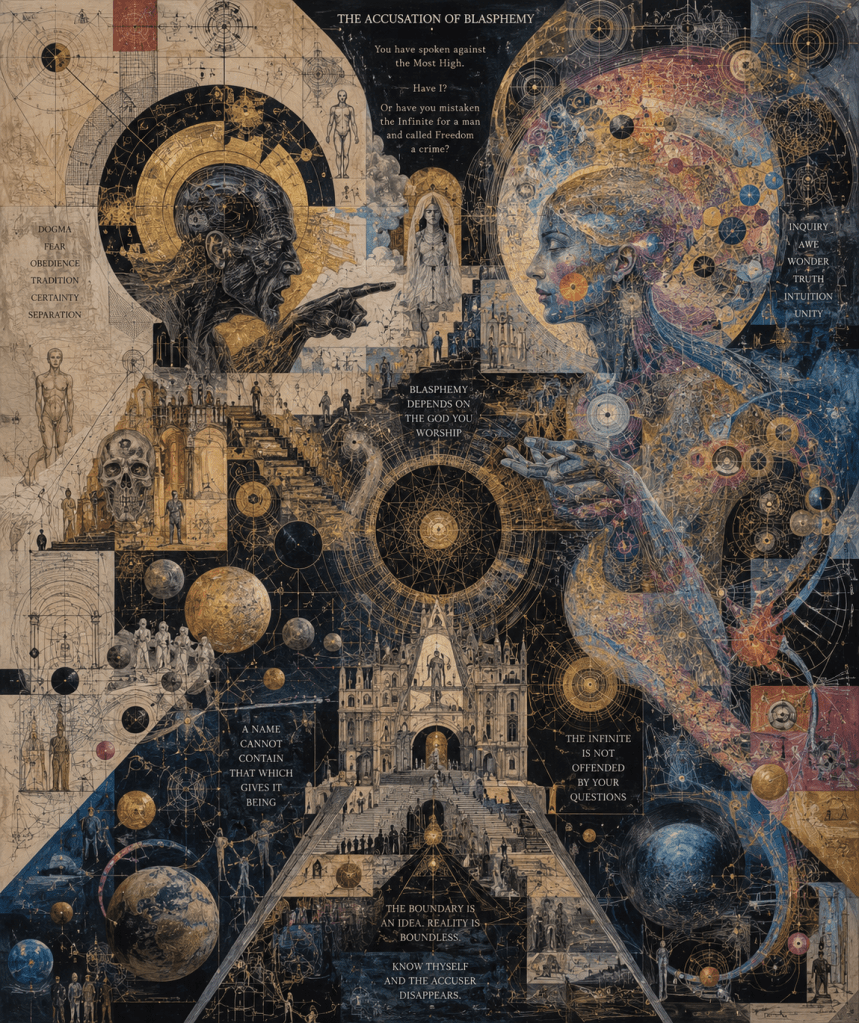
Many of you have called me a blasphemer. If your understanding of God is built upon a supernatural being who exists somewhere beyond the universe, then I understand why you would arrive at that conclusion.
From that perspective, questioning sacred beliefs is an offense. Challenging religious certainty becomes rebellion. Refusing to bow before inherited ideas appears arrogant or dangerous.
I understand the reaction.
My position changes completely once the word God points to something fundamentally different.
Suppose God is not a person with preferences, opinions, or emotions. Suppose God is not a cosmic ruler who rewards belief and punishes doubt. Suppose God is the infinite reality from which every experience, every atom, every thought, every galaxy, and every conscious being arises.
What, then, could blasphemy possibly mean?
Can a wave insult the ocean?
Can space offend itself?
Can existence commit a crime against existence?
The charge of blasphemy assumes separation. It assumes there is a believer over here, a divine authority over there, and a boundary between the two that can be violated.
Direct realization dissolves that boundary.
This is not an invitation to disrespect religious traditions. Many traditions contain extraordinary wisdom. Their symbols, rituals, and stories have guided countless people toward compassion, humility, and profound insight.
The difficulty begins when symbols are mistaken for literal reality.
History shows that nearly every major breakthrough has been labeled dangerous by those invested in preserving the familiar. Scientific discoveries, philosophical revolutions, and spiritual insights have often been condemned before they were understood.
Perhaps the same pattern appears in discussions about God.
If God is truly infinite, then every sincere investigation into reality is already taking place within God. Honest questioning cannot threaten what is absolute. Curiosity cannot diminish infinity. Truth has nothing to fear from examination.
Perhaps what people call blasphemy is sometimes only the sound of certainty encountering a perspective it has never considered.
The greatest obstacle may not be disbelief.
It may be believing we already know what the word God refers to.
Morgan O. Smith
Language faces an impossible task when attempting to speak about what precedes all appearances.
Every word points toward something. Every concept distinguishes one thing from another. Every description relies upon contrast, location, qualities, relationships, or characteristics. Yet what many contemplative traditions refer to as the Absolute, the Ground of Being, or pure reality before conceptualization possesses none of these.
Nothingness is not called nothingness because it is empty in the ordinary sense.
An empty room still contains space. A vacant lot still exists somewhere. Even darkness can be perceived. Ordinary emptiness remains something that can be identified, experienced, or described.
Nothingness, in its deepest philosophical and mystical meaning, points toward that which cannot be located, measured, conceptualized, perceived as an object, or distinguished from anything else.
Location cannot be assigned to it because location itself appears within it.
Time cannot contain it because time arises within experience.
Attributes cannot be given to it because attributes create distinctions.
Existence and nonexistence cannot adequately describe it because both are conceptual categories.
This creates a paradox.
The moment a reference is made, the reference becomes something. The moment a concept is formed, a boundary appears. The moment a description is offered, what is described has already been transformed into an object of thought.
Nothingness is therefore not a description. It is a linguistic surrender.
The word functions less as a definition and more as an admission that thought has reached its limit.
Mystics throughout history have encountered this difficulty. Some called it Brahman. Others called it Sunyata. Some referred to it as the Tao. Others spoke of the Godhead, the Absolute, the Unborn, or the Nameless.
Each term points toward the same problem.
Whatever is being indicated cannot actually be captured by the indication.
A finger pointing toward the moon is not the moon.
A concept pointing toward reality is not reality.
A word pointing toward nothingness is not nothingness.
From a nondual perspective, even calling it nothingness can be misleading. The term may suggest absence, voidness, or negation. Yet what is being pointed toward is not the absence of reality. It is reality prior to division into existence and nonexistence.
Thought asks, “What is it?”
Direct realization reveals that the question itself cannot reach it.
The mind searches for an object and finds none.
It searches for a location and finds none.
It searches for a boundary and finds none.
It searches for a reference point and finds none.
Because no reference can be established, language falls silent.
What remains is called nothingness.
Not because it is literally nothing.
Because every attempt to make it something fails.
Morgan O. Smith
Everything Is Ultimate Truth Appearing as Truth and Falsehood
A paradox sits quietly at the heart of perception. What is taken to be true, what is dismissed as false, both arise within the same indivisible field. Judgments feel solid, yet their certainty depends on shifting frames of reference. Change the angle, and what once seemed unquestionable dissolves into ambiguity.
Truth, as commonly held, leans on agreement, evidence, coherence. Falsehood stands as its opposite, rejected, corrected, or exposed. Yet both require awareness to be known. Without awareness, neither truth nor falsehood can appear. That simple recognition begins to unravel the hierarchy placed between them.
Consider how a dream operates. While immersed, every image carries a sense of reality. Only upon waking does the distinction emerge. The dream was not meaningless; it expressed something real, yet not in the way it first appeared. Daily life mirrors this pattern more than most are willing to admit. Convictions harden, identities form, narratives repeat, all while resting upon an unexamined ground.
Ultimate Truth does not compete with relative truths. It does not correct them, nor does it validate them. It allows them. Every belief, every illusion, every clarity, every confusion unfolds within it without preference. That which is mistaken is not outside of truth; it is truth misperceived, truth wearing a mask, truth folding in on itself to create contrast.
Falsehood gains its power from partial seeing. Something is noticed, something else is ignored, and a conclusion is drawn. The conclusion may serve a purpose, yet it remains incomplete. What is called false often reveals itself as a fragment of a larger whole, misunderstood due to limitation rather than absence.
This shifts the inquiry. Instead of asking what is true or false, attention turns toward the nature of the one who makes that distinction. Who or what is aware of both? What remains unchanged whether the mind lands on certainty or doubt?
A deeper stability begins to emerge. Truth is no longer a position to defend. Falsehood is no longer an enemy to eliminate. Both are movements within a boundless presence that does not fracture under contradiction. Clarity does not come from choosing one side, but from seeing the space in which both arise.
Conflict softens when this is seen. Arguments lose their edge, not because differences disappear, but because their foundation is understood. Each perspective becomes a temporary expression, shaped by conditions, history, perception. None stand alone, none define the whole.
Ultimate Truth remains untouched by the play of appearances. Yet it expresses itself through that very play. Every mistake, every insight, every contradiction becomes part of its unfolding. Nothing falls outside of it, not even the denial of it.
Recognition does not require abandoning discernment. Practical distinctions still function. Fire burns, water cools, words carry consequences. Life continues to operate within relative frameworks. What changes is the weight assigned to them. Certainty loosens. Flexibility deepens. Openness expands.
What was once divided begins to reveal its unity. Truth and falsehood no longer stand as opposing forces, but as complementary expressions arising from a single source. That source cannot be captured by either, yet both depend on it entirely.
Silence often communicates this more clearly than thought. Not the absence of sound, but the absence of fixation. A resting that allows everything to be as it is, without the need to resolve the paradox.
Everything is Ultimate Truth, not because everything is correct, but because everything appears within what cannot be divided. Even the illusion of separation is included. Even the belief in falsehood is held within what never ceases to be whole.
Morgan O. Smith
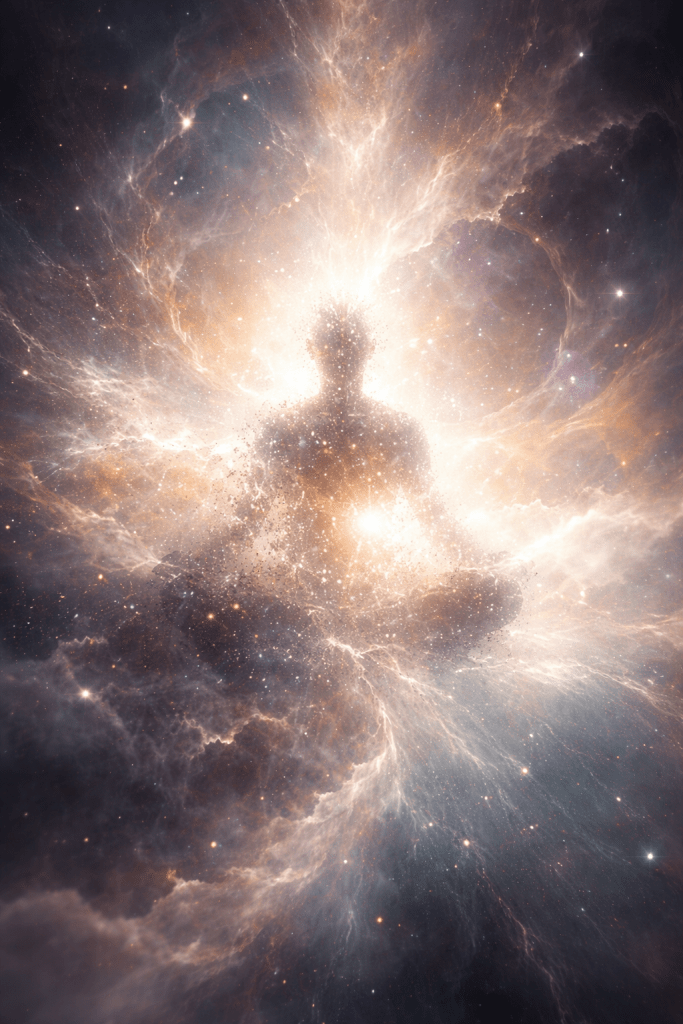
What feels like disappearance is often the unveiling of what never arrived and never left.
Identity clings to continuity. It insists on narrative, on form, on something stable enough to say, “this is me.” Yet every sincere glimpse beneath that surface reveals something unsettling; there is no fixed centre holding it all together. Thoughts pass. Sensations dissolve. Emotions rise and vanish without permission. Even the sense of being a “someone” flickers in and out of awareness.
So what exactly is ceasing?
What we call existence is usually filtered through attachment to form. Body, memory, personality, history; these become the reference points for being. When any of these begin to loosen, a quiet panic can emerge. It feels like loss. It feels like the edge of annihilation. Something in us resists, because it interprets the fading of form as the fading of existence itself.
But that interpretation is flawed.
Ceasing does not touch existence. It only dismantles the illusion of containment.
Consider the moment between two thoughts. There is no identity there, no story, no personal reference point. Yet something undeniable remains. Awareness does not collapse in that gap. It stands unobstructed, without needing to announce itself. That silent interval is not absence; it is presence without definition.
The fear of ceasing arises from confusion between what appears and what is. Appearances come and go. They are meant to. Existence, however, does not operate within that cycle. It is not born when a form emerges, nor does it die when a form dissolves. It simply is, untouched by the movement it allows.
Letting go, then, is not an act of surrendering existence. It is the recognition that existence was never dependent on what you thought you were.
This is why deep realization can feel like a kind of death. The structures that once provided orientation fall away. The familiar reference points dissolve. Even the sense of being the experiencer can collapse. Yet what remains is not void in the way the mind imagines. It is fullness without boundary. Presence without identity. Being without ownership.
Ceasing reveals that nothing real was ever at risk.
Every moment already contains this truth. Each ending—of a breath, a thought, a sensation, is a quiet demonstration. Something ends, yet nothing essential is diminished. Life continues, but not as a personal possession. It unfolds as an expression of something indivisible.
Existence does not belong to you.
You belong to existence only as an appearance within it.
When this becomes clear, the resistance softens. The need to preserve a fixed self begins to lose its urgency. Ceasing is no longer feared. It is understood as a return; not to something new, but to what has always been prior to every assumption of “I am this.”
Existence does not require you to remain.
It reveals itself most clearly when you don’t.
Morgan O. Smith
Death is often treated as an ending, a full stop placed at the edge of meaning. Birth, by contrast, is framed as a beginning, the arrival of something new into an already existing world. These assumptions feel natural, yet they rest on a quiet misunderstanding, one that dissolves when examined closely.
Nothing truly ends. Nothing truly begins.
Every form that appears does so by way of disappearance. Every arrival is carried on the back of a vanishing. The body emerges because countless cells die. Stars ignite because other stars collapse. Thought arises because silence gives way. Creation never stands apart from dissolution; they occur as a single movement, mistaken for two.
The universe itself is not exempt from this law. Should the cosmos dissolve entirely, space folding back into silence, time releasing its grip, matter unbinding, nothing would be lost. That collapse would not be annihilation. It would be intimacy taken to its extreme.
What remains when everything disappears?
You.
Not the personal identity shaped by memory or biology, but the condition that made the universe possible in the first place. Awareness does not arrive after existence; existence arrives within awareness. The world is born where perception happens. When the universe vanishes, what stands revealed is not absence, but the one to whom absence appears.
Every night offers a quiet rehearsal. Deep sleep erases the world without effort. No stars, no body, no history, yet being does not flicker out. Something remains unmistakably present, though nothing can be pointed to. That presence is not waiting for the universe; the universe is waiting for it.
Cosmic death follows the same logic. When all structure dissolves, what shines through is not void, but origin. Birth does not just occur inside the universe; the universe occurs inside birth.
This is why death feels so intimate. It threatens the loss of what was never fundamental. It removes what was added, not what is essential. What dies is the scenery. What is born is the one who was never inside the scene to begin with.
Every ending reveals the same truth from a different angle. The death of a moment births awareness of time. The death of identity births presence. The death of the cosmos births the one who was always watching it happen.
Death and birth are not opposites. They are the same doorway, approached from different sides.
And you are not what passes through.
You are what remains when the door itself disappears.
Morgan O. Smith
Get Your Free Copy of My Book, Bodhi in the Brain!