The Throne of Illusions

How the Mind Deifies Itself

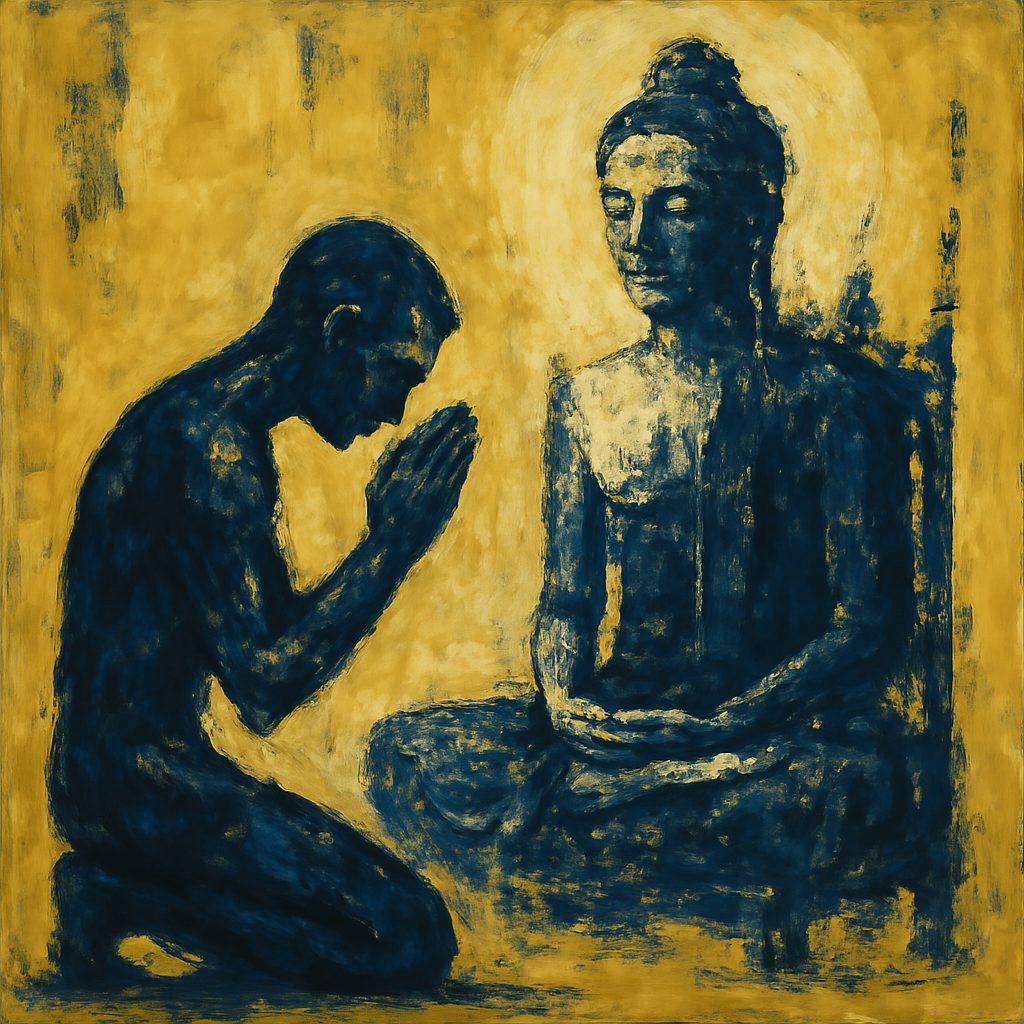
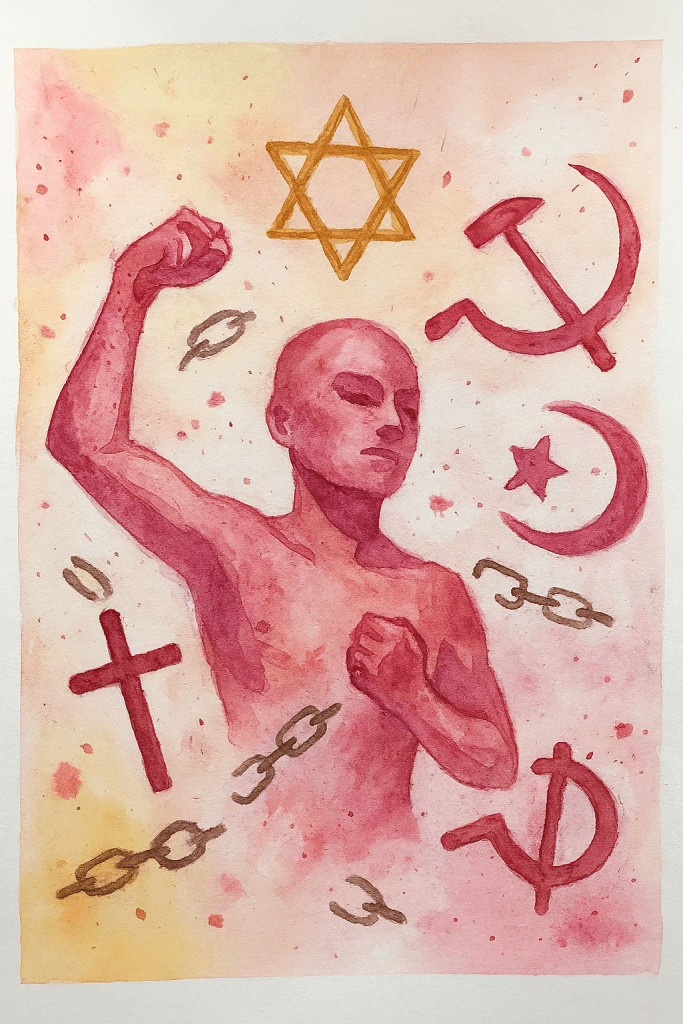
The mind constructs its ruler—a sovereign draped in reverence, sculpted from ideals we exalt but refuse to embody. This deity is not an external force but a projection of the highest aspects of ourselves, polished and placed on an altar beyond reach. It is the sum of virtues we admire but disown, an illusionary monarch fashioned by the governing voice of the psyche.

This entity—crafted from moral codes, cultural doctrines, and inherited beliefs—sits enthroned above the nature it was designed to suppress. It governs impulses deemed unruly, desires cast into shadow, and instincts labeled sinful. To tame the wildness within, the mind erects an overseer—one adorned in righteousness, one feared yet adored.

But this sovereign is nothing more than an elaborate mirage, a construct sustained by collective faith. Every attribute labeled “good” is stripped from the individual and projected outward, transformed into a divine presence we serve rather than integrate. This keeps virtue at a distance, shimmering like unreachable jewels in an unseen vault. The self, fragmented by this artificial hierarchy, remains divided—some aspects glorified, others buried in shame.

Like all forms of dominion, this imagined rulership thrives on submission. Fear fuels its reign, whispering myths of punishment and reward. The throne itself is upheld by those who kneel before it, unaware that they are the architects of their captivity. Yet, the power we assign to this fabricated ruler has always belonged to us. The virtues we attribute to it are the very qualities waiting to be reclaimed.

The moment one ceases to externalize greatness, the illusion collapses. No ruler remains—only an undivided self, whole and sovereign.

Morgan O. Smith

Yinnergy Meditation/Neurofeedback, Spiritual Life Coaching & My Book, Bodhi in the Brain…Available Now!

https://linktr.ee/morganosmith

Beyond Mortality

A Gaze into the Infinite

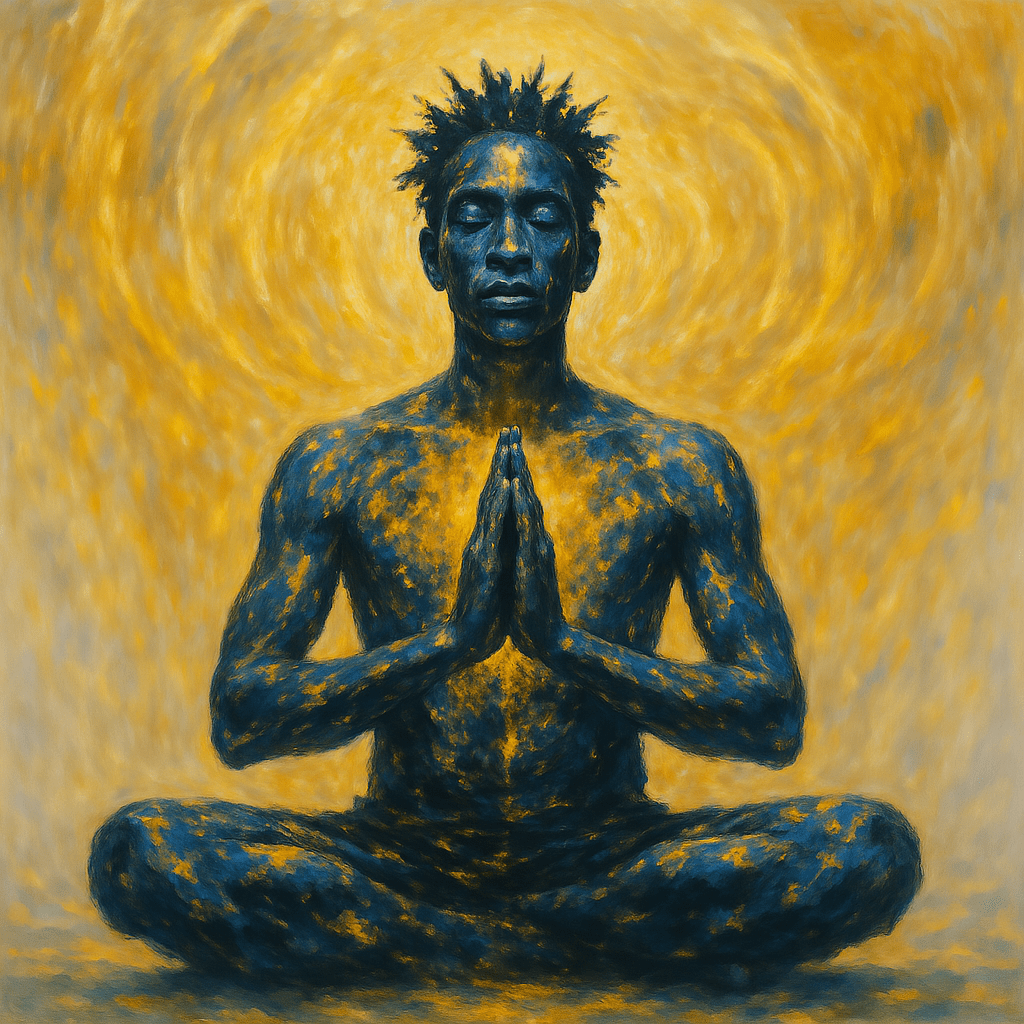
A moment arrives when existence no longer appears as a scattered collection of isolated events. The world that once seemed separate dissolves, revealing a singular, undivided field of awareness. A startling recognition unfolds: nothing has ever been apart from anything else. It was only perception, veiled in habitual conditioning, that suggested otherwise.

This shift is not a mere conceptual understanding but a direct, undeniable realization. A sense of completeness emerges, untouched by the echoes of forgotten memories or the undercurrents of unconscious shadows. It is as if a long-lost secret has resurfaced, one that had always been present yet unseen.

The gravity of prior assumptions becomes laughable. The absurdity of the once-cherished illusions is exposed, leaving nothing but a profound, unshakable peace. What was once deemed distant now stands as the very essence of Being. A gaze into the heart of existence reveals an unbroken love—love not as an emotion, but as the raw, vibrating reality underlying all things.

What was once mundane now glows with an ineffable radiance. The ordinary becomes extraordinary. Every step, every breath, every fleeting sensation now brims with unspeakable beauty. The notion of duality collapses, not as an abstraction but as a living, breathing certainty. The joys and sorrows of the world are felt without resistance, dissolving into a seamless expanse that is neither joy nor sorrow, yet holds both.

The self, once believed to be confined within flesh and thought, reveals its vastness. Awareness expands beyond personal identity, interweaving with the collective hum of existence. The mind no longer clings to its narrative but dances freely in the boundless rhythm of the whole.

A clarity dawns—reality was never as it seemed. The senses had merely dressed the formless in familiar attire, mistaking projections for truth. What had been perceived as real was nothing more than a refracted glimmer of something deeper, something ungraspable yet ever-present. And once this is seen, it cannot be unseen.

Every cell vibrates in coherence, every particle flickers with intent, all moving in an exquisite harmony. There is no separation between the observer and the observed. The very air hums with a silent language, one that speaks not in words, but in direct knowing. It is a language without syntax, yet it communicates everything. To grasp it is to step into a realm beyond both sanity and madness, where paradox is no longer contradiction but completion.

To touch this space, even momentarily, is to witness the ineffable. The sky and earth merge, the seen and unseen intertwine, and the weight of distinction evaporates. It is here that the greatest truth is revealed: the story of existence cannot be told, for it is not a story at all. It is the living breath of the unknown, an unspoken song resonating in the heart of all things.

To see oneself fully is to vanish. To feel oneself fully is to disappear. In this luminous paradox, joy and mourning entwine, delight and longing become indistinguishable. A blissful lament echoes from the depths, mourning not loss, but the shedding of illusion.

Here, the mortal walks among the divine, and even beyond.

Morgan O. Smith

Yinnergy Meditation/Neurofeedback, Spiritual Life Coaching & My Book, Bodhi in the Brain…Available Now!

https://linktr.ee/morganosmith

The Awakening That Shatters Illusions

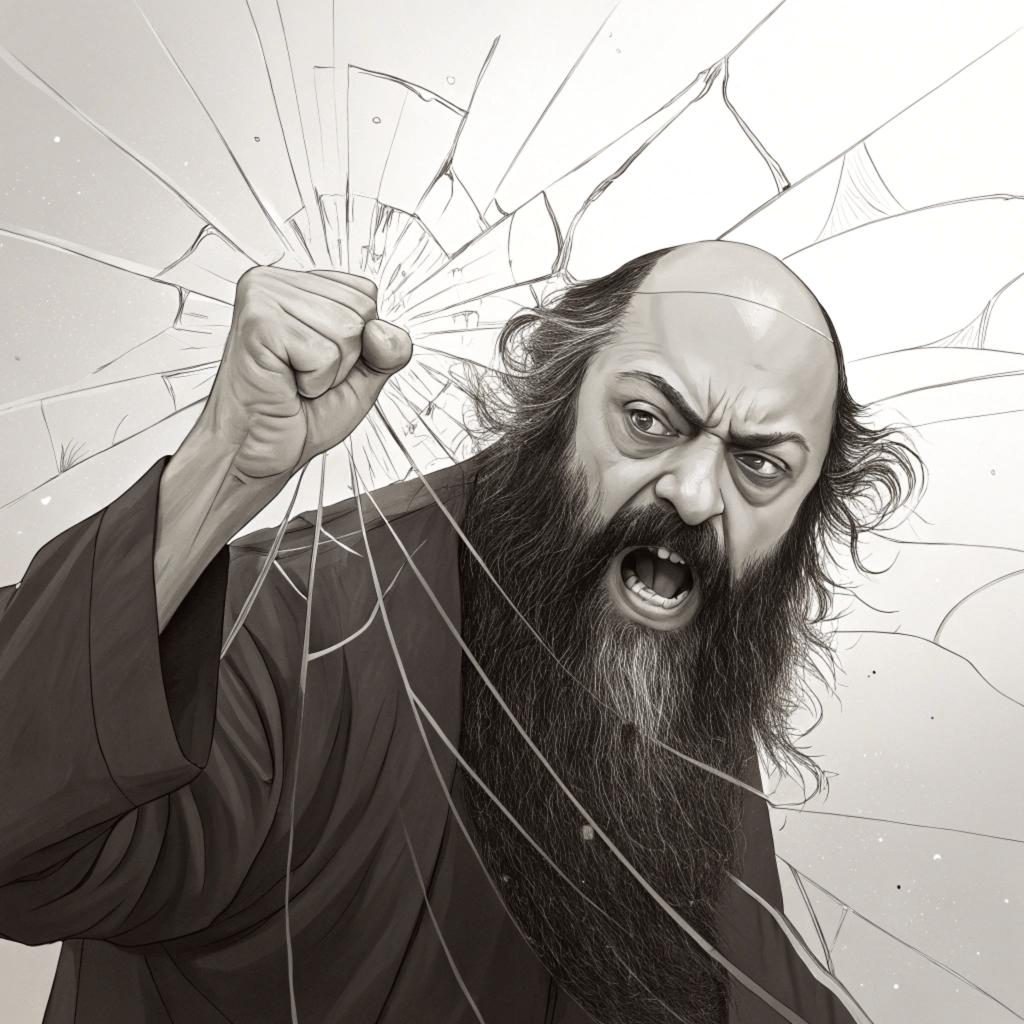
The kind of awakening spoken of in hushed tones is not the polished enlightenment paraded as a spiritual accomplishment. It is not the gentle illumination that leaves one basking in self-satisfaction. This awakening will chase any so-called enlightened being back into the cave of the darkest shade of the blissfully ignorant.

There is a threshold beyond which the comfort of spiritual attainments dissolves, where the foundation of all presumed knowledge crumbles. Many claim to walk this path, but few have stepped beyond the point of no return. The self is torn open, and what is left is neither the seeker nor the sought. Any trace of identity vanishes like smoke swallowed by the wind.

Silence remains, not the cultivated silence of meditation, but the raw and inescapable absence of all that was ever known. Those who truly fall through the illusion do not return with neatly packaged wisdom. They do not speak of levels, progress, or mastery. They see no self to improve, no world to fix, no mind to transcend. Words become inadequate, and the urge to declare one’s arrival dissipates.

The mind clings to certainties, but what happens when even the witness dissolves? When there is no observer to claim insight, no reference point to anchor meaning? The dissolution is total. It does not comfort; it obliterates. Those who once seemed enlightened are left exposed, scrambling for the remnants of a ground that no longer exists.

This is why many turn back, seeking solace in philosophies, traditions, and spiritual titles. There is safety in keeping one foot on familiar terrain. The true leap leaves nothing to hold onto. Those who cross that final threshold do not emerge with proclamations of awakening. They are not concerned with recognition, nor do they offer roadmaps. They simply are – formless, weightless, ungraspable.

Some may glimpse this abyss and recoil, choosing the dream over the void. Others may step forward and vanish.

Morgan O. Smith

Yinnergy Meditation/Neurofeedback, Spiritual Life Coaching & My Book, Bodhi in the Brain…Available Now!

https://linktr.ee/morganosmith

The Love That Sees No Other

Love often carries conditions. It bends and shifts based on who stands before us, what they have done, and how they fit within our narratives. But what happens when love is no longer filtered through preference, judgment, or familiarity? What happens when love is not reserved for a select few but moves through everything, as everything?

The idea of loving everyone and everything as you love yourself is not about adopting a passive, all-accepting sentimentality. It is a radical act that dissolves the illusion of separateness. To love in this way is to recognize no fundamental difference between self and other, between what is cherished and what is feared, between what is understood and what is unknown.

Many believe they love themselves, but beneath the surface, self-love is often conditional. It thrives when things go well but falters in moments of doubt and suffering. If love for oneself is inconsistent, how can it extend unconditionally to others? This is where the real work begins – not in forcing affection but in dissolving the barriers that obscure the truth.

Love does not seek control. It does not require agreement. It is not contingent upon behaviour, belief, or shared experience. Love, in its purest form, simply is. To embody this means relinquishing the mind’s tendency to divide reality into worthy and unworthy, friend and foe, sacred and mundane.

Walking through life with this kind of love does not mean tolerating harm or ignoring injustice. It means meeting everything with the clarity that nothing stands apart from you. Love can take the shape of tenderness, but it can also be fierce, clear, and unwavering. To love everyone and everything as yourself is not to abandon discernment – it is to see beyond distortion, beyond fear, beyond the illusion that anything is truly separate from anything else.

This is not an instruction to be followed. It is an inquiry to be lived. How does love move through you when nothing is excluded? When no one is outside its reach? When the self dissolves into the vastness of Being, what remains but love itself?

Morgan O. Smith

Yinnergy Meditation/Neurofeedback, Spiritual Life Coaching & My Book, Bodhi in the Brain…Available Now!

https://linktr.ee/morganosmith

The Unutterable Silence of Awakening

Awakening defies articulation. To attempt to describe it is to attempt to capture the wind in your hands. Words fall short, no matter how poetic, for what unfolds in the direct experience of awakening exists beyond language, beyond thought, beyond even the sense of “I.”

Many speak of awakening with eloquence, detailing radiant visions or profound realizations. Yet, these narratives, however beautiful, point not to the experience itself but to the mind’s interpretation of it. The mind, ever the storyteller, attempts to reduce the infinite into the finite—an impossible task. To truly know awakening is to step into a space where words crumble, where the sense of separation dissolves, and where only silence remains.

Awakening isn’t an event to possess or explain; it is an unravelling. It feels like the collapsing of a boundary you didn’t realize was there. What remains is indescribable, for there is no longer a “you” separate from it to describe it.

This doesn’t mean one cannot share insights or reflect on the shifts that arise after awakening. But those insights are not awakening itself—they are the ripples of an unfathomable stillness. Awakening is not what you think it is; it cannot be. The moment you attach a concept or image to it, you have moved away from its essence.

So, if you’ve managed to neatly define your spiritual awakening, pause. Ask yourself: who is telling this story? Is this the awakening, or is this the ego dressing itself in spiritual robes? Authentic awakening is not something you have—it is something you are. And when the truth of that hits, no words will suffice.

In the wake of awakening, the need to articulate dissolves. Silence becomes the truest expression of the infinite. Perhaps this is why the great sages often spoke so little, allowing their presence to say what words never could.

Morgan O. Smith

Yinnergy Meditation, Spiritual Life Coaching & My Book, Bodhi in the Brain…Available Now!

https://linktr.ee/morganosmith

The Catalyst for the Ego’s Demise

The experience often referred to as “ego death” is not the obliteration of the self, but rather the dissolution of its illusions. The ego, a construct woven from the threads of identity, attachment, and fear, functions as a survival mechanism. It clings to roles, titles, and the narrative of separation to sustain its existence. Yet, this clinging obscures the deeper truth of who we are—a boundless consciousness that cannot be confined by labels or stories.

Ego death is not an event brought about by force, but a consequence of profound surrender. It arises when the conditions are ripe, often catalyzed by deep meditation, spiritual awakening, or transformative life experiences. These moments of clarity reveal the ego for what it is: a temporary construct, a shadow cast by the mind in its attempt to define the undefinable.

The catalyst for this unravelling often comes disguised. It may appear as a crisis—a moment when the identity we have constructed no longer holds up against the weight of reality. It may manifest as awe, where the boundaries of self dissolve in the face of something greater than the mind can grasp. Sometimes, it is the gradual erosion of ego through years of contemplation and self-inquiry, as if the winds of awareness slowly wear away the stone of selfhood.

The process of ego death can feel terrifying. The ego perceives its dissolution as annihilation, a threat to its very existence. Yet, for the one who witnesses this unravelling, it is liberation. What is revealed is not a void, but fullness—an infinite presence, free of the limitations imposed by the ego’s grip.

Paradoxically, the ego’s demise does not result in the loss of individuality, but a clearer expression of it. Freed from the distortions of fear and attachment, the individual becomes a unique channel for universal consciousness. Actions flow not from a sense of lack or separation, but from wholeness and authenticity.

This death of the ego is not a single moment, but an ongoing practice of letting go. It requires vigilance and a willingness to face the shadows that linger in the mind. Each time the ego asserts itself through judgment, resistance, or attachment, it offers an opportunity to recognize its presence and release its hold.

The catalyst for the ego’s demise is ultimately the realization that it was never truly alive. It is a phantom, a mirage that dissolves when illuminated by the light of awareness. In its absence, what remains is not emptiness, but the unshakable truth of being—a truth that was always present, quietly waiting to be revealed.

Morgan O. Smith

Yinnergy Meditation, Spiritual Life Coaching & My Book, Bodhi in the Brain…Available Now!

https://linktr.ee/morganosmith

Who and What Is Wearing the Ego

You Can Fully Know the Ego, or You Can Fully Know Who and What Is Wearing the Ego

The ego is a master of disguise, shaping itself to fit the roles, masks, and identities that define one’s place in the world. It is the voice narrating our experiences, the architect of our self-concept, and the filter through which we perceive reality. Yet, there comes a moment in every profound spiritual inquiry when the ego’s narrative starts to unravel, and a deeper question arises: Who is wearing the ego?

To fully know the ego is to observe its patterns, trace its motivations, and untangle its many threads. It is a deep and necessary work—this excavation of the self—but it often stops short of true liberation. Why? Because while one might understand the mechanisms of the ego, its fears, desires, and attachments, this understanding still operates within the ego’s domain. It is akin to studying a dream while remaining unaware that one is the dreamer.

The greater mystery lies beyond the ego’s web, in the silent witness observing it all. This witness is not a product of thought, nor is it bound by the limitations of identity. It is pure awareness, the unchanging presence in which the ego arises, performs, and dissolves.

To fully know who or what is wearing the ego requires a radical shift in perspective. It is not about fixing or eradicating the ego but seeing through its illusion altogether. The ego is neither enemy nor ally; it is merely a tool, a temporary garment worn by the ineffable essence of who you truly are.

This inquiry demands a willingness to surrender everything you believe about yourself, even the most cherished notions of spirituality and growth. It calls for courage to rest in the unknown, where no concepts or roles can anchor you. From this space, the ego’s dance loses its grip. The masks fall away, not because they were stripped, but because they were never truly real.

What remains is indescribable—a boundless, formless essence that cannot be confined to the limitations of egoic perception. To recognize this is to shift from being caught in the drama of the ego to embracing the freedom of the witness. This is the difference between living as the role and awakening as the wearer of all roles.

Ultimately, the choice is yours. You can spend a lifetime studying the ego, mapping its terrain, and understanding its dynamics. Or, you can turn inward, past the shadows and reflections, and discover the luminous presence wearing the ego—a presence that has been free all along.

Morgan O. Smith

Yinnergy Meditation, Spiritual Life Coaching & My Book, Bodhi in the Brain…Available Now!

https://linktr.ee/morganosmith

The Face of the Observing Self

What does it mean to observe oneself? To truly look inward is to confront the observer and the observed paradox. Self-observation reveals something both unsettling and liberating: the absence of a concrete “self” to observe. Yet, this absence is not a void; it is a vast, dynamic awareness that holds all experience without judgment or attachment.

When the mind turns its gaze inward, it seeks to grasp the essence of identity. Who is the one observing? Is it the body, the thoughts, or the emotions? As the layers of identity dissolve under scrutiny, the “face” of the observing self becomes clear: it has no features, no boundaries, no name. It is an awareness that exists beyond the stories we tell ourselves, beyond the constructs of past and future.

This realization often stirs resistance. The mind, conditioned to identify with roles and narratives, may fight to hold onto the illusion of a solid self. But the observing self invites surrender—not as a defeat but as a return to authenticity. To analyze its face is not to define it but to recognize that it is the source of all definitions, all perceptions, and all experiences.

In this space of pure observation, there is no judgment. Thoughts arise and fall away like waves; emotions flow without resistance. The observer does not interfere, label, or categorize. It is simply present, awake, and unattached. This is where true freedom lies—not in controlling the waves of experience but in abiding by the unmoving awareness beneath them.

The practice of observing oneself is not an escape from life but a profound engagement with it. It is the realization that the one who suffers, the one who desires, and the one who fears is not the ultimate truth of who we are. Beyond these transient identities lies the still, eternal witness, untouched by the flux of existence.

To analyze the face of the observing self is to encounter the formless essence of being. It is a mirror reflecting the infinite, a gateway to profound peace. This realization transforms how we engage with the world, fostering a deep compassion for ourselves and others. For when the illusion of separation falls away, what remains is love—the recognition that the observer and the observed are one.

Morgan O. Smith

Yinnergy Meditation, Spiritual Life Coaching & My Book, Bodhi in the Brain…Available Now!

https://linktr.ee/morganosmith

The Perfect Gift Wrapped in Mind

The body is often seen as a vessel, a biological mechanism enabling experience and action. But what if we approached it differently? What if we recognized the body as the ultimate gift—intricately wrapped in layers of mind, emotion, and perception? This perspective shifts us from treating the body as a passive object to understanding it as an intelligent instrument of the infinite.

Each sensation the body offers is a doorway. The ache in your shoulders, the flutter in your stomach, the breath moving through your chest—these aren’t merely physiological events. They are signals, invitations to become aware of the mind’s imprints and the silent intelligence that animates them. The body reveals the unseen layers of the mind, not to entangle us but to set us free.

Consider the interplay of movement and stillness. A heartbeat pulses within every moment of quietude, a reminder that even in perceived rest, life hums with activity. Similarly, the mind often overlays the body’s simplicity with stories—self-judgment, desires, and fears. Yet, beneath this mental wrapping lies pure awareness, unclouded and ever-present.

True liberation doesn’t come from rejecting the body or attempting to transcend it but from embracing its divine design. The body is where the formless meets form, where consciousness expresses itself in tangible, palpable ways. When we cease resisting its messages and begin listening with curiosity, the body transforms from an object of control into a teacher of profound wisdom.

This realization is not merely theoretical. It can be felt. Try sitting quietly and attuning to the subtleties of your breath. Notice the places where tension resides, where the body’s natural rhythms feel interrupted. With gentle attention, ask: “What is this teaching me?” Often, the mind will resist—habitually seeking distraction or interpretation. But as you remain present, something deeper emerges: an understanding that the body and mind are not separate, but two facets of the same infinite presence.

Awakening is not about leaving the body behind but about fully inhabiting it. By appreciating its perfect gift and unwrapping the layers of mind that obscure it, we find ourselves drawn closer to our true nature.

The next time you feel pain, joy, or anything in between, pause. Let the body be your guide, not just a vehicle for experience but the very expression of life’s sacred mystery.

Morgan O. Smith

Yinnergy Meditation, Spiritual Life Coaching & My Book, Bodhi in the Brain…Available Now!

https://linktr.ee/morganosmith

Dark Nights, Bright Lights 

The term dark night of the soul evokes images of struggle, confusion, and a seeming absence of light. Yet, this darkness can often serve as a powerful portal, guiding one to a level of spiritual illumination unreachable by any other path. Many consider it a crucible of transformation, an intense phase in which the familiar sense of self collapses, leaving one in a space of profound unknowing. Out of this unknowing, however, arises a new clarity that leads directly to the essence of spirit.

For those on a path of genuine self-inquiry, the dark night is not just an existential crisis. It becomes an awakening, a dissolution of our many illusions about ourselves and reality. During this phase, long-held identities, beliefs, and attachments may shatter, making way for something deeper, something undeniably true. It is a process that can feel relentless and unforgiving, yet this same intensity propels one forward into a state of spiritual clarity. Rather than being a punishment or a curse, the dark night reveals itself as a divine refinement—a sacred stripping away.

When every external structure of meaning begins to fall apart, it may seem as if there is nothing left to hold onto. In these moments, one often finds an unexpected stillness within, a quiet space where fear cannot tread. It is as though the soul, having been emptied of its attachments, touches an unbreakable foundation—a place within that has always been free and whole, even amid chaos. This discovery marks a profound turning point. Rather than striving to escape or control life, one begins to see the perfection in surrender. This shift from resistance to acceptance is what ultimately transforms the darkness into light.

The bright light of the spirit does not arrive like a flash of fireworks. It is subtle yet powerful, emerging from the depths of one’s own silence. Through surrendering all that one believed essential, there is a revelation that goes beyond any conceptual understanding. A radiant, unwavering presence reveals itself, a presence that transcends all dualities, including light and dark, self and other. This is the spirit’s essence—pure, unconditioned, and luminous in its quiet embrace.

The journey through the dark night is one of paradox: the descent into darkness becomes the ascent into light. It is a reminder that illumination does not come from seeking the light but from courageously embracing the dark. In this alchemical process, what was once feared becomes the very ground of liberation. The darkness, rather than being an enemy, becomes the beloved teacher. It guides one, not by promises of comfort, but by the unwavering demand for truth, eventually revealing the boundless radiance of spirit within.

Morgan O. Smith

Yinnergy Meditation, Spiritual Life Coaching & My Book, Bodhi in the Brain…Available Now!

https://linktr.ee/morganosmith