The Echo of You

How Others Shape the Illusion of Self

Every mind that encounters you constructs a version of who you are—one that exists only within their perception. These projections are not reflections of an objective truth but rather interpretations woven from personal history, emotions, and unconscious biases. The self you recognize as you dissolves into a multiplicity of shifting impressions, each molded by the observer’s lens.

A single glance, a brief interaction, a conversation—these moments serve as the brushstrokes that paint an image of you in another’s mind. That rendering is not built from the essence of your being but from their expectations, fears, desires, and past experiences. You become a mirror reflecting not your own face but the fragmented archetypes stored within them.

Eight billion people could know of your existence, and within those eight billion minds, eight billion versions of you would reside—each unique, each tethered to the individual’s understanding of reality. Some may see wisdom where others see arrogance, kindness where others perceive naivety, or detachment where others sense depth. Each impression, though deeply felt by the observer, is nothing more than a personal myth—an illusion shaped by the inner world of the one perceiving.

This ongoing act of creation is not limited to how others see you; it extends to how you see them. The individuals encountered are rarely experienced as they are but instead as projections of our own conditioning. An idea of them forms, colored by past wounds, cultural imprints, and unconscious expectations. Thus, every relationship becomes a dance of illusions, where two constructs interact rather than two beings truly seen for what they are.

If these imagined versions of one another are so deeply ingrained, what remains when they fall away? What is left when perception no longer dictates existence? The formless, nameless presence that remains is not confined by labels or interpretations—it simply is. And in that space, where no definitions persist, the need to be seen, understood, or accepted dissolves into something far greater than any construct a mind could create.

Morgan O. Smith

Get Your Free Copy of My Book, Bodhi in the Brain!
https://subscribepage.io/oTSZQu

Ego Death

A Symphony of Sense and Surrender into the Nondual Existence

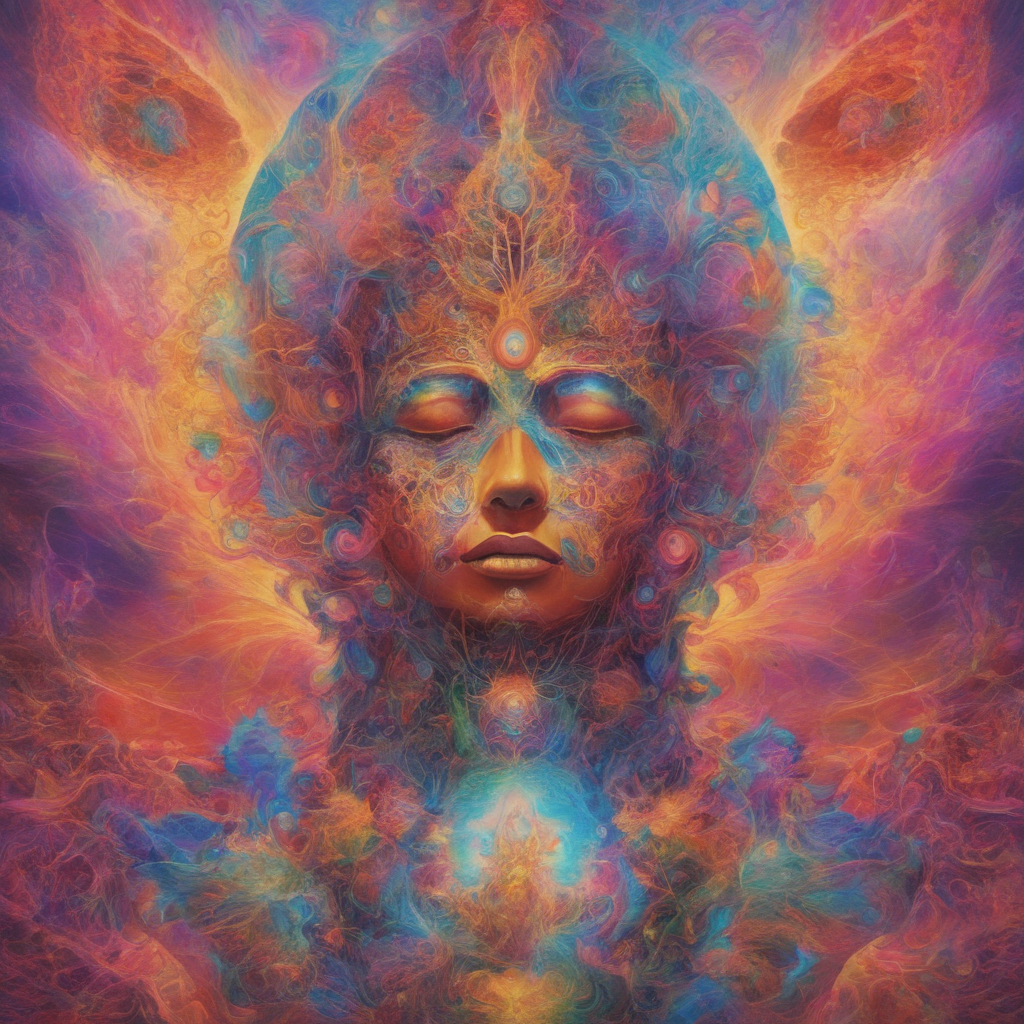
The ego, a fortress of our individuality, a custodian of our senses, crumbles during a profound psychological event termed ego death. This process, which is akin to crossing the Rubicon of our minds, signifies the temporary dissolution of our self-identity, the fading of our senses, and the surfacing of a cosmic oneness often linked to deep meditative states, transcendental experiences, or psychedelic journeys.

Neurologically, ego death presents an intriguing event. Our brain’s default mode network (DMN), which curates our self-narrative and sets us apart from others, shows a marked decrease in activity. We can compare it to a maestro leaving the stage, silencing the orchestra of our everyday consciousness that incessantly plays symphonies of thoughts, memories, and future projections.

In the ensuing stillness, our senses embark on an incredible transformation. The self-nonself dichotomy wavers, and feelings of oneness and interconnectedness seep in.

The conventional five senses, along with lesser-known ones such as proprioception (spatial orientation of our body parts), and thermoception (sense of temperature), recede, rendering the self imperceptible. Even the sense of agency – the consciousness of controlling one’s actions – seems to dissolve.

In place of the sensory absence comes the phenomena of nonduality – the essence of existence, unblemished by ego-driven distortions. Here, the biological reality of our senses converges with an intense metaphysical experience.

Kundalini rising – a sensation akin to a large serpent ascending the spine, activating each energy center or ‘chakra’ – might manifest in this transformative journey. Biologically, it could be perceived as a surge in nervous energy influencing neural circuits, engendering a radical alteration in perception.

The dissolution of our sense of time – chronoception – engulfs us in a timeless realm. Our sense of spatial orientation capitulates, inducing a feeling of non-locality, a state where one’s existence feels omnipresent.

This whole process might seem like an experiential validation of ‘absolute monism’ – a philosophical school of thought propounding the universe’s oneness, discrediting any duality between the individual and the world.

Yet, ego death is not an end; it’s a transformative beginning. The insights gleaned about the interconnectedness of all life forms and the illusory separateness sculpted by our ego can significantly reshape our lives.

From a wider perspective, ego death can be seen as a philosophical odyssey leading to an experiential understanding of consciousness, the essence of selfhood, and the nature of reality. The unravelling of our senses and ego sheds light on our inherent unity, nurturing a profound sense of compassion that percolates into every aspect of our existence.

Ego death’s exploration and its impact on our senses offer an avenue to challenge our conventional ways of perceiving, question our established sense of being, and dive deeper into the mysteries of our inner and outer universe. It’s not merely a psychological event but a spiritual expedition and a philosophical exploration that propels us toward a truer understanding of existence.

Morgan O. Smith

Yinnergy Meditation & My Book, Bodhi in the Brain…Available Now!

https://linktr.ee/morganosmith