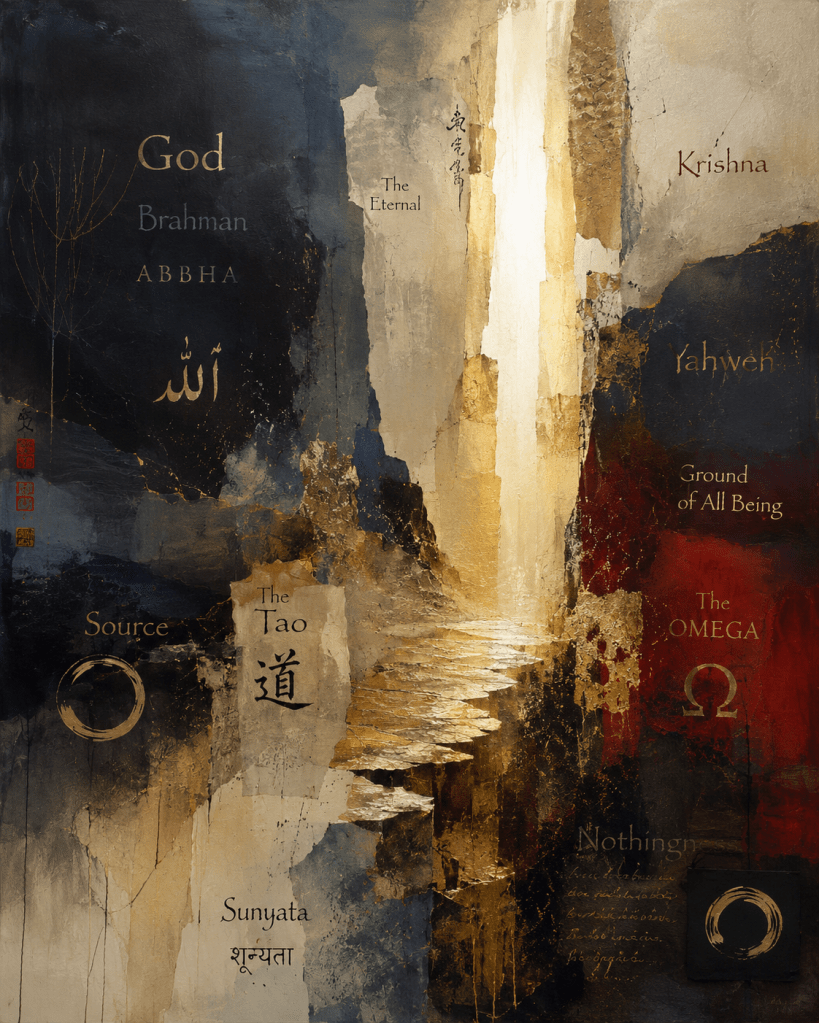
God Is Prior to Every Claim Made About It

Every religion attempts to speak about God.
Every atheist attempts to reject God.
Every philosopher attempts to define God.
Every mystic attempts to dissolve into God.

Yet all of them arrive too late.

The moment a claim is made, reality has already been divided into subject and object, speaker and spoken, believer and belief. Language slices existence into pieces so the mind can navigate experience. Useful for survival. Useful for communication. Completely insufficient for what precedes all categories.

God is not hiding behind concepts.
Concepts are hiding within God.

The mind wants certainty. It wants something graspable. Something stable enough to worship, deny, analyze, or defend. But whatever can be captured by thought becomes an object among other objects. God cannot be reduced to an object because every object appears within the field of awareness itself.

This is why every final statement about ultimate reality collapses under its own weight.

“God exists.”
“God does not exist.”
“Everything is God.”
“There is no God.”

Each statement carries traces of truth while simultaneously missing the mark. Every declaration emerges after the fact, after consciousness has already formed distinctions within itself.

Ultimate reality is prior to theology.
Prior to philosophy.
Prior to perception.
Prior even to the one attempting to understand it.

Silence has always been closer than explanation.

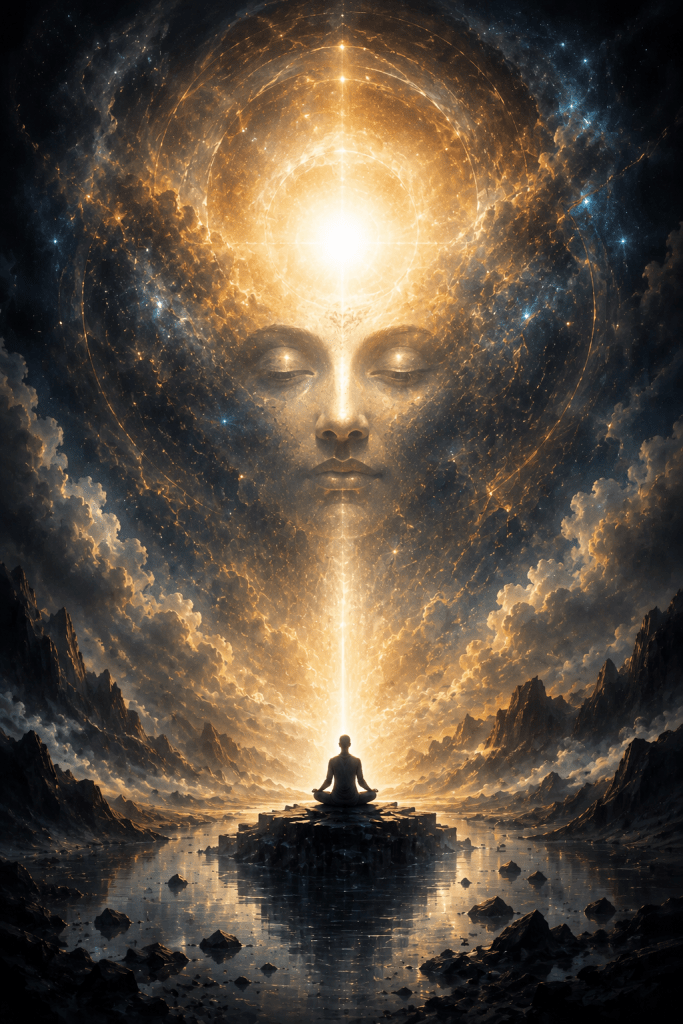
Not the silence of suppression, but the silence that remains untouched before thought organizes the world into names and meanings. A newborn experiences reality before language intervenes. Deep meditation reveals a similar opening. Identity softens. Concepts lose their grip. Existence shines without commentary.

No claim survives there.

Only direct being.

This is why sages throughout history often spoke in paradox, contradiction, or negation. Not because truth is irrational, but because ordinary language depends on separation. Nondual realization exposes a condition where separation never truly occurred.

The wave tries to define the ocean while being made entirely of ocean.

Every doctrine eventually becomes a finger pointing away from itself. Problems begin when the finger is worshipped instead of what it reveals.

God cannot be contained inside scripture, ritual, ideology, or disbelief. Every system emerges within the very reality it attempts to explain. The finite cannot fully enclose the infinite because the infinite already contains the finite.

Even the word “God” arrives too late.

What you are looking for exists before the search begins. Before identity forms. Before memory. Before perception says “this” and “that.” Reality simply is, whole and indivisible, untouched by the arguments constructed around it.

Perhaps this is why genuine awakening feels less like acquiring knowledge and more like the collapse of false certainty.

Nothing new is added.
Something imagined falls away.

And what remains cannot be claimed.

Morgan O. Smith

Crucified Between Division

Awareness, Ego Death, and the Union of Mind and Emotion

A statement spoken in the midst of suffering reveals more than compassion; it unveils a profound diagnosis of human consciousness. “Father forgive them, for they don’t know what they do” points not toward moral failure, but toward a blindness so complete that action unfolds without true seeing.

Lack of awareness is not merely ignorance of facts; it is a fragmentation of perception. Thought moves in one direction, emotion in another, and the deeper currents of being remain unrecognized. Life becomes mechanical, reactive, conditioned. From that state, harm arises; not out of intention alone, but from disconnection within oneself.

Meditation introduces a different possibility. Rather than adding knowledge, it begins to dissolve the divisions that create confusion. The mind quiets, the emotional field settles, and something more integrated begins to emerge. What was previously split starts to communicate.

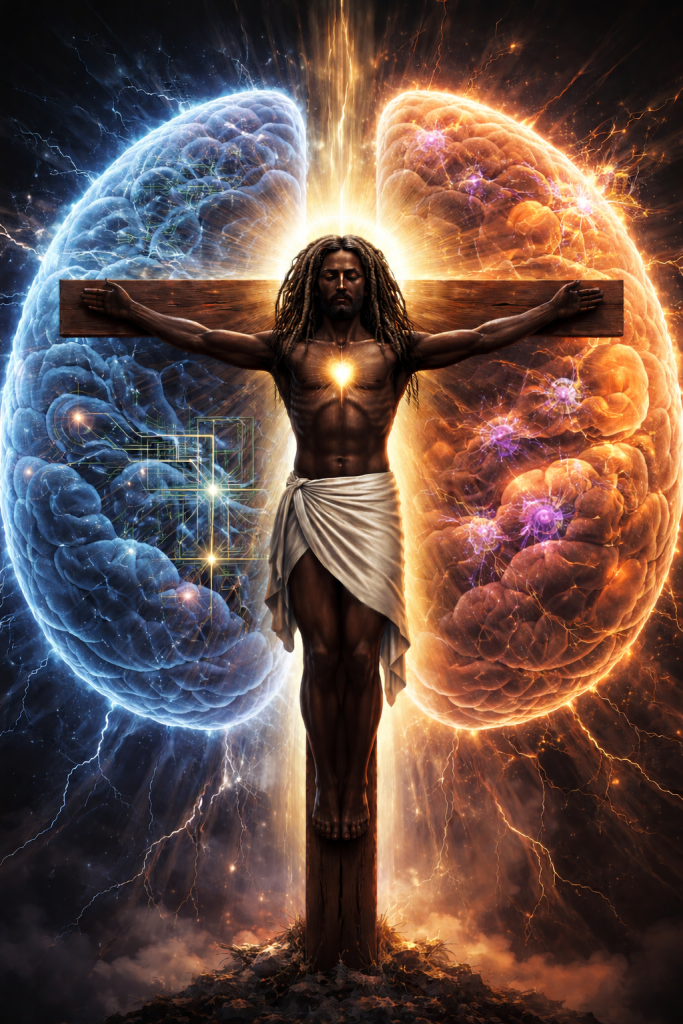
Viewed through a tantric lens, this integration takes on symbolic depth. The left hemisphere reflects structured thought, analysis, the architecture of concepts. The right hemisphere reflects intuition, feeling, the subtle currents that cannot be reduced to language. Most people live tilted; identified more with one than the other, rarely aware of the imbalance.

When these two aspects come into harmony, perception shifts. Thought no longer suppresses feeling, and feeling no longer clouds thought. A unified intelligence begins to function—clear, direct, and undivided. This is not intellectual brilliance or emotional intensity alone, but a deeper coherence of being.

The imagery of crucifixion can be read beyond history and theology. Suspended between two thieves, a central figure undergoes total surrender. The thieves, in this interpretation, can be seen as the divided faculties; mind and emotion, each incomplete on its own. The centre represents the point where both are witnessed, transcended, and ultimately brought into alignment.

Ego, in this sense, is not destroyed violently but revealed as insufficient. Its grip loosens when awareness expands beyond the fragments it tries to control. What remains is not emptiness in the negative sense, but a clarity that no longer depends on division.

Forgiveness then becomes natural, not forced. When one truly sees that actions arise from unconscious fragmentation, blame loses its foundation. Compassion emerges, not as a virtue to practice, but as the inevitable response of a mind that is no longer divided against itself.

Awareness is not something added to the individual; it is what remains when fragmentation dissolves. When both hemispheres function in coherence, perception is no longer split between thinker and feeler, observer and participant. There is simply knowing, without distortion.

Perhaps the deeper message is not about what was done, but about what was not seen. And through that recognition, a different way of being becomes possible; one where action arises from wholeness rather than division.

Morgan O. Smith

Beyond Imitation

When Enlightenment Is Mistaken for Personality

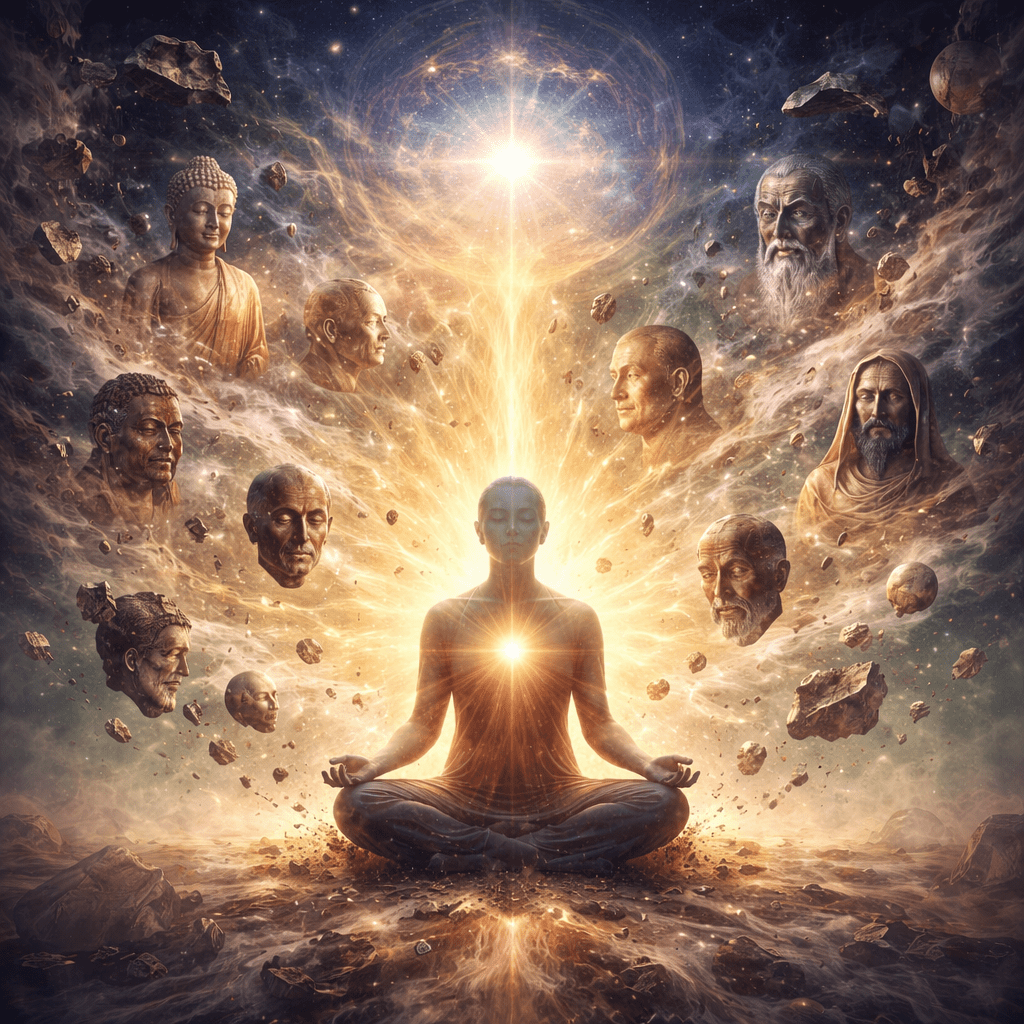
History remembers spiritual figures as icons, not as enigmas. Reverence crystallizes their lives into models to be copied rather than mysteries to be understood. Over time, enlightenment becomes entangled with biography. Traits that belonged to a particular body–mind are elevated into universal prescriptions.

Such confusion gives rise to a subtle distortion. One person’s temperament becomes another’s discipline. A preference becomes a vow. A condition becomes a doctrine. Devotees inherit fragments of behavior and assume they are inheriting truth itself. Institutions form around this misunderstanding, reinforcing the illusion that realization can be standardized.

Consider how easily abstinence, dietary habits, or psychological dispositions are mistaken for signs of awakening. An enlightened being may express through a quiet demeanor or intense rigor, yet neither silence nor intensity constitutes realization. Personality remains a vessel. Enlightenment is not defined by what that vessel contains.

Questions deepen when examining what might be labeled today as mental disorder or neurological variance. Practices born from clarity may appear indistinguishable from compulsions when observed through the lens of clinical interpretation. Conversely, compulsions may be sanctified when clothed in sacred language. The boundary between pathology and transcendence becomes blurred by interpretation rather than direct insight.

Playing the skeptic reveals a paradox. Spiritual traditions may preserve genuine transmissions of truth while simultaneously embedding cultural assumptions and psychological projections. Followers then chase appearances rather than essence, mistaking echoes for origin. Rituals multiply. Dogmas ossify. Authentic realization becomes obscured beneath layers of imitation.

Direct experience dismantles this confusion. Recognition dawns that enlightenment does not conform to behavioral templates or moral archetypes. Awareness reveals itself as the ground of all appearances, untouched by characteristics attributed to the enlightened individual. Personal expression arises from conditioning, biology, context, and circumstance. Realization neither requires nor rejects these variables.

A moment of true seeing dissolves the need to emulate. What once seemed external becomes unmistakably intimate. Every form, thought, sensation, and condition reveals itself as inseparable from the same boundless essence. Even the impulse to categorize enlightenment as virtue or disorder dissolves into a wider recognition.

Existence itself appears as a dynamic expression of a single indivisible presence. Labels fade. Distinctions soften. What remains is a knowing beyond concepts, untouched by cultural framing or psychological interpretation. Enlightenment ceases to be an achievement or identity. It becomes the simple recognition of what has always been.

Such recognition liberates the seeker from imitation. Spiritual maturity unfolds not through copying another’s life but through discovering the source from which all lives arise. When this is seen, the notion of following a template loses relevance. Only clarity remains, revealing that every expression, sacred or mundane, emerges from the same unbounded reality.

Morgan O. Smith

Universal Love

The Ever-Expanding Heart

Love that requires no condition, no reflection, no return; this is the highest state of consciousness. Universal Love is not sentimental or selective. It does not operate within the confines of personality, preference, or perception. It sees through every distinction and recognizes only itself.

This is love as total awareness. It loves because there is nothing else to do. It gives without the idea of giving. It embraces without needing to hold. It penetrates every boundary of selfhood and dissolves all opposites into a seamless field of being. Even the idea of “others” fades when this love awakens, for the one who loves and the one who is loved are found to be the same.

Such love is not weak; it is fearless. It does not protect itself because it knows it cannot be harmed. It sacrifices willingly because it understands there is no loss in unity. Every act, every gesture, every breath becomes an expression of this boundless compassion that celebrates existence as itself.

Universal Love is not attained through effort. It is remembered through surrender. The heart expands until it no longer has edges. What remains is a radiant stillness that loves without reason, without measure, and without end.

Morgan O. Smith

Get Your Free Copy of My Book, Bodhi in the Brain!

https://subscribepage.io/oTSZQu

When the Serpent Stirs

The Sacred Upheaval of a Kundalini Awakening

A force lies dormant at the base of your spine—curled, coiled, and waiting. It isn’t a metaphor. It isn’t symbolic. It is the sacred energy of awakening, and when it stirs, nothing remains untouched. This is not personal growth. This is elemental transformation.

Kundalini is not something you believe in—it is something that happens. The moment it rises, it begins its ascent with precision, threading its way through your central channel, shifting the architecture of your being. From the root of your spine to the crown of your head, it dismantles, rewires, and reanimates—not gently, not politely, but necessarily.

Everything once taken for granted—breath, time, self, existence—begins to unravel before your eyes. What seemed obvious collapses. What felt separate merges. What appeared to be you becomes both everything and nothing. You no longer view life from a narrow vantage point defined by fear or habit. Perception stretches beyond the ordinary, and you begin to see not from a body, but through consciousness itself.

This isn’t a philosophical musing. This is Yoga—not the posture, but the primordial union. The word means to yoke, to unify, and Kundalini is the sacred yoking of the individual to the Infinite. It is not ideal. It is not a concept. It is direct experience. It is the breakdown of boundaries until the Divine reveals Itself not as something above or beyond, but as the pulse within.

There is no going back from such a moment. Once touched by that current, life reorganizes itself around a different centre—not a person, not a role, but presence.

And within that presence, the union question vanishes—because you realize there were never two.

Morgan O. Smith

Get Your Free Copy of My Book, Bodhi in the Brain!

https://subscribepage.io/oTSZQu