A Meeting of East and West

Advaita Vedanta and Ken Wilber’s Four Quadrants

As we navigate through life’s labyrinth, we encounter myriad philosophical viewpoints designed to offer us clarity about the nature of reality. Two such perspectives – one rooted in ancient Eastern spirituality, Advaita Vedanta, and the other a more contemporary Western theory, Ken Wilber’s Integral Theory – provide us with intriguing interpretive lenses. While appearing distinct, when juxtaposed, they unfold a captivating dialogue, revealing the interconnectedness of diverse paths of wisdom.

**Non-Duality: The Heart of Advaita Vedanta**

At the core of Advaita Vedanta lies the profound principle of non-duality. The term ‘Advaita’ translates to ‘not two’, pointing towards the notion of unity beneath apparent multiplicity. According to this philosophy, all phenomena – whether perceived as separate entities or diverse experiences – are manifestations of a singular absolute reality known as Brahman.

This philosophy posits that the perceived distinction between the individual self (Atman) and the ultimate reality (Brahman) is an illusion (Maya), born out of ignorance (Avidya). The journey of spiritual awakening in Advaita Vedanta is about transcending this illusion, recognizing the non-dual nature of existence, where the Atman and Brahman are not separate but one.

**Ken Wilber’s Four Quadrants: A Comprehensive Map of Reality**

Ken Wilber’s Integral Theory, particularly the Four Quadrants model, offers a different but complementary perspective. Wilber presents a holistic map of reality, dividing it into four quadrants: Individual Interior (consciousness), Individual Exterior (behaviour), Collective Interior (culture), and Collective Exterior (society). Each quadrant represents an integral part of our existence and must be considered to understand reality holistically.

**The Interplay: Advaita Vedanta and Four Quadrants**

Drawing parallels between Advaita Vedanta and the Four Quadrants can create a fascinating synthesis of Eastern and Western thought.

The Upper Left Quadrant (Individual-Interior) aligns with the individual’s subjective experience, mirroring the Advaita exploration of Atman. The Upper Right Quadrant (Individual-Exterior) encapsulates the physical manifestation of the individual, aligning with the Advaita concept that even our physical existence is a manifestation of Brahman.

The Lower Left Quadrant (Collective-Interior) represents shared beliefs and cultures, resonating with the Advaita perspective that cultural differences are superficial, and at a deeper level, unity prevails. The Lower Right Quadrant (Collective-Exterior) mirrors societal structures, all manifestations of the same non-dual reality.

From the Advaita viewpoint, the division of the four quadrants are themselves expressions of Maya, as they create apparent separations where none ultimately exist. They are valuable tools for understanding and navigating the world but do not represent the deepest truth of non-duality.

**Uniting Perspectives: A Path to Enlightenment**

Exploring the intersection of Advaita Vedanta and Ken Wilber’s Four Quadrants offers a richer understanding of reality, harmonizing subjective and objective, individual and collective, Eastern spirituality and Western theory. As we understand that the lines dividing these quadrants are more porous than they seem, we move closer to the non-dual truth of Advaita – that beneath apparent diversity, unity pervades.

At a time when division and fragmentation are rampant, this synthesis could offer a path toward the kind of transcendental insight that can bridge divides, fostering a deeper sense of interconnectedness and wholeness. After all, as Advaita Vedanta teaches us, beneath the surface of multiplicity, we are ‘not two’ but one. As we embrace the wisdom of the four quadrants, we might just find ourselves taking a step closer to that unity, opening ourselves to a richer, more holistic understanding of the world.

Morgan O. Smith

Yinnergy Meditation & My Book, Bodhi in the Brain…Available Now!

https://linktr.ee/morganosmith

The Profound Journey

Into the Vastness of Nirvikalpa Samadhi

Embarking upon the voyage of self-realization, one might chance upon the profound state of Nirvikalpa Samadhi, a realm where ordinary definitions of consciousness cease to exist. A phenomenon beyond words, it is an experience of unbounded vastness, where the mind expands beyond its limitations, reaching toward the omnipresent truth of totality.

Becoming the Absolute

In this unfathomable dimension, you journey from your everyday self to a radiant wholeness, a unity that echoes in the depths of your being. As your identity dissolves into the absolute, the stark paradox of the universe comes into focus – the reality of nothingness. This is the state where you free yourself from all worldly attachments, transcend your ego and step into a realm of pure awareness. The essence of who you truly are emerges, unrestrained and sovereign. The concept of ‘you’ vanishes, leaving a sea of pure consciousness in its steads.

Realizing the Totality

Nirvikalpa Samadhi takes you beyond yourself, and merges you with the Universe, introducing you to the power of omnipresence. You discover your entire being present everywhere, intertwined with everything, past, present, and future. A profound realization dawns upon you as you feel the universe within you, and yourself within the universe. A beautiful interplay of microcosm and macrocosm emerges, painting a picture of cosmic unity.

Saccidananda: The Triune Reality

The experience deepens further as you ascend to Saccidananda – a Sanskrit term that merges Sat (existence), Chit (consciousness), and Ananda (bliss). In this transcendent state, you attain an all-encompassing awareness, understanding that you are everything that exists, everything that is conscious. You become the embodiment of bliss itself, experiencing an ineffable joy that pervades all creation.

Awakening from the Dream

As you delve deeper into Nirvikalpa Samadhi, you experience an awakening, reminiscent of rousing from a profound slumber. The world as you know it – a construct of your mind, appears as an illusory dream. The illusion of the self fades away, making way for an unfiltered perception of reality. The world, once a confusing labyrinth, the world transforms into a crystal-clear mirror reflecting your true essence.

The Unmanifested Oceanic Field

This ultimate state of consciousness acquaints you with your original face – a radiant, bright light that is the source of all creation. You find yourself in the heart of the unmanifested oceanic field, the Dharmakaya in Buddhist philosophy. A state where all potentials reside, this is the womb of the cosmos where creation unfolds from possibility into existence.

Engaging with Nirvikalpa Samadhi is not merely a philosophical exercise, but a transformative experience that illuminates the path towards self-realization and universal understanding. It is a mystical journey into the depths of consciousness, where one awakens to the fundamental truth of existence – that we are all interconnected, part of a cosmic symphony resonating with the music of the universe.

Morgan O. Smith

Yinnergy Meditation & My Book, Bodhi in the Brain…Available Now!
https://linktr.ee/morganosmith

The Ocean of Consciousness

A Deep Dive into Self-Realization

In the vast expanse of our existence, there exists an ocean, profound and unending. This is not an ocean you can traverse with a boat, nor one that can be mapped with lines and contours. It is the ocean of consciousness, the ocean within us, teeming with treasures waiting to be found and explored.

This inner cosmos reflects the enormity and complexity of our being. It is a reminder that we are not mere beings afloat on the surface of existence. We are the deep-sea divers, explorers of the unseen depths of our own consciousness, where the treasures of self-realization lie.

Each of us is invited to embark on this journey, to delve beneath the tranquil surface of our everyday awareness, to submerge into the depths of the self. It’s within these depths that the unexplored and unseen aspects of ourselves are concealed like sunken treasures.

The journey of self-realization is, indeed, a swim in these deep waters. It is not always an easy journey; at times, we may feel lost in the vast, nebulous expanse, unsure of where to look or what to seek. It is natural to fear the unknown, the hidden, the deep, but it is also where true treasures lie.

These treasures are not the tangible riches we often pursue; they are rather pearls of wisdom, gems of personal truth, and gold nuggets of self-understanding. They hold the power to transform our perspective, illuminate our purpose, and enrich our existence. Once discovered, these treasures have the capacity to fundamentally alter the way we perceive ourselves and our place in the cosmos.

But how does one navigate these waters? How do we uncover these treasures of the self? The compass guiding us through this journey is reflection, introspection, and mindful living. These tools help us dive into the currents of our thoughts, feelings, and experiences, allowing us to probe and understand the unseen layers of our consciousness.

As we continue to swim within these deep waters, we learn to appreciate the beauty of the journey more than the destination. We realize that the exploration itself is a form of treasure, a transformative process that molds us into more conscious, more self-aware beings.

In this philosophical journey of self-realization, we not only find treasures within ourselves but also learn to become treasures for the world around us. The knowledge, wisdom, and understanding we gain through this exploration have the power to influence and enrich the lives of others.

So, let us all dive into the deep waters of consciousness and continue to explore. In this exploration, we find not only the treasures of self-realization but the true essence of our existence. Amid the vastness of this ocean, we find ourselves, understanding that we are not just a part of the universe, but the universe itself, unfolding.

Morgan O. Smith

Yinnergy Meditation & My Book, Bodhi in the Brain…Available Now!
https://linktr.ee/morganosmith

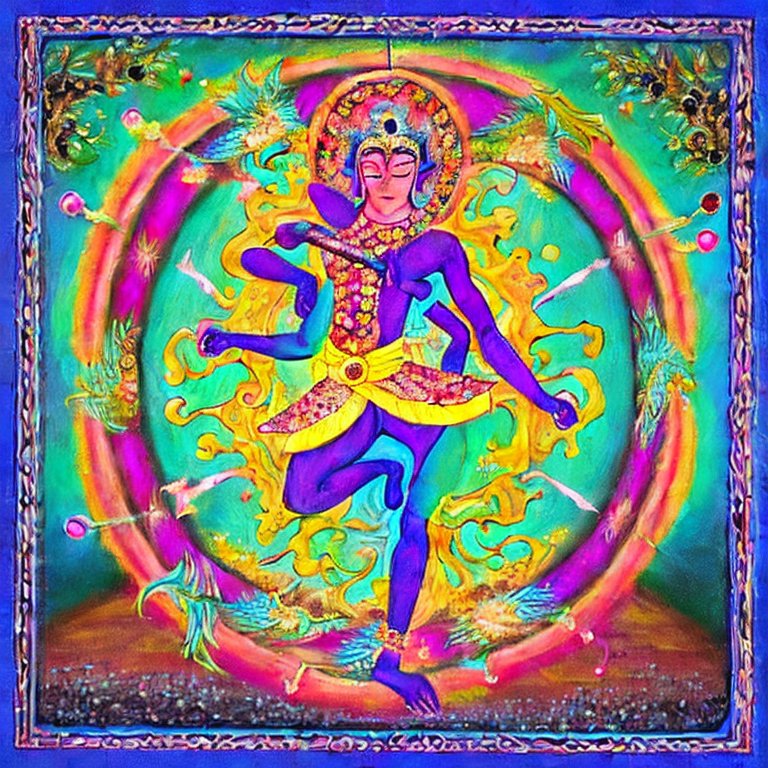
The Dance of Emptiness and Form

Unveiling the True Essence of Yoga

The philosophical underpinnings of Yoga transcend the popular perception of it as merely a physical discipline. Yoga, in its quintessence, is a union, a symbiotic dance between emptiness and form. This dance, a philosophical waltz within the vast expanses of the universe, finds a profound echo within us.

When we speak of form, we are drawn towards the tangible, quantifiable aspects of our existence—our body, the physical world around us. These are things we can touch, see, smell, hear, taste—the concrete attributes of our being. On the Yoga mat, the physical form is the obvious manifestation of our practice. Asanas are the embodiment of form, an expression of our grounded reality.

On the other hand, emptiness is an abstract concept, often considered synonymous with void or nothingness. In Eastern philosophies, emptiness does not signify a lack or absence but is regarded as the space that allows the form to exist, the silence that cradles the sound. It is the immaterial consciousness, the observer within us.

In the practice of Yoga, we cultivate the experience of both form and emptiness. Through asanas, we engage with form, enhancing our physical wellness and strength. Yet simultaneously, through meditation and breath control (Pranayama), we connect with the space of consciousness, the emptiness.

The union of emptiness and form in Yoga echoes the concept of Yin and Yang in Taoism. These seemingly opposing forces are complementary and interdependent. Similarly, in Yoga, the physical form (body) and the immaterial consciousness (emptiness) are intertwined in a dance, with neither one being superior to the other.

The realization of this union empowers us to perceive ourselves beyond the limitations of physical existence. We start to experience our oneness with the universe, recognizing that the emptiness within us is the same as the cosmic void, and the form is an expression of universal matter.

In true Yoga, we find balance and harmony between form and emptiness. We start understanding that emptiness isn’t a void but a space filled with infinite possibilities, and form is not rigid but a fluid and ever-changing phenomenon. This balance and harmonious interaction between emptiness and form illuminate the path toward self-realization and enlightenment.

Consequently, Yoga transforms from a practice into a way of life, a journey towards unveiling the veiled, harmonizing the paradox of existence and experiencing the profound unity of all creation. It’s a journey that, while dancing on the stage of duality, ultimately guides us back to unity.

In essence, Yoga teaches us to embrace the dance of life, the continuous ebb and flow between form and emptiness. In this dance, we discover our true selves, learning to live in harmony with our internal rhythms and the universal pulse. Only by acknowledging and understanding both emptiness and form can we truly unfold the potential within, ultimately experiencing the profound union that is the heart of Yoga.

Through this exploration, may we all find our unique rhythm in the cosmic dance and awaken to the truth that Yoga is not just something we do, but rather a state of being. A union of emptiness and form, a harmonious dance in the infinite canvas of existence.

Morgan O. Smith

Yinnergy Meditation & My Book, Bodhi in the Brain…Available Now!
https://linktr.ee/morganosmith

The Dance of Divine Ignorance

Brahman’s Playful Journey to Self-Realization

From the mysterious depths of Hindu philosophy arises a compelling concept, the notion of divine ignorance. Within this notion, we find an intriguing paradox: Brahman, the supreme reality or absolute truth, embarks on a deliberate voyage of self-forgetfulness, only to rediscover itself anew.

The journey begins with Brahman, the substratum of all existence. As an eternal, infinite entity beyond time, space, and causality, it is all-knowing and all-encompassing. Yet, it willingly dons the cloak of divine ignorance, becoming unaware of its true nature. Why? It’s an act of divine playfulness or ‘lila.’ It is a purposeful exercise to experience life’s duality, diversity, and the contrasts it can offer.

In this state of divine ignorance, Brahman may assume any form, animate or inanimate, and traverse a myriad of experiences, each unique and valuable. As humans, animals, or even as the elements themselves, Brahman willingly dives into the sea of forgetfulness, plunging into the game of life and death, joy and sorrow, love and hatred. Brahman is there in every moment, in every experience, playing hide-and-seek with itself.

Each incarnation in this state is a chapter of the cosmic narrative, leading to an eventual grand finale – the rediscovery of the self as Brahman. This moment of awakening is not a simple return to the start but a profound realization heightened by the accumulated experiences. It is a conscious awareness of oneness, a dissolution of the illusory divide between the self and the universe.

However, this journey isn’t a linear path. It’s a dance, a rhythm of existence where each beat is a cycle of divine ignorance and self-realization. Each turn of the dance spirals upwards, towards an ever-deepening understanding and experience of the truth.

The concept of divine ignorance challenges us to see life not as a series of random events but as a purposeful, meaningful journey toward self-realization. It teaches us that ignorance isn’t a flaw to be eradicated, but an essential part of the cosmic play. It is a transformative cocoon that emerges as the butterfly of awareness.

Divine ignorance invites us to embrace our vulnerabilities, our doubts, and our seeming ‘ignorance,’ and use them as catalysts for growth. It gently reminds us that the path to self-realization isn’t a desperate escape from ignorance but a joyful dance through it.

In conclusion, the dance of divine ignorance is not just Brahman’s journey but ours. We are not separate from Brahman, we are Brahman; playing the role of being a part of it, participating in this cosmic dance. Divine ignorance is not an obstacle but a bridge to our ultimate truth. It’s a profound truth worth reflecting upon, and perhaps, just perhaps, it’s time for us to embrace the dance and rediscover ourselves anew.

Morgan O. Smith

Yinnergy Meditation & My Book, Bodhi in the Brain…Available Now!
https://linktr.ee/morganosmith

In Divine Light

Society’s Golden Shadow 

Intro:

In a world where the quest for meaning continues to stir the human soul, spirituality and reverence for the divine emerge as quintessential human experiences. But what if the collective admiration and worship of God are manifestations of society’s golden shadow – the unexplored, positive aspects of our shared unconscious? This post delves into the notion that the sacred spaces we turn towards in times of despair or joy are indeed reflections of the inherent greatness within ourselves.

Understanding the Golden Shadow:

Drawing from Carl Jung’s concepts, the golden shadow encompasses the positive attributes within our unconscious minds that we might not recognize. When these attributes are exemplified by an external entity, such as a deity, we project our golden shadow upon it.

God as the Epitome of Society’s Golden Shadow:

The divine figures across cultures are often epitomes of virtues – love, compassion, wisdom, and more. Society’s adoration for these figures could be interpreted as an admiration for the virtues themselves. The deities become mirrors, reflecting what individuals and societies aspire to embody.

Religion as a Path to Self-Realization:

One could argue that the rituals, prayers, and moral teachings of religion serve as vehicles for cultivating the qualities represented by the divine within ourselves. In essence, by worshipping or admiring God, individuals are also venerating and nurturing their own latent potential.

The Challenges:

This perspective might not sit well with everyone, especially those who believe in the transcendental nature of God. Moreover, using religious practices solely as tools for self-improvement might seem reductive. It’s essential to approach this hypothesis with respect for the diversity of beliefs and experiences.

Conclusion:

The notion that society’s worship and admiration for God is a projection of its golden shadow is thought-provoking. It offers a lens through which we can perceive religious and spiritual practices as not just pathways to the divine, but also as avenues to recognize and cultivate the virtues within ourselves. Whether or not one subscribes to this idea, it invites reflection on the profound interconnectedness between the human spirit and the sacred.

Morgan O. Smith

Yinnergy Meditation & My Book, Bodhi in the Brain…Available Now!

https://linktr.ee/morganosmith

Sand Castles of Consciousness

Discovering the Essence Within

Introduction:


In the tranquil tapestry of Eastern philosophy, where contemplation converges with existence, there lies a profound revelation – Everything in existence is composed of Pure Consciousness. Here, Consciousness is not merely an attribute; it is capitalized, symbolizing its omnipresence as the very fabric that weaves through the cosmos. It is akin to an ancient tale of a castle crafted from sand, reflecting that though it may don the guise of a majestic structure, it remains, in essence, sand.

The Sand and the Castle:

Visualize a child meticulously building a sand castle on the shore. The grains of sand, amassed and sculpted, assume the shape of a castle. Does the sand cease to be sand when shaped into a castle? Certainly not. This allegory mirrors the realization that while the myriad forms around us may appear different, they are all permutations of the same unyielding Consciousness.

The Essence of Consciousness:

Consciousness is akin to Brahman in Hinduism or the Tao in Taoism in the Eastern philosophical context. The unchanging, infinite, immanent, and transcendent reality is the Divine Ground of all matter, energy, time, space, being, and everything beyond. Our ephemeral existence is a mere reflection, a ripple in the vast ocean of Consciousness.

Flow of Forms:


Just as a sand castle is subjected to the whims of waves and winds, forms in the material world are in a constant state of flux. The ancient Hindu text, the Bhagavad Gita, illustrates this with the concept of ‘Lila’, depicting the world as a divine play of forms. The Taoist philosophy also reverberates with this thought through the Tao, which flows through and is the inherent nature of all things.

The Inner Alchemy:

One might inquire, how does this realization benefit our daily lives? Understanding that we are not just isolated entities, but integral threads woven into the fabric of Consciousness, can be transformative. It helps us transcend the illusion of separateness and cultivates compassion, humility, and interconnectedness with all beings and the natural world.

Conclusion:


As we embrace the wisdom of Eastern philosophy, let us be mindful of the sand castles we build and the sands that shape them. Let us embark on a spiritual odyssey to unearth the Consciousness within and around us, recognizing that the essence is unchanging, infinite and all-encompassing. Like the sand castles by the sea, our forms are transient, but the Consciousness that shapes us is eternal.

Morgan O. Smith

Yinnergy Meditation & My Book, Bodhi in the Brain…Available Now!
https://linktr.ee/morganosmith

Meditative Practices and the Illusory Nature of the False Self

A Journey Towards Self-Realization

Introduction:
Meditative practices have long been revered as transformative tools in the realm of self-discovery and spiritual growth. They offer a profound pathway for individuals to explore the depths of their consciousness, seeking truth, peace, and liberation. However, beneath the surface lies a fascinating paradox—the false self, which appears as the practitioner, ultimately leads to the revelation of the Ultimate Self, the Ground of All Being.

The Illusion of the False Self:
Within the tapestry of various spiritual traditions, the notion of the false self arises—a deceptive construct born out of our attachments to external roles, labels, and conditioned beliefs. This illusory identity emerges from our tendency to assign significance to transient aspects of our existence, such as social standing, material possessions, and superficial identities. Meditative practices, in their diverse forms, serve as illuminating mirrors, enabling us to perceive the transient nature of the false self and transcend its illusory grasp.

Meditation as a Mirror:
Meditation acts as a reflective surface, offering a clear reflection of the illusory nature of the false self. By turning inward and observing our thoughts, emotions, and sensations without judgment or attachment, we gain a heightened awareness of the ever-changing nature of our experiences. Regular practice nurtures a profound realization—an understanding that our thoughts come and go, emotions rise and subside, and identities shift fluidly. This awakening brings us closer to recognizing that the false self is not a fixed entity but a construct that can be deconstructed through the power of self-inquiry.

The Ultimate Self:
While meditative practices may originate from the false self, they hold within them the potential to reveal the Ultimate Self—the very essence of our being, the Ground of All Being. As we delve deeper into our meditative journey, we begin to touch upon an interconnectedness and unity with the vast cosmos. The boundaries that once separated our individual selves from the external world begin to dissolve, and we catch glimpses of the inherent oneness that permeates all existence. In this expanded state of awareness, the false self loses its grip, and we realize that our essential nature transcends the limitations of individual identity.

Integration and Transformation:
The true essence of meditative practices lies in the interplay between the false self and the Ultimate Self. The false self, while illusory, acts as a vehicle for the exploration and transformation of consciousness. Engaging with meditative practices allows us to intimately observe the patterns and tendencies of the false self, ultimately leading us to transcend its limitations. By embracing the false self as a catalyst for growth, we integrate its lessons and move closer to the realization of our true nature—the Ultimate Self.

Conclusion:
In the realm of meditative practices, the interconnection between the false self and the Ultimate Self invites profound contemplation. While the false self may present itself as real and compelling, it is merely a construct that can be unravelled through the transformative power of meditation. Engaging in these practices propels us on a journey of self-realization, unveiling the essence of our being—the Ground of All Being. Meditative practices serve as bridges, guiding us from the illusion of the false self to the profound truth of our interconnected existence. Embrace these practices, embrace the false self, and embark on the path toward ultimate liberation and self-realization.

Morgan O. Smith

Yinnergy Meditation & My Book, Bodhi in the Brain…Available Now!
https://linktr.ee/morganosmith

The Eternal Now

Enlightenment as the Ever-Present Journey

Introduction:
Time is a mysterious and often bewildering dimension of our existence. Like the fleeting shadow of tomorrow, enlightenment is often thought to be something that is always just out of reach. However, what if the key to enlightenment was not in endlessly chasing it, but in realizing that it is already here?

The Illusion of Tomorrow:
Many of us tend to postpone our happiness or goals for the future. “I will be happy when…” or “I will do that tomorrow,” are phrases we frequently tell ourselves. Yet, as time moves forward, tomorrow remains as elusive as ever. It’s always today. This is a poignant reminder that the present moment is all we have.

Parallel to the Illusion of Enlightenment:
Enlightenment is often perceived as the pinnacle of spiritual accomplishment, a state to be attained in the distant future. However, much like tomorrow, the notion of enlightenment as a destination may be an illusion. If enlightenment is truly understanding and being at peace with oneself and the universe, then it must exist in the here and now.

The Eternal Present:
The Buddhist concept of “Satori” embodies a sudden awakening or flash of insight. It illustrates that enlightenment is not a far-off goal but an ever-present possibility. When we begin to see that the essence of life and self-realization is embedded in the present, the journey toward enlightenment takes on a different texture. It becomes a continuous, unfolding process rather than a destination.

Cultivating Awareness:
The path to recognizing that enlightenment is in the present involves cultivating awareness and mindfulness. By fully engaging with the present moment and releasing our attachments to the past and future, we can find clarity and wisdom.

The Role of Experience:
Our experiences, no matter how mundane, are integral to our understanding. Every moment provides an opportunity for growth and learning. Through mindfulness, we can recognize the sacredness in the ordinary, and see that enlightenment isn’t something distant, but an ever-present reality.

Conclusion:
“Enlightenment is always here” is not just a statement, but an invitation to break the chains of time and enter the eternal now. It’s an invitation to stop searching and start living. Like the enigmatic nature of tomorrow, enlightenment is not something that can be grasped or attained in the future. It is a journey that is happening right now. Every moment is an opportunity for awakening. May we have the courage to embrace the present and recognize the enlightenment that is always here.

Morgan O. Smith

Yinnergy Meditation & My Book, Bodhi in the Brain…Available Now!

https://linktr.ee/morganosmith

Embracing the Infinite

Unravelling the Unity of Being in Nondual Realization

Introduction:
Nondual realization, a concept deeply rooted in various spiritual and philosophical traditions, beckons us to unravel the intricate fabric of perceived separateness. It nudges us to fathom that our heads, shoulders, knees, and toes are not disjoint fragments, but an interwoven tapestry of existence that extends beyond our physical form to encompass the entirety of the cosmos.

The Mirage of Separation:
Our conditioned minds are apt at categorizing and labelling. We discern our body parts as separate entities, our thoughts as ours alone, and our experiences as exclusive. This discernment perpetuates a mirage of separation, where we see ourselves as isolated entities distinct from others and the world around us.

The Confluence of Suchness:
Nondual realization, however, invites us to shed these layers of compartmentalization and dive into the undercurrent of ‘suchness’. Suchness refers to the raw, unfiltered state of existence, free from conceptualizations. At this juncture, the distinctions blur, and the head, shoulders, knees, and toes emerge not as isolated landmarks but as interconnected contours of a boundless landscape.

Unity in Diversity:
Imagine a symphony where every instrument contributes to a harmonious melody. Each note, when observed in isolation, has its identity, but together they create music that is beyond the sum of its parts. Similarly, in the realm of nondual awareness, every form and phenomenon is an integral note in the cosmic symphony.

Bodies Within the Cosmic Body:
In the space of nondual awareness, the body is seen not as a solitary vessel but as a wave in the ocean of existence. Each wave is distinct yet made of the same essence as the ocean. The ‘body’ extends beyond physical form and encapsulates the trees, stars, and galaxies – all expressions of the same primordial energy.

Relevance in the Modern World:
In an era characterized by division and strife, embracing the understanding of nonduality can be transformative. When we recognize the interconnectedness of all forms and phenomena, compassion and empathy naturally flow. As we perceive others and the environment not as separate but as extensions of ourselves, a sense of stewardship and responsibility emerges.

Conclusion:
Nondual realization is not just a philosophical concept, but an experiential reality that can awaken us to the interconnected tapestry of existence. By perceiving the unity in diversity, recognizing the body as a microcosm of the cosmic body, and letting go of entrenched categorizations, we can nurture a more inclusive, compassionate, and harmonious world. This realization invites us to not only tread more lightly upon the Earth but also to embrace the boundlessness of our being.

Morgan O. Smith

Yinnergy Meditation & My Book, Bodhi in the Brain…Available Now!

https://linktr.ee/morganosmith