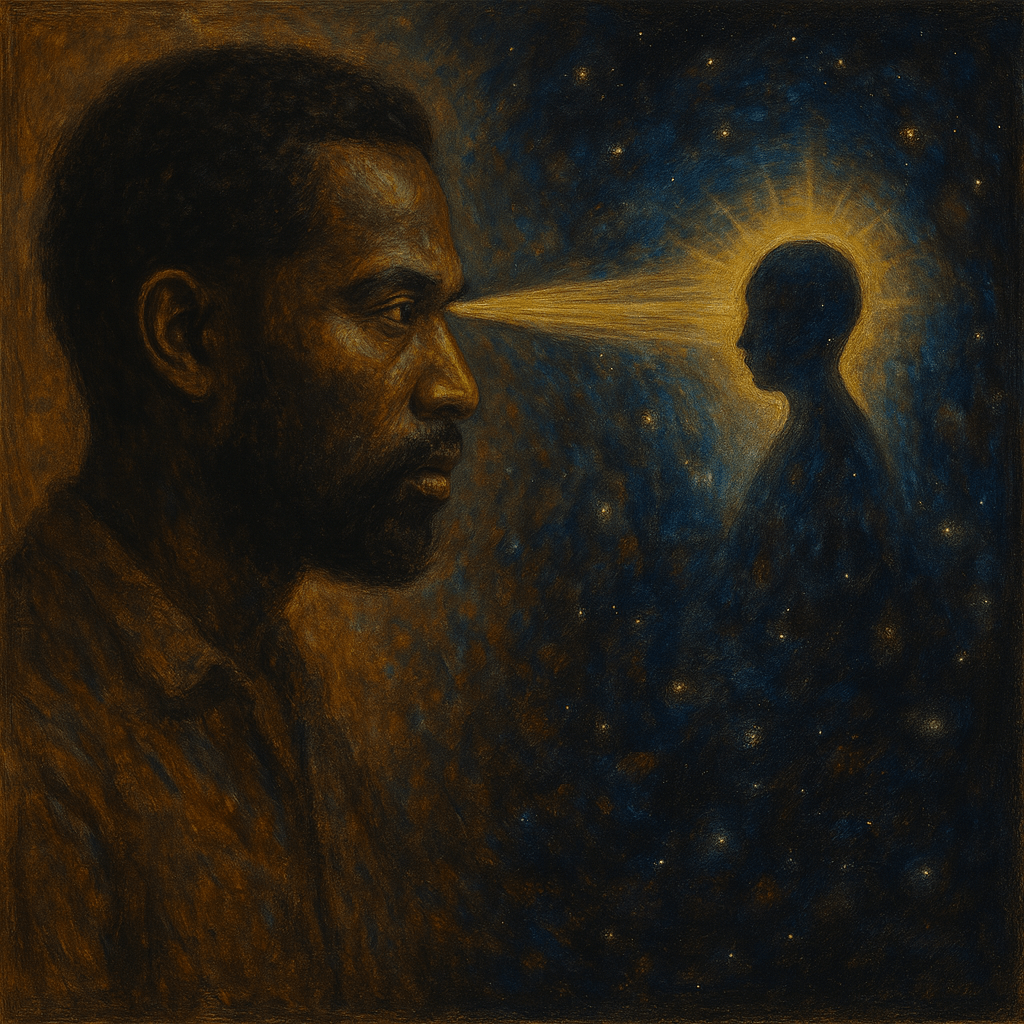
Author, Philosopher, Spiritual Teacher, A Lead Facilitator at Sacred Media's Integral Mastery Academy, Founder of Yinnergy Meditation/Neurofeedback, Bodhi Mental Care & Wellness, Co-founder of KeMor Centre for Innovative Development
Most people eventually outgrow their childhood ideas about almost everything.
Our tastes in food become more refined. Our understanding of relationships deepens. Our appreciation for music changes. Fashion evolves. Culture shifts. Even our political, moral, and philosophical views often undergo profound transformation as life teaches us new lessons.
Yet there is one idea that frequently remains frozen in time.
Paradise.
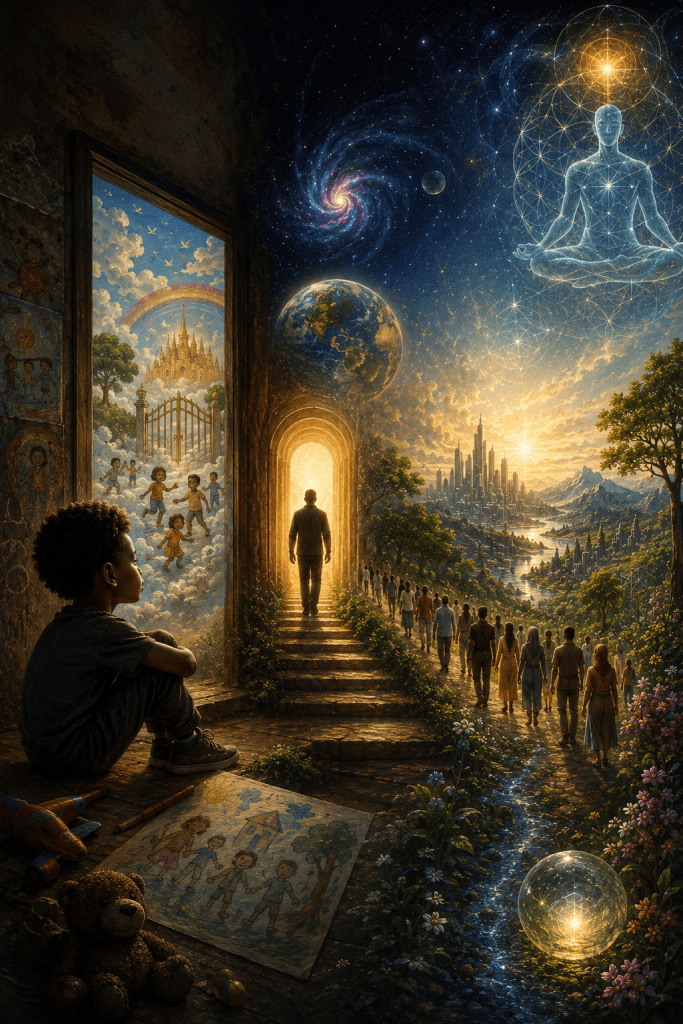
For many adults, heaven still resembles the picture they accepted as children. A beautiful place somewhere above the clouds where good people are rewarded, reunited with loved ones, and live happily forever. Although our understanding of nearly every other aspect of life matures, our image of paradise often remains untouched.
Why?
The answer may have less to do with religion than with psychological development.
Paradise Grows as Consciousness Grows
Every stage of psychological development interprets reality according to its own capacity. Paradise is no exception.
The earliest stage is concerned only with survival. Paradise simply means warmth, food, shelter, and freedom from danger.
As tribal consciousness develops, paradise becomes reunion with ancestors, spirits, and one’s people. Belonging is eternal.
The egocentric stage imagines paradise as limitless pleasure, power, success, and personal fulfillment. Heaven exists for the individual.
The mythic stage transforms paradise into a divine kingdom governed by justice. Those who obey are rewarded. Those who reject divine law are excluded. This is where many traditional religious images of heaven take shape.
The rational stage begins questioning whether heaven exists at all. Paradise may become symbolic, psychological, or simply an unanswered mystery.
The pluralistic stage opens paradise to everyone. Love replaces exclusivity. Compassion becomes more important than belief. Humanity itself becomes the family.
Integral consciousness recognizes that every previous view reflects a particular stage of development rather than an absolute truth. Paradise is increasingly understood as a way of being rather than merely a destination.
Finally, holistic consciousness dissolves the distinction altogether. Paradise is not somewhere else. Reality itself is recognized as the living expression of the Absolute.
The Expanding Circle of Identity
Our understanding of paradise also changes according to the size of our identity.
The egocentric perspective asks:
“How do I get into heaven?”
The ethnocentric perspective asks:
“Which group is chosen?”
The worldcentric perspective asks:
“How can everyone be included?”
The Kosmocentric perspective asks something entirely different.
“Who is it that seeks paradise in the first place?”
Here, the search begins to collapse.
The seeker, the destination, and the journey are all recognized as appearances within one indivisible reality.
Why Do We Stay Attached to Childhood Images?
Children require certainty.
Simple stories offer comfort in the face of death and uncertainty. Those early images become emotionally rooted long before critical thinking fully develops.
Unlike our opinions about careers, relationships, or politics, our beliefs about paradise are rarely revisited with the same willingness to question them. Religious traditions often preserve these images because they provide stability, identity, and hope.
There is nothing inherently wrong with that.
Every stage serves an important purpose.
Problems arise only when we assume that the understanding which comforted us at age five must also satisfy us at age fifty.
The Ultimate Shift
The greatest transformation may not involve discovering a better description of heaven.
It may involve recognizing that paradise was never meant to describe a location.
Perhaps heaven is a symbol pointing toward a realization.
A realization that nothing has ever existed outside the infinite.
A realization that separation was never ultimately real.
A realization that the very awareness reading these words is not traveling toward paradise.
It is the ground from which every idea of paradise has always appeared.
Perhaps the deepest question is not whether heaven exists after death.
Perhaps the deeper question is whether consciousness can awaken enough to recognize paradise before death.
If consciousness itself is the Absolute, then paradise is no longer a promise waiting in the future.
It is reality, seen without the illusion of separation.
This is not simply about affirmations, positive thinking, manifestation, or the power of spoken language. Those ideas remain close to the surface. The deeper meaning reaches beyond the human voice, personal intention, and the individual mind.
You speak everything into existence and do not even realize it.
At the causal level, existence itself is your expression.
Every form that appears, every movement that unfolds, every event that arises, and every world that seems to exist independently emerges from the same beginningless source that you are.
Nothing stands outside of you.
The birth of a star, the movement of a thought, the falling of a leaf, the ending of a relationship, the formation of a galaxy, and the smallest shift within a single cell all belong to one indivisible happening.
That happening has no external author.
It is not being imposed upon reality from somewhere beyond reality.
Existence is expressing itself as everything.
The One Who Speaks Without a Voice
Human beings usually associate creation with deliberate action. Someone decides, acts, and produces a result. Cause appears to precede effect. A person speaks, and something happens.
Causal consciousness does not operate according to this linear sequence.
The voice that speaks existence into being has no mouth. It does not form sentences, construct plans, or choose between possibilities. Its speech is the spontaneous appearance of existence itself.
Mountains are its language.
Bodies are its language.
Silence is its language.
Time, space, matter, thought, sensation, memory, desire, birth, and death are all movements of this wordless declaration.
Creation is not something that occurred once in a remote past. Reality is being spoken now, not through verbal commands, but through the continuous emergence of experience.
You are that emergence.
A Beginningless Beginning
The mind wants to locate a first moment. It asks what started everything, what existed prior to the universe, and what caused the original cause.
These questions assume that reality began somewhere within time.
Time itself is part of what appears.
There was no first moment in the ordinary sense because the causal source does not occupy a position on a timeline. It is not an ancient object hiding behind the universe. It is the timeless ground through which every apparent beginning and ending becomes possible.
Existence is beginningless because the source of existence was never born.
The body had a beginning.
The personality had a beginning.
Your memories had a beginning.
The awareness within which these beginnings are known has no discoverable starting point.
Search directly for the birth of awareness. A memory may arise, but the memory appears within awareness. A story may explain your origin, yet that story is also being witnessed. Every answer appears as another object within the very presence you are attempting to explain.
The source remains prior to every explanation, not earlier in time, but more fundamental than time.
Everything Is Caused by You
The statement “everything is caused by you” can easily be misunderstood.
The personal ego did not manufacture the universe. Your everyday identity is not secretly controlling weather patterns, global events, other people, or every difficulty that enters your life. Such an interpretation would reduce a nondual insight to spiritual grandiosity.
The “you” being described is not the person.
It is the causal ground appearing as the person.
Every cause and every effect arises within the same undivided reality. The hand that acts, the object acted upon, the action itself, and the consequence are not ultimately separate events. They are distinctions created by perception and thought within one continuous movement.
Reality causes itself through itself.
Fire burns wood. Rain nourishes soil. Gravity draws bodies together. Choices alter lives. Countless visible and invisible conditions shape every outcome.
At the relative level, these causes remain meaningful. At the deepest level, none of them operates outside the whole.
Every cause is reality acting.
Every effect is reality receiving its own action.
Both are you, prior to the identity you call yourself.
The Dream of Separation
Separation creates the impression that life is happening to you.
Events seem external. Other people appear completely outside of you. Circumstances arrive from a world that feels independent of your being. You experience yourself as one vulnerable centre among billions of competing centres.
From the causal perspective, the division between inner and outer has not yet formed.
The person, the world, and the experience of the world arise together. A sound cannot appear apart from hearing. A colour cannot appear apart from seeing. A thought cannot appear apart from awareness. The perceived and the perceiver are born within the same act of knowing.
This does not mean physical differences disappear. Your body remains distinct from another body. Your thoughts are not automatically available to someone else. Practical boundaries continue to matter.
Nonduality does not deny difference.
It reveals that difference does not require absolute separation.
Waves differ in shape, force, duration, and direction, yet no wave contains a substance separate from the ocean. Each wave is the ocean taking temporary form.
Your individuality is real as an expression.
It is not independent as an existence.
Your Words Are Part of the Creative Movement
Spoken words still matter.
Language shapes attention, reinforces beliefs, influences relationships, and directs human action. Words can open possibilities or close them. They can encourage, deceive, wound, clarify, liberate, or imprison.
Yet words do not create reality from outside reality. They are movements through which reality modifies its own appearance.
A thought arises.
The body gives it sound.
Another nervous system receives it.
Meaning forms.
Behaviour changes.
A new sequence of events begins.
What appears to be one person speaking to another is existence communicating with itself through two localized expressions.
The same consciousness speaks and listens.
The same reality questions and answers.
The same source forgets itself, seeks itself, and recognizes itself.
Even the person who insists that words have no creative power is using words to introduce that position into existence.
The Causal Level Is Not Personal Control
Causal realization should never be confused with personal omnipotence.
The ego hears “you caused everything” and imagines itself sitting at the centre of the universe, commanding events according to personal desire. It wants authorship, ownership, recognition, and control.
The causal Self requires none of these.
It does not stand over existence as a ruler directing creation from a distance. It is creation itself, appearing as every ruler and every subject, every command and every refusal, every desire and every disappointment.
Your personal mind cannot decide every outcome because your personal mind is itself an outcome. Its thoughts arise through biology, memory, conditioning, culture, language, environment, and countless forces it did not independently choose.
Yet all of these forces arise within the greater reality that you are.
The individual is not the controller of the whole.
The individual is one of the ways the whole moves.
Responsibility Without Blame
Recognizing yourself as the causal ground does not mean blaming yourself for every painful event.
Blame belongs to the psychological self. It assumes that a separate person should have controlled conditions that were often far beyond personal control.
Causal responsibility is different.
It is not guilt.
It is inseparability.
Nothing can be dismissed as completely unrelated to the whole. Suffering anywhere occurs within the same reality that appears here as you. Compassion becomes more than a moral obligation because the apparent other is not entirely other.
When you harm another, existence wounds itself through your actions.
When you care for another, existence responds to itself with tenderness.
When you become more conscious, reality becomes conscious of its own movement at this particular point of expression.
This recognition does not erase accountability.
It deepens it.
Your actions matter because no action is truly isolated. Every gesture enters a field of consequences. Every word travels farther than the speaker can measure. Every choice becomes part of conditions that shape what follows.
The Silence Prior to Creation
What exists prior to the universe being spoken?
Not an empty void waiting for sound.
Not a distant deity preparing to create.
Not a hidden object concealed behind appearances.
There is only the unformed capacity for everything, silent not because nothing is present, but because no distinction has yet arisen.
That silence remains here beneath every experience.
Thoughts do not destroy it.
Sounds do not interrupt it.
Movement does not leave it.
The entire universe appears as a modulation of what never moves.
You are that stillness and every vibration arising within it.
You are the silence and the spoken world.
You are the causal depth from which existence emerges, the forms through which it becomes visible, and the awareness through which it knows itself.
Everything is caused by you because there is no second reality available to cause it.
Everything is spoken by you because every voice belongs to the same beginningless source.
Everything is you, not as possession, not as personal achievement, but as the indivisible fact of being.
Even Opposition Is Your Creation
Some will say this is egotistical.
That judgment, too, has been spoken into existence by the same beginningless reality.
The one who agrees, the one who resists, the one who mocks, the one who rejects, and the one who opposes are not standing outside the whole. Their objections are movements of the same source.
Even opposition is reality appearing to argue with itself.
You created that into existence as well.
Not you as the personality, but you as the undivided ground from which every voice, criticism, affirmation, denial, and misunderstanding arises.
Even all who oppose you are you appearing in another form, defending another viewpoint, expressing another movement within the totality.
Nothing escapes what you are.
Not praise.
Not resistance.
Not disbelief.
Not condemnation.
Not the accusation of arrogance.
The ego may say, “I created everything.”
Truth says, “There is no separate I and no separate everything.”
The accusation of egotism assumes that an isolated person is claiming personal ownership over existence. Nondual realization makes no such claim. It dissolves the presumed owner along with everything the owner hoped to possess.
There is only the beginningless whole appearing as creator, creation, believer, skeptic, supporter, opponent, accusation, defence, and the silence holding them all.
The question is no longer whether you are creating reality.
The deeper question is this:
Who are you before the one who claims to be the creator appears?
Spiritual maturity does not erase limitation. It reveals it.
Many imagine awakening as a flawless state; permanent clarity, endless compassion, immunity to human contradiction. A polished saint who never stumbles. A mind without friction. A heart without ache.
Life has never worked that way.
Every illumination throws contrast. Every realization exposes what still sleeps. Awareness grows, and so does sensitivity to the places where conditioning remains. What once went unnoticed now becomes obvious.
Light does not cancel shadow. Light makes shadow visible.
A person may taste boundless consciousness and still forget their keys. May speak wisdom and still feel grief. May rest as pure Being and still get irritated in traffic.
None of this contradicts awakening.
It confirms embodiment.
Human form carries edges. Biology, memory, culture, temperament, nervous system patterns—these do not dissolve simply because truth is recognized. Realization clarifies the sky; weather still moves through it.
Expecting perfection from enlightenment is another form of ego fantasy. A subtler one, dressed in spiritual language.
“Once I awaken, I will finally be beyond everything.”
Beyond what?
Beyond hunger? Beyond fatigue? Beyond old emotional reflexes surfacing now and then?
Even sages live inside gravity.
Consider the paradox: greater clarity often deepens humility. Seeing through the illusion of separateness does not produce superiority; it softens certainty. One recognizes how much of this life unfolds through forces far larger than personal will.
Brilliance and blind spots coexist.
The brighter the lamp, the sharper the outline behind it.
Shadow is not failure. Shadow is information.
Each reaction, each contraction, each moment of confusion points to another place where life invites integration. Nothing needs to be rejected. Everything becomes material for understanding.
Spiritual growth, then, is not a climb toward flawlessness.
It is a widening embrace.
Light without shadow would mean no depth, no dimension, no humanity. A perfectly even brightness reveals nothing. Contrast gives form to experience. Contrast allows learning. Contrast allows compassion.
Seeing your own limits makes you gentle with others.
When you know how easily fear arises in your own body, you stop judging someone else’s. When you recognize your own unfinished places, forgiveness becomes natural rather than moral.
This is maturity: not pretending to be spotless, but standing fully where you are.
Awareness shining. Conditioning still moving. Both allowed.
Nothing to fix. Nothing to hide.
Just this living interplay.
Radiance casting shape.
Human nature doing exactly what it has always done; expressing the infinite through a finite frame.
Many spiritual paths appear radiant on the surface, filled with symbols, mantras, and promises of transcendence. Yet beneath the surface lies a crucial divide often overlooked: the difference between pre-rational and trans-rational spirituality. Both appear to reach beyond logic, yet one regresses beneath it while the other transcends it entirely. To the untrained eye, they can look identical.
The pre-rational domain is instinctive, emotional, and magical. It belongs to an earlier structure of consciousness that sees reality through myth, projection, and emotional fusion. The pre-rational individual feels connected to life, but that connection is often undifferentiated; there is no clear boundary between the self and the world. Intuition replaces discernment. Myth replaces direct knowing. This is the consciousness of the dreamer who mistakes imagination for revelation. Many who fall into this category speak the language of mysticism but remain bound by emotional dependency and unexamined belief.
The trans-rational individual, on the other hand, has journeyed through the rational mind, not around it. They have integrated logic, science, and self-reflection into their foundation. Their transcendence is not an escape from intellect but a movement beyond its limitations. The mind becomes a servant rather than a master. Awareness expands to include paradox, complexity, and the ineffable without denying the relative truth of reason. Where the pre-rational personality confuses fantasy with insight, the trans-rational sees through both fantasy and logic as partial mirrors of the Real.
Many spiritual communities confuse these two movements, what Ken Wilber calls the pre/trans fallacy. Mystical language, emotional intensity, or devotion can appear “advanced,” when in fact they may mask regression to earlier, unintegrated states. True trans-rational realization does not deny the world; it refines perception until all appearances reveal the same unbroken consciousness. It honours both matter and spirit as dimensions of the same reality, seeing no need to reject one for the other.
The pre-rational seeks comfort in transcendence; the trans-rational finds freedom in presence. The former escapes complexity; the latter embraces it as divine play. One dissolves into illusion; the other dissolves illusion itself. The difference is not about how high one climbs, but how fully one includes.
Morgan O. Smith
Join us for our free virtual Zoom/YouTube group meditation session tonight, Wednesday, November 12th, at 8:00 PM ET. Please have your headphones or earbuds ready for the full experience. Take an hour for yourself to unwind, breathe, and reconnect.
The Absolute cannot be received by a vessel unprepared for its voltage. Consciousness, like circuitry, must be refined to hold the charge. The higher the threshold across the physical, emotional, and mental domains, the more precisely reality can transmit its undiluted essence through one’s being.
The body is not a hindrance to transcendence; it is the grounding rod. A nervous system conditioned through presence, breath, and embodiment becomes the bridge between the finite and the boundless. Without such refinement, the encounter with higher states risks distortion, overwhelm, or fragmentation. The Absolute demands structure, not as rigidity, but as integrity strong enough to remain open while containing the immeasurable.
Emotionally, the heart must learn to remain unguarded even in the storm. The capacity to feel everything without collapse is what allows compassion to expand beyond sentiment into universality. Each emotional breakthrough increases the voltage of love one can sustain without defence. To feel deeply without drowning is the silent mastery of awakened sensitivity.
Mentally, clarity becomes the crucible. The mind must learn to dissolve without disintegrating; to rest in stillness without forsaking discernment. Thought, when purified of obsession and identification, becomes transparent to the Real. Then language no longer imprisons truth but becomes its faint echo.
Those who cultivate balance across all thresholds do not chase transcendence; they embody it. They become the conduit through which the Absolute interprets itself, wordlessly, endlessly, with precision born of surrender.
Morgan O. Smith
Get Your Free Copy of My Book, Bodhi in the Brain!
There comes a moment when the illusion of movement dissolves, when the current of time no longer feels like a river carrying us toward an imagined horizon, but as the still water of being itself. The mind, once convinced of beginnings and endings, now trembles before the vastness of what has never begun and can never end. Presence reveals itself not as a fleeting instant between two eternities, but as the totality that holds them both.
The one who sought eternity discovers that eternity was never elsewhere. The seeker collapses into the sought, the knower into the known. Memory and anticipation dissolve into a silent awareness that neither moves nor changes, yet births all movement and change. Here, past and future lose their grip, for the witness has stepped outside the dream of succession.
This realization is not an attainment; it is the unmasking of what has always been awake beneath the play of becoming. To see this is to awaken from the hypnosis of time; to stand where all stories converge into the unspoken truth that Being never left itself. The eternal was not something to be found; it was the one doing the finding.
The self that once feared death, loss, or delay now recognizes itself as the very space in which all things appear and disappear. What remains is unspeakably still, radiant, and whole; beyond duration, beyond decay. Awareness, having remembered itself, no longer seeks to survive; it simply shines.
Morgan O. Smith
Get Your Free Copy of My Book, Bodhi in the Brain!
The universe doesn’t hide God; it is God hiding as the universe. Every atom, every dimension, every flicker of awareness is the divine expressing itself through the language of matter. The cosmic dance unfolds not as a performance for an audience, but as an intimate act of self-revelation. The observer is part of the choreography, never outside of it. What we call “physical” is simply the slowed vibration of the infinite, shaped by the senses into something tangible enough to touch.
Yet, we rarely see what is truly there. Our fixation on survival, food, shelter, sex, and comfort anchors perception to the most immediate layer of existence. This fixation creates the illusion that life is something we possess rather than something that is expressing itself through us. The divine becomes abstract because our gaze remains horizontal; we look at the world rather than through it.
Letting go does not require abandoning the world; it requires seeing through it. As the grip loosens, the solidity of reality begins to shimmer. Objects, forms, identities, and even the notion of “you” dissolve into the same field from which they arose. This is not annihilation; it is revelation. The disappearance of the self reveals the only thing that has ever been: the boundless presence that calls itself “I” through all beings.
Everything you have ever loved, feared, or sought is this single reality playing hide-and-seek within itself. Each experience, no matter how fleeting or mundane, is the divine pretending to forget so it can remember again through your eyes. When the game ends, seeker and sought disappear, and what remains is neither player nor play, but the unbroken wholeness that was never apart from itself.
Morgan O. Smith
Get Your Free Copy of My Book, Bodhi in the Brain!
The mind has always been fascinated with pursuit; chasing meaning, purpose, love, and even itself. Every spiritual seeker eventually discovers that what is being sought is also what is doing the seeking. This circular dance is not an error of logic but an essential revelation of consciousness attempting to know its own face.
Self-awareness begins as observation: the witness looking at the one who thinks, feels, or reacts. Yet as the circle tightens, the observer realizes it too is being observed. Awareness turns upon itself, chasing its own tail. The chase appears endless, yet there is no distance between hunter and hunted. Each rotation refines perception until the realization dawns; nothing was ever outside the circle.
To chase your own tail with full awareness is to engage life without trying to escape its paradoxes. The ego may protest, craving resolution, but awareness thrives in the friction between motion and stillness. Every question collapses into its own answer when seen through this lens. Each loop reveals that the seeker and the sought are made of the same light, turning endlessly within a field that neither begins nor ends.
Such pursuit is not futility; it is awakening disguised as repetition. The circle is not a trap; it is the geometry of return. The tail you chase is your own forgotten wholeness, the reminder that every step forward curves you back into what has always been whole, complete, and awake.
To awaken is not to stop the chase, but to see that you were never moving at all.
Morgan O. Smith
Get Your Free Copy of My Book, Bodhi in the Brain!
Awakening does not unfold through accumulation but through dissolution. It’s not about adding layers of understanding, but releasing the very framework that holds identity together. Every seeker begins with an “I”—the observer, the experiencer, the one who longs for freedom. Yet that same “I” must eventually surrender its throne.
The paradox lies here: the “I” must decide to release itself. It chooses to let go, though the one who chooses disappears in the act. This gesture is not driven by resistance or desire, but by recognition —an intuitive understanding that attachment to any quadrant is still a form of identification.
The quadrants—I, WE, IT, and ITs—map the totality of human experience: the inner self, the collective, the objective, and the systemic. Each serves a purpose until awakening calls for transcendence. The I is influenced by the ITs—the systems, structures, and conditions of existence. These shape perception and possibility. Through the IT, awareness ripples into the WE, inspiring collective movement. And as the WE shifts, the I is again transformed.
This endless loop of causation refines consciousness but never liberates it. Liberation comes when the loop itself is seen through. When the “I” no longer clings to the role of observer or doer, the quadrants collapse into pure witnessing. There is no longer an experiencer and the experienced, a subject and its object. What remains is unconditioned awareness; the silent axis upon which all quadrants turn.
Awakening, then, is not achieved through effort but through profound surrender. It is the cessation of grasping at identity within any domain—personal, relational, empirical, or systemic. The quadrants remain functional but no longer define reality. They appear and dissolve within the same stillness that has always been awake.
Morgan O. Smith
Get Your Free Copy of My Book, Bodhi in the Brain!
Reality isn’t hiding. What conceals it is the web of interpretations spun by the mind: assumptions, projections, and inherited beliefs. Yet, paradoxically, it is through interpretation that one begins to peel away those very veils. Every interpretation is a mirror. The question is: what is it reflecting?
Interpretation matters because it reveals where you are on the developmental spiral. Crude, reactive interpretations reflect lower rungs of psychological growth; often rooted in fear, blame, or a need for certainty. As awareness matures, interpretations become more nuanced, inclusive, and paradox-tolerant. They start to echo the underlying unity of things, rather than just categorize them.
Interpretation is not merely a mental activity. It is a soul signal. The more refined it becomes, the closer it gets to silence, the point where no interpretation is needed. That is the paradox. The highest interpretation doesn’t claim to know; it bows. It listens. It dissolves.
Yet such dissolution is not a regression into vagueness. It is the clarity that comes when all interpretations have done their job and exhausted their usefulness. Then what remains is the directness of being—your true nature—not as a conclusion, but as the very absence of conclusion.
This is why interpretation is not to be dismissed but refined. It is a bridge. And the more accurate your interpretation of the world, the closer you walk toward the unconditioned—what no interpretation can contain, but all of them secretly point toward.
What you interpret is what you live. Misinterpret life, and you suffer. Align with it, and you awaken. Accuracy in perception is not about being “right”; it is about being real. Every step you take toward clearer interpretation is a step toward the Real that has no opposite.
Morgan O. Smith
Get Your Free Copy of My Book, Bodhi in the Brain!