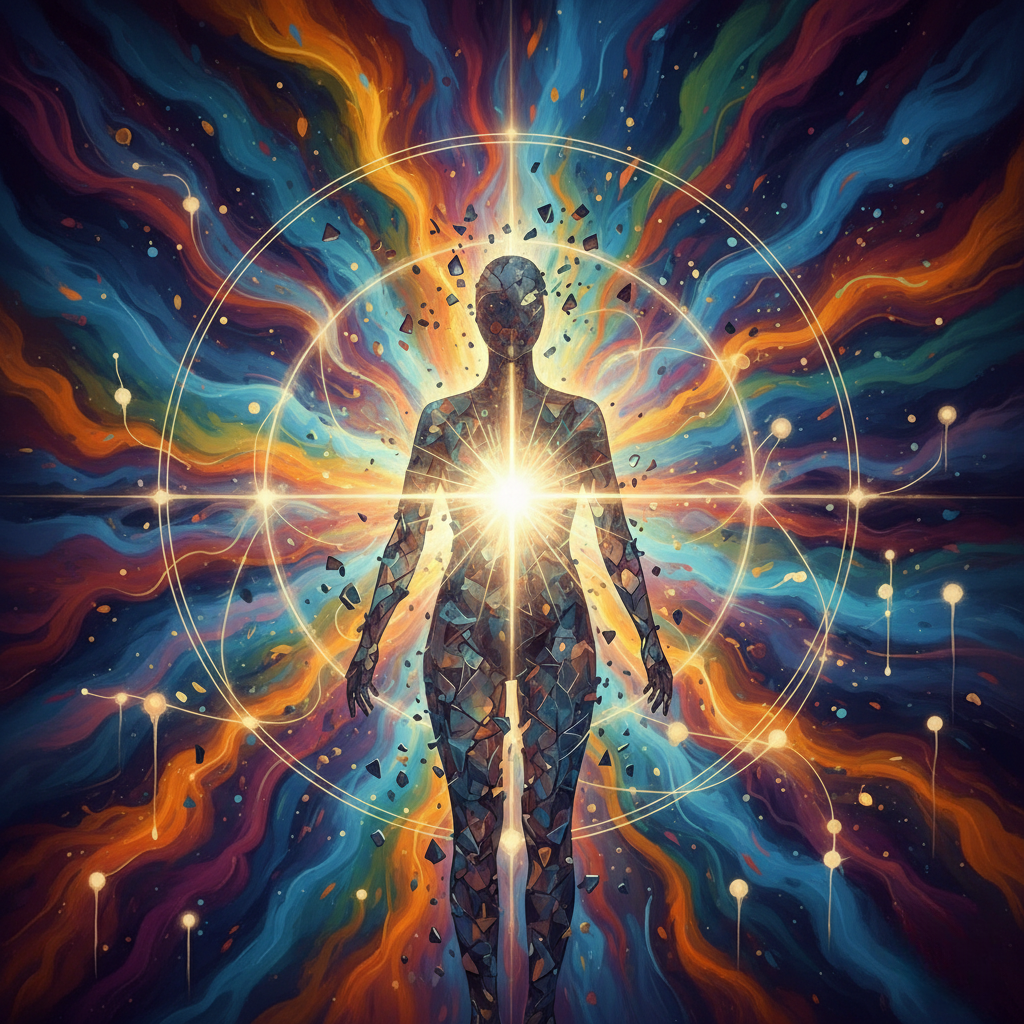
Ego death is often spoken about casually, yet nothing about it is casual. It is not a poetic phrase, nor a dramatic exaggeration. Something very specific occurs—precise, unmistakable, and irreversible at the level of insight.
This is not a biological event. The body remains alive. The brain continues to function. Memory does not disappear. Consciousness does not black out. What vanishes is the internal reference point that says, this is me. The structure that once organized experience around a personal center dissolves, and with it goes the assumption of separation.
No negotiation happens here. No partial surrender. No internal debate. Doubt does not survive the moment. The mind does not ask whether this is real. Verification becomes unnecessary because the one who would seek confirmation is no longer present.
Psychological death may sound abstract until it happens. When it does, the body reacts as though an actual death is occurring. Survival instincts flare. Meaning collapses. Familiar orientation fails. Yet awareness remains clear—perhaps clearer than it has ever been. This clarity is what distinguishes ego death from unconsciousness. Awareness does not dim. It expands beyond the need for identity.
Enlightenment does not occur after ego death. Enlightenment is what is revealed when the ego can no longer interfere. The ego cannot be refined into truth. It cannot be educated into realization. It must fall away entirely, because it is structurally incapable of holding what is uncovered.
At the causal level of realization, identity no longer rests in form, personality, history, or narrative. Cause and effect are no longer observed from the outside. They are known as oneself. Everything that arises is recognized as both originating from and resolving into the same source. Nothing stands apart. Nothing is accidental. Agency is no longer personal, yet responsibility is absolute.
Deeper still, even causality dissolves. Distinctions between origin and outcome lose meaning. What remains is not many things connected, but a single indivisible reality. This is what Advaita Vedanta names Absolute Monism; not a belief, not a concept, but a lived recognition.
Time no longer appears linear. Past, present, and future are not sequential events but simultaneous expressions. Every occurrence, across all scales and dimensions, is apprehended as one movement without edges. Beginning and ending collapse into the same point. Eternity ceases to be a duration and reveals itself as immediacy.
The ego cannot survive this recognition. It was never meant to. The ego exists to navigate relativity, not to comprehend totality. Asking it to grasp nonduality is like asking a shadow to contain light. The moment the ego loosens its grip, what remains is not annihilation, but the recognition that life and death were never opposites.
Ego death feels final because it ends the search forever. Nothing remains to achieve. Nothing remains to defend. What is discovered was never acquired. It was always present, waiting for the interference to stop.
This is why enlightenment is never uncertain. Anyone still asking whether it happened is still standing outside the threshold. When it occurs, the questioner disappears, and only knowing remains; silent, complete, and beyond reversal.
Morgan O. Smith
AI for Wellness and Spirituality Summit
February 9 & 10, 2026
 Morgan O. Smith