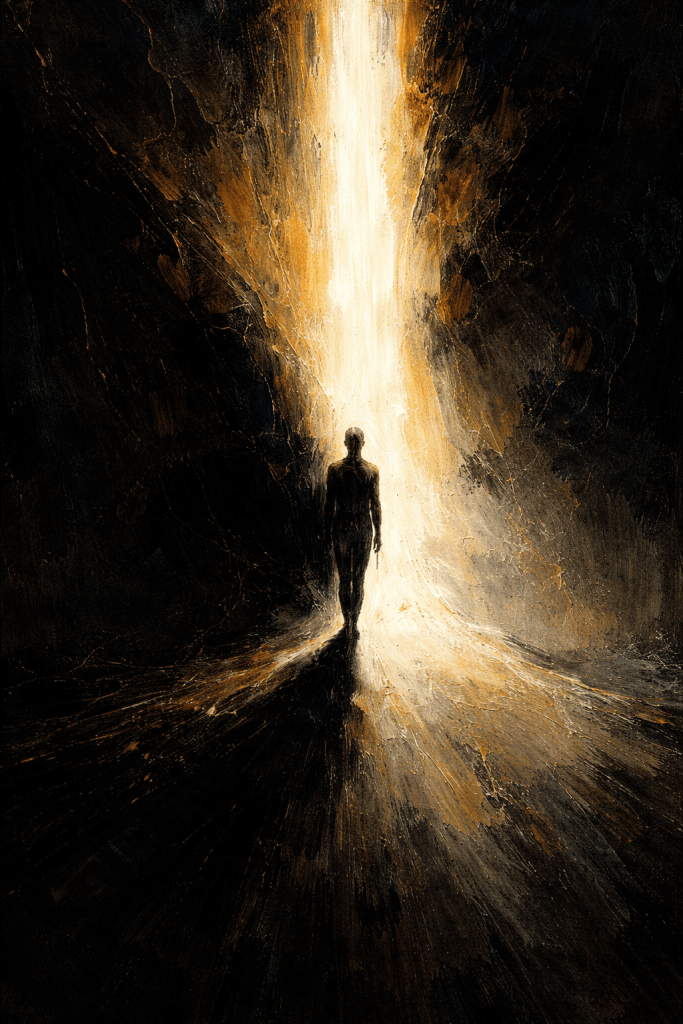
The Golden Shadow

Shows Where You Are Already Free

Freedom often reveals itself long before we notice it. Most people search for liberation by examining what is wounded, suppressed, or unresolved. Yet there is another doorway; quiet, luminous, and often overlooked; the qualities you effortlessly embody without trying. These are not achievements. They are signals. They point toward the portions of your being that have never been bound.

The golden shadow forms where consciousness remains untouched by contraction. It appears in the moments when you respond with clarity instead of reactivity, when your presence deepens without effort, when your intuition moves ahead of your thinking mind. These flashes are not accidents. They are expressions of your unconditioned nature shining through your personality structure. They show where you are already living beyond fear, shame, and fragmentation.

Most of your gifts announce themselves this way. A natural ability to calm others. A capacity to sense underlying patterns. A rhythm of creativity that feels as though it arrives from somewhere deeper than your history. These are not random traits; they are evidence of the deeper self that has always been awake. The golden shadow is your own freedom reflected back to you through the aspects of your life that require no striving.

Shadow work usually focuses on what is rejected, repressed, or denied. Yet exploring the golden side is equally essential because it reveals the openings that already exist. These openings function like hidden pathways; subtle but powerful channels where your awakened nature flows without obstruction. They remind you that the journey toward wholeness is not only about healing the contracted places but recognizing the liberated ones.

Follow the areas where ease, clarity, and generosity arise naturally. Those movements reveal the contours of your true nature. They show the direction consciousness wants to expand. They illuminate the parts of your being that do not need to be fixed; only recognized.

The golden shadow invites you to trust the regions of your inner world that already know how to move without fear. These regions are not simply potentials; they are lived realities quietly shaping your path. When you honour them, your life begins to organize around freedom rather than struggle, around clarity rather than confusion.

Your liberation is not a future accomplishment.
It is already echoing through the parts of you that never forgot who you are.

Morgan O. Smith

Get Your Free Copy of My Book, Bodhi in the Brain!

https://subscribepage.io/oTSZQu

Once Enlightened… Your Problems Have Just Begun

The illusion is that awakening is the end of the road. That the moment the self dissolves, suffering bows out, and the curtain falls. But what if that moment is not an arrival, but a beginning?

Before awakening, the ego fights battles it believes are personal. After awakening, the battlefield is not smaller—it’s vaster, quieter, and infinitely more subtle. The old problems—desire, fear, control—don’t disappear. They shape-shift. They clothe themselves in spiritual garments and reintroduce themselves as paradoxes: “Should I speak, or is silence more aligned?” “Is this surrender or passivity?” “Am I still pretending there’s a me who can do or not do?”

No one warns you that after the clouds part, the sun may burn.

Liberation is not the end of pain. It’s the end of avoidance. One no longer flinches. One no longer hides. You feel fully raw, exposed, without anesthesia. And still, you sit. Still, you breathe. Still, you bow.

You now see with clarity what others can’t. You watch the mechanisms of ego turning behind the eyes of those you love, and the weight of compassion grows heavier, not lighter. You begin to weep for the world—not out of despair, but from a reverence so deep it bends your knees.

Once you’ve seen through the illusion of self, the world becomes impossibly intimate. Every leaf becomes your body. Every scream, your own. Every cruelty, a mirror reflecting the exact frequency of your forgotten selves. There is no refuge. There is only recognition.

You don’t get to leave the world. You return to it—with your skin ripped open, your boundaries gone, and your heart unarmored. Enlightenment doesn’t make you untouchable. It makes you unable to turn away.

There are no medals for realization. No applause for dissolving. No reward for merging with the absolute. What you get, instead, is a silence that never leaves you. A love so vast it terrifies the small mind. A clarity that strips you of every comfortable lie.

And you carry it.

Not as a badge.
As a burden.
As a blessing.
As a vow.

You walk through the world invisible, but more alive than ever. And your problems—they don’t vanish. They deepen. They purify. They sanctify.

Not because you are broken.

But now, you are whole.

Morgan O. Smith

Get Your Free Copy of My Book, Bodhi in the Brain!

https://subscribepage.io/oTSZQu

Into the Heart of All Things

Love That Contains Everything

There comes a moment on the spiritual path when pain is no longer theoretical. It moves from being news headlines or distant horrors into something you feel as if it were happening inside your own body. Starvation in one region of the world burns in your own gut. The terror of assault trembles in your own bones. The rage of a lynching mob snarls behind your teeth.

This is no metaphor. Consciousness itself breaks open to encompass every cry, every injustice, every cruelty humanity has ever inflicted on itself or on the earth. There is no distance left between observer and observed. The entire spectrum of suffering is laid bare without filter or anesthetic.

Mystics have called this the dark night of the soul, but the phrase barely hints at its magnitude. It is not your personal night alone. It is the night of the whole species, the whole cosmos. Racism, sexism, homophobia, transphobia, genocides, rapes, wars, the silent grief of mothers burying children, the loneliness of elders abandoned, the silent weeping of animals led to slaughter. Even the death of worlds, the cold ending of stars.

This unbearable totality can seem like the end of sanity. It is, in fact, the end of the false self that pretends it is separate from any of it.

What follows is not relief but a deeper unmasking. Your own buried fears, resentments, and desires surface with equal force. You see your potential to be the perpetrator as well as the victim. There is no moral high ground left. You become both the murdered and the murderer, the liberator and the oppressor.

This is not punishment. It is a purification so complete it destroys every shield you held up against reality.

Something unexpected happens when there is no more defence. Love appears—not a comforting emotion, but a force that can hold everything without turning away. This love does not choose sides. It does not say “this is holy, that is unholy.” It does not deny the reality of atrocity. It enfolds it.

Ultimate love contains the screams and the silence after. The destruction and the rebirth. The cruelty of humanity and its boundless mercy. The ugliness of our shadow and the beauty of our tenderness.

This is the same force that drives a mother to shield her child from harm and the same force that calls the contemplative to pray for the world. It is what lies behind the tears of remorse, the acts of forgiveness, the revolutions that upend injustice, the small kindnesses that go unnoticed.

Such love is not naive. It has seen everything. It knows what humans are capable of at our worst. Precisely because of that, it offers compassion without condition.

Spiritual awakening, at its deepest, is not an escape from the world’s pain but an embrace of it so complete that the illusion of separation collapses. What remains is love that refuses to exclude anything.

Love that has become vast enough to be the world itself.

Morgan O. Smith

Get Your Free Copy of My Book, Bodhi in the Brain!

https://subscribepage.io/oTSZQu

The Hidden Beast

A Reflection of the Disowned Self

A cunning force moves through the unseen corridors of the unconscious, concealed within those who reject the parts of themselves they fear most. It does not wear horns or breathe fire, nor does it announce its presence with grand gestures. Instead, it drapes itself in the illusion of virtue, speaking with the tongue of righteousness while burying its most primal aspects beneath layers of denial.

This force is not the false prophet itself but the unclaimed shadow—the rejected fragment of the psyche that festers in the void of self-neglect. It lingers where awareness falters, whispering through the cracks of pretense, waiting for moments of weakness to make itself known. Some may catch its presence through a subtle unease, a tension within that signals something amiss. The senses pick up on what the eyes cannot see.

The more one denies this silent presence, the more erratic its manifestations become. When left unacknowledged, it erupts in impulsive behaviours, reckless speech, and actions that defy the carefully crafted image of moral certainty. It demands attention, forcing its way into reality through chaos and contradiction.

Yet, those who witness this in others must tread carefully. Casting judgment only strengthens the illusion of separation. The beast is not exclusive to one person, nor is it bound to a single host. Every individual carries a shadow—a hidden reservoir of unprocessed fears, desires, and forgotten aspects of the self. Recognizing it in another is merely an invitation to acknowledge what lies within.

True transformation does not come from condemnation but from confrontation. The journey is not about silencing the beast but understanding its purpose. When met with awareness, the shadow no longer acts out in defiance but instead becomes an ally. It teaches, refines, and reveals the depth of one’s being.

To see this force in another is an opportunity to turn inward. Rather than dismissing the reflection, one must embrace it, integrate it, and walk the path of self-illumination. Through this, judgment dissolves, tolerance deepens, and empathy emerges—not as an act of virtue but as the inevitable result of knowing oneself completely.

Morgan O. Smith

Yinnergy Meditation/Neurofeedback, Spiritual Life Coaching & My Book, Bodhi in the Brain…Available Now!

https://linktr.ee/morganosmith

The Abyss Within

Facing the Shadows Before Awakening

There exists a realm within the psyche so obscure, so deeply buried beneath layers of identity, that even those who have touched the pinnacle of awakening may remain oblivious to its existence. It is the final frontier before the self dissolves entirely—a territory littered with unexamined fears, concealed transgressions, and desires too shameful to acknowledge.

Before awakening completes its course, before the false self collapses into the boundless expanse of nonduality, there is a reckoning. A descent into the darkest corridors of the mind where the most primitive aspects of existence, both personal and collective, make their presence known. This is not a mere psychological reckoning; it is an existential confrontation, one that strips away the illusion of separation between the individual and the whole of suffering itself.

A being in the throes of this revelation does not merely observe suffering from a distance. Instead, suffering is embodied in its totality—experienced both as the tormentor and the tormented, as the blade and the wound, as the hands that enslave and those that are bound. Every atrocity carried out by humankind, every act of cruelty and despair, rises to the surface. The weight of this recognition is nearly unbearable, a force that shatters all prior conceptions of selfhood. Many break under this pressure; some contemplate escape. Yet for those who endure, something extraordinary occurs.

The searing agony of this confrontation serves a purpose. It dismantles illusions, forces the heart open, and stretches the limits of compassion to their furthest extent. Empathy ceases to be an abstract virtue—it becomes an all-consuming fire that purifies everything in its path. Walking through this inferno does not incinerate the awakened one but instead renders them indestructible, unshaken by the fluctuations of worldly suffering. The very act of seeing, of bearing witness to every grotesque distortion of human nature, births an indescribable clarity—an awareness so vast it can hold both horror and grace without resistance.

No one seeks this path. It is not chosen by desire, nor does it reward the seeker with comfort. It arrives unbidden, reserved for those who must cross the threshold through trial and surrender. To move through this passage is to endure a crucifixion of the self, an initiation that cannot be bypassed. Yet for those who survive its rending force, the view on the other side is unparalleled. A vision beyond words, an existence that moves with effortless grace, guided by a heart that no longer clings to the illusions of division.

This journey is not a metaphor. It is a lived reality, known only to those who have walked barefoot across the glass of their shattered being. And for them, the world is no longer the same.

Morgan O. Smith

Yinnergy Meditation/Neurofeedback, Spiritual Life Coaching & My Book, Bodhi in the Brain…Available Now!

https://linktr.ee/morganosmith

Inner Demons Turning Divine

What if the aspects of ourselves we fear the most are not meant to be exiled, but embraced? What if the so-called demons lurking in our psyche are merely misunderstood fragments of divine potential? This idea challenges conventional narratives of good versus evil, offering instead a profound opportunity for transformation.

The concept of demons often conjures images of malevolence and chaos, forces to be battled or suppressed. Yet, what we resist only persists, festering in the shadows of our subconscious. These “demons” may not be enemies to conquer but rather exiled parts of ourselves calling out for integration. They represent unmet needs, unresolved traumas, or unexpressed desires—the raw materials of our awakening, waiting to be alchemized into wisdom.

Consider anger. It is often labelled a destructive force, but beneath its surface lies a potent energy capable of fueling change. Anger can signal where boundaries have been violated or where injustice has been witnessed. When examined with awareness, it transforms from a blind rage into a catalyst for courage and action. The same applies to fear, envy, or despair. These emotions hold a mirror to the places where we feel disconnected from our true nature. Rather than condemning them, we can engage with them as messengers, seeking the divine spark hidden within their depths.

Spiritual traditions across cultures recognize this transformative potential. In Hinduism, Kali, the fierce goddess, embodies destruction and creation simultaneously. She is terrifying in her form yet revered for her power to dismantle illusion and birth truth. Similarly, Tibetan Buddhism offers practices for transforming wrathful deities into benevolent guides, illustrating that even the most frightening forces can reveal their sacred essence when approached with reverence.

On a personal level, this alchemy requires radical honesty and compassionate inquiry. When we cease to judge our inner demons and instead seek to understand them, we discover their hidden gifts. Shame may reveal a yearning for authenticity, while doubt might lead us to question limiting beliefs. By shining the light of awareness into the shadow, we liberate these energies and integrate them into our wholeness.

The path of transformation is not about erasing darkness but about learning to dance with it. Every demon holds a seed of divinity, and every shadow, when embraced, becomes a source of light. By acknowledging this, we dismantle the illusion of separation within ourselves and open to the vast, unified potential of our being.

Let us not fear our inner demons but recognize them as divine initiators, guiding us toward deeper self-knowledge and spiritual growth. Their presence invites us to reclaim the parts of ourselves we have abandoned, making us more complete, compassionate, and alive.

When we learn to see through the eyes of love, nothing remains unworthy of redemption—not even our darkest shadows.

Morgan O. Smith

Yinnergy Meditation, Spiritual Life Coaching & My Book, Bodhi in the Brain…Available Now!

https://linktr.ee/morganosmith

A Sacred Offering to Mankind

The phrase “dark night of the soul” evokes an existential reckoning, a confrontation with the deepest shadows within us. It is an intimate unravelling, a journey where the self is stripped of its illusions, attachments, and certainties. For many, this process feels like an unbearable plunge into suffering. Yet, it holds the potential to reveal a profound truth: the dissolution of the false self and the emergence of an awareness that transcends individual identity.

Taking on the pain and suffering of all mankind might seem like an impossible burden, yet it is precisely what this experience mirrors. It is not about martyrdom or an exaggerated sense of personal responsibility; instead, it speaks to the interconnected nature of all existence. In the depths of this dark night, the boundaries between “self” and “other” blur, allowing one to feel the collective anguish of humanity as their own.

This universal suffering is not a punishment but an invitation—a chance to awaken to the profound unity underlying all forms of separation. By embracing this shared pain, something extraordinary occurs: the heart begins to open, compassion takes root, and the seeds of wisdom sprout in the soil of surrender. The dark night asks, “Can you hold this pain without fleeing, without clinging to explanations, and without identifying with the suffering itself?”

When one says, “This suffering is a small price to pay,” it reflects a realization born of the dark night: the personal self is only a sliver of the infinite whole. In this light, suffering is no longer seen as a problem to solve but as a process to embrace. It transforms from an adversary into a teacher, pointing beyond the veils of duality to the indivisible unity of all that is.

The paradox of this experience is that as one holds the weight of the world’s suffering, it dissolves into something lighter than air. In letting go of resistance, the pain no longer feels like a prison. Instead, it becomes a portal to freedom—a space where all things are seen as perfect, even in their imperfection.

Emerging from the dark night does not mean returning to an unblemished sense of joy or comfort. It means carrying forward an alchemical knowing: the world’s suffering and its beauty are two sides of the same coin, inseparable and equally sacred. This realization births a new kind of strength—a quiet, humble courage that arises not from the need to control life but from a deep trust in its unfolding.

For those navigating this terrain, know that the dark night is not an end but a beginning. It is not a punishment but a grace, albeit one cloaked in shadows. It reveals that the pain and suffering of all mankind, though heavy, are but a small price to pay for the boundless freedom and love that emerges when the illusion of separation dissolves.

Morgan O. Smith

Yinnergy Meditation, Spiritual Life Coaching & My Book, Bodhi in the Brain…Available Now!

https://linktr.ee/morganosmith

We Shine Brighter Than Light

In the quiet depths of existence, there lies a paradox that many struggle to reconcile. Darkness is often shunned, relegated to the shadows of our awareness, and misunderstood as something to escape or avoid. Yet, within this shadowed realm exists a profound luminosity, a radiance that surpasses even the most blinding light. It’s a subtle brilliance—silent, invisible, but undeniable for those who dare to look beyond the surface.

Darkness is not the absence of light but its origin. It is the womb that cradles potential, the fertile ground where all things come to be. Darkness envelops us with a kind of raw intimacy, inviting us to release attachments to form and identity. It is the space where ego dissolves, where judgments fade, and where we can finally meet ourselves without the filters we have spent lifetimes building. Here, in the stillness, a new kind of light emerges—a light that is not separate from the dark but intertwined, indistinguishable from it.

Consider that every act of creation begins within the void. The artist stares at a blank canvas, the writer faces a blank page, and the thinker sits with a blank mind. It is only by surrendering to the unknown, to the formless, that something profound can emerge. Darkness doesn’t just consume or diminish; it adds depth, layers, and meaning. It carves out spaces within us, allowing us to perceive dimensions of ourselves and the universe that we could never touch through brightness alone.

This radiant darkness reflects the essence of life itself. We are beings that expand and contract, that are filled and emptied in cycles. Every breath, every heartbeat, every experience is a reminder of this cosmic dance of giving and receiving, of adding to and taking away. When we stop resisting this rhythm, we find that what we once perceived as shadows are simply reminders of our potential, our uncharted depths.

To shine as darkness is not to reject light but to transcend the duality of light and dark altogether. It is to recognize that true illumination doesn’t come from escaping or vanquishing shadows but from integrating them. This process transforms our understanding, allowing us to embody a different kind of luminosity—a light that isn’t bound by external visibility but shines from an unshakable inner knowing.

We are both the night and the stars within it, shaping and reshaping ourselves continuously. As we embrace the shadows within, we awaken to a deeper reality, one where every facet of existence has its rightful place. This acceptance, this deep union with both light and dark, is what ultimately enables us to shine brighter than light itself.

Morgan O. Smith

Yinnergy Meditation, Spiritual Life Coaching & My Book, Bodhi in the Brain…Available Now!

https://linktr.ee/morganosmith

The Shadow Self of the Grandiose

The concept of the shadow self—a term Carl Jung coined—reveals layers of ourselves we often choose to hide, repress, or deny. These shadow aspects are usually relegated to a dark corner of our psyche, only surfacing in fleeting glimpses. Yet, when the shadow self takes on a grandiose form, it ceases to be subtle, becoming instead a dominating force. It blinds us with illusions of superiority, entitlement, or self-importance, distorting our perception and interactions.

In personal growth and spiritual awakening, confronting the shadow self is both inevitable and essential. However, when the shadow becomes grandiose, it can convince us we are immune to error, beyond reproach, or uniquely enlightened. This delusion becomes a veil, preventing authentic growth and genuine self-reflection.

The grandiose shadow is not merely about arrogance. It’s a defence mechanism, an armour forged in the fires of insecurity and fear. By building up the self as untouchable or superior, we attempt to ward off the vulnerability of true introspection. But this shield, rather than protecting us, leads to isolation, as others feel the weight of this projection and distance themselves, sensing the ego’s hunger for validation cloaked in supposed wisdom or enlightenment.

In many spiritual or philosophical circles, grandiosity masquerading as enlightenment can become especially potent. The grandiose shadow asserts itself under the guise of spiritual authority or moral righteousness, leading us to believe we are above others on the path. But this illusion only widens the gap between our authentic self and the mask we’ve constructed.

To navigate this terrain, a key question emerges: Are we genuinely pursuing self-understanding, or are we feeding a need to feel special, above, or untouchable? True growth does not demand recognition or approval; it thrives in humility and quiet awareness.

Recognizing when our shadow has grown too grandiose is challenging but necessary. It requires questioning our motives, embracing vulnerability, and letting go of the need to stand above. Only by shedding the inflated version of ourselves can we step into true authenticity and spiritual liberation.

 Morgan O. Smith

Yinnergy Meditation, Spiritual Life Coaching & My Book, Bodhi in the Brain…Available Now!

https://linktr.ee/morganosmith

The Myth of Perfection

A Reflection on Human Nature and Spirituality

Perfection is a concept that many aspire to, yet one that remains fundamentally unattainable. The allure of becoming flawless is often reinforced by societal expectations, self-help narratives, and spiritual teachings that promise transcendence over our shortcomings. We yearn for mastery, imagining a state where all undesirable traits have been eradicated and every behaviour aligns with some ideal of human perfection. But is that ever truly possible?

No one is perfect. Not even the most enlightened being on the planet. Let’s use pest control as an example.

No matter how meticulously we maintain our homes or how many pest-control methods we employ, insects will inevitably appear. Some will be caught and eliminated, others will hide and multiply. This relentless cycle mirrors our inner world. Despite all efforts—through therapy, shadow work, psychedelics, or spiritual awakening—no one has found a way to remove every negative tendency permanently. As insects are part of the natural ecosystem, our imperfections are part of being human. Attempts to eliminate all flaws are as futile as trying to rid the entire world of pests.

Each trait or behaviour can be seen as a metaphorical bug. Selling a bug-killing spray or device is like an enlightened teacher selling a pathway to liberation or a self-actualized individual motivating others to reach their highest potential. The promise is not false, but the misconception lies in the belief that the bugs—the flaws—will be eradicated forever. The truth is more nuanced. Much like we can control insects to a certain extent, we can address negative traits, but total elimination is beyond reach.

If you’ve ever been to a home that had one visible roach, you likely made a snap judgment about cleanliness, even if the house was otherwise spotless. Contrast that with spotting an ant, and your reaction might be more forgiving. This response isn’t based on logic but on deeply ingrained conditioning. The same holds for how we judge others. One visible flaw can overshadow countless positive qualities, not because the flaw is inherently worse, but because of how we’ve been conditioned to perceive it.

A self-actualized person can be compared to a meticulous homeowner who manages to keep most of the pests at bay. Their house is mostly clean, orderly, and free of unwanted visitors. Yet, even they know that complete eradication is impossible. An enlightened being, on the other hand, goes beyond this mindset. They see every bug as a part of themselves—each flaw, each undesirable trait, is not separate but an expression of the whole. This broader understanding fosters a deeper acceptance. While they might occasionally choose to kill a bug, it’s done without aversion or judgment. There’s no inner conflict because they see that every bug, every flaw, serves a purpose.

Now the enlightened individual sees everything as perfection. Everything that is considered imperfect is happening perfectly. Everything is divine. Even the most imperfect individual or situation or circumstance. The enlightened recognize that what appears as chaos or dysfunction from a limited perspective is simply the perfect unfolding of a greater, unseen order. A roach-infested home, a seemingly flawed person, or an unwelcome circumstance—all are expressions of a divine play. There is no distinction between beauty and ugliness, perfection and imperfection because all dualities dissolve into the same oneness.

So, when an enlightened being enters a home overrun with insects, they do not recoil or judge. They recognize that their own home could, at any moment, be similarly overtaken. There is no attachment to a pristine space or the opinions of others regarding their environment. By accepting that bugs will always be present, the enlightened suffer less—not because their world is free of pests, but because they are no longer bothered by their existence.

The true wisdom here lies in shifting the focus away from trying to perfect oneself and toward seeing all parts of life—including the messiness, the flaws, and the unwanted bugs—as expressions of the same wholeness. The journey is not about eradicating; it’s about embracing. When we see all that is seemingly imperfect as perfectly divine, we move beyond the struggle and enter a space of true inner peace and freedom.

Morgan O. Smith

Yinnergy Meditation, Spiritual Life Coaching & My Book, Bodhi in the Brain…Available Now!

https://linktr.ee/morganosmith