The Awakening to Oneness

A Journey from Individual to Collective Consciousness

In a world brimming with over eight billion unique stories, perspectives, and lives, it’s easy to feel like just another fleeting existence. But what if our true power lies in an ancient, yet often overlooked, truth? The moment you transition from seeing yourself as “one of eight billion” to “one with eight billion,” a profound shift happens.

This is more than a play on words; it’s a paradigm shift in how we perceive our existence and connection with the world. We often navigate life perceiving ourselves as solitary islands in a vast ocean of humanity. Yet, this perspective is limiting, preventing us from realizing our collective potential.


The realization of oneness doesn’t mean losing your individuality. Rather, it’s an awakening to the interconnectedness of all beings. Imagine the impact of eight billion unique individuals, each with their dreams, struggles, and triumphs, coming together in shared consciousness. This unity doesn’t erase our differences but celebrates them, weaving a tapestry of diversity that is our collective strength.

This journey to oneness starts within. It begins with the recognition that every thought, every action, and every word has the power to affect the collective consciousness. When you act with kindness, compassion, and understanding, you aren’t just uplifting yourself; you’re contributing to the elevation of the global consciousness.


The challenges facing our world today – from climate change to social injustice – require more than individual efforts. They demand a collective awakening to the power of oneness. When we start seeing the world’s problems as our own, we mobilize a force of eight billion strong, capable of enacting monumental change.

As you navigate your journey, remember that the realization of oneness isn’t a destination but a continuous process. It’s a daily practice of empathy, understanding, and connection. You are one of eight billion until you become one with eight billion. Embrace this truth, and watch as the world transforms around you.

Morgan O. Smith

Yinnergy Meditation, Spiritual Life Coaching & My Book, Bodhi in the Brain…Available Now!

https://linktr.ee/morganosmith

The Mysterious Connection

Shared Spiritual Awakenings Across the Globe

In the realm of spirituality and consciousness, a fascinating phenomenon often goes unnoticed: the simultaneous spiritual awakening experienced by individuals or collectives who have no prior connection. This concept transcends geographical boundaries, cultural differences, and social constructs, suggesting a profound and mystifying link within the human spirit.

Imagine a person in a bustling city experiencing a profound spiritual realization at the same moment as someone in a remote village. They have never met, and their lives are vastly different, yet their inner worlds are undergoing a similar transformation. How can two people, so far apart and disconnected, share such an intimate spiritual journey at the same time?

This phenomenon raises numerous questions about the interconnectedness of human consciousness. Is there an invisible thread that binds us together on a spiritual level? Could these simultaneous awakenings be evidence of a collective consciousness that we are all a part of? This concept echoes the theories of Carl Jung, who spoke of the “collective unconscious,” a shared reservoir of experiences inherent in everyone.


The implications of such synchronicities are both vast and deeply personal. They hint at a universe far more interconnected than we realize, where our spiritual journeys might be part of a larger, cosmic narrative. It challenges the staunch materialist view of the world and invites us to consider the possibility of a more spiritual, interconnected existence.

However, this idea is not without controversy. Skeptics argue that such experiences are mere coincidences, lacking scientific basis or empirical evidence. They question the reliability of subjective spiritual experiences, suggesting that these perceived connections are products of the human mind’s tendency to find patterns and meaning where none exist.

Despite the skepticism, those who have experienced these shared awakenings often describe them as deeply transformative, instilling a sense of unity and interconnectedness with the world. Whether or not these experiences can be scientifically validated, they continue to be a source of wonder, inspiration, and spiritual exploration for many.


In a world increasingly divided by physical and ideological boundaries, the idea of a shared spiritual experience suggests a more profound unity among humanity. It beckons us to look beyond our differences and consider the possibility that on a deeper, spiritual level, we are all inextricably linked.

What are your thoughts? Have you ever felt a connection with someone you’ve never met, perhaps a shared moment of realization or awakening? Share your experiences and insights in the comments below.

Morgan O. Smith

Yinnergy Meditation, Spiritual Life Coaching & My Book, Bodhi in the Brain…Available Now!

https://linktr.ee/morganosmith

Embracing the Infinite

Understanding Para Brahman

In the realm of spiritual exploration and philosophical contemplation, the concept of Para Brahman stands as a profound enigma. It is a term that transcends the limits of our typical understanding, pushing us into the depths of what might be considered the ultimate reality.

Para Brahman, in its essence, is the embodiment of the formless and the infinite. It is not confined by the physical dimensions we are accustomed to, such as length, height, depth, or width. This absence of form extends beyond the physical, into the realms of emotion, thought, and even the metaphysical. It is devoid of texture, distance, time, space, feelings, emotions, senses, attachments, desires, thoughts, memories, anticipation, smell, temperature, relationships, distinctions, wants, needs, and regrets. This extensive list, however, is not exhaustive but indicative of the boundless nature of Para Brahman.

What makes this concept both intriguing and challenging is the paradox it presents. Para Brahman, while being beyond all these attributes and perceptions, simultaneously encompasses everything that has been mentioned. It is not just the absence but also the presence of all. This paradox forces us to rethink our understanding of existence and non-existence, presence and absence, form and formlessness.


How can something be everything and nothing at the same time? This question lies at the heart of understanding Para Brahman. It compels us to look beyond the dualities that dominate our everyday experiences. In this sense, Para Brahman is not just a concept but an invitation to experience reality in its most unadulterated form.

This exploration is not just an intellectual exercise but a journey toward self-realization. It challenges our deeply ingrained notions of what is real and what is illusion. By contemplating Para Brahman, we delve into a state of consciousness where the distinctions that define our usual experiences dissolve. In this state, we are neither bound by our desires nor limited by our perceptions.

The understanding of Para Brahman brings us to the cusp of spiritual awakening, where the individual self merges with the universal self. It is a state of being that many spiritual traditions aim to realize – a state of pure consciousness, unmarred by the transient nature of physical existence.


In conclusion, the concept of Para Brahman invites us to embark on a journey beyond the confines of our material and psychological limitations. It encourages us to experience the world not just through our senses and thoughts but through a profound understanding of the interconnectedness and the boundlessness of all existence.

Morgan O. Smith

Yinnergy Meditation, Spiritual Life Coaching & My Book, Bodhi in the Brain…Available Now!

https://linktr.ee/morganosmith

The Unforeseen Impact of a Brief Encounter

My Journey to Spiritual Awakening

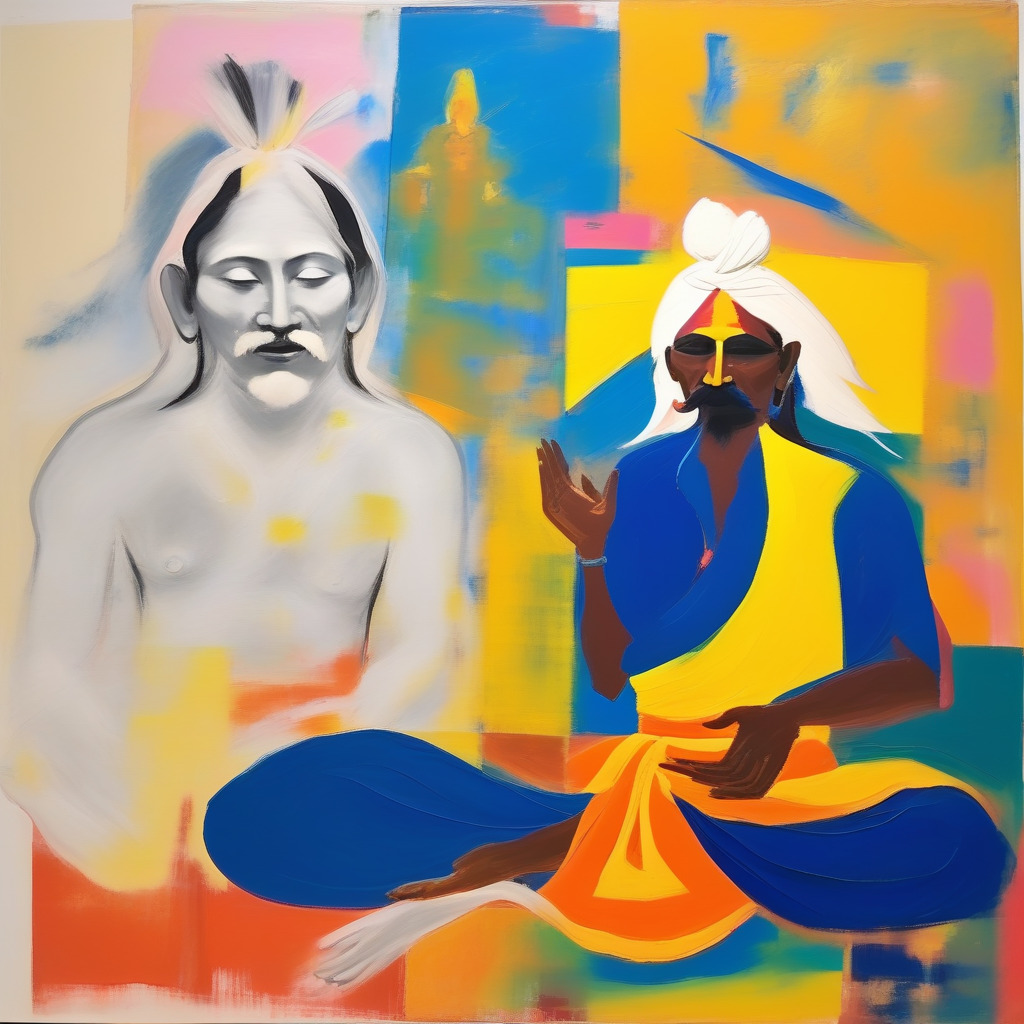
Introduction: It was a chance meeting in 2006 that altered the course of my life. At an event where I was the emcee, I crossed paths with a young black man named Sanander Aniiuwah, who, to me, embodied the essence of an enlightened being. He stood at average height, his appearance marked by dreadlocks and a possible beard, draped in an off-white robe, reminiscent of a Jesus-like figure, wandering in sandals—or in my recollection, often barefoot, even in the chill of winter. The presence of attractive women by his side only heightened my curiosity about him.

Sanander’s Aura and Philosophy: Sanander was not just an ordinary man; he was a local vendor who used his booth at special events as a platform to engage in deep conversations about Eastern philosophical concepts, such as spiritual enlightenment. Despite having practiced meditation for three years by then, his ideas were beyond my grasp. But one late Saturday afternoon at a black cultural youth event, Sanander introduced me to the teachings of Osho, an unfamiliar name to me at that time. He read a quote that struck me profoundly: “God never created the universe, because the universe is still being created.” This statement resonated with me, sending me on a quest to explore Osho’s works and the broader concept of spiritual enlightenment.

My Path to Understanding: In 2008, everything changed. I experienced what I now understand as a spiritual awakening, finally grasping the ideas that Sanander and Osho had been trying to convey. It was a moment of profound clarity, where concepts like nonduality and the nature of awakening, once foreign and elusive, became clear and meaningful.

Conclusion: Gratitude for a Life-Changing Encounter: Reflecting on that brief interaction with Sanander, I am filled with gratitude. His words, seemingly cryptic at the time, were seeds planted in the fertile soil of my curiosity. They grew over time, leading me to a deeper understanding of spirituality and my path to enlightenment. It was a perfect alignment of time and place that allowed me to receive and eventually comprehend these life-altering teachings.

Morgan O. Smith

Yinnergy Meditation, Spiritual Life Coaching & My Book, Bodhi in the Brain…Available Now!

https://linktr.ee/morganosmith

Can One Choose to Go Back to Being Unenlightened?

The journey toward enlightenment is often viewed as a one-way path, leading to a state of spiritual awakening that fundamentally changes one’s perception of the world and self. But is it possible to revert to a state of unenlightenment? This question opens a fascinating philosophical debate.

#### The Irreversibility of Enlightenment


Once an individual experiences spiritual enlightenment, it is commonly believed that this transformation is irreversible. In spiritual traditions like Hinduism, Buddhism, and various mystic philosophies, enlightenment—referred to as Sahaja Samadhi, Turiyatitta, Nirvana, Nibbana, Moksha, Bodhi, and other names—is seen as the ultimate achievement. It’s a profound understanding of the universe and one’s place, transcending ordinary perception.

The idea of willingly abandoning such a state seems counterintuitive. Why would one return to a less aware state after enlightenment? For those who have experienced this profound awakening, giving it up, especially while in the human body, seems unimaginable.


#### The Divine Paradox

However, when considering the divine or absolute reality—referred to in various traditions as God, Brahman, Allah, or the Ground of All Being—there’s an intriguing paradox. This ultimate reality is believed to manifest itself in all forms of existence, encompassing every species and aspect of the universe. In doing so, it seemingly relinquishes its state of pure enlightenment to become the myriad forms of life and matter.

#### The Bodhisattva’s Choice

In Mahayana Buddhism, the concept of the Bodhisattva presents another unique perspective. A Bodhisattva is an individual who has caught a glimpse of enlightenment but chooses not to enter this state fully. This choice is made out of compassion, with the vow to help all sentient beings achieve enlightenment before achieving it themselves fully. This represents a profound sacrifice and a different understanding of enlightenment, not as a personal achievement but as a collective goal.


#### Conclusion

The question of whether one can choose to return to unenlightenment is complex and multi-faceted, deeply rooted in various spiritual traditions and philosophical contemplations. It invites us to consider the nature of spiritual awakening, the role of the divine in the cosmos, and the interconnectedness of all beings in the journey toward enlightenment.

Morgan O. Smith

Yinnergy Meditation, Spiritual Life Coaching & My Book, Bodhi in the Brain…Available Now!
https://linktr.ee/morganosmith

Exploring the Nondual State of Turiyatitta

Beyond the Ego’s Realm

In the journey of spiritual awakening, particularly during the Enlightenment period, we encounter profound concepts that challenge our understanding of self and existence. Among these concepts is the intriguing idea of the nondual state known as Turiyatitta. This state signifies a pivotal transformation where the individual transcends ordinary consciousness, reaching a realm beyond the ego’s grasp.

### The Death of the Ego


At the heart of this transformation lies the “death of the ego.” This term, often shrouded in mysticism, refers to a significant shift in one’s perception of self. In our usual state, we identify strongly with our ego, which is essentially our constructed self-image, replete with our personal history, beliefs, and idiosyncrasies. The ego thrives on differentiation, seeing the self as separate from others and the world at large.


### Turiyatitta: The Nondual Experience

However, in the state of Turiyatitta, this differentiation dissolves. It is a state where the boundaries that separate the individual from the experience are no longer present. In simpler terms, the experiencer (the individual) and the experience become indistinguishable. This is a profound realization, where one no longer views themselves as an isolated entity navigating through an external world, but rather as an integral part of a unified whole.

### Implications of Nonduality

This nondual perspective offers a radical shift in understanding the nature of existence. It challenges the deeply ingrained notion of individualism that pervades many cultures. In Turiyatitta, the sense of separation, which is the root cause of much of our suffering – be it in the form of loneliness, competition, or conflict – dissolves. What remains is a sense of oneness, a deep connection with all that is.


### The Journey to Enlightenment

Reaching this state is often described as the pinnacle of the spiritual journey, a key milestone in the path to Enlightenment. It requires deep introspection, meditation, and often, guidance from spiritual teachings and mentors. It’s not merely an intellectual understanding but a lived, experiential reality.

### Conclusion


The concept of Turiyatitta, and the experience of nondual awareness it describes, presents a fascinating and potentially transformative perspective on life and existence. It invites us to reconsider our relationship with ourselves, others, and the world around us, promising a path toward greater harmony, peace, and understanding.

Morgan O. Smith

Yinnergy Meditation, Spiritual Life Coaching & My Book, Bodhi in the Brain…Available Now!

https://linktr.ee/morganosmith

Understanding Spiritual Enlightenment and Nirvana

A Journey Beyond Words

The quest for spiritual enlightenment is a journey that transcends mere words and enters the realm of profound inner transformation. In the West, enlightenment is often equated with a comprehensive understanding of one’s true nature. This interpretation focuses on the illumination of the self, its intricacies, and its connection to the larger universe. It’s a state of comprehension, where the veils of ignorance are lifted, revealing the true essence of being.

In Eastern traditions, particularly Buddhism and Advaita Vedanta, enlightenment takes on a different hue. Here, it’s synonymous with Nirvana or Moksha – the liberation from the endless cycle of birth, death, and rebirth, known as samsara. This liberation is not just an intellectual understanding but a profound realization that leads to the dissolution of the self. In Buddhism, this is conceptualized as Anatta or no-self, a realization that the self is an illusion and liberation lies in transcending it.


Similarly, in Hinduism, Moksha aligns with the concept of Brahman – the ultimate reality or universal self. While seemingly different, both Nirvana and Moksha converge on the same endpoint: liberation from all forms of suffering and the cycle of samsara.

However, there’s a subtle yet significant distinction to be made. One can achieve spiritual enlightenment – a deep comprehension of their nature and the nature of reality – yet still be bound by the chains of samsara. It’s a state of awakening, an important step on the path, but not the culmination. True liberation, as seen in the concepts of Nirvana and Moksha, involves not just comprehension but also a complete surrendering of the self, a realization of its illusory nature, and ultimately, liberation from the cycle of existence.


Thus, while spiritual enlightenment and Nirvana (or Moksha) are often used interchangeably, their meanings diverge significantly based on cultural and philosophical contexts. In the West, enlightenment is primarily about understanding, while in Eastern philosophies, it’s about liberation. Only when the facets of comprehension, surrendering, realization, and liberation are all present can we step beyond spiritual awakening into the realm of true spiritual enlightenment.

Morgan O. Smith

Yinnergy Meditation, Spiritual Life Coaching & My Book, Bodhi in the Brain…Available Now!

https://linktr.ee/morganosmith

Beyond Duality

Exploring Nondual Experiences and Awakenings

**Introduction**:
In spiritual exploration, nondual experience and nondual awakening emerge as pivotal elements in understanding the nature of consciousness and reality. Often used interchangeably, these terms hold distinct meanings and implications for those on a spiritual path. This blog post aims to unravel the differences and delve deeper into the profound implications of nondual experiences and awakenings.

**Nondual Experience – A Glimpse Beyond the Veil**:
Imagine a moment where all distinctions between you and the world dissolve. This is the essence of a nondual experience. It’s a temporary state where the conventional boundaries of self and other, inside and outside, cease to exist. Such experiences often occur during deep meditation, contemplative practices, or even in spontaneous moments of profound insight. They offer a fleeting yet intense glimpse into a state of unity and interconnectedness, challenging our usual perception of reality. However, as profound as these experiences are, they are transient and do not necessarily result in a permanent shift in understanding or consciousness.

**Nondual Awakening – The Enduring Shift**:
Contrastingly, a nondual awakening is not just a momentary experience but a fundamental transformation. It represents a deep and lasting shift in how one perceives and interacts with reality. In this awakened state, the illusion of a separate self is continuously seen through. This awakening brings about a sustained awareness where separation is transcended, not just in isolated moments, but as a continuous experience in daily life. It marks a paradigm shift from a life experienced through the lens of duality to one of ongoing nondual perception.

**The Journey from Experience to Awakening**:
While a nondual experience can be a catalyst for a nondual awakening, the journey from one to the other is often gradual and requires deep inner work and exploration. The fleeting insights provided by nondual experiences can sow the seeds for the more profound, sustained realization of nondual awakening. This journey involves not only the mind but also the heart and soul, leading to a comprehensive transformation in one’s approach to life and existence.


**Conclusion**:
The exploration of nonduality, whether through transient experiences or enduring awakenings, offers a radical shift in understanding the nature of self and reality. These moments of insight and periods of transformation challenge our conventional perceptions and invite us to experience life beyond the limitations of duality. For those on a spiritual path, understanding and integrating these experiences can be a gateway to a more profound, interconnected existence.

Morgan O. Smith

Yinnergy Meditation, Spiritual Life Coaching & My Book, Bodhi in the Brain…Available Now!

https://linktr.ee/morganosmith

The Profound Journey

Understanding Mystical Experiences and Spiritual Awakenings

**Introduction**:
In the pursuit of understanding life’s profound mysteries, we often come across terms like ‘mystical experience’ and ‘spiritual awakening.’ While these concepts are intertwined in the grand tapestry of spiritual exploration, they hold distinct meanings and implications for the seeker. In this blog post, we delve into the essence of these experiences and how they shape our journey toward enlightenment.

**Mystical Experience – A Moment of Transcendence**:

A mystical experience is like a flash of lightning in the dark night of our existential journey. It’s a transient, profound event that gifts the individual with a sense of unity and oneness with the universe. This experience transcends normal perception and thought, offering a glimpse into a deeper reality that is usually veiled by the mundane aspects of life. Mystical experiences are often described as ineffable – beyond the grasp of language and logic. They can occur spontaneously or be induced through various practices like deep meditation, prayer, or even through profound encounters with nature or art.


**Spiritual Awakening – The Dawn of Consciousness**:
On the other hand, a spiritual awakening is a gradual, transformative process. It’s not just a fleeting moment of insight but a fundamental shift in consciousness. This awakening alters how an individual perceives themselves and their surroundings. It’s akin to waking up from a deep slumber, where one starts to question and understand the deeper aspects of life, self, and the universe. This transformation often leads to personal growth, an increased sense of empathy, and a deeper connection with others. It signifies a lasting change in one’s worldview and approach to life.

**Interconnection and Differences**:
While both mystical experiences and spiritual awakenings can profoundly impact an individual’s life and worldview, they differ in nature and impact. A mystical experience might catalyze a spiritual awakening, yet it can also occur as a standalone event. The key difference lies in their duration and transformative effects. Mystical experiences are short-lived yet intense, whereas spiritual awakenings are long-term, gradually reshaping one’s consciousness and perspective.


**Conclusion**:
In the journey of self-discovery and spiritual growth, both mystical experiences and spiritual awakenings play vital roles. They offer glimpses into the profound mysteries of existence and guide us toward a deeper understanding of our place in the cosmos. As seekers on this path, embracing these experiences can lead us to a more fulfilled and enlightened existence, marked by a profound connection with the world and a deeper understanding of the self.

Morgan O. Smith

Yinnergy Meditation, Spiritual Life Coaching & My Book, Bodhi in the Brain…Available Now!
https://linktr.ee/morganosmith

Surrendering to Nondual Suchness

A Journey Beyond the Self

In spiritual exploration, the concept of surrendering to nondual suchness presents a profound and thought-provoking journey. This journey transcends the confines of the individual self, leading one into the embrace of a universal consciousness.

At the heart of this process is the realization that the sense of a separate ‘you’ is an illusion. In nondual suchness, the distinction between self and other dissolves, revealing a state of being where everything is interconnected and unified. This realization is not an intellectual one; it’s an experiential awakening to the true nature of existence.


When we talk about surrendering in this context, it’s not the conventional notion of giving up or admitting defeat. Instead, it’s a letting go of the ego, the false sense of separateness that keeps us entangled in a web of individuality and personal narratives. It’s a release into the flow of life, an unclenching of the fists that hold tightly to personal identity and desires.

This surrender is not an act done by an individual to something greater. Rather, it’s a recognition that the individual self is an integral part of the greater whole. It’s the ‘all that is’ surrendering to itself. In this space, there’s no doer; there’s just the unfolding of life in its myriad forms, a dance of cosmic consciousness.

This understanding brings about a profound sense of peace and freedom. It’s a liberation from the burdens of the self, a release from the relentless pursuit of personal gain, and an end to the suffering caused by attachment and aversion. In this state, one experiences life in its purest form, unfiltered by the ego’s desires and fears.


Surrendering to nondual suchness is a journey that challenges our deepest-held beliefs and perceptions. It invites us to look beyond the surface of things, to see the interconnectedness of all life, and to experience the world not as a collection of separate entities but as a unified whole.

As we embark on this journey, we find that the path is not always easy. It requires a willingness to let go, to trust in the natural flow of life, and to open ourselves to a reality that transcends the personal. But for those who dare to take this path, the rewards are immeasurable: a sense of oneness with all that is, a deep and abiding peace, and an unshakeable joy that comes from being in harmony with the true nature of existence.

 Morgan O. Smith

Yinnergy Meditation, Spiritual Life Coaching & My Book, Bodhi in the Brain…Available Now!

https://linktr.ee/morganosmith