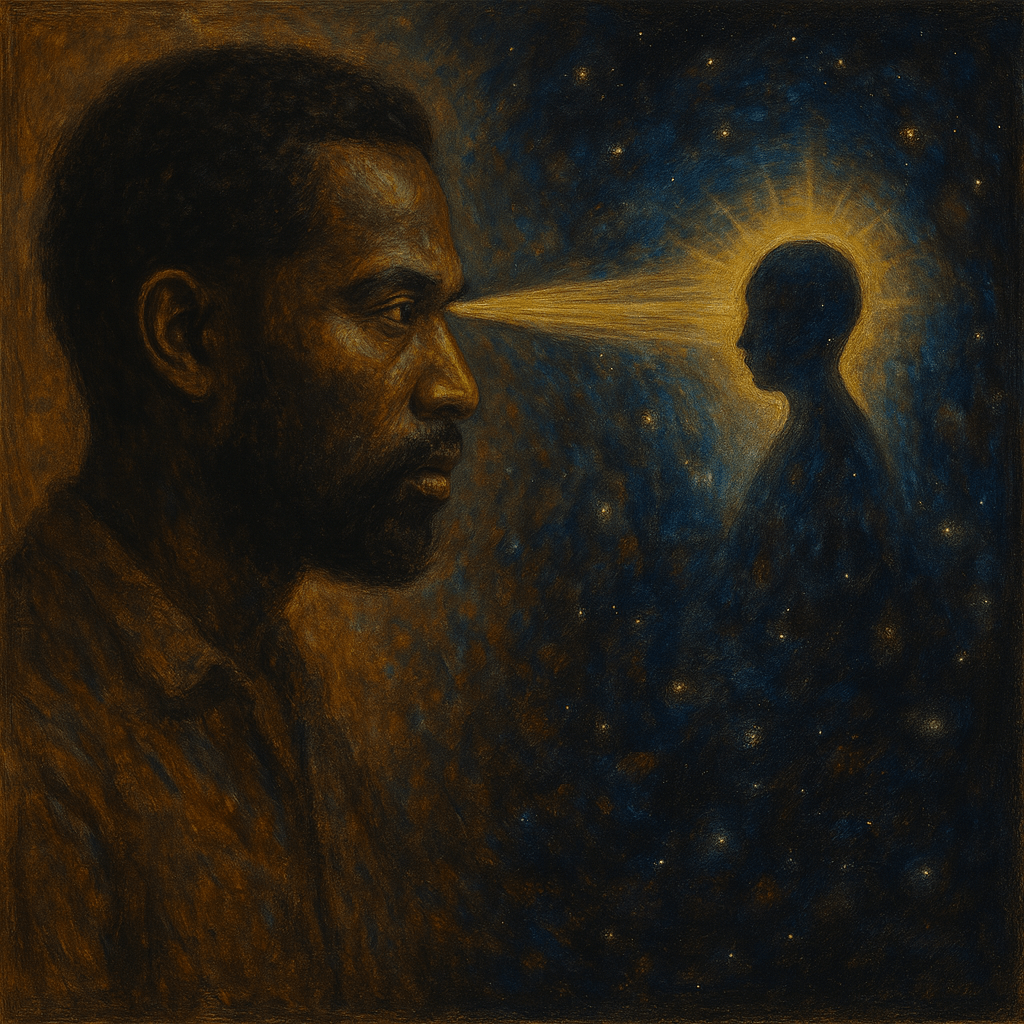
The Precision of Perception

Why Interpretation Shapes Your Awakening

Reality isn’t hiding. What conceals it is the web of interpretations spun by the mind: assumptions, projections, and inherited beliefs. Yet, paradoxically, it is through interpretation that one begins to peel away those very veils. Every interpretation is a mirror. The question is: what is it reflecting?

Interpretation matters because it reveals where you are on the developmental spiral. Crude, reactive interpretations reflect lower rungs of psychological growth; often rooted in fear, blame, or a need for certainty. As awareness matures, interpretations become more nuanced, inclusive, and paradox-tolerant. They start to echo the underlying unity of things, rather than just categorize them.

Interpretation is not merely a mental activity. It is a soul signal. The more refined it becomes, the closer it gets to silence, the point where no interpretation is needed. That is the paradox. The highest interpretation doesn’t claim to know; it bows. It listens. It dissolves.

Yet such dissolution is not a regression into vagueness. It is the clarity that comes when all interpretations have done their job and exhausted their usefulness. Then what remains is the directness of being—your true nature—not as a conclusion, but as the very absence of conclusion.

This is why interpretation is not to be dismissed but refined. It is a bridge. And the more accurate your interpretation of the world, the closer you walk toward the unconditioned—what no interpretation can contain, but all of them secretly point toward.

What you interpret is what you live. Misinterpret life, and you suffer. Align with it, and you awaken. Accuracy in perception is not about being “right”; it is about being real. Every step you take toward clearer interpretation is a step toward the Real that has no opposite.

Morgan O. Smith

Get Your Free Copy of My Book, Bodhi in the Brain!

https://subscribepage.io/oTSZQu

The Architecture of the Ideal

Why the Myth Matters More Than the Man

Whether Jesus walked the earth or not is irrelevant to me. I am less concerned with the historicity of a man than I am with the utility of what he represents. Jesus is a technology. So is the Buddha. So is Krishna. These aren’t merely personalities from the past; they are structured mechanisms—living blueprints—for the cultivation of inner transformation and the evolution of civilization.

They function like algorithms for awakening, coded into the myths and memories of culture, waiting to be activated. Each offers a symbol-set, a behavioral protocol, an ethical framework, and a psychological mirror. Whether or not they existed, they exist. Their presence in the collective psyche is undeniable, and their effect, observable.

Civilizations have risen around these templates. Wars have been fought in their names, yes—but so have peace movements been born, arts been inspired, and lives reoriented toward compassion, surrender, and truth. These are not minor outcomes. These are pivotal shifts in the trajectory of human consciousness.

When a society lacks mythic technologies, it spirals. When the sacred is reduced to opinion or dismissed entirely, a vacuum forms. And into that vacuum pours the lesser gods of the day—greed, algorithmic manipulation, ego-as-brand. The sacred figures stand not because they are flawless historical beings, but because they point beyond history. They are fingers, pointing not to the past, but to what is possible—personally, collectively, cosmically.

To see Jesus as a technology is to acknowledge the architecture of possibility. To understand the Buddha as a psychological operating system is to awaken to what it means to be truly sane. Whether temporary or permanent, these peak states—compassion without condition, awareness without center, love without lack—are doorways we are meant to pass through, again and again, until their impermanence no longer discourages us, but refines us.

Maybe they were fictionalized. Maybe they were real. Doesn’t matter. They were necessary. They remain necessary. Because without the fiction of perfection, how would we recognize the direction of our ascent?

Morgan O. Smith

Get Your Free Copy of My Book, Bodhi in the Brain!

https://subscribepage.io/oTSZQu

The Environmental Evolution of Being

Put Yourself in an Environment That Forces You to Evolve

Evolution is not a passive process. It requires friction, challenge, and a deliberate shift in how we engage with the world around us. Too often, we find ourselves clinging to the familiar – a comfort zone that insulates us from growth. But the truth is, stagnation often masquerades as comfort, and transformation rarely occurs in spaces that feel safe and predictable. To truly evolve, you must immerse yourself in environments that demand more of you than you believed possible.

Imagine a seed placed on barren soil. No matter how much potential it holds, without the right environment, it cannot thrive. The same principle applies to human consciousness. When you place yourself in an environment that challenges your assumptions, disrupts your routines, and stretches your understanding of who you are, evolution becomes inevitable.

Surround yourself with individuals who inspire you through their authenticity, resilience, and wisdom. Seek experiences that make you question your current perspective. Choose spaces that encourage vulnerability while fostering accountability. These environments act as mirrors, reflecting aspects of yourself that may have gone unnoticed or unacknowledged. Growth arises when you embrace what you see, even when it feels uncomfortable.

It is not the environment alone that transforms; it is your willingness to engage with it fully. A forest does not teach you to climb, but the presence of towering trees invites you to rise above. The ocean does not command you to swim, but its vastness compels you to move beyond your limits. Similarly, environments rich with opportunity and challenge do not demand evolution – they inspire it.

This process requires discernment. Not every difficult situation is fertile ground for growth. Some environments drain, diminish, or distort your sense of self. The key is to distinguish between spaces that stretch you and those that stifle you. Recognize the difference between discomfort that promotes expansion and harm that reinforces contraction.

Ask yourself: What environments am I currently choosing, and how are they shaping my trajectory? Are they calling me to deepen my understanding, expand my horizons, or confront the parts of myself that remain unseen? Or are they keeping me tethered to outdated patterns of thinking and being? These questions hold the power to shift your reality.

To evolve is to risk. It is to step into uncertainty with the faith that growth lies on the other side. No great transformation ever came from staying the same. If you feel the urge to grow, listen to it. Put yourself in the soil of challenge, water it with intention, and let your potential rise to meet the environment that beckons you forward.

Morgan O. Smith

Yinnergy Meditation, Spiritual Life Coaching & My Book, Bodhi in the Brain…Available Now!

https://linktr.ee/morganosmith

The Exponential Unfolding of Consciousness

From the Ego to the Infinite

The sequence 1, 2, 4, 8, 16, 32, 64 etc is known as a geometric progression—a pattern where each term after the first is found by multiplying the previous one by a fixed, non-zero number. Each number is doubled in this case, creating an exponential growth that is not just a mathematical concept but a fundamental principle found throughout nature. This sequence is critical because it represents how small beginnings can lead to vast, expansive outcomes, demonstrating the power of exponential transformation. The same principle that drives population growth, the branching of trees, and the spiralling of shells can also be seen as a metaphor for the process of spiritual awakening. Just as nature uses geometric progression to unfold complexity and beauty, so too might our spiritual experiences expand as the mind transcends from the small “I” or ego into the vastness of collective consciousness, and ultimately into Consciousness itself.

At the outset, the mind identifies with the number 1. It is the small “I,” the ego, the center of an individual’s universe. This singular identity believes itself to be separate, and distinct from the world around it. The self sees itself as the subject in a world of objects, the thinker in a sea of thoughts, and the doer in a realm of actions. The ego stands alone, encapsulated within its boundaries, perceiving the world through a lens of duality.

But, as with the sequence, there comes a moment when the ego perceives something beyond its singular existence. It doubles into 2. This is the first awakening—a recognition that there is more to existence than just the self. The mind begins to sense its connection to others, the threads of interdependence that weave through the fabric of life. This is the initial glimpse into the collective consciousness.

As the mind continues to expand—4, 8—it begins to transcend the confines of the ego. The boundaries that once seemed so solid start to dissolve. The self no longer sees itself as merely an individual but as part of a larger whole, an integral part of the collective consciousness. This is the stage where the mind starts to perceive the unity underlying all diversity, recognizing that the separation it once clung to was an illusion.

The sequence continues—16, 32, 64—each step representing a deeper level of awareness, a more profound surrender to the truth of existence. The mind begins to transcend even the collective consciousness, moving towards the infinite, the realm of pure Consciousness. Here, the small “I” completely dissolves, and what remains is the recognition of being one with the entire universe, with the very essence of life itself.

This final stage of the sequence symbolizes the ultimate spiritual awakening. The mind has moved beyond the personal and the collective, into the boundless expanse of pure Consciousness. It is here that the true nature of reality is revealed—that there is no separation, no division, only the infinite play of Consciousness experiencing itself in myriad forms.

The journey from ego to infinite Consciousness is not just one of linear progression but of exponential transformation. Each doubling in the sequence represents a quantum leap in awareness, a step closer to the ultimate realization of nonduality. And just as the sequence could continue indefinitely, so too does the journey of spiritual awakening, for Consciousness is limitless, ever-expanding, and eternally evolving.

In reflecting upon this natural and spiritual process, we are reminded that the same patterns that govern the physical world may also govern our inner worlds. As nature grows and evolves, so too do we, propelled by the same forces of expansion, ever moving toward greater complexity, unity, and understanding. In this sense, the pattern found in the sequence 1, 2, 4, 8, 16, 32, 64 is not just a mathematical curiosity but a universal truth, guiding us on our journey from the limited self to the infinite.

Morgan O. Smith

Yinnergy Meditation, Spiritual Life Coaching & My Book, Bodhi in the Brain…Available Now!

https://linktr.ee/morganosmith

The Evolution Beyond Personal Deities

Embracing the Infinite

In the profound journey of spiritual awakening, there comes a moment when the personal god, once a comforting presence, begins to feel like an ill-fitting garment. This is not a rejection but an evolution, akin to an adolescent who outgrows their need for an imaginary friend. This metaphorical maturation reflects a deeper understanding of the divine as an infinite, formless presence, beyond any personal characteristics or limitations.

In our early spiritual development, the idea of a personal god can be immensely comforting. It offers a sense of security and companionship, much like a child’s imaginary friend. This anthropomorphic deity provides guidance, solace, and a moral compass, helping us navigate the complexities of life. However, as we delve deeper into the realms of spirituality and nonduality, our perception of divinity begins to transform.

The transition from a personal god to an impersonal, infinite reality mirrors our journey from ego-bound identities to the realization of our true, boundless nature. This shift is not about abandoning faith but about expanding it. It is about moving from a limited, dualistic perception of the divine to an all-encompassing, nondual awareness. Here, the divine is not a separate entity but the very essence of existence itself, permeating every atom of the cosmos.

Embracing this infinite reality requires a profound letting go of old paradigms. It involves releasing the need for a deity who looks like us, thinks like us, and intervenes in our lives. Instead, we begin to see the divine as an all-pervasive consciousness, a vast, unconditioned presence that transcends all forms and concepts. This realization brings a deep sense of peace and unity, as we recognize our inherent connection to the divine.

This evolution can be challenging. It demands that we confront our deepest fears and insecurities, the aspects of ourselves that clung to the comfort of a personal god. Yet, it is in this very confrontation that we find liberation. By letting go of the need for a personal deity, we open ourselves to the infinite, experiencing the divine in every moment, every breath, and every heartbeat.

In this state of expanded awareness, prayer and meditation transform. They become less about seeking guidance or intervention from a higher power and more about attuning themselves to the subtle, ever-present flow of divine energy. Our spiritual practices deepen, becoming a means of aligning with the infinite, of experiencing the divine as an intimate part of our being.

Ultimately, the evolution beyond a personal god is a return to our true nature. It is a journey from the confines of duality to the boundless expanse of nonduality. This realization is not an endpoint but a continuous unfolding, a never-ending exploration of the infinite depths of existence.


As we embrace this evolution, we step into a new dimension of spiritual maturity. We recognize the divine in all its forms and formlessness, in every aspect of life and beyond. And in this recognition, we find a profound sense of belonging, a deep, abiding peace that transcends all understanding.

Morgan O. Smith

Yinnergy Meditation, Spiritual Life Coaching & My Book, Bodhi in the Brain…Available Now!

https://linktr.ee/morganosmith

The Guru’s Enlightenment Isn’t the Absence of Your Own

It’s easy to fall into the comparison trap in the vast landscape of spiritual awakening. We witness the profound transformations and mystical experiences of others, and a subtle voice within us begins to whisper: “Why not me?” This whisper can grow into a chorus, overshadowing our path with doubt and impatience. However, understanding that someone else’s enlightenment isn’t the absence of your own can be a liberating revelation on the spiritual journey.

Each soul’s journey is a unique odyssey, carved out of their experiences and inner work. Just as no two fingerprints are the same, no two paths to enlightenment mirror each other perfectly. When we compare our progress with that of others, we risk overlooking the intricacies and nuances of our spiritual growth.

Imagine the spiritual journey as a grand symphony, where each individual’s enlightenment represents a distinct, essential note. The melody of the universe is incomplete without the contribution of each soul’s unique vibration. Another’s moment of illumination doesn’t dim your light; instead, it enriches the collective harmony, elevating the entire symphony to greater heights.

This realization invites us to shift our focus inward, recognizing the profound wisdom and beauty in our own experiences. Every moment of insight, every challenge faced, and every small victory on the path is a testament to the unfolding of our consciousness. When we honour our journey, we embrace the understanding that enlightenment is not a race but a deeply personal and transformative process.

The nature of nonduality teaches us that separation is an illusion. In the realm of pure consciousness, there is no competition or hierarchy. Each individual’s enlightenment contributes to the awakening of the collective, reflecting the interconnectedness of all beings. The enlightenment of one is a spark that ignites the potential within all.

Instead of viewing others’ enlightenment as a benchmark for our own, we can celebrate their milestones as a reflection of what’s possible within us. Their breakthroughs become a source of inspiration, reminding us of the boundless potential that lies within. By cultivating patience and trust in our unique path, we align ourselves with the natural rhythm of our spiritual evolution.

The journey to enlightenment is as diverse as those who embark on it. Embrace your path with gratitude, knowing that every step you take is perfectly purposeful. Remember, the guru’s enlightenment isn’t the absence of your own; it is a testament to the infinite possibilities that exist within the boundless expanse of consciousness.

Morgan O. Smith

Yinnergy Meditation, Spiritual Life Coaching & My Book, Bodhi in the Brain…Available Now!

https://linktr.ee/morganosmith

Navigating the Shades of Morality

Embracing Our Humanity Through Spiritual Evolution

In the labyrinth of human experience, we often find ourselves at a crossroads between contrasting moral landscapes. This journey, fraught with myriad complexities, guides us through a transformative process—a shift from seeing the world in stark contrasts to embracing the nuanced shades of morality that define our existence. It’s a journey that doesn’t just challenge our perceptions but also enriches our understanding of what it means to be inherently human.

The Evolution of Perception

As we embark on this spiritual and psychological evolution, our initial encounters with morality are often painted in broad strokes of black and white. This dichotomy, while offering clarity, is also a testament to our nascent understanding of the moral universe. However, as we delve deeper into our journey of self-discovery and spiritual awakening, we begin to notice the emergence of grey areas. These are not mere anomalies but signposts of our evolving consciousness.

The Tug of War Within

This recognition ushers in a period of internal conflict—a tug-of-war between the polarities of good and evil, right and wrong. It’s a battle that rages within, pulling us in opposing directions. Yet, it’s through this struggle that we learn the invaluable lesson of acceptance. By integrating these disparate aspects of our being, we unlock a more profound comprehension of our nature and the world around us.


Standing Firm in the Middle

The ultimate aim of this journey is not to choose a side but to find equilibrium amidst the chaos. To stand firm in the middle is to acknowledge our capacity for both the divine and the diabolical. It is in this space that we discover true empathy and compassion, unburdened by bias and judgment. This balanced stance does not signify indifference but a deeper connection to the vast spectrum of human experiences and emotions.

The Gift of Empathy and Compassion

By embracing the grey areas of morality, we cultivate a more empathetic and compassionate perspective. This transformation is not just personal but collective, as our increased understanding and acceptance ripple outwards, influencing our interactions and relationships. In recognizing our complexities, we become more forgiving of others, bridging divides and fostering a sense of shared humanity.


Conclusion: Embracing Our Humanity

The journey through the shades of morality is an integral part of our spiritual evolution. It challenges us to confront and reconcile the complexities within ourselves, leading to a more empathetic, compassionate, and balanced existence. By standing in the middle of our moral landscape, we embrace the full spectrum of our humanity, finding peace in the acceptance of our multifaceted nature.

Morgan O. Smith

Yinnergy Meditation, Spiritual Life Coaching & My Book, Bodhi in the Brain…Available Now!

https://linktr.ee/morganosmith

The Quiet Power of Self-Affirmation

Embracing Truth Beyond Validation

In the realm of personal growth and spiritual enlightenment, a profound realization dawns upon us: when we harbour an unwavering conviction in truth, the need for external affirmation diminishes. This realization is a cornerstone in the journey toward self-awareness and inner peace.

Consider the nature of truth as perceived through the lens of Eastern philosophy. It is not a construct external to us, waiting for validation or approval. Instead, truth is an intrinsic part of our being, resonating deeply within our consciousness. The moment we recognize and embrace this inner truth, we transcend the dependence on external validation. This is a pivotal step in our spiritual evolution, marking a shift from seeking approval to cultivating self-assurance.

The beauty of this realization lies in its simplicity and power. When you are convinced of a truth – be it a personal belief, a spiritual insight, or an understanding of the self – you stand firm in your conviction without the crutch of others’ opinions. This is not to undermine the value of dialogue and shared perspectives but to highlight a more profound sense of confidence that comes from within.


This confidence is not born of arrogance or unwarranted self-assurance. It is a quiet, unshakable belief that what you hold has been reflected upon, deeply felt, and integrated into your being. It is a testament to the journey of self-discovery and personal enlightenment you have embarked upon.

The concept of non-duality in Eastern philosophy offers a valuable perspective here. It teaches us that the distinctions we make between self and others, between our beliefs and the external world, are illusory. In recognizing the non-dual nature of existence, we understand that our deepest truths are not separate from the universal truth. They are interwoven in the very fabric of existence, and as such, they require no external endorsement.

Embrace this journey of self-affirmation with humility and openness. Let your truths be a source of strength and guidance, rooted deeply in your experience and understanding. As you do so, you will find that the need for external validation naturally falls away, leaving you with a serene confidence in your path and beliefs.


In conclusion, the path to spiritual awakening and enlightenment is illuminated by the truths we hold dear, truths that require no external validation to shine brightly within us. They reflect our deepest selves, resonating with the universal truths that bind us all.

Morgan O. Smith

Yinnergy Meditation, Spiritual Life Coaching & My Book, Bodhi in the Brain…Available Now!

https://linktr.ee/morganosmith

Meditative Practice as a Perpetual State

An Evolutionary Stage in Spiritual Development

In the journey of self-discovery and spiritual growth, the concept of meditation often surfaces as a pivotal practice. However, there’s an evolutionary stage within this practice that transcends beyond the mere act of meditating – it’s the transformation of meditative practice into a perpetual state of meditation. This shift marks a significant milestone in an individual’s spiritual development, where meditation is no longer an isolated activity but an intrinsic part of one’s existence.

## The Essence of Perpetual Meditation

Perpetual meditation is not about allocating specific hours of the day to meditate; it’s about integrating the essence of meditation into every moment of life. This stage is reached when the clarity, calmness, and mindfulness cultivated during meditation persist throughout the day, influencing our thoughts, actions, and interactions. It’s a state where the mind is constantly attuned to the present, free from the clutches of past regrets and future anxieties.

## Evolutionary Spiritual Development

Reaching this stage of perpetual meditation signifies a profound shift in spiritual evolution. It’s a transformation from doing to being – from practicing meditation as a task to living meditatively. This evolution is marked by a heightened sense of awareness and a deep connection with the inner self. It’s a journey from the surface layers of consciousness to the deeper, more subtle realms of existence.

## The Impact on Individual and Collective Consciousness

The transition to a perpetual state of meditation has far-reaching implications, both for the individual and the collective consciousness. On a personal level, it cultivates inner peace, resilience, and a profound understanding of life. On a collective level, it can lead to a more compassionate, empathetic, and conscious society, as individuals who embody this state naturally radiate positivity and understanding.

## Navigating the Path

The path to this evolutionary stage is unique for each individual, yet some universal practices can guide the journey. Regular meditation, mindfulness exercises, and a conscious effort to stay present can gradually lead to the internalization of meditative awareness. It’s a path of patience, persistence, and profound introspection.

## Conclusion

Transforming meditative practice into a perpetual state of meditation is a significant evolutionary step in spiritual development. It’s a journey towards becoming a beacon of peace and awareness, influencing not only one’s life but also the world at large. This state is not an end but a beginning – a gateway to deeper spiritual realms and a more profound understanding of existence.

Yinnergy Meditation


Embark on a transformative journey with Yinnergy Meditation, a distinctive and potent program crafted to unleash your inner capabilities. More than just a meditation technology, Yinnergy guides you on a path of emotional, mental, and spiritual evolution. Experience the depths of meditation, increased tranquillity, and notable improvements in creativity, concentration, and intuition through Yinnergy. Suitable for both novices and experienced practitioners, it offers an accessible yet impactful route to heightened self-awareness and well-being. Choose Yinnergy Meditation for a life filled with clarity, equilibrium, and harmony. Begin your journey of transformation today and connect with your deepest inner strengths!

Remember to make the most of our exclusive Holiday promotion. Apply the discount code R7X9Z2P for special savings on all Yinnergy products during checkout.

https://yinnergy.gumroad.com/

The Expansive Self

Beyond the Boundaries of Individual Identity

In the vast tapestry of human experience, one of the most profound and transformative realizations is the awakening to a sense of identity that stretches far beyond the individual self. This philosophical journey, explored by thinkers, mystics, and seekers throughout history, offers an exploration into the very essence of what it means to be human, and more profoundly, what it means to be a part of the cosmos.

### The Layers of Self

**1. The Individual Identity**: Our daily lives are governed by our personal experiences, histories, and beliefs. This individual self, encapsulated by our distinct personalities, desires, and aspirations, is like a drop in the vast ocean of existence.

**2. The Collective Identity**: There are moments, often inspired by shared experiences, when we resonate with a group, whether based on nationality, religion, or shared purpose. Here, the boundaries blur slightly, and the drop becomes a wave, united in its motion with other droplets.

**3. The Universal Self**: Delving deeper, we encounter a realm where the wave realizes it’s not just a part of the ocean, but the ocean itself. This vast sense of identity, encompassing all of life, the universe, and the myriad forms within it, is an experience of unity and oneness with all that exists.

### The Power of Oneness


With an expanded identity, empathy and compassion naturally flourish. The pain and joy of another are no longer abstract experiences; they become deeply personal as if they were our own. This profound interconnectedness also extends to nature, leading to an intrinsic desire to safeguard the environment and all its inhabitants.

Moreover, as one navigates this expanded identity, the grip of personal desires and ego-based needs loosens. Life begins to flow with an acceptance of its unfolding mystery, reducing resistance and enhancing serenity.

### Mystical Insights and Modern Science

Historically, mystics from various traditions spoke of experiences of union with the divine, the universe, or the underlying essence of reality. Today, intriguingly, modern science, especially in fields like quantum physics, hints at ideas of interconnectedness and non-locality. Such insights suggest that the ancient intuitions of interconnectedness may have parallels in our current understanding of the cosmos.

### Challenges of the Expansive Self


However, this journey is not without its pitfalls. As we embrace a broader sense of self, there’s the risk of “spiritual bypassing” – a tendency to use these expansive realizations to sidestep personal issues or challenging emotions. An expansive identity doesn’t negate personal responsibilities or the need for personal boundaries. It invites a deeper engagement with life in all its complexity.

### Conclusion

Our identity’s evolution, from a solitary droplet to the vast ocean, is a journey of consciousness and profound realization. It reminds us that beneath the multiplicity and diversity of existence lies an undercurrent of unity, urging us to rediscover and embrace our place in the cosmos.

As we ponder on the vastness of our identity, it serves as a beacon, guiding us toward a life of deeper meaning, connection, and purpose. In recognizing our expansive self, we find not only our place in the universe but also the universe within ourselves.

Morgan O. Smith

Yinnergy Meditation & My Book, Bodhi in the Brain…Available Now!

https://linktr.ee/morganosmith