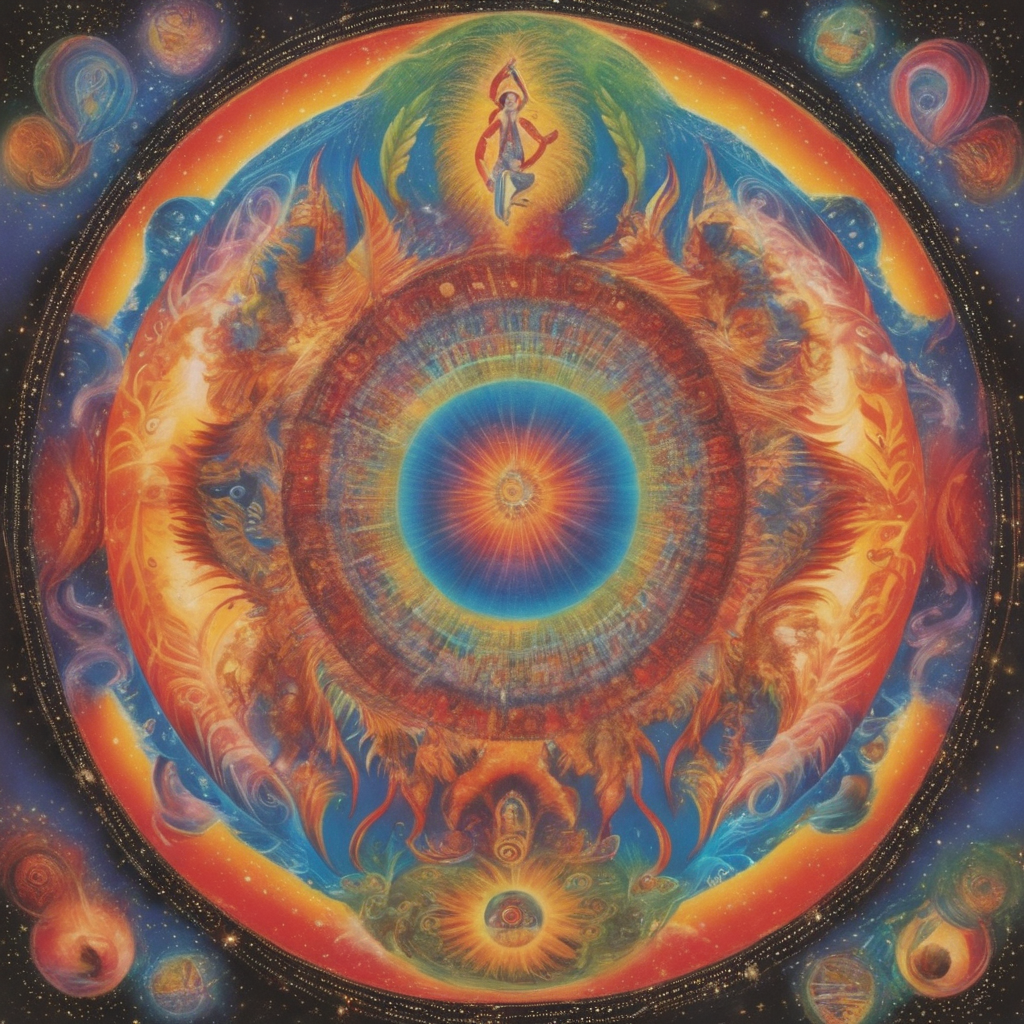
The Circular Journey of Reincarnation

A Dance of Spirit, Self, and Transcendence

Sculpted by ancient wisdom and breathed into existence by mystic philosophies, the idea of reincarnation challenges our perception of reality, questioning the depth of life, death, and the realms that extend beyond our comprehension. It’s an intriguing path leading to a fascinating panorama of eternal becoming, a ceaseless cycle of birth, death, and rebirth that we often term ‘Samsara’. Delving deeper into this concept, a theory emerges, where the omnipresent Spirit, or the Ground of all Being, embarks on a journey to experience life from an individual standpoint.

The Spirit, in its omnipotent and omniscient state, voluntarily decides to fragment its infiniteness into a finite form, breathing life into an individual self. But why does this transition occur? Could it be that the Spirit seeks to experience, understand, and embrace the existential dynamics from the individual lens? To dive into the chaotic beauty of life, to suffer, to joy, to yearn, and to discover? We can only speculate.

The interaction between the Spirit and its earthly existence forms an intricate dance, a dance that eventually leads to the enrichment of the Spirit. Each incarnation, each dance, is an opportunity for the Spirit to learn, grow, and evolve. If Nirvana or Moksha, the state of absolute liberation, isn’t attained in a single lifetime, the Spirit continues its journey through subsequent lifetimes, circling the samsara wheel.

In this theory, one might imagine each cycle of Samsara to be equivalent to a full rotation of 360 degrees. Each degree of rotation represents the lived experiences, the struggles and victories, the heartaches and joys, and the insights and awakenings that shape the individual soul’s evolution. Upon completing this 360-degree cycle, the Spirit transitions to a new plane of existence, a higher level of consciousness, armed with the wisdom and enlightenment accumulated from its previous journey.

This continuum is profound. It’s a cosmic design that instills a sense of awe and wonder, presenting the possibility of existence in planes beyond our material world. It grants our life a transcendent purpose, a grandeur that transcends the limitations of a single life span.

Reincarnation, as visualized in this theory, leads us to reconsider the significance of our lives. It encourages us to perceive every event, every interaction, as an opportunity for the Spirit to learn and evolve. Furthermore, it nudges us to view ourselves not merely as transient beings but as vessels for the Spirit’s journey toward the absolute.

In conclusion, the philosophical discourse on reincarnation paints a vivid picture of the Spirit’s quest. It traverses from the individual standpoint to the Ground of all Being, from the mortal realm to the absolute. In each cycle, in each dance, in each 360-degree turn, we find the Spirit growing, understanding, and inching closer to its final destination: a state of total enlightenment and liberation. As seekers on this journey, may we live mindfully, learn incessantly, and evolve steadily. After all, aren’t we the Spirit’s manifestation seeking its way back home?

Morgan O. Smith

Yinnergy Meditation & My Book, Bodhi in the Brain…Available Now!

https://linktr.ee/morganosmith

Three Perspectives on Divinity

A Journey of Self-Discovery and Cosmic Connection

Every human being, at some point, grapples with the concept of divinity. How we perceive the divine greatly influences how we understand ourselves and our place in the cosmos. While there are many ways to envision divinity, let us ponder the “Three Faces of God” – “I am That,” “Thou art,” and “It, the Ground of All Being.” Each provides a distinct lens through which we may view and experience the divine.

1. Divine Within: The Face of “I am That”

“I am That” is a call to recognize the divine within us. It is not just a statement; it’s an acknowledgment of our inherent divinity. This perspective dissolves the illusion of separateness, helping us realize that we’re not merely fleeting existences in an indifferent universe, but integral fragments of a divine whole.

This face asks us to engage in deep introspection, to see beyond the veil of our mundane identities, and to understand that our true essence is not our transient ego, but the eternal spirit. Could it be that we’re more divine than we’ve ever imagined? This face prompts us to explore that possibility.

2. Divine As Other: The Face of “Thou Art”

The face of “Thou Art” offers a contrasting perspective. Here, the divine is seen as the ‘Other,’ an entity outside ourselves with whom we can establish a personal connection. This relationship with the divine, filled with reverence and love, is akin to the bond between a devotee and their deity.

In this model, God is the figure we pray to, seek comfort from, and surrender our troubles to. It’s a perspective that creates a powerful, intimate bond with the divine, letting us experience the divinity not as a part of us, but as a separate, caring, and guiding entity.

3. Divine As All: The Face of “It, the Ground of All Being”

The third face, “It, the Ground of All Being,” portrays God as an impersonal essence, the primal energy that permeates the cosmos. This face of divinity does not personify the divine but sees it as the raw material of existence. It is the unchanging reality amidst the ceaseless flux of the universe.

This view urges us to go beyond the traditional understandings of God and probe deeper into the mysteries of existence. Could it be that the divine is not just a deity or a spirit within, but also the very fabric of reality?

Wrapping Up

The Three Faces of God offer a multidimensional understanding of the divine, guiding us on our spiritual and philosophical quest. They propose different ways to connect with the divine, based on our personal inclinations and spiritual needs. More than a simple triad, they represent a spectrum of possibilities on our spiritual journey.

In acknowledging these perspectives, we can foster a richer understanding and experience of God, allowing us to discover the divine within ourselves, in an intimate relationship, and as the underlying reality of existence. Such an exploration can become a catalyst for personal growth and spiritual evolution, leading us to new levels of self-discovery and cosmic connection. After all, isn’t that what the quest for understanding divinity is all about?

Morgan O. Smith

Yinnergy Meditation & My Book, Bodhi in the Brain…Available Now!

https://linktr.ee/morganosmith

Journeying the Spectrum of Selfhood

A Novel Take on Eastern Philosophy

We’re all familiar with the concept of the individual ‘self’, the ego, and our personal identity that separates us from others. Conversely, many of us are aware of the concept of the ‘Universal Self’, the unbounded reality that underpins all existence, a staple idea in Eastern Philosophy. But what if we looked at these two states not as polar opposites but as points on a spectrum of selfhood? What if our understanding of ‘self’ could be broadened into a continuum that spans from the individual ego to the Ultimate Reality? In this blog, we explore the Theory of the Spectrum of Selfhood.

**Understanding the Spectrum of Selfhood**

The Theory of the Spectrum of Selfhood posits a fluid transition from the ‘small self’ or ego to the ‘big self’ or the Ultimate Reality. The journey from the ego-bound state of individual identity to the egoless state of universal consciousness isn’t an abrupt leap but a gradual progression along a continuum of selfhood.

**Navigating the Spectrum**
While this process of self-evolution is dynamic and fluid, it might be useful to outline several potential stages or ‘selves’ along the spectrum:

1. **The Empathetic Self**: The first significant step beyond pure self-interest is when we start appreciating and feeling the needs and emotions of others. This is the dawn of less dualistic thinking, where others begin to be seen as extensions of oneself.

2. **The Societal Self**: Here, we become more community-focused, perceiving ourselves as parts of the societies or communities we belong to. We adopt group values, work towards communal goals, and blur the lines between the self and others.

3. **The Global Self**: Progressing further, we extend our consciousness beyond our immediate surroundings to encompass all of humanity. We acknowledge our shared human experiences and feel connected to diverse cultures, races, and backgrounds, which promotes unity and erodes dualistic perspectives.

4. **The Cosmic Self**: At this stage, we expand our identity beyond humanity, resonating with all life forms and the cosmos itself. As a cosmic self, we experience the interconnectedness of all beings and sense a deep unity with the universe, inching closer to non-duality.

5. **The Transcendent Self**: Here, the illusion of a separate self begins to dissolve. We start to experience moments of transcendence where we feel absolutely unified with all that is, leading us further down the path of non-duality.

6. **The Big Self (The Self/Ultimate Reality)**: The final stop on our journey where the individual self is completely transcended. We realize our true nature as pure consciousness and become one with the Ultimate Reality, embodying absolute non-duality.

**A Journey, Not a Destination**
Remember, the Theory of the Spectrum of Selfhood presents a journey, a process of becoming, rather than a fixed state to attain. As such, these stages are not rigid or sequential; they provide a framework to understand the fluid and expansive nature of selfhood.

In embarking on this journey, we might find ourselves oscillating between different stages at different times, and that’s perfectly fine. The aim is not to rush through to the ‘end’ but to understand, embrace, and learn from each stage as we continue to evolve and expand our sense of self.

To borrow a phrase from the Greek philosopher Heraclitus, “No man ever steps in the same river twice.” Similarly, our journey along the spectrum of selfhood ensures that we are not the same ‘self’ at any two points in our life. We are always evolving, always expanding, forever journeying toward that Ultimate Reality.

This theory offers a refreshing perspective, and a new lens to view our spiritual evolution and growth. It invites us to acknowledge and accept that our sense of self is not a static or a binary concept but a dynamic and expansive one.

**Implications of the Theory of Spectrum of Selfhood**
Understanding ourselves as existing on this spectrum can foster tolerance, empathy, and a deeper connection with all that is around us. As we move along the spectrum, our focus shifts from a purely self-centred perspective towards a more inclusive view that acknowledges our interconnectedness with the universe.

This shift in perspective allows us to approach our lives and interactions with a sense of unity and compassion. It also helps us to appreciate the diversity and complexity of human experiences. After all, we are all on our own unique journey along this spectrum, each of us exploring and expressing different aspects of selfhood at different stages of our lives.

**In Conclusion**
The Theory of the Spectrum of Selfhood, while grounded in Eastern philosophy, offers a universal model for understanding and exploring our own identity. By viewing selfhood as a spectrum, we can embrace the complexity, fluidity, and dynamism of our personal and spiritual evolution.

Every moment provides us an opportunity to experience a different point on this spectrum, and each point brings us a step closer to the Ultimate Reality. So, let’s celebrate the journey, acknowledging each phase of selfhood as a stepping stone towards broader awareness and deeper understanding.

And remember, you are not just the drop in the ocean; you are the entire ocean in a drop, ever-evolving, ever-expanding. Happy journeying along your Spectrum of Selfhood!

Morgan O. Smith

Yinnergy Meditation & My Book, Bodhi in the Brain…Available Now!

https://linktr.ee/morganosmith