Author, Philosopher, Spiritual Teacher, A Lead Facilitator at Sacred Media's Integral Mastery Academy, Founder of Yinnergy Meditation/Neurofeedback, Bodhi Mental Care & Wellness, Co-founder of KeMor Centre for Innovative Development
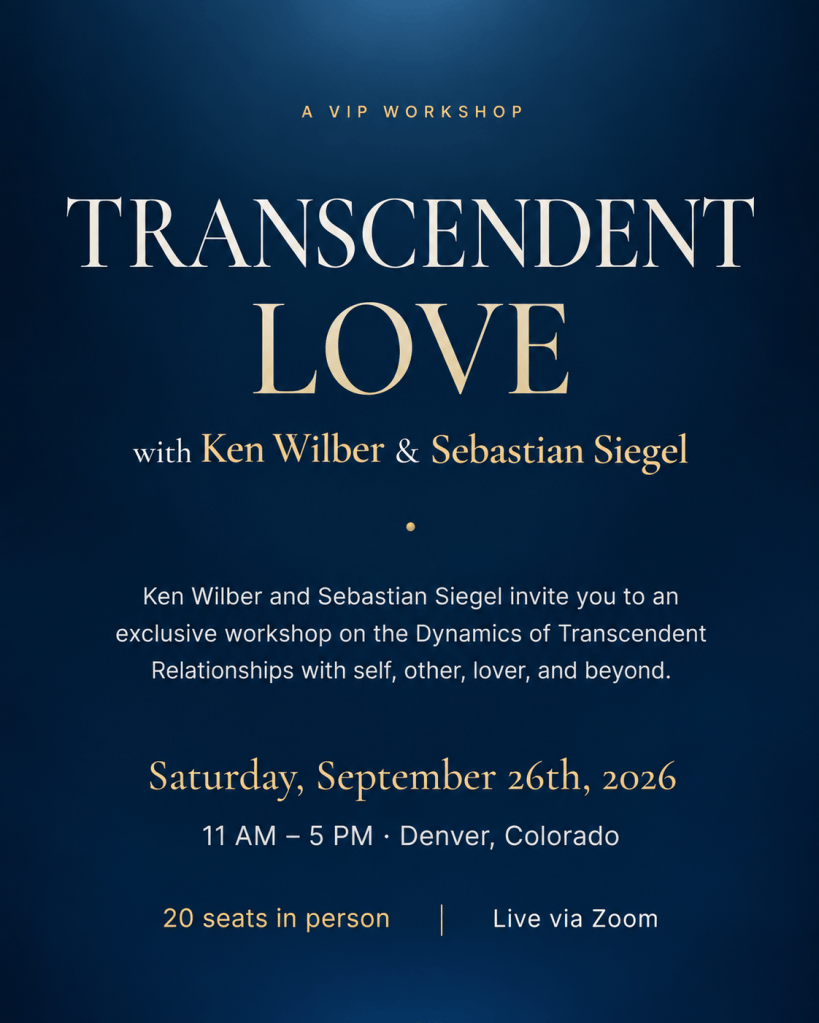
I’ll be hosting the Zoom experience for Transcendent Love this Saturday, September 26, as Ken Wilber and Sebastian Siegel come together for a special exploration of:
“Relationship as Pathway to Awakening”
This event celebrates the transcendent love story of Grace and Grit while opening a deeper dialogue around relationship as a pathway to awakening, including our relationship with self, other, lover, and beyond.
The day will include an intimate conversation, reflection, Q&A, and a live in-person screening of Grace and Grit, featuring Mena Suvari and Stuart Townsend.
📅 Saturday, September 26, 2026 🕚 11:00 AM – 5:00 PM Mountain Daylight Time 📍 Denver, Colorado + Live via Zoom
I’ll be present throughout the day as the main Zoom host. During the film, the Zoom room will remain open as a shared space where our online community can reflect, exchange thoughts, explore themes from the book and film, or simply watch quietly and reconnect afterward.
I’ll also be selecting some of the top questions from our Zoom participants to pass along to Ken and Sebastian during the Q&A.
Grace and Grit is currently available on several streaming platforms, including Tubi, Pluto TV, The Roku Channel, Plex, Amazon Prime, Apple TV, YouTube, and others, depending on your region.
Looking forward to connecting with everyone joining us online for what should be a meaningful day of love, relationship, awakening, and Integral exploration.
Worship your idols until your idols are no longer needed.
Another way to say this is:
Focus on your objectives until you’re forced to look within.
There is nothing inherently wrong with having idols.
There is nothing inherently wrong with ambition, achievement, recognition, wealth, status, influence, romance, physical beauty, intellectual mastery, spiritual attainment, or the desire to become extraordinary.
Sometimes the road beyond desire must first travel directly through it.
We often imagine spiritual maturity as the immediate rejection of worldly pursuits. Renounce the ego. Abandon ambition. Stop chasing things. Detach from outcomes. Transcend desire.
Yet premature renunciation can become another form of avoidance.
You can claim that money does not matter when you have never had any.
You can dismiss recognition when you secretly crave it.
You can condemn power because you have never experienced what it feels like to possess it.
You can declare yourself detached from relationships while quietly fearing intimacy.
You can criticize ambition while wondering whether you were capable of achieving what you wanted.
Sometimes you have to meet the idol before you can discover what it cannot give you.
The Idol Is Not Necessarily the Problem
An idol is anything onto which we project the promise of completion.
It might be a person.
A career.
A relationship.
A spiritual teacher.
A certain amount of money.
A perfect body.
A degree.
A mystical experience.
A following.
A business.
Enlightenment itself can become an idol.
The object changes, but the psychological movement remains remarkably similar:
When I obtain that, I will finally be complete.
This is what gives the idol its power.
The object itself may have value. Money can create freedom. Relationships can bring intimacy. Achievement can develop discipline. Knowledge can expand perspective. Meditation can transform how consciousness relates to experience.
The illusion begins when we ask something finite to provide what only the recognition of our fundamental nature can reveal.
We are not merely pursuing the object.
We are pursuing a feeling we believe the object will produce.
Freedom.
Security.
Love.
Wholeness.
Significance.
Peace.
The object becomes a symbol for an internal condition.
This is why getting what you want can sometimes be more spiritually disruptive than failing to get it.
Failure allows the fantasy to survive.
Success puts the fantasy on trial.
When Success Becomes a Spiritual Crisis
Suppose you spend twenty years believing that reaching a particular objective will finally make you happy.
Then you reach it.
For a while, there may be exhilaration. There should be. Something meaningful has happened.
But eventually ordinary consciousness returns.
You wake up as yourself.
The mind still moves.
Old insecurities may remain.
Fear still visits.
The body still ages.
Relationships still require work.
The applause fades.
Yesterday’s achievement becomes today’s normal.
Then an unsettling question appears:
Is this it?
That question can be more transformative than years of abstract spiritual philosophy.
You received what you asked life for, yet something remains unresolved.
The idol has fulfilled its purpose.
Not because it saved you, but because it failed to.
Its failure becomes instruction.
Desire Can Educate You
Certain desires disappear through understanding rather than suppression.
A child may desperately want a particular toy. Telling the child that the toy cannot provide lasting happiness will probably accomplish very little. The child needs the toy.
Then something fascinating happens.
The child gets it.
Plays with it.
Loves it.
Eventually puts it down.
What philosophy could not accomplish, experience did.
Adults are not fundamentally different.
Our toys become more sophisticated.
Titles.
Cars.
Followers.
Properties.
Credentials.
Partners.
Awards.
Spiritual experiences.
We give them adult names, but psychologically we may still be saying:
Maybe this will finally be enough.
There is wisdom in discovering for yourself what “enough” actually means.
This does not mean deliberately becoming materialistic or compulsively pursuing every desire that enters the mind. Some desires are destructive, and maturity includes discernment.
The deeper point is that genuine transcendence is different from repression.
Repression says:
I am not supposed to want this.
Transcendence says:
I understand what this can and cannot give me.
Those are radically different states of consciousness.
Even the Spiritual Path Has Idols
Spiritual seekers sometimes exchange socially acceptable idols for spiritually acceptable ones.
The pursuit of money becomes the pursuit of awakening.
Status becomes spiritual authority.
Achievement becomes attainment.
Possessions become experiences.
Comparison with coworkers becomes comparison with meditators.
Who has had kundalini awaken?
Who has experienced samadhi?
Who has reached jhana?
Who has dissolved the ego?
Who has seen God?
Who is enlightened?
The costume changes while the machinery of becoming continues operating underneath it.
The ego can pursue its own disappearance.
That is one of the great paradoxes of spiritual practice.
There may come a point when even enlightenment must be surrendered as an objective.
Not because awakening is meaningless, but because the imagined individual who intends to possess enlightenment may itself become the final idol.
You cannot own the Absolute.
You cannot place infinity on your spiritual résumé.
The Objective Eventually Turns You Around
Pursue your objectives consciously.
Build something.
Learn.
Create.
Love.
Risk failure.
Develop your gifts.
Become excellent at something.
Explore what human life is capable of expressing.
But pay attention.
Notice what happens when you get what you wanted.
Notice how quickly the mind moves the finish line.
Notice when “I’ll be happy when…” quietly becomes another “when.”
Notice how every arrival eventually becomes another departure point.
The external journey gradually begins pointing somewhere unexpected.
Back toward the one who has been searching.
Who wants this?
What exactly am I hoping to receive from it?
What would happen if I obtained everything I wanted?
What remains when achievement, identity, status, belief, memory, personality and aspiration are temporarily set aside?
What is aware of all of this?
At some point the search changes direction.
You stop asking only:
What else can I acquire?
You begin asking:
Who is the one trying to become complete?
That question opens a very different door.
When the Idol Falls From the Altar
The mature relationship with an idol does not necessarily require destroying it.
You simply stop worshipping it.
Money can remain money.
Success can remain success.
A relationship can remain a relationship.
A teacher can remain a teacher.
Meditation can remain meditation.
Achievement can remain achievement.
They no longer carry the impossible responsibility of completing you.
You can enjoy them without confusing them with your Being.
You can participate without becoming psychologically imprisoned by participation.
You can succeed without needing success to tell you who you are.
You can fail without failure becoming a verdict on your existence.
Something profound changes when the world is no longer required to complete the one experiencing it.
Perhaps this is one meaning of freedom.
Not escaping the world.
Not rejecting desire.
Not pretending that objectives do not matter.
Rather, seeing their proper place.
Worship your idols if you must.
Study them.
Pursue them.
Stand before them.
Perhaps even achieve what they represent.
Then look carefully at what remains.
Eventually, the idol may cease to be an idol.
Not because someone convinced you that worship was foolish, but because experience revealed the limitation of what you were worshipping.
The objective did not betray you.
It brought you exactly where it was ultimately capable of bringing you.
To the edge of itself.
From there, there is only one direction left to look.
Most people eventually outgrow their childhood ideas about almost everything.
Our tastes in food become more refined. Our understanding of relationships deepens. Our appreciation for music changes. Fashion evolves. Culture shifts. Even our political, moral, and philosophical views often undergo profound transformation as life teaches us new lessons.
Yet there is one idea that frequently remains frozen in time.
Paradise.
For many adults, heaven still resembles the picture they accepted as children. A beautiful place somewhere above the clouds where good people are rewarded, reunited with loved ones, and live happily forever. Although our understanding of nearly every other aspect of life matures, our image of paradise often remains untouched.
Why?
The answer may have less to do with religion than with psychological development.
Paradise Grows as Consciousness Grows
Every stage of psychological development interprets reality according to its own capacity. Paradise is no exception.
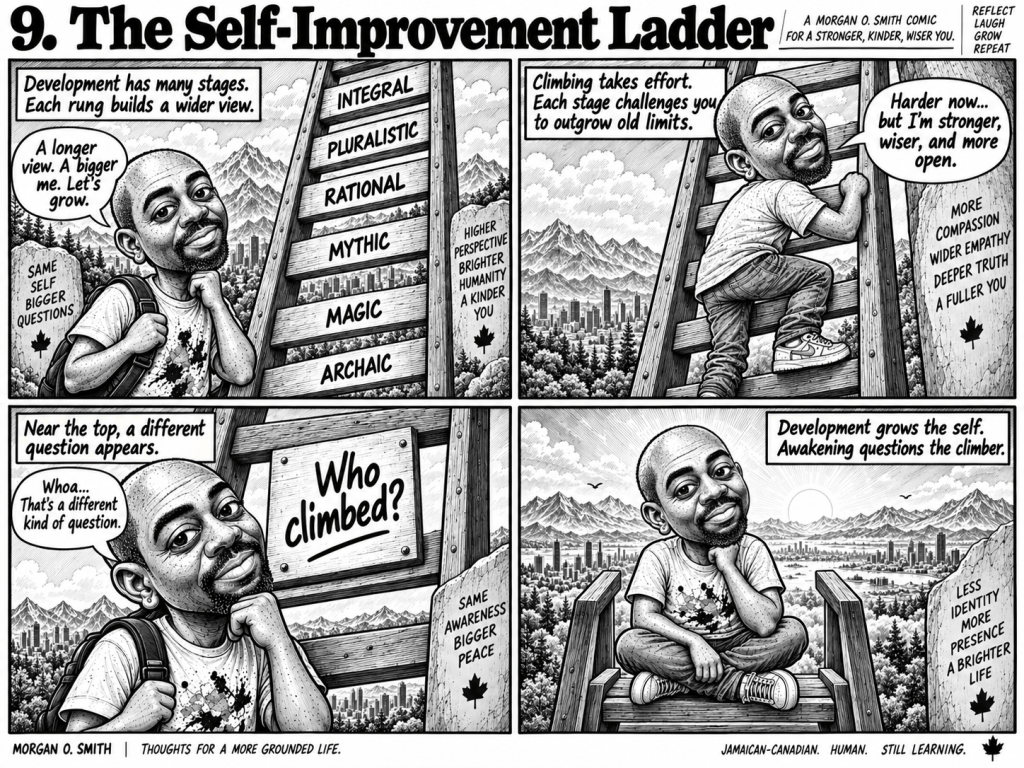
The earliest stage is concerned only with survival. Paradise simply means warmth, food, shelter, and freedom from danger.
As tribal consciousness develops, paradise becomes reunion with ancestors, spirits, and one’s people. Belonging is eternal.
The egocentric stage imagines paradise as limitless pleasure, power, success, and personal fulfillment. Heaven exists for the individual.
The mythic stage transforms paradise into a divine kingdom governed by justice. Those who obey are rewarded. Those who reject divine law are excluded. This is where many traditional religious images of heaven take shape.
The rational stage begins questioning whether heaven exists at all. Paradise may become symbolic, psychological, or simply an unanswered mystery.
The pluralistic stage opens paradise to everyone. Love replaces exclusivity. Compassion becomes more important than belief. Humanity itself becomes the family.
Integral consciousness recognizes that every previous view reflects a particular stage of development rather than an absolute truth. Paradise is increasingly understood as a way of being rather than merely a destination.
Finally, holistic consciousness dissolves the distinction altogether. Paradise is not somewhere else. Reality itself is recognized as the living expression of the Absolute.
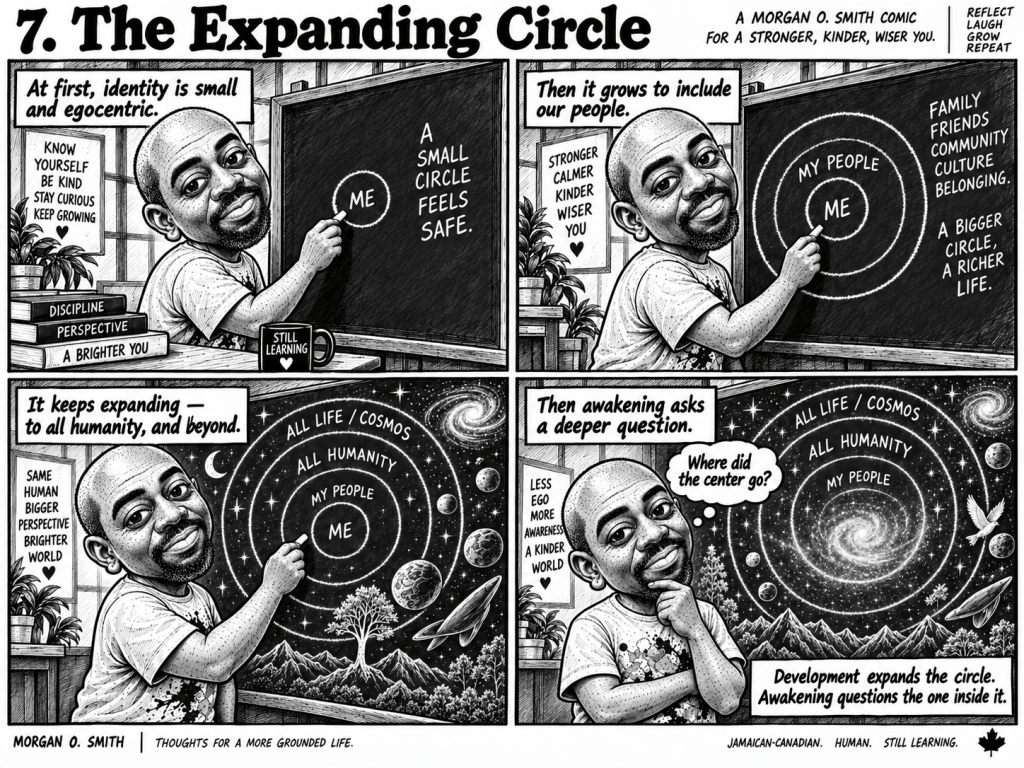
The Expanding Circle of Identity
Our understanding of paradise also changes according to the size of our identity.
The egocentric perspective asks:
“How do I get into heaven?”
The ethnocentric perspective asks:
“Which group is chosen?”
The worldcentric perspective asks:
“How can everyone be included?”
The Kosmocentric perspective asks something entirely different.
“Who is it that seeks paradise in the first place?”
Here, the search begins to collapse.
The seeker, the destination, and the journey are all recognized as appearances within one indivisible reality.
Why Do We Stay Attached to Childhood Images?
Children require certainty.
Simple stories offer comfort in the face of death and uncertainty. Those early images become emotionally rooted long before critical thinking fully develops.
Unlike our opinions about careers, relationships, or politics, our beliefs about paradise are rarely revisited with the same willingness to question them. Religious traditions often preserve these images because they provide stability, identity, and hope.
There is nothing inherently wrong with that.
Every stage serves an important purpose.
Problems arise only when we assume that the understanding which comforted us at age five must also satisfy us at age fifty.
The Ultimate Shift
The greatest transformation may not involve discovering a better description of heaven.
It may involve recognizing that paradise was never meant to describe a location.
Perhaps heaven is a symbol pointing toward a realization.
A realization that nothing has ever existed outside the infinite.
A realization that separation was never ultimately real.
A realization that the very awareness reading these words is not traveling toward paradise.
It is the ground from which every idea of paradise has always appeared.
Perhaps the deepest question is not whether heaven exists after death.
Perhaps the deeper question is whether consciousness can awaken enough to recognize paradise before death.
If consciousness itself is the Absolute, then paradise is no longer a promise waiting in the future.
It is reality, seen without the illusion of separation.
Every relationship you form with people, ideas, environments, challenges, and even suffering becomes part of your inner architecture. Nothing exists independently. Each connection enlarges the field through which life recognizes itself. What many call “growth” is often the gradual dissolution of false separation.
An integral human being does not merely collect information or experiences. They become increasingly interconnected with existence itself.
The more integral you become, the more relationships emerge naturally. Those relationships are not limited to human interaction. A relationship can exist between you and music, silence, nature, philosophy, responsibility, creativity, discipline, grief, or stillness. Every authentic connection widens consciousness.
Expanded relationship leads to expanded inheritance.
Inheritance is not only financial. It includes wisdom, opportunity, insight, support, emotional intelligence, resilience, creativity, intuition, and access to dimensions of reality that remain hidden to fragmented awareness. A disconnected mind sees scarcity because it perceives itself as separate from the whole. An integrated mind begins to recognize that life is constantly offering resources through connection.
Access creates abundance.
Abundance is frequently misunderstood as accumulation. Real abundance is access. Access to insight. Access to support. Access to clarity. Access to meaningful relationships. Access to inner stability. Access to possibility.
A person with few inner or outer connections may possess money yet still feel impoverished. Another person may possess little materially yet move through life with deep richness because they are profoundly connected to existence.
Connection multiplies options.
Options reduce limitation.
Limitation often originates less from external circumstance and more from contracted identity. When consciousness identifies itself as isolated, separate, or incomplete, possibilities narrow. Fear increases. Defensiveness grows. Rigidity forms.
As awareness expands through relationship, identity softens. The walls separating “self” from “other” begin to weaken. Life no longer appears as a battlefield of competing fragments but as an interconnected movement expressing itself through countless forms.
This movement gradually reveals The Self.
Not the egoic self built from memory and social conditioning, but the deeper Self prior to division. The Self that exists before identity becomes trapped inside labels, roles, status, beliefs, or psychological boundaries.
Realizing The Self reduces distinction.
Distinction is necessary within functional reality, yet psychological separation creates suffering. The mind continuously divides existence into categories: mine and yours, success and failure, worthy and unworthy, sacred and ordinary.
Awareness beyond fragmentation begins to perceive unity without erasing diversity. Differences still exist, but hostility toward difference dissolves. Separation loosens its grip.
As separation fades, love ceases to be an emotion directed toward selected objects.
Love becomes the natural condition of unobstructed consciousness.
Not sentimental love.
Not transactional love.
Not possessive love.
A deeper form emerges when the illusion of absolute separateness begins to collapse. That love expresses itself through compassion, patience, understanding, generosity, listening, forgiveness, and presence. It does not arise because reality becomes perfect. It arises because resistance to reality weakens.
Integral living is therefore not simply a developmental achievement.
It is participation in wholeness.
Every meaningful relationship becomes a doorway beyond limitation.
Every moment of genuine connection becomes a form of remembrance.
Every dissolution of separation reveals more of what has always been here.
Ready to release emotional heaviness, find more clarity, and deepen your meditation practice? Yinnergy’s guided sound-based meditation experience is designed to help you go inward, reset, and reconnect.
🌿 Supports emotional balance 🧠 Encourages mental clarity 💫 Deepens self-awareness and inner transformation 🎧 Easy to use with headphones from home
Whether you’re new to meditation or ready for a deeper journey, Yinnergy offers a powerful path to inner growth.
Sensitivity often increases when perception begins to clear.
Sounds feel sharper. Emotions carry more weight. Light appears brighter. Even small interactions can land with surprising intensity. What once passed unnoticed now registers deeply, almost as if the protective filters of the mind have thinned.
Everything feels raw.
This rawness can be confusing. Many assume spiritual growth should produce constant calm or detachment. Instead, greater awareness frequently exposes what has always been present but hidden beneath distraction and conditioning.
Life becomes vivid.
Rawness does not necessarily mean fragility. It often signals openness. The nervous system is no longer numbed by habit. Experience is received directly rather than buffered through layers of interpretation.
Pleasure becomes clearer.
Pain becomes clearer as well.
Each moment arrives without as much resistance. Joy may appear unexpectedly in simple things—breathing, walking, sunlight touching the skin. At the same time, sorrow or discomfort may feel closer to the surface. The range of experience expands rather than contracts.
Many people try to escape this stage.
They attempt to rebuild the old armor. They seek ways to dull sensation again. Yet the invitation within rawness is not to retreat. It is to learn how to remain present without shutting down.
Strength develops differently here.
Instead of emotional walls, stability comes from grounding. Slow breathing. Physical movement. Honest conversation. Quiet time without stimulation. These simple actions help the nervous system integrate heightened sensitivity.
Raw perception eventually refines into clarity.
At first, awareness may feel overwhelming, like standing in bright sunlight after leaving a dark room. Gradually the eyes adjust. What once seemed too intense becomes natural. The system learns to hold experience without being consumed by it.
Rawness becomes intelligence.
The heart responds more quickly to suffering. Compassion becomes immediate rather than theoretical. The body senses subtle shifts in energy and emotion. Boundaries become clearer because sensitivity recognizes what nourishes and what drains.
Nothing is filtered unnecessarily.
Life arrives unedited.
This does not mean living in constant vulnerability. It means allowing experience to move through awareness without the reflex to numb it. Over time the sharp edges soften. What remains is a steady presence capable of feeling deeply without collapsing.
Rawness is often the early stage of authenticity.
The layers of performance and protection loosen. What remains may feel exposed, but it is also real. Beneath that exposure lies a quiet strength that no longer depends on pretending to be unaffected.
Everything feels raw because awareness is finally touching life directly.
And direct contact, though intense, is also profoundly alive.
Spiritual maturity does not erase limitation. It reveals it.
Many imagine awakening as a flawless state; permanent clarity, endless compassion, immunity to human contradiction. A polished saint who never stumbles. A mind without friction. A heart without ache.
Life has never worked that way.
Every illumination throws contrast. Every realization exposes what still sleeps. Awareness grows, and so does sensitivity to the places where conditioning remains. What once went unnoticed now becomes obvious.
Light does not cancel shadow. Light makes shadow visible.
A person may taste boundless consciousness and still forget their keys. May speak wisdom and still feel grief. May rest as pure Being and still get irritated in traffic.
None of this contradicts awakening.
It confirms embodiment.
Human form carries edges. Biology, memory, culture, temperament, nervous system patterns—these do not dissolve simply because truth is recognized. Realization clarifies the sky; weather still moves through it.
Expecting perfection from enlightenment is another form of ego fantasy. A subtler one, dressed in spiritual language.
“Once I awaken, I will finally be beyond everything.”
Beyond what?
Beyond hunger? Beyond fatigue? Beyond old emotional reflexes surfacing now and then?
Even sages live inside gravity.
Consider the paradox: greater clarity often deepens humility. Seeing through the illusion of separateness does not produce superiority; it softens certainty. One recognizes how much of this life unfolds through forces far larger than personal will.
Brilliance and blind spots coexist.
The brighter the lamp, the sharper the outline behind it.
Shadow is not failure. Shadow is information.
Each reaction, each contraction, each moment of confusion points to another place where life invites integration. Nothing needs to be rejected. Everything becomes material for understanding.
Spiritual growth, then, is not a climb toward flawlessness.
It is a widening embrace.
Light without shadow would mean no depth, no dimension, no humanity. A perfectly even brightness reveals nothing. Contrast gives form to experience. Contrast allows learning. Contrast allows compassion.
Seeing your own limits makes you gentle with others.
When you know how easily fear arises in your own body, you stop judging someone else’s. When you recognize your own unfinished places, forgiveness becomes natural rather than moral.
This is maturity: not pretending to be spotless, but standing fully where you are.
Awareness shining. Conditioning still moving. Both allowed.
Nothing to fix. Nothing to hide.
Just this living interplay.
Radiance casting shape.
Human nature doing exactly what it has always done; expressing the infinite through a finite frame.