Knowing vs. Believing

The Subtle Divide Between Truth and Interpretation

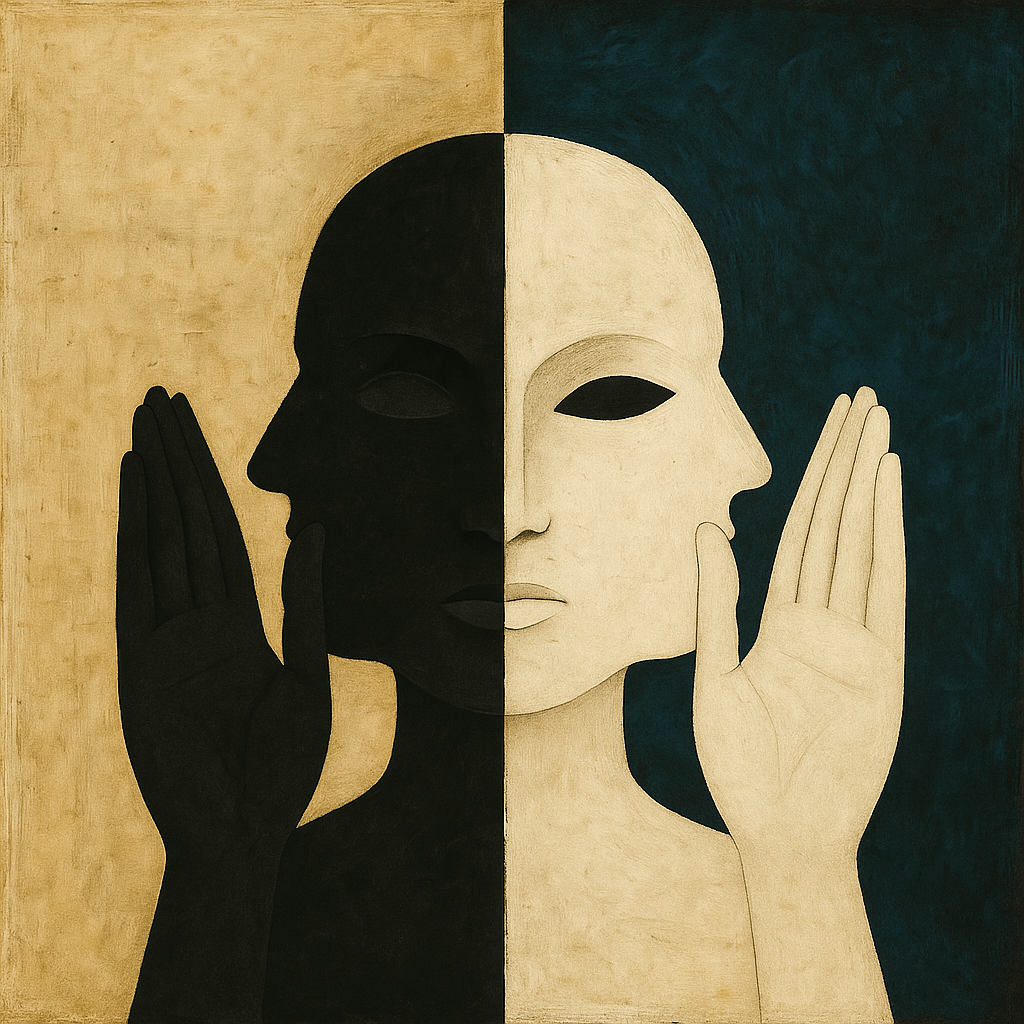
Knowing there’s a God is not a religious concept; believing in a God is.
One is a recognition—silent, direct, and intimate. The other is a construct—layered with doctrines, culture, and inherited symbols.

What is known requires no belief. It reveals itself without needing validation, much like light doesn’t require agreement to be seen. The moment belief arises, there is already a distance. A gap. A reaching toward what seems separate.

Belief is an echo of knowing, distorted by time, language, and fear.
It builds shrines to certainty where awe once stood unguarded. It memorizes truths that once moved freely through silence. And often, it turns the unknowable into a caricature—a God of preferences, sides, and punishments.

Knowing is not about having answers. It’s the crumbling of the question.
It doesn’t declare “There is a God.”
It dissolves the very boundary between the knower and what is known. There is no longer a subject seeking an object. Only the raw immediacy of Being aware of itself.

Those who know are rarely interested in convincing others.
Those who believe often are.

The danger isn’t belief itself—it’s mistaking belief for truth.
Truth, when known, renders belief obsolete.
It doesn’t divide, it doesn’t declare superiority—it simply is.

To know is to surrender the need for interpretation.
To believe is often to defend the interpretation, even at the cost of truth.

And yet, belief can serve as a bridge. A necessary illusion for those not yet ready to let go of the comfort of form. But let it be a bridge, not a home.

Morgan O. Smith

Get Your Free Copy of My Book, Bodhi in the Brain!
https://subscribepage.io/oTSZQu

Beyond the Infinite

Contemplating the Vastness Beyond Para-Brahman

In the profound depths of Hindu philosophy, the concept of Para-Brahman represents the ultimate, unchanging reality, the absolute existence that transcends all forms and phenomena. It is an entity beyond human perception, beyond all attributes, the substratum of both the manifest and the unmanifest. But the human mind, insatiably curious and inherently uncontent with limits, dares to ponder—what, if anything, lies beyond Para-Brahman?

To consider what is beyond Para-Brahman is to engage in a philosophical exercise that stretches the boundaries of thought and existence. It is like trying to illuminate the space beyond the edge of the universe’s observable horizon. Para-Brahman itself is defined as the highest Brahman, beyond which nothing further can be conceptualized within the traditional frameworks of Hindu philosophy. However, this does not deter the most adventurous minds from speculating on the nature of the absolute’s transcendence.

In attempting to name that which is beyond the ultimate, we delve into a realm of thought that precedes language and form. Such a pursuit may lead us to the Sanskrit term “Anirvachaniya,” meaning that which cannot be expressed or described. In this context, the term acknowledges the limitations of human language and understanding when faced with the immensity of the infinite.

Yet, it is in the silence of meditation and the stillness of contemplation that Hindu tradition often finds its deepest insights. Here, the individual soul (Atman) comes into direct experience with Brahman, and it is perhaps in the dissolution of the self where one might fleetingly encounter the hint of something even more profound than Para-Brahman—something that, by its very nature, cannot be encapsulated by any concept or word.

We might then call this speculative beyond “Ananta,” the infinite, a term that suggests an endlessness that extends even beyond the ultimate expanse of Para-Brahman. It is not a place, entity, or state that can be reached or understood; it is the possibility of infinity within infinity, the essence of boundlessness that permeates every aspect of the cosmos and yet is apart from it, untouched and untouchable.

To ponder what lies beyond Para-Brahman is to embrace the essence of the Upanishadic inquiry, “Neti, neti,” not this, not this. By negating all that can be known, we are left with silent wonder, an acknowledgment that the truth is ever beyond the grasp of our finest conceptions. It is a journey not toward another concept, but towards an ever-deepening mystery that invites us to find peace in the acceptance of the unknown.

The spiritual endeavour to reach beyond even the concept of Para-Brahman invites us to a profound humility, an understanding that what we know and experience is only a fragment of the vastness of reality. It is a cosmic reminder that the journey is not just about seeking answers, but also about appreciating the beauty of the questions themselves.

In this exploration, we are not just students of Hindu philosophy but of the universe itself, engaged in a ceaseless dialogue with the essence of existence. And perhaps, in that very dialogue, we come to realize that the ultimate truth is not a distant reality to be pursued but an ever-present mystery to be lived.

Morgan O.  Smith

Yinnergy Meditation & My Book, Bodhi in the Brain…Available Now!

https://linktr.ee/morganosmith


The Sacred Within the Flawed

A Paradox of Divine Texts

In an intricate dance between the divine and human, sacred texts from various religious and philosophical traditions find themselves at the nexus of reverence and scrutiny. These texts, while venerated as conduits of divine wisdom and moral guidance, are not immune to critique nor the acknowledgment of their inherent flaws.

When we unravel the threads of any sacred text, we find them woven with not just divine insights but also the human elements of error, contradiction, and historical context. Many perceive the imperfections found within these texts as reasons for critique and skepticism. Yet, there is a compelling perspective to be explored – the idea that the very flaws embedded within sacred texts render them genuinely sacred.

In dwelling within the flawed, we find a reflection of our imperfect nature. Sacred texts do not present an unattainable moral and existential utopia but rather provide a mirror through which we can perceive and engage with our own imperfections and moral dilemmas. The contradictions and ambiguities are not simply obstacles to faith but rather essential elements that provoke deeper questioning, reflection, and ultimately, a more profound understanding of our place within the cosmic order.

The perfection of the divine, if it were to be communicated through a medium devoid of error or contradiction, may remain eternally aloof and incomprehensible to our flawed human nature. Therefore, perhaps it is within the inconsistencies and paradoxes of sacred texts that we find an accessible pathway toward divine wisdom – a bridge crafted from the very imperfections that define our humanity.

By acknowledging and engaging with the flaws within these revered writings, believers do not denounce their faith but rather deepen it, embracing a spiritual journey that accepts the entwinement of the divine and the human, the perfect and the imperfect. It becomes a spiritual practice wherein the belief is not despite the flaws but is enriched and deepened by them.

In this juxtaposition, an opportunity for an intimate and authentic spiritual journey is birthed. The flaws compel believers to wrestle with their understanding, to question, and to seek, rather than passively accept a prescribed truth. This active engagement fosters a spirituality that is not static but dynamically interwoven with the realities of human experience, constantly evolving and adapting to the nuances of our understanding and experience.

As we traverse through the passages of sacred writings, embracing both divine wisdom and human error, we embark upon a journey that is both inward and outward, exploring the realms of the divine and our soul. In this sacred exploration, the flaws do not deter us but rather beckon us into a deeper, more authentic engagement with the divine, where faith is not a blind acceptance but a perpetual quest, rich with inquiry, reflection, and spiritual growth.

Perhaps then, the sacredness of these texts is not diminished by their flaws but is instead, beautifully and mysteriously, illuminated by them.

Morgan O.  Smith

Yinnergy Meditation & My Book, Bodhi in the Brain…Available Now!

https://linktr.ee/morganosmith