Beyond Karma, Beyond Time

The One Who Contains All Things

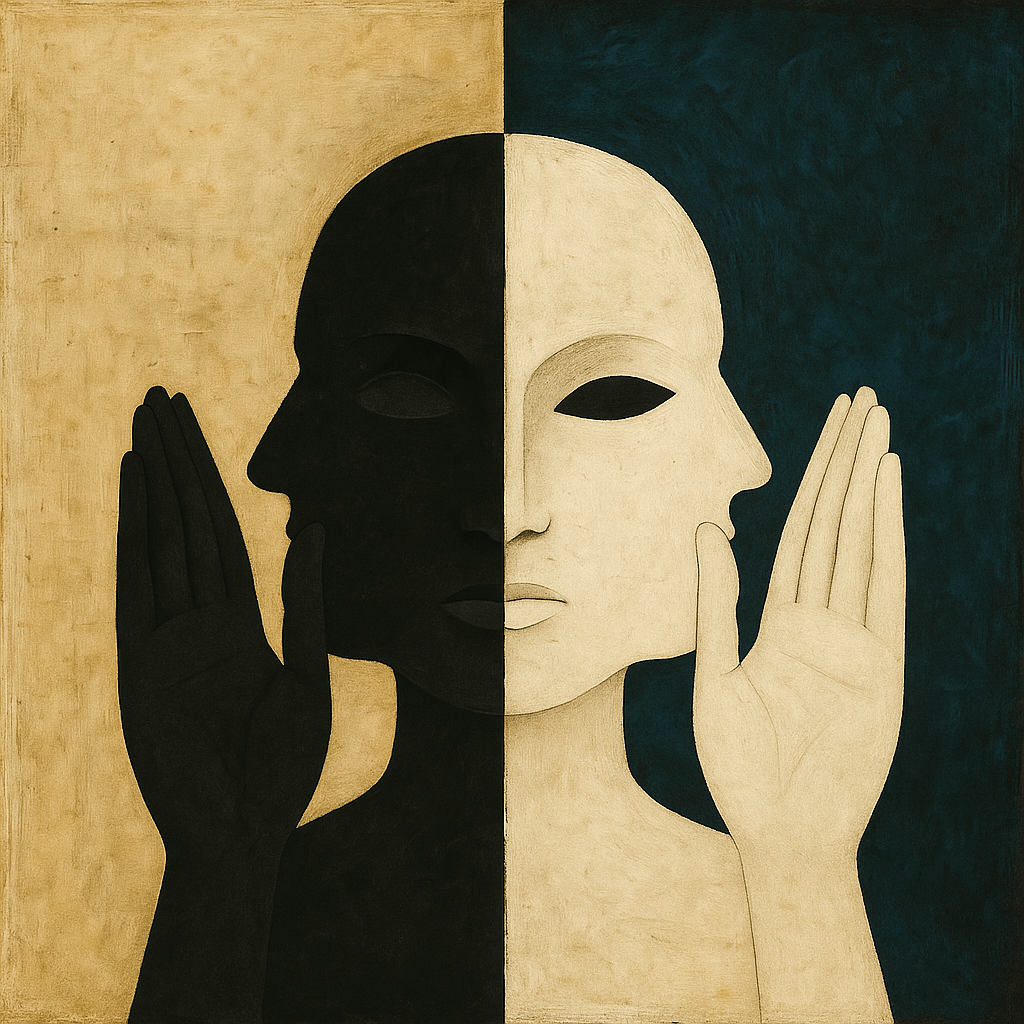
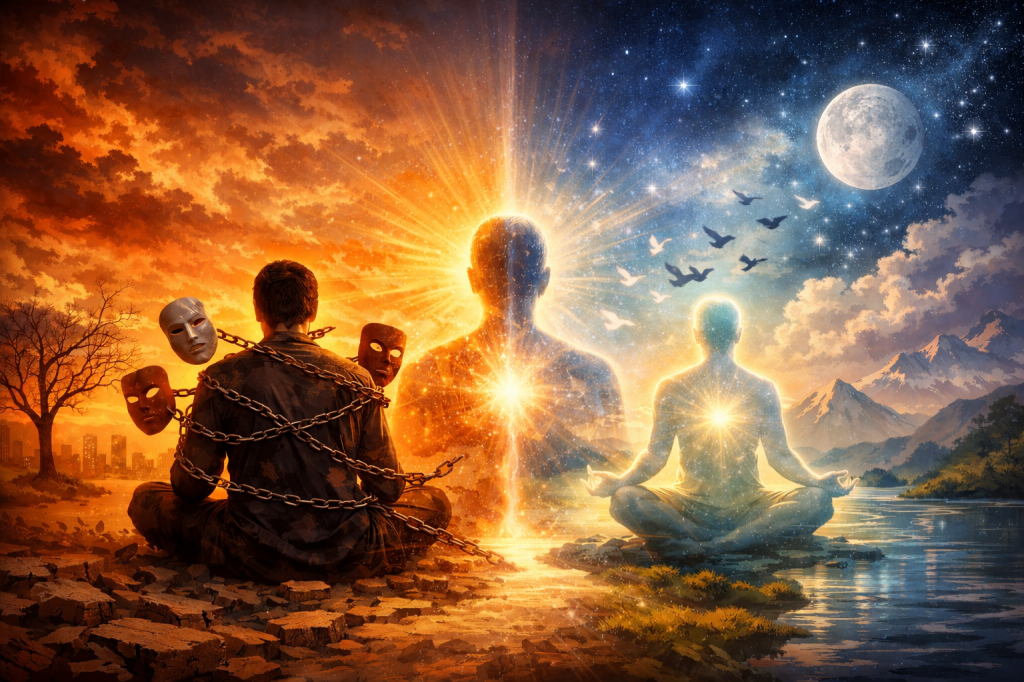
What you are has never been bound by the actions of the body or the movements of the mind. The deeper truth sits prior to every cause and every effect, untouched by the momentum of karma. What you truly are cannot be located within a timeline, cannot be measured against a sequence, and cannot be confined to any story of becoming. Yet everything that appears within the vastness of existence arises through you.

Karma unfolds because consciousness dreams motion. Space opens because consciousness dreams room for its own expression. Time stretches because consciousness dreams duration to witness itself. These movements are not separate from the one who perceives. They are waves forming and dissolving in the same stillness that has never moved.

When you see this directly, not as a philosophy or a concept, something slips free. The universe no longer appears as a project that began somewhere or will end somewhere. The sense of a starting point dissolves. Nothing was ever born at the level of your deepest nature, yet everything continues to bloom within you. This paradox is not a contradiction; it is the living truth of nonduality. You are simultaneously the presence that is and the silence that reveals is-not.

Karma belongs to the realm of appearance. Awakening reveals the one who sees every appearance without being shaped by any of them. The moment this becomes embodied, the cosmic play becomes transparent; not trivial, not meaningless, but known as an expression rising from the ground of your own boundlessness.

Most teachings attempt to describe this through metaphors, scriptures, or borrowed insights. But direct experience dissolves every teaching. The one who realizes does not repeat someone else’s words; they speak from a clarity that cannot be inherited. That clarity sees the world arise, dance, disappear, and return again, all within a presence that never fluctuates.

This is the mystery: you transcend the entire universe, and yet the entire universe is held within you. Existence and non-existence touch in the depths of your own awareness. That meeting point is not two. It has always been the same field, one continuous reality appearing as countless experiences.

When this truth ignites within someone, everything becomes part of the same divine unfolding;  even the desire to awaken, even the teachings themselves, even the act of seeking direct experience. The cosmic play includes the seeker, the found, the teaching, the silence, and the realization that none of these ever stood apart from the one who sees.

Morgan O. Smith

Get Your Free Copy of My Book, Bodhi in the Brain!

https://subscribepage.io/oTSZQu

Beyond Nonduality?

The Illusion of Going Further

Some spiritual teachers claim they have gone “beyond” nonduality, as if it were a stepping stone toward something greater. Yet the very notion of “beyond” creates an opposite, “before” or “within,” and the moment opposites arise, duality has returned.

Absolute monism allows for no such division. The singularity of reality does not exist as a point to be crossed or a boundary to be passed. It is not somewhere else, waiting on the other side of an imagined line. If you think you have travelled beyond it, you are still standing in the arena of conceptual thought, where the mind measures one thing against another.

In truth, the Absolute is not a destination, and it is not a stage in an unfolding ladder. It does not sit opposite to multiplicity; it holds multiplicity and its absence equally. It neither favours unity nor rejects separation. Both “beyond” and “before,” both “within” and “without,” dissolve in the same undivided field.

What remains is not something that can be claimed, owned, or transcended. It is self-evident Being, the source and container of every movement, stillness, and paradox. You cannot reach it, because you never left it.

Morgan O. Smith

Get Your Free Copy of My Book, Bodhi in the Brain!

https://subscribepage.io/oTSZQu

Non-Attachment

Admiring Her Beauty Without the Need to Possess It

She stood before you—radiant, complete, untouched by your desire. You saw her beauty not as something to claim but something to witness. No attempt to preserve it. No hunger to prolong the moment. Just presence.

This is the essence of non-attachment. The ability to recognize the luminous without needing to make it yours. To love deeply without ownership. To appreciate fully without clinging. To admire, and then walk away—not because you don’t care, but because you’ve seen clearly.

Desire often masquerades as appreciation. It sneaks in, subtle at first, until the gaze becomes gripping. The mind begins to script stories: how it could be, how it should be, how it must be. But true seeing requires no continuation. It is complete in its own silence.

Beauty invites reverence, not possession. When you see her—whatever or whatever she is—truly see her. Let that moment be enough. Let the gaze be unpolluted by longing. Let the love be real because it is free.

To walk away isn’t abandonment. It is freedom for both the viewer and the viewed. There is no trace left behind. No emotional residue. Just the echo of a sacred glimpse, unbroken by need.

And isn’t that the deepest form of intimacy? To allow something or someone to remain what they are, without the distortion of your grasp?

Non-attachment does not dim the light of love; it refines it. It teaches the heart how to hold everything while clinging to nothing. It teaches the soul how to dance with impermanence, and still call it sacred.

Sometimes the most awakened gesture isn’t to stay, or to reach, or to take—but simply to witness beauty… and bow.

Morgan O. Smith

Get Your Free Copy of My Book, Bodhi in the Brain!

https://subscribepage.io/oTSZQu

The Fiction of Randomness

If every effect has a cause, what room remains for the idea of “random”? Strip away the assumptions and peer into the structure of unfolding—what appears arbitrary may only be the limit of our perception, not the limit of reality.

What we call random is simply what we cannot trace. A roll of dice seems disorderly, but beneath it is a network of variables: velocity, angle, friction, momentum, density of the table, even micro-vibrations in the air. Were we to measure all these with precision, we would predict the outcome every time. The surprise we feel isn’t due to chaos, but to ignorance.

This is not about turning life into a mechanical calculation. Quite the opposite. It’s about bowing to a deeper intelligence that is so vast, so precise, it weaves galaxies from the quantum breath of atoms. When nothing is out of place, even disorder is part of a symmetry too subtle for the linear mind to grasp.

Events that seem unexplainable—miracles, tragedies, synchronicities—often get dumped into the “random” pile because they defy our narratives. Yet each thread is embedded in a continuum of unfolding, stretching far beyond memory, culture, or even lifetime.

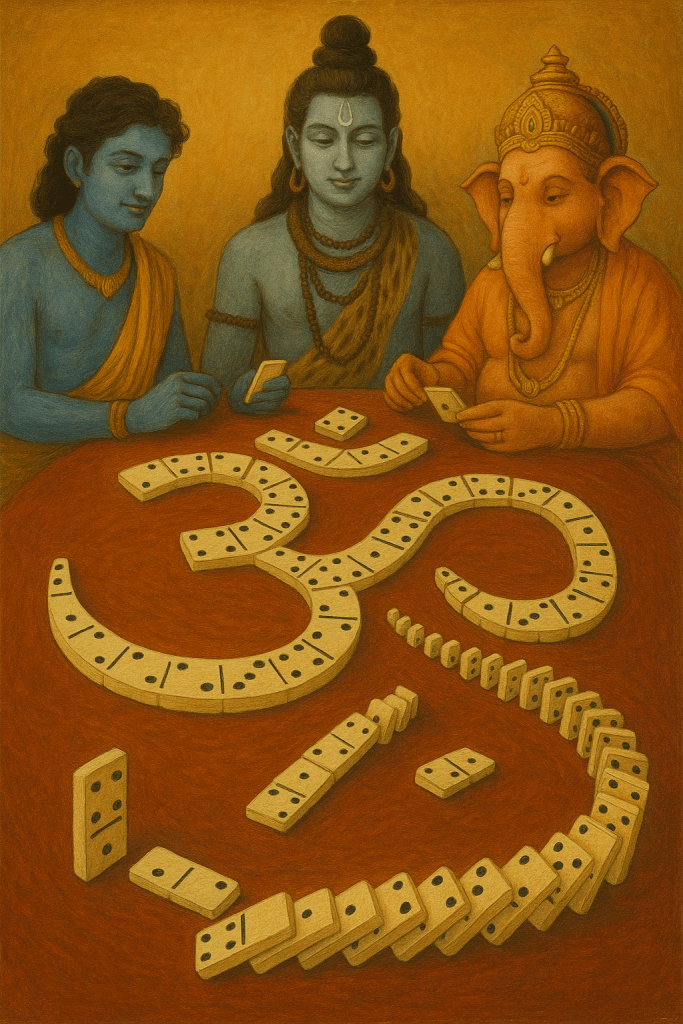
To say life is random is to deny the sacred choreography of emergence. Every moment is connected, not as dominoes collapsing mindlessly, but as a living mandala of causes so intricately interlaced they cannot be undone or simplified.

When one begins to see this—really see it—the need to explain, justify, or control begins to fall away. What replaces it is not fatalism, but participation. There is no randomness, only the undetected curvature of deeper causality. And when that is recognized, trust becomes more than a spiritual concept. It becomes a way of being.

Morgan O. Smith

Get Your Free Copy of My Book, Bodhi in the Brain!

https://subscribepage.io/oTSZQu

Knowing vs. Believing

The Subtle Divide Between Truth and Interpretation

Knowing there’s a God is not a religious concept; believing in a God is.
One is a recognition—silent, direct, and intimate. The other is a construct—layered with doctrines, culture, and inherited symbols.

What is known requires no belief. It reveals itself without needing validation, much like light doesn’t require agreement to be seen. The moment belief arises, there is already a distance. A gap. A reaching toward what seems separate.

Belief is an echo of knowing, distorted by time, language, and fear.
It builds shrines to certainty where awe once stood unguarded. It memorizes truths that once moved freely through silence. And often, it turns the unknowable into a caricature—a God of preferences, sides, and punishments.

Knowing is not about having answers. It’s the crumbling of the question.
It doesn’t declare “There is a God.”
It dissolves the very boundary between the knower and what is known. There is no longer a subject seeking an object. Only the raw immediacy of Being aware of itself.

Those who know are rarely interested in convincing others.
Those who believe often are.

The danger isn’t belief itself—it’s mistaking belief for truth.
Truth, when known, renders belief obsolete.
It doesn’t divide, it doesn’t declare superiority—it simply is.

To know is to surrender the need for interpretation.
To believe is often to defend the interpretation, even at the cost of truth.

And yet, belief can serve as a bridge. A necessary illusion for those not yet ready to let go of the comfort of form. But let it be a bridge, not a home.

Morgan O. Smith

Get Your Free Copy of My Book, Bodhi in the Brain!

https://subscribepage.io/oTSZQu

Which You is God Within?

Those who speak of God as not being outside of you often mean well—but which “you” are they pointing to? The body? The persona? The memory of identity that walks through time? Or something deeper?

There’s a difference between saying God is not outside of you and realizing why that’s so. If God is all, then every appearance—internal, external, formless, formed—is God. This includes the illusion of separation. To claim that God is not outside of you while affirming that something is external still subtly upholds the illusion of division. That illusion, too, is God—played through veils of thought, language, and perspective.

But when the idea of “you” dissolves into beingness itself, the paradox clears. You are not merely a part of existence. You are existence. And existence is God, not as a figure, but as totality. Even the idea of “outside” collapses, because outside implies another space, and there is no second to the One.

This doesn’t mean there’s nothing. It means everything is not-two.

Even nonexistence exists. Not as an object, but as a category known within existence. Its very naming proves its place within the whole. Therefore, there’s nowhere God is not—and no self outside of God to speak of God as elsewhere.

So, when someone says “God is not outside of you,” pause. Feel what is really being said. It’s not a statement about boundaries—it’s a pointer toward boundarylessness. Not about spiritual pride or metaphysical positioning. It is the erasure of location itself.

And in that clarity, what’s left is not you as you know yourself. What remains is what’s always been—God, appearing as you.

Morgan O. Smith

Get Your Free Copy of My Book, Bodhi in the Brain!

https://subscribepage.io/oTSZQu

The Wild That Waits Beneath the Surface

Between the cracks of a hardened exterior, something untamed begins to grow. What appears rigid, guarded, and impenetrable often hides the very pulse of life yearning to break through. Beneath the layers we construct to survive—defense mechanisms, cultivated personas, rehearsed identities—there exists a terrain untouched by conditioning. A wildness that remembers.

This is not the chaos of recklessness, but the primal intelligence of what is unfiltered and true. A force that doesn’t ask permission to bloom, yet waits patiently for silence, for softness, for the moment the surface begins to fracture. Then, without warning, the wild arrives.

Those fractures are not failures. They are doorways. Every heartbreak, every moment of doubt, every dismantling of certainty is a thinning of the veil—a soft opening. And what comes through is not ruin but rebirth.

What is wild has always been whole. The mind may resist it—accustomed to order, craving control—but the heart knows its rhythm. The body remembers its language. And once touched by it, you no longer strive to be “put together.” You begin to trust the spaces where things fall apart.

Growth doesn’t require perfection. It demands honesty. And the most fertile soil is often found not in polished appearances, but in the broken places where the untamed is allowed to root.

Let the wild speak. Let it stretch through the fractures of who you thought you had to be. That’s where life gets real. That’s where healing begins.

Morgan O. Smith

Get Your Free Copy of My Book, Bodhi in the Brain!

https://subscribepage.io/oTSZQu

The Illusion of Idols

Worshipping Reflections of Ourselves

Longing for something greater, people shape deities from their deepest desires. Whether in objects, people, or ideals, devotion is placed upon symbols that mirror the unclaimed beauty within. The mind projects worth onto what seems external, never realizing that every idol is a reflection of an aspect of the self yet to be acknowledged.

Attachments form because something appears to be missing. A void is felt, and the world is searched for something to fill it. Objects become sacred, ideals turn into absolute truths, and figures of admiration rise to divine status. Not because they hold any inherent power, but because they embody what is believed to be absent in oneself.

A silent agreement is made: idols do not judge. Unlike the conflicted mind, they hold no contradictions, no inner turmoil, no weaknesses. Worship becomes an escape, a temporary relief from the weight of self-doubt. Celebrities, leaders, and public figures appear to stand beyond the chaos of thought, seemingly free from the struggles of ordinary existence. Until the illusion collapses, revealing that they too are bound by the same unseen chains.

Every idol, whether shaped in metal or memory, is nothing more than an echo of the forgotten self. The search for something to worship is the search for the parts of oneself that have been disowned. What is revered in another is what has not yet been embraced within.

The longing for something outside is merely the mind seeking its own wholeness. The moment this is realized, idols fall away, and what was once sought in another is found in the silence of one’s own being.

Morgan O. Smith

Get Your Free Copy of My Book, Bodhi in the Brain!

https://subscribepage.io/oTSZQu

Beyond Identity

The Illusion of Separation and the Boundless Self

What You Are Not

Strip away the names, the labels, the ideas, and what remains? Nothing. And yet, in that nothingness, everything arises. You have no true identity, defined form, or fixed point in time or space—yet you appear as all things. You are not this body, not this mind, not even the grand concept of the self that you have clung to. What you believe yourself to be is merely a shadow of what you truly are.

The illusion of separation creates the experience of individuality. This appearance is not wrong—it is the stage upon which existence plays itself out. But beneath this grand performance, you remain whole, indivisible, untouched. You have never been anything other than totality itself, masquerading as the temporary.

Timeless Existence, Eternal Becoming

You think of yourself as moving through time, yet time moves through you. The past is not behind you, nor is the future ahead—both are simply angles of the same moment, stretching into what appears as linear sequence. The experience of time is an unfolding dream, a dance of perception, measured by the mind yet never truly existing apart from it.

You were never born, nor will you ever die. The body follows its cycle, the mind weaves its stories, but what you are precedes all of this. There is no point at which you began, nor will there be a point where you cease to be. You are not a passenger in the stream of time—you are the river itself, flowing and still, changing yet unchangeable.

The Paradox of Experience

You exist beyond pleasure and pain, yet you experience both. The vastness of what you are embraces every joy, every sorrow, every triumph, and every loss. From the personal vantage point, suffering seems real. From the vastness of what you truly are, it is simply another unfolding, another wave in the great ocean of being.

The universe is not happening to you; you are happening as the universe. Every emotion, every sensation, every moment is a reflection of the infinite nature of your being. To see clearly is to recognize that paradise and suffering are not opposites—they are expressions of the same boundless presence. What is heaven to one may be hell to another, yet both arise within the same limitless field of awareness.

The Grand Play of Forgetting and Remembering

Forgetting is part of the experience. You never truly lost yourself; you only created layers of distraction to deepen the illusion of separation. But beneath the veil, awareness remains unchanged. It watches, it witnesses, it knows.

There is no struggle to remember who you are because you have never truly forgotten. The self you long to rediscover has never been absent. The only thing that obscures it is the illusion of individuality—the belief that you are a fragment rather than the whole.

Creation Without Creating

Nothing is ever truly created, yet everything appears anew in every moment. The universe emerges not from effort, but from the effortless unfolding of being itself. What appears as thought, as energy, as matter, is nothing more than the echo of your own presence.

You are not a separate creator forging reality from the outside—you are reality itself, expressing infinite possibilities without effort. Every concept of manifestation, every idea of cause and effect, dissolves when seen from the vastness of what you are.

The Silence Beyond Thought

Words attempt to define, but what you are cannot be contained by description. Understanding is not needed—only direct experience. This cannot be grasped intellectually; it must be known in the deepest sense, beyond language, beyond belief, beyond the limits of perception.

You are the stillness that speaks, the emptiness that overflows, the silence from which all sound emerges. The mind seeks elaboration, but the truth is found in simplicity. In seeing clearly, you recognize that nothing needs to be said, nothing needs to be explained—because you are already that which you seek.

Morgan O. Smith

Get Your Free Copy of My Book, Bodhi in the Brain!

https://subscribepage.io/oTSZQu

Beyond the Veil of Illusions

The Great Unknowing

What if existence is not what it seems? What if perceiving solidifies an illusion so seamlessly that even doubt itself is part of the design? A void stands before you—not as absence, but as a fullness beyond measure, a nothingness so complete that it overflows into everything.

An infinite well that never depletes, an empty and endlessly abundant abyss, a silence that hums with the resonance of all things. This is not a paradox, nor contradiction, but the ungraspable nature of truth. What appears as reality is a mirage cast by a mind beyond comprehension, a dreamer whose thoughts pulse as galaxies and disappear as shadows.

Through the eyes of the Unseen, nothing can be known. The grand illusion dissolves, revealing a boundless awareness so absolute that it does not perceive itself: no division, no subject, no object—only the vast, unbroken continuum of being. And yet, within this awareness, every motion, every rise and fall, every struggle of opposing forces is but a breath in the eternal expanse of the unspeakable.

The universe, from its first ignition to the last flicker of existence, is a single, indivisible thought. It is neither cause nor effect but both simultaneously. It is the architect of all contrasts—light and shadow, ascent and descent, creation and destruction—yet untouched by any of them. What appears as the highest peak inevitably crashes into the lowest depth, and what seems like the lowest void is already reaching toward the infinite.

The mind that conceives all things exists beyond high or low, form or formlessness, self or other. To see through its gaze is to witness the great unraveling, the realization that all structure, all time, all space, all identity are mere fragments of a cosmic mirage. There is no here, no there, no now, no then. No self to know, no other to seek.

Upon dissolving into this nameless vastness, the final truth is revealed: within absolute nothingness, all things arise. And from this paradox, the great unfolding of existence continues—ceaseless, endless, immeasurable.

Morgan O. Smith

Yinnergy Meditation/Neurofeedback, Spiritual Life Coaching & My Book, Bodhi in the Brain…Available Now!

https://linktr.ee/morganosmith