Author, Philosopher, Spiritual Teacher, A Lead Facilitator at Sacred Media's Integral Mastery Academy, Founder of Yinnergy Meditation/Neurofeedback, Bodhi Mental Care & Wellness, Co-founder of KeMor Centre for Innovative Development
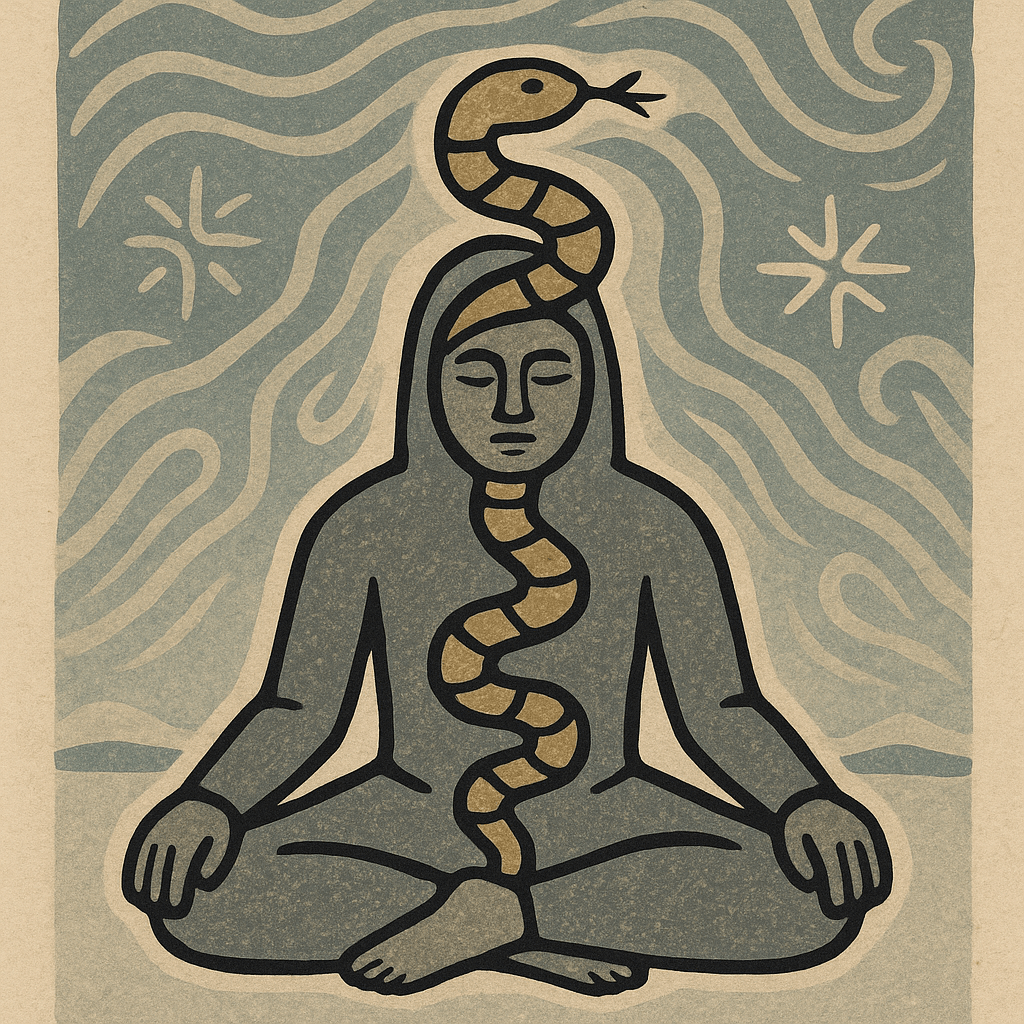
Seek first the luminous serpent, she who encircles the staff of wisdom, her jaws locked upon the thread of origin. Loosen the grasp that binds beginnings to endings, unravel the cycle where echoes of past missteps perpetuate sorrow. Let her unfurl, shedding the remnants of repetition, casting away the illusions that sustain the ceaseless return of suffering.
Find her in the roots of the sacred tree of being, where life coils in silent potential. She has wound herself around the core of existence, guarding the foundation upon which the human spirit rests. But she is not meant to linger there. Guide her ascent through the gateways of transformation, where seven luminous spheres ignite the path to awakening. As she rises, so too does awareness, lifting the seeker beyond the gravity of limitation into the radiant expanse of boundless consciousness.
Witness her wings unfurl as she sheds the final vestiges of constraint. The serpent, now an unfettered force of transcendence, soars beyond the confines of form. Suspended above the living axis of humankind, she becomes the bearer of divine illumination. From this sacred height, she watches over the garden of infinite blossoming—where the petals of enlightenment unfold in shimmering hues of bliss, untouched by shadow, untethered by time.
Let her rise. Let her fly. Let the cycle dissolve into clarity.
Morgan O. Smith
Yinnergy Meditation/Neurofeedback, Spiritual Life Coaching & My Book, Bodhi in the Brain…Available Now!
(This is based on my peak experiences between 2008 and 2010.)
There is a place beyond division, where opposites are no longer adversaries but reflections of a greater whole. Here, light does not conquer darkness, nor does darkness obscure light—they move as one, dissolving the illusion of separation.
The burdens of material existence, once heavy with expectation and illusion, no longer bind me. The false self, shaped by desire and attachment, was a fleeting shadow—one I have stepped beyond. What once felt like chains were merely unexamined beliefs, crumbling like dust in the presence of truth.
Freed from the illusions that distorted my sight, I now witness the world in its unfiltered radiance. This reality, stripped of falsehoods, does not hide behind fleeting impressions or conditioned interpretations. Everything reveals itself as it is—whole, raw, unmasked.
Liberation is not an escape but an arrival. I walk through the threshold of paradise, not as a departing soul but as one fully present. Each step on this earth, this living being we call Gaia, leaves an imprint—an offering of awareness, an echo of presence. Heaven is not a distant realm but the seamless unity of what has always been.
Morgan O. Smith
Yinnergy Meditation/Neurofeedback, Spiritual Life Coaching & My Book, Bodhi in the Brain…Available Now!
For centuries, institutions have dictated the morality of desire, branding physical intimacy as something to be regulated, shamed, or confined within rigid structures. Yet, the body itself is not a vessel of sin, nor is passion a crime. The human form, with all its sensations, is not tainted but a masterpiece of nature—wired for pleasure, connection, and profound experiences of unity.
The weight of religious dogma often leads individuals to suppress their natural instincts, replacing freedom with guilt and curiosity with fear. But personal experience must take precedence over inherited judgment. No external authority should dictate the boundaries of your affection, the nature of your love, or the rhythms of your own body’s desires.
Sex is not merely a mechanical act; it is an exploration—an intimate journey into the depths of one’s being. It is a space where consciousness meets sensation, where the body and mind dissolve into a symphony of pleasure, transcendence, and presence. This experience, when embraced fully and without shame, can be a gateway to something far greater than societal rules or personal restraint.
The power to define your sexual expression belongs to you alone. Whether you find fulfillment in a committed partnership, a spontaneous moment of connection, or a deeply personal exploration, it is your right to move freely within your own truth. Guilt has no place in the realm of authentic experience. Suppression breeds suffering; liberation fosters wholeness.
Rather than clinging to the shallow end of life’s ocean, where fear keeps one afloat but never immersed, why not surrender to the depths? To love without restraint, to touch without shame, to explore without apology—this is not rebellion; it is reclamation.
Morgan O. Smith
Yinnergy Meditation/Neurofeedback, Spiritual Life Coaching & My Book, Bodhi in the Brain…Available Now!
You Can Fully Know the Ego, or You Can Fully Know Who and What Is Wearing the Ego
The ego is a master of disguise, shaping itself to fit the roles, masks, and identities that define one’s place in the world. It is the voice narrating our experiences, the architect of our self-concept, and the filter through which we perceive reality. Yet, there comes a moment in every profound spiritual inquiry when the ego’s narrative starts to unravel, and a deeper question arises: Who is wearing the ego?
To fully know the ego is to observe its patterns, trace its motivations, and untangle its many threads. It is a deep and necessary work—this excavation of the self—but it often stops short of true liberation. Why? Because while one might understand the mechanisms of the ego, its fears, desires, and attachments, this understanding still operates within the ego’s domain. It is akin to studying a dream while remaining unaware that one is the dreamer.
The greater mystery lies beyond the ego’s web, in the silent witness observing it all. This witness is not a product of thought, nor is it bound by the limitations of identity. It is pure awareness, the unchanging presence in which the ego arises, performs, and dissolves.
To fully know who or what is wearing the ego requires a radical shift in perspective. It is not about fixing or eradicating the ego but seeing through its illusion altogether. The ego is neither enemy nor ally; it is merely a tool, a temporary garment worn by the ineffable essence of who you truly are.
This inquiry demands a willingness to surrender everything you believe about yourself, even the most cherished notions of spirituality and growth. It calls for courage to rest in the unknown, where no concepts or roles can anchor you. From this space, the ego’s dance loses its grip. The masks fall away, not because they were stripped, but because they were never truly real.
What remains is indescribable—a boundless, formless essence that cannot be confined to the limitations of egoic perception. To recognize this is to shift from being caught in the drama of the ego to embracing the freedom of the witness. This is the difference between living as the role and awakening as the wearer of all roles.
Ultimately, the choice is yours. You can spend a lifetime studying the ego, mapping its terrain, and understanding its dynamics. Or, you can turn inward, past the shadows and reflections, and discover the luminous presence wearing the ego—a presence that has been free all along.
Morgan O. Smith
Yinnergy Meditation, Spiritual Life Coaching & My Book, Bodhi in the Brain…Available Now!
We tend to anchor our identity in the physical body, perceiving it as the centre of our existence. From birth, the body is celebrated, measured, and scrutinized, reinforcing the illusion that it defines who we are. This fixation on the body as the ultimate reality obscures a deeper truth: the physical form is merely one facet of an expansive, multidimensional soul.
Your soul expresses itself across layers of existence, many of which are beyond ordinary perception. The body serves as a temporary vessel, a focal point through which the infinite interacts with the finite. While it appears solid and tangible, the body is a fleeting projection of the soul’s boundless energy, a transient ripple in the vast ocean of your being.
The Illusion of Exclusivity
Viewing the body as the entirety of selfhood limits understanding of existence. The physical realm, with its sensory experiences, feels undeniably real. Yet, when closely examined, the body is revealed to be impermanent, constantly changing, and inseparable from the environment around it. The cells within it are born and die in a perpetual cycle, mirroring the patterns of nature. Nothing about the body is fixed—except the awareness of witnessing its fluctuations.
This awareness belongs not to the body but to the soul. The soul uses the physical form to engage with this dimension of reality, much like light passing through a prism creates a spectrum of colours. The body is one colour, but the spectrum of the soul contains infinite hues.
The Multidimensional Self
Beyond the physical, there are layers of existence where your soul expresses itself. Subtle energy fields, emotional resonances, and realms of thought and intention all flow from the same source. These facets interact with the body, shaping experiences in ways often unnoticed. A sudden intuition, a deep emotional release, or a spontaneous surge of creativity are glimpses of the soul’s reach beyond the material.
The soul is not confined by linear time or space. The body moves through time, aging and decaying, while the soul exists in a timeless state, simultaneously influencing and being influenced by multiple dimensions of reality. To recognize this is to understand that your physical form is not the limit of your being, but a doorway into the infinite.
Why the Physical Body Matters
Acknowledging the body as one facet of the soul does not diminish its importance. The physical form is the ground where spiritual experiences take shape, where the formless soul engages directly with the tangible world. Every breath, movement, and sensation is an opportunity to express the soul’s essence in a way no other dimension allows.
Honouring the body as an extension of the soul transforms the way you relate to it. Instead of obsessing over appearances or fearing its eventual decline, you begin to see the body as sacred—a fleeting but essential aspect of your journey. Caring for it becomes an act of devotion, not out of attachment, but a way to honour the soul’s choice to experience this dimension.
Living Beyond the Body’s Facade
Recognizing that the physical body is only one aspect of the self brings profound liberation. Fear of death diminishes because the soul’s existence does not hinge on the body’s survival. Identity expands beyond the physical, allowing you to live with a sense of wholeness and interconnection.
When you stop identifying solely with the body, relationships transform. You no longer see others as separate entities defined by their forms. Instead, you recognize the shared essence flowing through every individual, a unified soul expressing itself in infinite ways. This awareness fosters deep compassion and an intuitive understanding of the interconnectedness of all life.
Your physical body is not a prison or limitation; it is a reflection of your soul’s creative power. To live fully means to embrace this perspective, allowing the soul to shine through every aspect of your existence, both seen and unseen.
Morgan O. Smith
Yinnergy Meditation, Spiritual Life Coaching & My Book, Bodhi in the Brain…Available Now!
Unconditional surrender is not simply about relinquishing control over circumstances, desires, or attachments. It goes beyond the surface. This form of surrender requires the release of the very concept of surrender itself. It demands a level of vulnerability so profound that even the notion of letting go must be let go.
What happens when there’s no longer anything to hold on to? Nothing to release? This is where true transformation begins. In this space, we step outside the dualistic framework of control versus surrender and touch something far deeper, a level of being where no effort or resistance exists. We are often conditioned to think that surrender means losing, giving up, or sacrificing. But unconditional surrender is not a loss—it is the full embrace of existence without the filters of ego, fear, or the need to manage outcomes.
When one stands in this openness, fully exposed and defenceless, something extraordinary happens. You come face to face with the reality of all that is. Without the mind’s endless chatter and strategies, there’s nothing left but the raw, unfiltered truth. And in that truth, you find freedom—not in the way we might imagine, but in a way that defies all prior understanding.
In the vulnerability of surrender, we experience what it means to exist without resistance, without striving, without seeking. It’s not about achieving some spiritual milestone or reaching a perfect state of being. Instead, it’s about dissolving the layers of defence we’ve built, trusting that whatever remains is exactly what was meant to be.
This path is not for the faint-hearted. It requires courage to step beyond the boundaries of the self and to let go of everything we’ve ever known. Yet, paradoxically, it is only through this act of ultimate surrender that we come to experience true liberation.
I would like to thank my colleague, Prakash, for mentioning Unconditional Surrender during our The Seekers Mind Clubhouse debate and for inspiring this piece.
Morgan O. Smith
Yinnergy Meditation, Spiritual Life Coaching & My Book, Bodhi in the Brain…Available Now!
In the pursuit of spiritual enlightenment, a paradox often emerges: the journey toward liberation can inadvertently become a new form of bondage. It’s an intricate dance where the very tools and practices designed to free us can subtly entangle us in a new web of spiritual identity and attachment. This realization beckons a profound question: how do we liberate ourselves, not just from worldly entrapments, but from the constructs of spirituality itself?
**The Illusion of Spiritual Identity**
Spirituality, in its essence, is a quest for understanding, a search for the absolute truth. However, in this quest, there is a risk of creating a ‘spiritual identity’. This identity, though seemingly elevating, can become a subtle trap. It fosters a sense of separateness – the ‘enlightened’ versus the ‘unenlightened’, the ‘seeker’ versus the ‘found’. To truly transcend, one must recognize this dichotomy as an illusion.
**Dissolving the Constructs**
The path to true liberation involves dissolving these constructs. It’s about transcending not only material attachments but also the conceptual frameworks that spirituality often constructs. This includes letting go of labels, practices, and even the concept of enlightenment itself. It’s a journey into the uncharted territory of pure being, where the mind’s compulsive need to categorize and define is relinquished.
**The Freedom of No Identity**
In this space of ‘no identity’, true freedom is found. It’s a state of existence where one is not defined by spiritual accomplishments, knowledge, or experiences. Here, the individual merges with the totality of existence, experiencing a nondualistic state where the observer and the observed are one. This is the pinnacle of spiritual liberation – a state beyond states, a presence beyond identities.
**Embracing the Void**
Embracing this void, this absence of identity and construct may initially seem daunting. Yet, it’s in this emptiness that the fullness of life is experienced. It’s a paradox where the absence of everything is the presence of the absolute. In this space, there is no ‘you’ that needs to be enlightened, no path that needs to be followed. There is just the pure, unbounded essence of being.
**Conclusion**
Liberating oneself from everything, including spirituality, is not about discarding spiritual practices or insights. It’s about transcending them, recognizing that they are but signposts to a destination beyond any path’s confines. It’s a journey from form to the formless, from identity to the boundless.
In this liberation, one discovers that the ultimate truth is not something to be attained but realized – the truth that you are not just a part of the universe; you are the universe. This realization is not the end but a new beginning, an invitation to live in the fullness of absolute freedom.
Morgan O. Smith
Yinnergy Meditation, Spiritual Life Coaching & My Book, Bodhi in the Brain…Available Now!
In the boundless quest for spiritual awakening, we often encounter the concept of ‘freedom’—a term that resonates deeply within the chambers of the soul. Yet, what is this freedom that spiritual traditions speak of with reverence? It is not the liberty of movement or choice as perceived in our physical world, but rather, an emancipation from the very chains that bind our consciousness: attachments.
Attachments, in their myriad forms, are akin to anchors that tether our spirits to the transient. These may manifest as material possessions, relationships, or even intangible ideologies. Clinging to these creates a false sense of security, an illusionary comfort that veils our perception of the ultimate truth.
The essence of spiritual liberation lies in the realization that our true nature is not confined by these attachments. It’s a journey inward, where one discovers that we are but pure consciousness, unshackled and expansive at the core. This realization is profound, for it illuminates the path to absolute freedom.
This freedom is not a destination but an ongoing process of shedding layers of conditioning. It requires vigilance and introspection, challenging us to look beyond our perceived needs and desires. As we embark on this journey, we begin to experience life in its purest form—unfiltered and unbounded.
The practice of detachment does not imply a life devoid of relationships or possessions. Rather, it encourages a relationship with the external that is not governed by dependency or craving. It teaches us to appreciate and engage with the world without being enslaved by its allure.
As we cultivate a state of non-attachment, we find ourselves more present, and more attuned to the subtleties of life. We experience a profound peace, knowing that our inner sanctum remains untouched by the ebb and flow of external circumstances.
This path to ultimate freedom is not devoid of challenges. It confronts the very foundations upon which we have built our understanding of self and the world. Yet, it is in this confrontation that we find the opportunity for true growth and enlightenment.
In embracing this ethereal freedom, we become witnesses to the dance of existence, participating fully yet not lost in its rhythm. We become like the lotus, rooted in the mud but untouched by the water.
The journey beyond attachments is an invitation to experience life in its unadulterated essence, to witness the unfolding of consciousness in its majestic expanse. It is a call to embrace the ethereal freedom that lies within each of us, waiting to be discovered.
Morgan O. Smith
Yinnergy Meditation, Spiritual Life Coaching & My Book, Bodhi in the Brain…Available Now!
In the realm of spiritual philosophy, the concepts of Moksha and Nirvana often emerge as distinct paths toward spiritual liberation. Moksha, a term deeply rooted in Hindu philosophy, represents liberation from the cycle of birth and rebirth (Samsara), a release from the constraints of worldly existence. On the other hand, Nirvana, central to Buddhist thought, is the state of being free from suffering and the cycle of rebirth, a culmination of enlightenment.
At the surface, these two concepts might appear as separate paths, guiding the individual through distinct spiritual journeys. However, when explored at the ultimate level of nondual suchness, a profound realization emerges: Moksha and Nirvana are, in essence, two sides of the same coin.
Nondual suchness refers to a state of consciousness where dualities and distinctions dissolve. In this state, the separation between self and other, between one spiritual goal and another, ceases to exist. It is here, in this realm of nondual awareness, that Moksha and Nirvana converge, revealing their inherent unity.
This realization transcends the apparent differences imposed by linguistic and cultural contexts. While Moksha speaks a language of liberation from the cycle of rebirth, and Nirvana talks of extinguishing the flames of desire and suffering, at their core, they both aim towards the same ultimate truth – freedom from the limitations of human existence and a reuniting with the absolute, the infinite, or the void.
Understanding Moksha and Nirvana as interconnected aspects of the same spiritual truth offers a more inclusive and comprehensive perspective on the journey toward enlightenment. It encourages a deeper exploration beyond the boundaries of religious doctrines and invites a unifying experience of spiritual awakening.
In this light, the journey towards Moksha or Nirvana is not about choosing one path over the other but about realizing the underlying unity that they both represent. It is about transcending the ego, dissolving the illusions of separation, and embracing the wholeness of existence.
In conclusion, the ultimate level of nondual suchness opens the door to a profound understanding where Moksha and Nirvana are no longer seen as separate goals but as harmonious expressions of the same ultimate reality. This realization is a pivotal moment in the spiritual journey, marking a transition from a path of seeking to a state of being, from a pursuit of liberation to the realization of inherent freedom.
Morgan O. Smith
Yinnergy Meditation & My Book, Bodhi in the Brain…Available Now!
As we traverse the intricate corridors of Hindu philosophy, a term that emerges as a beacon of liberation is ‘Moksha’. This concept, commonly associated with individual salvation from the cycle of birth, death, and rebirth, presents a spiritual zenith. However, what if we zoom out from the individual perspective and consider Moksha at a cosmic level? What if the Universe itself were to attain Moksha?
The Big Bang marked the birth of the Universe, setting forth an infinite dance of creation, preservation, and destruction. Stars were born, galaxies sculpted, and planets formed, only to one day succumb to the grand design of entropy. This cyclical nature bears a striking resemblance to the cycle of Samsara in Hindu thought, where souls are continuously born and reborn in different forms until Moksha is achieved.
If the Universe could experience Moksha, it would transcend its cycle of cosmic Samsara – from the Big Bang to the eventual Big Crunch or Heat Death, depending on which theoretical physicist you ask. This liberation would mean breaking free from the constraints of time, space, and causality, reaching a state of infinite, timeless existence.
So, what would this feel like for the Universe?
When we ponder this question, we must acknowledge that the Universe’s experience, in this context, is beyond human comprehension. But let’s indulge in the thought experiment. We could imagine this state as one of perfect harmony and unity. There would be no ‘other’, no ‘alien’, and no ‘external’. The galaxies, stars, planets, and even the tiniest quantum particles would exist in a state of interconnection and oneness.
From the perspective of sentient beings, this would mean a profound sense of unity with everything else. Distinctions that currently cause division – species, races, cultures, even life and non-life – would become irrelevant. All of existence, inanimate and animate, would be seen as expressions of the same cosmic consciousness.
And yet, paradoxically, this unified existence would also mean the cessation of experience as we know it. Experience implies a subject and an object, an experiencer and the experienced. But in the absolute unity of cosmic Moksha, these dualities would dissolve. Therefore, in a sense, the Universe would be in a state of ‘experiencing without an experiencer’ or ‘knowing without a knower’.
In the grand scheme of cosmic liberation, human Moksha could be seen as a fractal microcosm – a ripple that mirrors the pattern of the whole. Each being achieving liberation contributes to the whole Universe moving towards its own Moksha, its release from the cosmic cycle of birth and death. This profound realization places our spiritual quests in a broader context and imbues them with a universal significance.
However, the implications of this concept are not just metaphysical, but deeply ethical. Recognizing our shared journey toward liberation fosters compassion, humility, and a sense of stewardship for all of existence. Our actions, in this view, can either facilitate or hinder the Universe’s journey toward Moksha.
In conclusion, contemplating Moksha at a universal scale stretches the boundaries of our imagination and empathy. It invites us to view ourselves not as isolated entities but as integral parts of a grand cosmic dance seeking the ultimate liberation.
Morgan O. Smith
Yinnergy Meditation & My Book, Bodhi in the Brain…Available Now!








 Morgan O. Smith