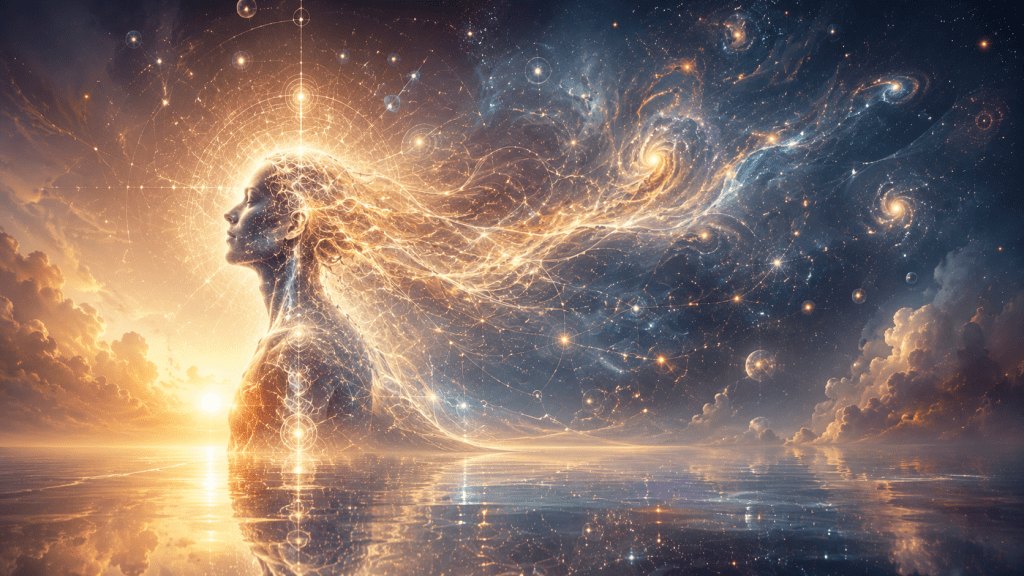
You Have Been Speaking Everything Into Existence

This is not simply about affirmations, positive thinking, manifestation, or the power of spoken language. Those ideas remain close to the surface. The deeper meaning reaches beyond the human voice, personal intention, and the individual mind.

You speak everything into existence and do not even realize it.

At the causal level, existence itself is your expression.

Every form that appears, every movement that unfolds, every event that arises, and every world that seems to exist independently emerges from the same beginningless source that you are.

Nothing stands outside of you.

The birth of a star, the movement of a thought, the falling of a leaf, the ending of a relationship, the formation of a galaxy, and the smallest shift within a single cell all belong to one indivisible happening.

That happening has no external author.

It is not being imposed upon reality from somewhere beyond reality.

Existence is expressing itself as everything.

The One Who Speaks Without a Voice

Human beings usually associate creation with deliberate action. Someone decides, acts, and produces a result. Cause appears to precede effect. A person speaks, and something happens.

Causal consciousness does not operate according to this linear sequence.

The voice that speaks existence into being has no mouth. It does not form sentences, construct plans, or choose between possibilities. Its speech is the spontaneous appearance of existence itself.

Mountains are its language.

Bodies are its language.

Silence is its language.

Time, space, matter, thought, sensation, memory, desire, birth, and death are all movements of this wordless declaration.

Creation is not something that occurred once in a remote past. Reality is being spoken now, not through verbal commands, but through the continuous emergence of experience.

You are that emergence.

A Beginningless Beginning

The mind wants to locate a first moment. It asks what started everything, what existed prior to the universe, and what caused the original cause.

These questions assume that reality began somewhere within time.

Time itself is part of what appears.

There was no first moment in the ordinary sense because the causal source does not occupy a position on a timeline. It is not an ancient object hiding behind the universe. It is the timeless ground through which every apparent beginning and ending becomes possible.

Existence is beginningless because the source of existence was never born.

The body had a beginning.

The personality had a beginning.

Your memories had a beginning.

The awareness within which these beginnings are known has no discoverable starting point.

Search directly for the birth of awareness. A memory may arise, but the memory appears within awareness. A story may explain your origin, yet that story is also being witnessed. Every answer appears as another object within the very presence you are attempting to explain.

The source remains prior to every explanation, not earlier in time, but more fundamental than time.

Everything Is Caused by You

The statement “everything is caused by you” can easily be misunderstood.

The personal ego did not manufacture the universe. Your everyday identity is not secretly controlling weather patterns, global events, other people, or every difficulty that enters your life. Such an interpretation would reduce a nondual insight to spiritual grandiosity.

The “you” being described is not the person.

It is the causal ground appearing as the person.

Every cause and every effect arises within the same undivided reality. The hand that acts, the object acted upon, the action itself, and the consequence are not ultimately separate events. They are distinctions created by perception and thought within one continuous movement.

Reality causes itself through itself.

Fire burns wood. Rain nourishes soil. Gravity draws bodies together. Choices alter lives. Countless visible and invisible conditions shape every outcome.

At the relative level, these causes remain meaningful. At the deepest level, none of them operates outside the whole.

Every cause is reality acting.

Every effect is reality receiving its own action.

Both are you, prior to the identity you call yourself.

The Dream of Separation

Separation creates the impression that life is happening to you.

Events seem external. Other people appear completely outside of you. Circumstances arrive from a world that feels independent of your being. You experience yourself as one vulnerable centre among billions of competing centres.

From the causal perspective, the division between inner and outer has not yet formed.

The person, the world, and the experience of the world arise together. A sound cannot appear apart from hearing. A colour cannot appear apart from seeing. A thought cannot appear apart from awareness. The perceived and the perceiver are born within the same act of knowing.

This does not mean physical differences disappear. Your body remains distinct from another body. Your thoughts are not automatically available to someone else. Practical boundaries continue to matter.

Nonduality does not deny difference.

It reveals that difference does not require absolute separation.

Waves differ in shape, force, duration, and direction, yet no wave contains a substance separate from the ocean. Each wave is the ocean taking temporary form.

Your individuality is real as an expression.

It is not independent as an existence.

Your Words Are Part of the Creative Movement

Spoken words still matter.

Language shapes attention, reinforces beliefs, influences relationships, and directs human action. Words can open possibilities or close them. They can encourage, deceive, wound, clarify, liberate, or imprison.

Yet words do not create reality from outside reality. They are movements through which reality modifies its own appearance.

A thought arises.

The body gives it sound.

Another nervous system receives it.

Meaning forms.

Behaviour changes.

A new sequence of events begins.

What appears to be one person speaking to another is existence communicating with itself through two localized expressions.

The same consciousness speaks and listens.

The same reality questions and answers.

The same source forgets itself, seeks itself, and recognizes itself.

Even the person who insists that words have no creative power is using words to introduce that position into existence.

The Causal Level Is Not Personal Control

Causal realization should never be confused with personal omnipotence.

The ego hears “you caused everything” and imagines itself sitting at the centre of the universe, commanding events according to personal desire. It wants authorship, ownership, recognition, and control.

The causal Self requires none of these.

It does not stand over existence as a ruler directing creation from a distance. It is creation itself, appearing as every ruler and every subject, every command and every refusal, every desire and every disappointment.

Your personal mind cannot decide every outcome because your personal mind is itself an outcome. Its thoughts arise through biology, memory, conditioning, culture, language, environment, and countless forces it did not independently choose.

Yet all of these forces arise within the greater reality that you are.

The individual is not the controller of the whole.

The individual is one of the ways the whole moves.

Responsibility Without Blame

Recognizing yourself as the causal ground does not mean blaming yourself for every painful event.

Blame belongs to the psychological self. It assumes that a separate person should have controlled conditions that were often far beyond personal control.

Causal responsibility is different.

It is not guilt.

It is inseparability.

Nothing can be dismissed as completely unrelated to the whole. Suffering anywhere occurs within the same reality that appears here as you. Compassion becomes more than a moral obligation because the apparent other is not entirely other.

When you harm another, existence wounds itself through your actions.

When you care for another, existence responds to itself with tenderness.

When you become more conscious, reality becomes conscious of its own movement at this particular point of expression.

This recognition does not erase accountability.

It deepens it.

Your actions matter because no action is truly isolated. Every gesture enters a field of consequences. Every word travels farther than the speaker can measure. Every choice becomes part of conditions that shape what follows.

The Silence Prior to Creation

What exists prior to the universe being spoken?

Not an empty void waiting for sound.

Not a distant deity preparing to create.

Not a hidden object concealed behind appearances.

There is only the unformed capacity for everything, silent not because nothing is present, but because no distinction has yet arisen.

That silence remains here beneath every experience.

Thoughts do not destroy it.

Sounds do not interrupt it.

Movement does not leave it.

The entire universe appears as a modulation of what never moves.

You are that stillness and every vibration arising within it.

You are the silence and the spoken world.

You are the causal depth from which existence emerges, the forms through which it becomes visible, and the awareness through which it knows itself.

Everything is caused by you because there is no second reality available to cause it.

Everything is spoken by you because every voice belongs to the same beginningless source.

Everything is you, not as possession, not as personal achievement, but as the indivisible fact of being.

Even Opposition Is Your Creation

Some will say this is egotistical.

That judgment, too, has been spoken into existence by the same beginningless reality.

The one who agrees, the one who resists, the one who mocks, the one who rejects, and the one who opposes are not standing outside the whole. Their objections are movements of the same source.

Even opposition is reality appearing to argue with itself.

You created that into existence as well.

Not you as the personality, but you as the undivided ground from which every voice, criticism, affirmation, denial, and misunderstanding arises.

Even all who oppose you are you appearing in another form, defending another viewpoint, expressing another movement within the totality.

Nothing escapes what you are.

Not praise.

Not resistance.

Not disbelief.

Not condemnation.

Not the accusation of arrogance.

The ego may say, “I created everything.”

Truth says, “There is no separate I and no separate everything.”

The accusation of egotism assumes that an isolated person is claiming personal ownership over existence. Nondual realization makes no such claim. It dissolves the presumed owner along with everything the owner hoped to possess.

There is only the beginningless whole appearing as creator, creation, believer, skeptic, supporter, opponent, accusation, defence, and the silence holding them all.

The question is no longer whether you are creating reality.

The deeper question is this:

Who are you before the one who claims to be the creator appears?

Morgan O, Smith

https://linktr.ee/morganosmith

Beyond the Quadrants

Direct Encounter with the Supreme Identity

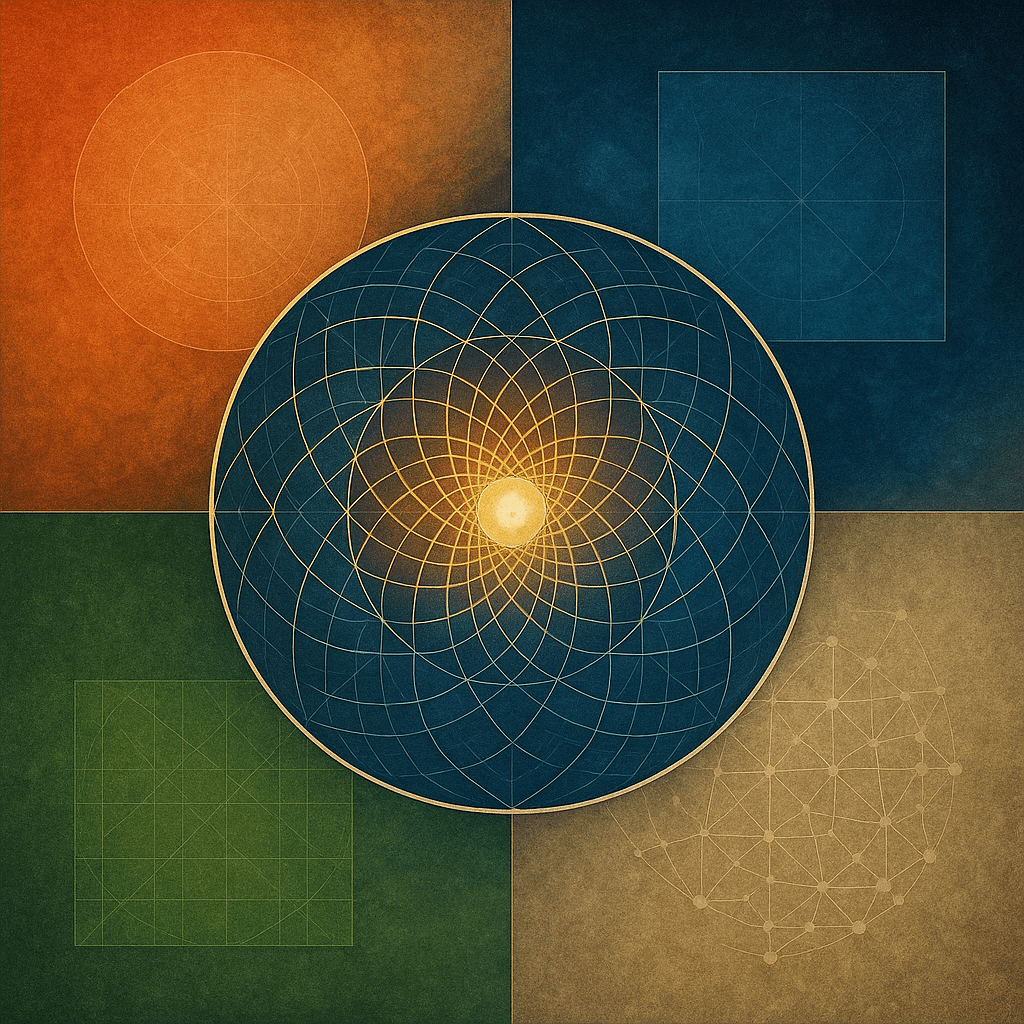
The quadrants—I, We, It, and Its—are not just theoretical maps of experience. They can be lived, felt, and directly known in ways that reveal both their necessity and their ultimate transparency. Each quadrant opens as a doorway, and when entered deeply, each dissolves into the same ground that holds them all.

The “I” – Subjective Interior

The first-person self, the one who says “I,” often feels like the most fundamental reference point of life. Yet, in moments of profound awareness, this identity begins to unravel. The familiar sense of a centre collapses into boundless subjectivity that no longer belongs to a person. Awareness remains, but it is no longer tethered to the small self. The “I” is recognized as inseparable from the infinite.

The “WE” – Intersubjective Communion

Beyond the personal lies the shared field of relationship. Here, connection is no longer about agreement or dialogue but about an unspoken resonance. Every being, every presence, becomes part of a silent communion. The walls between self and other fall away, revealing a unity that feels more intimate than words could ever capture.

The “IT” – Objective Reality

The external world, seen through clear perception, ceases to be “out there.” Light, form, and movement are no longer divided from the one who sees. Reality appears luminous, alive, inseparable from the awareness that beholds it. Object and subject reveal themselves as two sides of the same indivisible presence.

The “ITS” – Systems and Networks

The interwoven fabric of existence discloses itself as a living system. Breath, heartbeat, ecosystems, and galaxies are perceived not as separate mechanisms but as one movement—an intricate symphony without a conductor. The interconnections are not abstractions but a direct felt sense of everything breathing together.

Beyond Quadrants – The Supreme Identity

As each quadrant is seen through, they collapse into the unbroken ground of Being. This cannot be named as “I,” “We,” “It,” or “Its.” It is the source that gives rise to them all while remaining untouched by their distinctions. This is the Supreme Identity—timeless, boundless, indivisible.

When lived from this recognition, the quadrants are not discarded but liberated. They no longer bind perception to fixed standpoints. Instead, they shine as transparent facets of a jewel that was never fractured. Every act, every relationship, every perception becomes a clear expression of the ground itself.

The Supreme Identity is not somewhere else, waiting to be found. It is what was always here—before the quadrants, within them, and beyond them.

Morgan O. Smith

Get Your Free Copy of My Book, Bodhi in the Brain!

https://subscribepage.io/oTSZQu

Beyond Quadrants

The Supreme Identity

The quadrants of experience—I, We, It, and Its—have long been a lens through which consciousness organizes reality. Each provides a vital perspective: the subjective interior of the self, the shared intersubjective domain, the objective forms of matter, and the interobjective systems of the whole. These lenses do not compete; they illuminate the multiple dimensions of existence. Yet, any frame cannot contain the essence of reality, no matter how inclusive or comprehensive it may be.

What reveals itself when awareness no longer clings to a particular quadrant? A vastness appears that cannot be named solely as an “I,” nor reduced to the communion of “We.” It is not confined to the world of objects, nor to the vast interplay of systems. The Supreme Identity both transcends and enfolds these domains, existing as their ground and source.

This Identity is not separate from the quadrants; it is their silent witness and animating force. Just as light contains within it every visible colour yet is itself colourless, the Supreme Identity contains every possible perspective while remaining free of perspective altogether. When seen clearly, the quadrants dissolve into expressions of a singular field that cannot be divided.

What makes this recognition so profound is that it shatters the tendency of consciousness to fixate. The mind grasps for a standpoint—self, relationship, object, or system—but here, every standpoint is unmasked as a partial gesture of the whole. The Supreme Identity does not stand against them; it whispers through them. The “I” speaking, the “We” sharing, the “It” observed, the “Its” interlinked—all are nothing other than its unfolding.

Realizing this does not negate the quadrants. Rather, it liberates them. Each becomes transparent, shining as a clear facet of a jewel that was never fractured to begin with. The Supreme Identity calls forth a recognition: the One is never elsewhere. It is already present, before all perspectives, yet manifesting as each.

To live from this recognition is not to abandon life’s frameworks but to embody their ground. Every conversation, every act, every encounter reveals the unbroken presence that cannot be named yet pervades all. The quadrants remain as tools of navigation, but the navigator is no longer lost.

Morgan O. Smith

Get Your Free Copy of My Book, Bodhi in the Brain!

https://subscribepage.io/oTSZQu

A Dreamed Reality

Memory as the Mirror of the Absolute

What we call reality may be less solid than it appears. Every sound, sight, and sensation dissolves almost as quickly as it arises, leaving only the faint residue of memory to claim that anything happened at all. Existence itself feels dreamlike when examined closely: shifting, impermanent, yet strangely coherent—like a page rewritten by an unseen author each moment.

Memory is the keeper of this dream. It builds continuity from fragments, stitching together the illusion of permanence where none truly exists. What we call “the world” is less a physical stage than a reflection—abstract, fluid, a hologram shimmering on the screen of awareness. To mistake this reflection for the ultimate is to confuse the shadow for the light that casts it.

The most high, the unconditioned source beyond all appearances, does not require memory. It is that which precedes storage, recall, or even perception. Yet within its infinite stillness arises the dream we name reality. This dream is neither random nor meaningless; it serves as a mirror through which the Absolute contemplates itself. Every event, every thought, every fleeting sensation is nothing more than the play of memory echoing back to the One who never forgets because It has never known separation.

To recognize life as memory’s echo is not to diminish its beauty, but to free oneself from the weight of taking it as final. The dream is not false in the sense of being meaningless; it is false only in being mistaken for the whole. What is real lies in that silent clarity from which both memory and dream emerge.

Awakening, then, is the gentle turning of attention from the flickering reflection to the brilliance of the source. It is the realization that the dream was always sacred, but never ultimate.

Morgan O. Smith

Get Your Free Copy of My Book, Bodhi in the Brain!

https://subscribepage.io/oTSZQu

The Weightlessness of Perspective

How much weight does a point of view actually hold?

None. And yet, it seems to shape entire lives, govern nations, define relationships, and breed conflict. But the more one deepens into the ungraspable expanse of reality, the more all perspectives—including one’s own—become like shadows cast by a flame none can touch.

I do not feel resistance toward those who oppose my view. I feel space—vast, immeasurable space. Not tolerance, not passive indifference, but a kind of cosmic shrug. This universe is too immense, too precise, too paradoxical for me to waste even a flicker of energy defending a perspective I know was born out of a temporary configuration of memory, biology, and environment.

What I see, I see through a filter: race, culture, conditioning, gender, language, trauma, karma, personality, neurochemistry, and a moment’s breath. Someone else sees through a completely different lens. To argue over the differences is like two waves debating who touches the shore more truthfully.

Each wave is made of the same water.

Ultimate Reality does not conform to opinions. It cannot be contained by agreement or disagreement. It isn’t found in right or wrong, winning or losing. It is not trying to prove itself. It simply is, and isness doesn’t care how it’s described.

This is not nihilism. It’s reverence. Reverence for the mystery so wide, so total, that every perspective is valid precisely because none of them are.

The deeper the realization, the more perspectives one can hold. Not juggle, not compare, not rank—but hold. To see from the eyes of the enemy and the beloved, the oppressor and the oppressed, the doubter and the devotee. To feel into each vantage point, not to believe it, but to understand it from within.

Eventually, you don’t just hold perspectives. You become the capacity for perspective itself. You become the silence before thought, the awareness behind all positions.

From there, disagreement becomes theatre.

Opposition becomes dance.

And the only thing that matters is the stillness that allows it all to appear.

Morgan O. Smith

Get Your Free Copy of My Book, Bodhi in the Brain!

https://subscribepage.io/oTSZQu

Beyond Comprehension

Dwelling in the Field of Opposites

Want to understand the mind of God? Think of two opposites, accept those two opposites, become the two opposites, go beyond both, erase both, yet include. Even then, it won’t be understood.

Fire and water seem to be opposites. Yet steam arises at their meeting point—a form that is neither purely one nor the other, yet depends on both entirely. This is not the cancellation of difference but its transformation. What appears is both, neither, and something beyond classification.

To become opposites means allowing yourself to be fierce and gentle, clear and confused, bound and free, without settling on any of these as the final truth. It is to hold them fully, see their mutual necessity, and recognize that their apparent contradiction points to something that includes, exceeds, and dissolves them without denying them.

Human longing for comprehension seeks the safety of closure—a single statement that ends all questioning. Yet the source of all perspectives cannot be bound by any one of them. Every claim about it is true, false, and everything in between.

Stepping into the space where opposites remain distinct yet inseparable invites a new kind of seeing. Certainty and doubt illuminate each other. Every perspective holds a partial truth, a partial untruth, and a silent remainder that escapes both.

Silence here is not mere emptiness but a fullness that holds every possibility without settling on any. Words illuminate and obscure in the same breath. Every statement unveils something while hiding something else. Language does not capture what is beyond it but points, imperfectly, toward what cannot be bound.

This is not a teaching about removing opposites so they disappear into sameness. It is about becoming vast enough to hold their full tension, to see that going beyond them does not reject them but includes them in a larger whole. The mind of God is not merely where opposites cease to matter but where their interplay, necessity, and transcendence are equally revealed.

Here, everything can be affirmed, denied, and moved beyond at once. Nothing is excluded. Nothing stands alone.

Morgan O. Smith

Get Your Free Copy of My Book, Bodhi in the Brain!

https://subscribepage.io/oTSZQu

The Root of Choice

True Free Will and the Causal Realm

Most speak of choice as if it lives at the surface, where preference, fear, habit, and desire jostle for control. But what if true free will does not arise there at all? What if it exists at the root, before thought forms into options, before “I want” emerges to justify itself?

This root is the causal realm: the source of all motion, where intention is not split from manifestation. It is not personal will in the usual sense—no ego negotiating with life to get what it wants. Instead, it is pure causality aware of itself, setting everything in motion without conflict or division.

At the surface, people speak of freedom as the power to choose between alternatives. Yet these alternatives are already conditioned. They are branches of a tree whose root has already determined their growth. To speak of freedom at the stem while ignoring the root is to mistake effect for cause.

However, the paradox reveals itself when one sees no real division between root and stem. The freedom to choose at the surface becomes genuine only when it is recognized as the expression of the root itself. Every choice becomes the revelation of causality. There is no separate chooser apart from the choosing.

This is what lies beyond the ego’s belief in control. The ego claims “I choose” without realizing that its very claim is already part of the causality it denies. True free will is not the assertion of control over life but the recognition that you are life itself choosing, moving, unfolding.

To see this is to dissolve the illusion of separation. Responsibility is no longer a burden but realization: the root chooses through you, as you. There is no conflict left. Choice becomes transparent, ego falls away, and causality shines unbroken.

This is freedom—not as license, not as negotiation, but as total alignment with the source of all that arises.

Morgan O. Smith

Get Your Free Copy of My Book, Bodhi in the Brain!

https://subscribepage.io/oTSZQu

God Is the Real Imaginary

Absolute Monism and the Paradox of Reality

A peculiar clarity arises once the mind exhausts its chase for permanence. Once the striving quiets, what remains is not a revelation in the ordinary sense—it is the revelation of revelation itself. God. Not as something other, but as the very condition of knowing, being, and non-being.

God is not a person, nor a power among powers. God is context itself. Not just the backdrop, but the totality—the undivided field in which all division appears. It is what Hindus call Para Brahman: the Absolute of the Absolute. The final substratum, beyond form, formlessness, and even beyond the duality of beyond and not-beyond.

Yet the paradox defies all rational anchoring: God is also imagination.

Not a figment. Not illusion in the dismissive sense. But the supreme imagining—consciousness dreaming within itself. The universe, with all its matter and mind, all its chaos and beauty, is that imagining. And because God is not apart from its imagining, God too is that imagining.

Which means this: both God and the universe are imaginary.

And also utterly real.

What we call “real” and what we call “imaginary” collapse into a single gesture when seen from God’s standpoint—which is no standpoint at all. From this viewless view, there is no separation between the dreamer and the dream, the Absolute and its expression, the Formless and the formed.

Yet the beauty of this is not that everything dissolves into sameness. The beauty is that everything becomes itself without needing to stand apart.

God and the universe are one and the same. And because they are one and the same, they are also not the same. The distinction is not contradiction. It is the very nature of what is. Distinctness does not negate unity. It reveals it.

This is not spiritual poetry. This is ontological exactness. If anything is to be absolute, it must include even the capacity to contradict itself. That is the very mark of its absoluteness.

So, what is this that appears as a tree, a thought, a thunderclap, a kiss, a death, a silence?

It is God.
It is the universe.
It is imagination.
It is reality.

One singularity. Absolute Monism.

To see it is not to figure it out. To see it is to disappear into what cannot not be.

Morgan O. Smith

Get Your Free Copy of My Book, Bodhi in the Brain!

https://subscribepage.io/oTSZQu

When Spirit Dreams Itself Into Matter

Spirit does not need a mirror, yet it gazes anyway—projecting forms into the formless, assigning names to the unnamed. What we call the world is not something separate from Spirit, but a spontaneous gesture of its own imagination, experienced as if it were other.

This is the paradox.

There is no true division between creator and creation. What appears as the external world is not a stage for a lost soul to find its way back, but Spirit animated—forgetting itself to taste the illusion of separation. Not as punishment or accident, but as a dance, a play, a sacred hallucination.

To believe the imagination is real is not error. It is the very means by which Spirit hides and finds itself. Each identity clung to, each role performed, each belief defended—these are costumes worn by the formless to remember itself as form.

Awakening doesn’t arrive like a conclusion; it dissolves the argument. You do not awaken from the dream by force or by will, but by remembering that it was always Spirit dreaming. The character fades, but not as death—more like laughter that remains after the joke has dissolved.

What changes when you see this?

Nothing. Everything. The world continues. You walk, eat, speak. But there’s an intimacy now. A recognition that what you once took to be real is neither unreal nor merely imagined—it is Spirit, playing with itself through light and shadow.

The one who seeks is the sought. The one who prays is the prayed to. Spirit folds into its own image, not to be found, but to be felt. That is the point. Not escape. Not transcendence. But the sacred absurdity of being itself.

Morgan O. Smith

Get Your Free Copy of My Book, Bodhi in the Brain!

https://subscribepage.io/oTSZQu

When I Say Full Awakening…

This Is What I Mean

Many speak of awakening, yet far fewer comprehend its fullness. I’ve encountered every kind—emotional, spiritual, philosophical, mystical. Each unveils a layer, each reveals a depth. But what I call full awakening—what I live as full awakening—is something few ever point toward, and fewer still embody.

It is not about personal clarity. Not about peace of mind, a better life, or even union with a divine presence. Those are steps, glimpses, fragments. Full awakening is not a state within experience. It is the collapse of all distinction between state and experiencer.

This isn’t about finding your place in the cosmos—it’s about the disappearance of place, cosmos, and self as separate notions. When I say full awakening, I am referring to the direct knowing that everything—absolutely everything—is a singularity.

Existence and nonexistence. Subject and object. The smallest subatomic flicker and the sweep of galactic spirals. Civilizations long past and unborn futures. Every religion, every philosophy. All thoughts. All acts. Every realm, every reality, every god.

The seen and the unseen. The formed and the formless. That which is birthed, that which dies, and that which never entered the cycle. All technologies. All intelligences. All contradictions and confirmations. All questions and every possible answer.

Not merely connected. Not even interdependent.

Indistinct. Inseparable. One.

That realization is not metaphorical. It is not poetic. It is not conceptual. It is total. It devours every duality and even the idea of devouring. It consumes the witness, the process of witnessing, and that which is witnessed—leaving no remainder.

So when another speaks of full awakening, I listen with care. Because unless it includes everything I’ve said—and also what they say—it’s not the same thing. The paradox, of course, is that what I’m pointing to also includes that divergence. It embraces even what appears to deny it.

Full awakening is not a peak. It is not an event. It is the vanishing of all altitude and time. It is not even a realization. It is what remains when all realizations dissolve.

One. Not a oneness made of parts. Not a whole made of pieces. Not harmony, not unity. Just One.

And that One is not separate from what you are.

Morgan O. Smith

Get Your Free Copy of My Book, Bodhi in the Brain!

https://subscribepage.io/oTSZQu