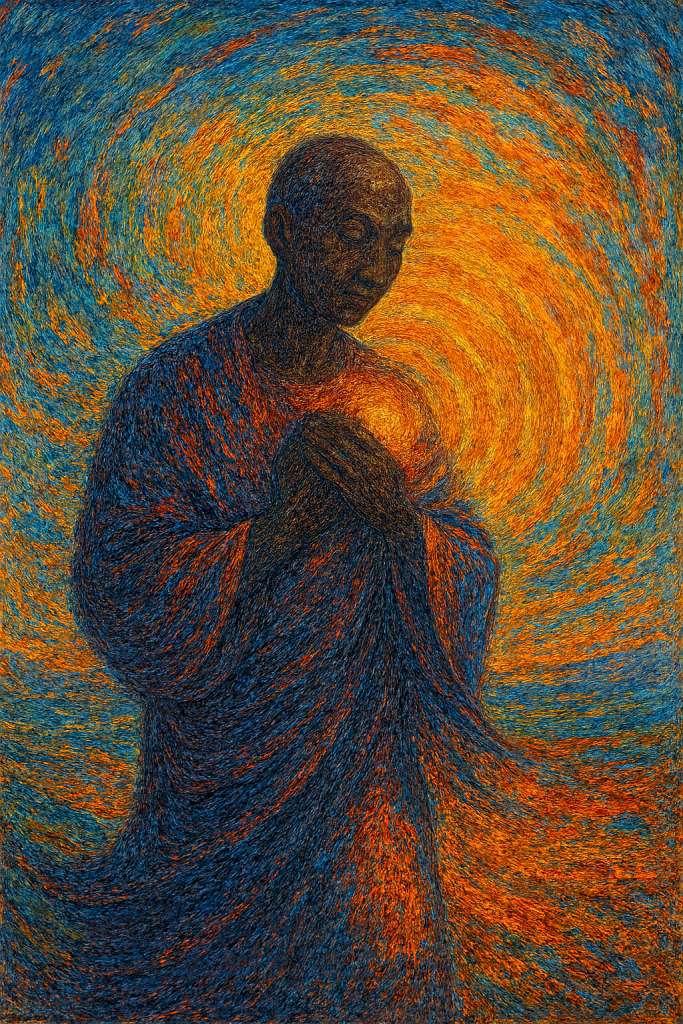
Empathy is often described as understanding another’s feelings, yet this description barely scratches the surface of its deepest expression. At its highest register, empathy ceases to be an act of imagination and becomes an act of participation. Something more radical occurs; identity loosens, boundaries soften, and awareness enters a living intimacy with another mode of being.
Such empathy does not merely observe suffering or joy from a distance. Consciousness steps into the interior rhythm of another life and begins to feel from within. Breath, sensation, and perception reorganize themselves. Experience no longer revolves around a private centre. A wider gravity takes hold.
Kosmocentric awareness emerges at this threshold. Attention no longer privileges the personal narrative or even the collective identity of a group. Life is sensed as a single field expressing itself through countless forms. Compassion, here, is not chosen. It flows naturally, the way heat radiates from fire.
To walk in the shoes of a bodhisattva is not to adopt a moral stance or imitate a spiritual role. It is to feel what it means to be animated by responsibility without burden. The heart expands beyond emotional warmth into something rhythmic and vast, beating not for one life, but for life itself. Suffering is felt directly, yet it does not collapse the system. The capacity to hold pain grows alongside the capacity to love.
Such an experience dissolves the familiar distinction between self and other. Helping another no longer feels like altruism. It feels like circulation; energy moving where it is needed, without hesitation or self-congratulation. Action arises spontaneously, guided by clarity rather than obligation.
This level of empathy cannot be sustained through effort alone. It arises when identification with the separate self loosens enough for consciousness to re-centre itself within the whole. What remains is not detachment, but intimacy without possession. Care without agenda. Presence without contraction.
Moments like these recalibrate what it means to be human. After tasting kosmocentric empathy, ordinary indifference becomes impossible to justify. Even when the experience fades, something irreversible has occurred. A deeper reference point has been established.
Empathy, at its summit, reveals itself not as an emotional skill, but as a shift in being. Life recognizes itself through you, and the heart learns a larger rhythm; one that beats for all beings, without exception.
Morgan O. Smith
Get Your Free Copy of My Book, Bodhi in the Brain!

 Morgan O. Smith