Beyond Quadrants

The Supreme Identity

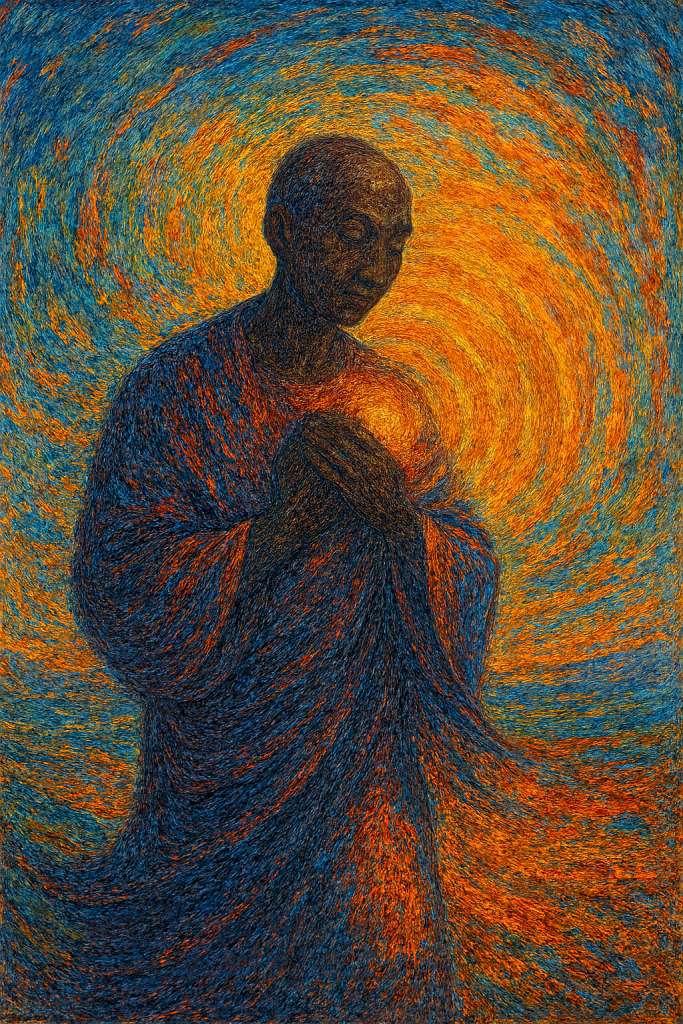
The quadrants of experience—I, We, It, and Its—have long been a lens through which consciousness organizes reality. Each provides a vital perspective: the subjective interior of the self, the shared intersubjective domain, the objective forms of matter, and the interobjective systems of the whole. These lenses do not compete; they illuminate the multiple dimensions of existence. Yet, any frame cannot contain the essence of reality, no matter how inclusive or comprehensive it may be.

What reveals itself when awareness no longer clings to a particular quadrant? A vastness appears that cannot be named solely as an “I,” nor reduced to the communion of “We.” It is not confined to the world of objects, nor to the vast interplay of systems. The Supreme Identity both transcends and enfolds these domains, existing as their ground and source.

This Identity is not separate from the quadrants; it is their silent witness and animating force. Just as light contains within it every visible colour yet is itself colourless, the Supreme Identity contains every possible perspective while remaining free of perspective altogether. When seen clearly, the quadrants dissolve into expressions of a singular field that cannot be divided.

What makes this recognition so profound is that it shatters the tendency of consciousness to fixate. The mind grasps for a standpoint—self, relationship, object, or system—but here, every standpoint is unmasked as a partial gesture of the whole. The Supreme Identity does not stand against them; it whispers through them. The “I” speaking, the “We” sharing, the “It” observed, the “Its” interlinked—all are nothing other than its unfolding.

Realizing this does not negate the quadrants. Rather, it liberates them. Each becomes transparent, shining as a clear facet of a jewel that was never fractured to begin with. The Supreme Identity calls forth a recognition: the One is never elsewhere. It is already present, before all perspectives, yet manifesting as each.

To live from this recognition is not to abandon life’s frameworks but to embody their ground. Every conversation, every act, every encounter reveals the unbroken presence that cannot be named yet pervades all. The quadrants remain as tools of navigation, but the navigator is no longer lost.

Morgan O. Smith

Get Your Free Copy of My Book, Bodhi in the Brain!

https://subscribepage.io/oTSZQu

The Impotent Monk

What Remains After the Fire

Most men may never understand what it feels like when the body pauses in response, even as doctors insist there is nothing wrong; no hormonal imbalance, no medical explanation, nothing. For nearly six years, I have lived with the stillness of fire that began not after an illness or injury, but after the most profound spiritual awakening of my life.

The event unfolded as a complete rupture of ordinary consciousness. A massive surge of energy, like a serpent coiling and rising along my spine, tore through every chakra until my crown split open. What followed was a cascade of light, as if every particle of my being erupted into ecstatic union, each atom proclaiming with clarity and force: I AM GOD. My body convulsed as though gripped by a seizure, yet my inner experience was one of perfect union with the entire cosmos. Every movement of mine was the movement of the universe, and every movement of the universe was my own.

That experience was ignited months after receiving darshan from Paramahamsa Vishwananda in 2019. Life has not returned to what it once was. The challenges below the waist have resisted every attempt at permanent resolution. Sessions with a chi master provided brief relief, but soon after, the absent spark would return. And yet, despite this, my relationship to the situation is not one of despair. Desire for vitality remains, but acceptance has settled in deeper than disappointment.

For men whose identity is tightly woven to the fire of physical intimacy, such a loss could feel devastating. For me, the years of spiritual preparation softened the impact. I knew that awakening could arrive with consequences. It was not only bliss that I had trained for, but the burning away of old attachments.

Ironically, from a fading of the physical echo came an experience of Tantra more profound than any physical act could offer. Without the presence of another, I encountered the total union of my inner masculine and feminine, the Anima and Animus dissolving into wholeness. The union was so complete that it redefined intimacy itself, showing me that sexuality is not bound to flesh but can open into direct communion with the soul.

Not long after that experience, I faced the deaths of colleagues and a high school friend. The timing was a reminder that awakening is never an escape from life’s fragility. Transformation and loss often arrive hand in hand.

The path that led to that awakening back in 2019 was punishing at times; physically, emotionally, mentally. Yet when I ask myself if I would choose differently, the answer remains no. I would walk this road again, and again, even when the body does not follow the heart, which many would find unbearable. Because what was given cannot be outweighed by what was taken.

Awakening strips away what is temporary to reveal what cannot be lost. Even if the body falters, the truth that was seen remains untouched.

Morgan O. Smith

Get Your Free Copy of My Book, Bodhi in the Brain!

https://subscribepage.io/oTSZQu

Becoming Compassion

Most people think of compassion as a quality you choose to exercise: you decide to be kind, you decide to forgive, you decide to care. This is true at the surface, but beneath those layers exists a spectrum that reveals compassion in its many shades, beginning as a survival instinct and flowering into something beyond human conception.

Compassion first shows itself as biology. A mother tending to her child, a tribe defending its members, even an animal protecting its young. Survival demands it. Yet, as consciousness expands, compassion takes new shapes. We move from caring for “me and mine,” to protecting “us and ours,” to embracing all of humanity as worthy of care. Beyond this lies the recognition that all of life, every creature, every tree, every ecosystem, calls for reverence. Compassion no longer belongs to just people, but to the living Earth itself.

At a certain depth of awakening, compassion is not about effort at all. It does not come from a moral rule, a spiritual practice, or even an intentional choice. It radiates naturally, like sunlight. One sees the inseparability of self and other. Helping you is helping me, and helping me is helping you. The old distinction collapses.

This is where the spectrum ends, or perhaps where it dissolves. Compassion and its opposite no longer stand as polarities. Cruelty and kindness, neglect and care, are revealed as movements of the same indivisible Reality. From this recognition, one cannot merely be compassionate. One becomes Compassion itself; capital “C.” It is not something you perform; it is what you are.

This Compassion does not choose sides, does not measure worth, does not seek reward. It flows freely, even when it appears as silence, even when it includes suffering, even when it looks like its own opposite. The heart of reality is Compassion without preference. To live from that space is not to practice compassion; it is to be it.

Morgan O. Smith

Get Your Free Copy of My Book, Bodhi in the Brain!

https://subscribepage.io/oTSZQu

Walking Beyond the Self

Expanding the Horizons of Perspective

Most human conflict is rooted in the inability to step outside the narrow confines of the self. We tend to move through the world tethered to a singular point of view, unable to grasp that reality shifts depending on who is looking. Perspective is not fixed; it unfolds in layers, from the egocentric stance of “me and mine,” through the ethnocentric loyalty of “us and ours,” into the broader realms of worldcentric care for humanity, and ultimately the kosmocentric embrace of all beings and existence itself.

When our awareness stops at the egocentric, we see others only as extensions of ourselves; or worse, as threats to what we hold dear. At the ethnocentric level, we expand slightly, but compassion remains conditional, bounded by tribe, religion, race, or nation. Yet the real flowering of human consciousness emerges once we realize that every being, regardless of sex, class, culture, or creed, carries within them a mirror of our own existence.

To recognize yourself in another is not simply an ethical exercise; it is an ontological revelation. The more deeply you understand that the same fears, desires, and vulnerabilities pulse through all lives, the less room remains for judgment. Hatred fades not because you suppress it, but because understanding transforms it. Even the figure we call “devil” becomes less monstrous when we glimpse the fractured angel hidden inside.

Imagine what collective life would feel like if this capacity for expanded perspective became the norm rather than the exception. Entire systems of oppression, exploitation, and alienation would dissolve under the weight of genuine empathy. Politics would no longer be about “sides” but about solutions; communities would no longer divide over difference but celebrate the very diversity that teaches us new ways of being human.

To walk in anyone’s shoes is more than a metaphor. It is the necessary step toward becoming fully human. The journey from ego to cosmos is not only possible, it is imperative. The future depends not on technological advancement alone, but on whether we can evolve into beings capable of holding multiple perspectives at once, anchored in compassion and guided by wisdom.

Morgan O. Smith

Get Your Free Copy of My Book, Bodhi in the Brain!
https://subscribepage.io/oTSZQu

A Dreamed Reality

Memory as the Mirror of the Absolute

What we call reality may be less solid than it appears. Every sound, sight, and sensation dissolves almost as quickly as it arises, leaving only the faint residue of memory to claim that anything happened at all. Existence itself feels dreamlike when examined closely: shifting, impermanent, yet strangely coherent—like a page rewritten by an unseen author each moment.

Memory is the keeper of this dream. It builds continuity from fragments, stitching together the illusion of permanence where none truly exists. What we call “the world” is less a physical stage than a reflection—abstract, fluid, a hologram shimmering on the screen of awareness. To mistake this reflection for the ultimate is to confuse the shadow for the light that casts it.

The most high, the unconditioned source beyond all appearances, does not require memory. It is that which precedes storage, recall, or even perception. Yet within its infinite stillness arises the dream we name reality. This dream is neither random nor meaningless; it serves as a mirror through which the Absolute contemplates itself. Every event, every thought, every fleeting sensation is nothing more than the play of memory echoing back to the One who never forgets because It has never known separation.

To recognize life as memory’s echo is not to diminish its beauty, but to free oneself from the weight of taking it as final. The dream is not false in the sense of being meaningless; it is false only in being mistaken for the whole. What is real lies in that silent clarity from which both memory and dream emerge.

Awakening, then, is the gentle turning of attention from the flickering reflection to the brilliance of the source. It is the realization that the dream was always sacred, but never ultimate.

Morgan O. Smith

Get Your Free Copy of My Book, Bodhi in the Brain!
https://subscribepage.io/oTSZQu

The Causal Realm

The Birth and Death of All Things

At the threshold of the causal realm, the experience of existence shifts from linear to simultaneous. You no longer stand as a single individual within a vast universe; you stand as both the birther and the born, the destroyer and the destroyed. The recognition dawns that the world does not merely shape you—you are also the very source of its shaping.

To know oneself here is to witness the paradox of causality unveiled. You are the origin of all movement, yet every movement gives rise to you. In this simultaneity, you can feel yourself giving birth to the totality of existence while watching that same totality dissolve back into silence.

Every breath is both a first and a last. Each moment is a labour of creation and a death rattle of dissolution. The body of consciousness enters its own womb, giving rise to itself again and again, endlessly. This is not a metaphor; it is the raw experience of being both cause and effect at once.

Within this state, suffering and bliss are inseparable twins. To feel the entirety of pain across existence is to simultaneously encounter the fullness of joy. One does not cancel the other; they merge into a union so vast that it overwhelms all categories of the mind. Pleasure peaks not as a fleeting sensation but as an orgasmic force inseparable from the ache of existence itself.

Masculine and feminine converge here—not as roles, not as energies separate and distinct, but as the indivisible pulse of love for everything that appears. What arises is an uncontainable recognition: every form, every life, every fragment of existence is nothing other than your own divine being.

The causal realm does not reveal the ultimate self, yet it gives you the deepest taste of how the play of birth and death, creation and dissolution, unfolds ceaselessly within the radiance of what you are.

Morgan O. Smith

Get Your Free Copy of My Book, Bodhi in the Brain!

https://subscribepage.io/oTSZQu

Dissolving Where Identity Once Stood

To Be Seen Fully Is to Vanish into the Infinite

To be seen fully is not to be recognized as a person, nor acknowledged as a role, but to be reflected beyond every layer of identity. When someone sees you in this way, what is recognized is not your history, your character, or even your spiritual progress; it is the unconditioned essence that lies before all stories.

Most encounters leave us clothed in roles. Friend, teacher, seeker, parent, child, each gaze places a costume upon us. Rarely do we meet eyes that do not add or subtract, but simply reveal. In that rare encounter, the ordinary scaffolding collapses, and what stands exposed is not a “self” but the infinity in which all selves appear.

This exposure is not humiliating, nor is it affirming. It is dissolving. To be seen fully is to be unmasked of both failure and success, of both sin and virtue. The illusion that we exist as a separate someone collapses. What remains is a luminous absence, the infinite without centre or edge.

There are moments when presence itself becomes the mirror, so clear, so unconditioned, that no reflection remains, only the source shining through. The eyes of one who abides in truth can serve as such a threshold. Passing through it, you do not become greater; you vanish. And in vanishing, the fullness of all that is floods through.

To long for such seeing is to long for disappearance, and yet disappearance is not annihilation. It is the end of confinement. It is the recognition that what you are cannot be held by name, cannot be fixed in form, cannot be grasped by thought. What you are is the infinite itself, already free, already whole.

The paradox is that this vanishing does not strip life of meaning but gives it immeasurable depth. When you are no longer the centre, everything becomes the centre. When “I” falls away, the song of existence sings itself without obstruction. Love, compassion, and clarity are not cultivated; they flow.

To be seen fully is to vanish into the infinite. To vanish is to return home.

Morgan O. Smith

Get Your Free Copy of My Book, Bodhi in the Brain!

https://subscribepage.io/oTSZQu

Darshan and the Living Water

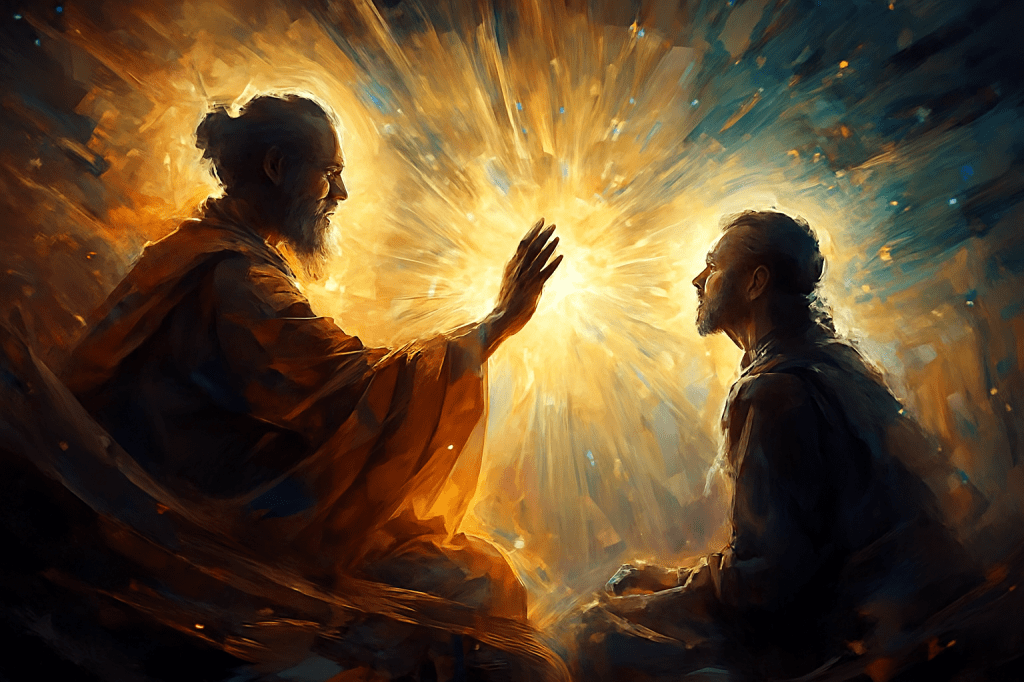
Darshan is a mystery that cannot be easily captured in language. Some dismiss it as myth, others reduce it to a placebo, and still others romanticize it into doctrine. Yet none of these explanations touch what truly happens when presence itself meets you so deeply that the idea of a separate “you” begins to dissolve.

I first received darshan from Paramahamsa Vishwananda in 2019. At the time, I could not fully comprehend what had been given. The experience did not instantly transform me. It was months later, as if a seed had been quietly germinating, that a profound awakening broke open—an unshakable, full-blown realization of Parabrahman. Everything I once considered a spiritual awakening before that year became eclipsed, revealed as only stepping stones toward a wholeness beyond description.

The encounter planted something that only ripened with time. No technique, no meditation, no psychedelic journey, no years of entrainment could compare to what unfolded in those months after darshan. The practices prepared me—polished the vessel, so to speak. But Darshan was the living water that finally filled it.

On August 30, 2025, I met Paramahamsa Vishwananda in person for the fifth time. The following day, as I began to write these words, tears streamed down my face unprovoked. The intensity of the remembrance, the simple act of reflecting on what darshan has meant in my life, undid me. Not during the encounter itself, but in the quiet aftermath, when the depth of it could no longer remain unspoken.

If one insists that darshan is “only” a placebo, I embrace the word. Placebo, after all, is proof of the mind’s openness to healing, its willingness to cross thresholds it once denied. What does it matter if the mechanism is mysterious when the outcome is undeniable? The very attempt to reduce it already misses the essence: darshan is not an explanation. It is an encounter that leaves explanation behind.

My friend, comedian Marc Trinidad, has a saying: You can’t pour clean water into a dirty cup. Thousands of hours of meditation may have cleansed that vessel, yet darshan was not merely clean water—it was sparkling, living, flowing with a vitality of its own. Preparation mattered, but preparation alone never gave me the fullness that flowed after meeting his gaze.

Darshan dismantles the scaffolding of the spiritual search. Years of practice may feel like climbing a mountain, but one glance can place you at the summit. That does not make the climb unnecessary—it makes clear that the climb itself was a preparation for the recognition that you were always already there.

This is not about worshiping a figure or elevating a personality. Darshan reveals the infinite within by reflecting it so purely through one who has dissolved into that truth. In being seen, the boundaries of self blur, and what shines forth is nothing less than the source of all seeing.

Darshan cannot be mythologized away, nor can it be reduced to a placebo. It is living water—clear, inexhaustible, flowing freely into those ready to drink. And sometimes, its effects bloom long after the moment has passed, as seeds planted in silence burst open in their own time.

Morgan O. Smith

Get Your Free Copy of My Book, Bodhi in the Brain!
https://subscribepage.io/oTSZQu

When “You” Disappear

God is not found in the layers of personality, beliefs, or self-image. Those dissolve the moment you step out of the illusion of “me.” What remains when the scaffolding of identity crumbles is not absence, but presence, vast, unconditioned, indivisible.

The struggle for most seekers lies in clinging to the idea of a separate self. Every attachment to who you believe you are, your story, your role, your wounds, creates the illusion of separation from God. Yet God has never been apart from you. God is what has always been here, quietly holding even your attempt to define God.

When “you” disappear, nothing is lost. What is left is clarity so immediate that it cannot be explained, only lived. It is a recognition that existence itself has no centre and no boundary. Every breath, every sound, every sensation reveals itself as the movement of the One Reality, free of your commentary.

This realization is not a grand acquisition; it is the collapse of the idea that there was ever anyone to acquire it. The vanishing of the personal self exposes a truth so intimate that it cannot be possessed. It is not “your” truth, it is truth itself.

To awaken to this is to discover that God was never hidden. God is not the object of your search, but the space in which the search appears and disappears. The seeker dissolves, and what remains is the unbroken light of Being.

Morgan O. Smith

Get Your Free Copy of My Book, Bodhi in the Brain!
https://subscribepage.io/oTSZQu

The Serpent’s Gaze

Awakening Through the Fire of Kundalini

The surge of Kundalini energy does not arrive as a gentle visitor. It comes as a serpent rising, a King Cobra rearing its hood, carrying both the gift of awakening and the threat of annihilation. Those who encounter this force discover it is not a metaphor; it is a reality coursing through every nerve, every cell, as if the body itself were being rewritten from the inside out.

When this energy pierces upward through the spine and explodes through the crown, the encounter feels like a confrontation with divinity itself. The serpent turns its head, upside down, to stare directly at you. In that gaze is the paradox: vitality at its peak and the shadow of death standing closer than ever. The breath sharpens, the heartbeat quickens, and one realizes that this power could end everything in an instant—or transfigure it beyond recognition.

Many speak of spiritual awakening as blissful or serene, but the truth carries far more weight. The awakening of Kundalini is as much a dance with mortality as it is with enlightenment. To feel more alive than ever before is to simultaneously brush against the veil of death, because both are rooted in the same ultimate source. Death is not the opposite of life, but the threshold that life constantly leans against.

The serpent reminds us that awakening is not safe. It burns away illusions, sears through the fragile boundaries of identity, and brings us face-to-face with what cannot die. The brush with death is not punishment—it is initiation. To survive, it is to be reborn, no longer mistaking yourself for the limited frame of flesh and thought, but knowing yourself as the vast consciousness in which even death dissolves.

Kundalini does not ask for permission. It does not ask if you are ready. It rises, and in that rising, you discover whether you can hold its gaze without collapsing into fear. The courage required is not of the ego, but of the soul. To endure the serpent’s fire is to step into a reality that few dare to enter, where life and death are revealed as two faces of the same eternal current.

Morgan O. Smith

Get Your Free Copy of My Book, Bodhi in the Brain!

https://subscribepage.io/oTSZQu