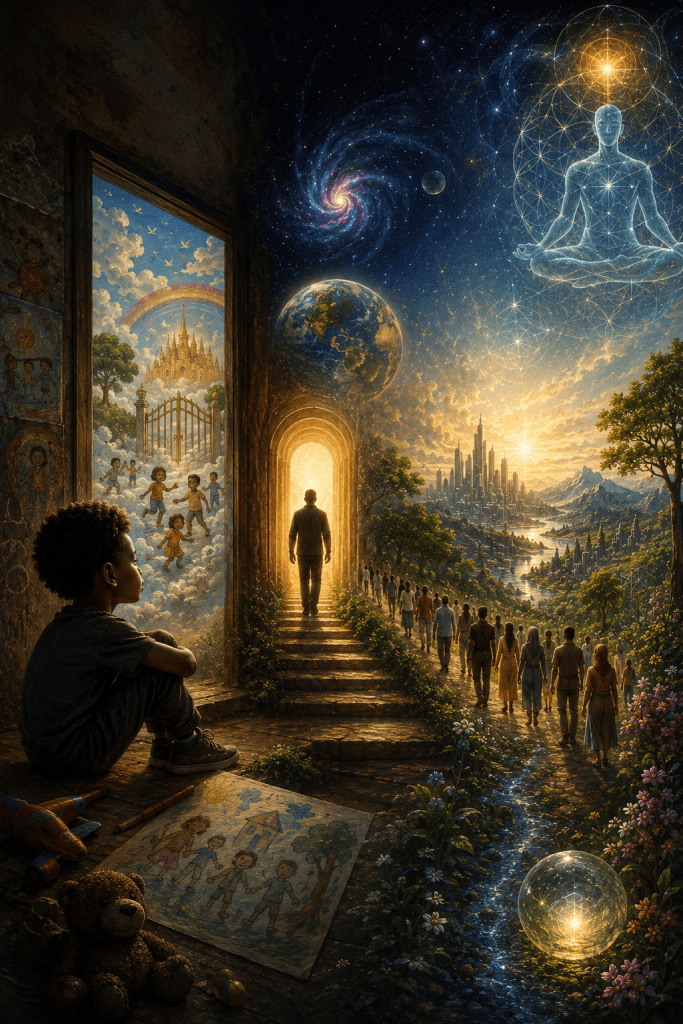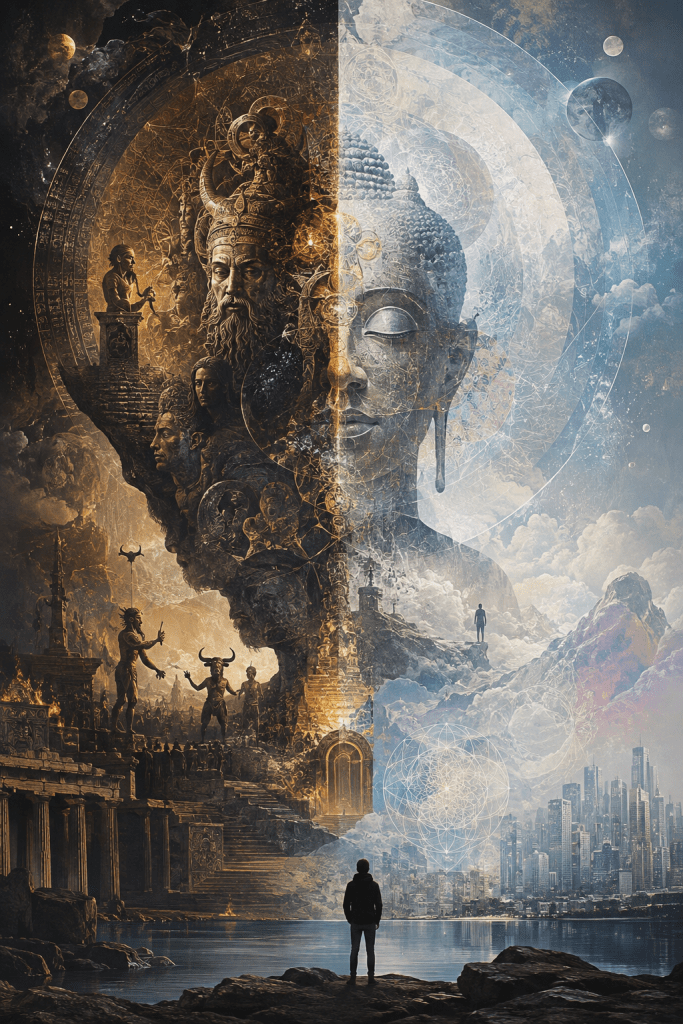
What if many of humanity’s earliest ideas about God reveal as much about the psychological development of human beings as they do about the Divine?
The archaic, magical, and mythical God did not simply appear from nowhere. These images of God emerged through human consciousness at particular stages of individual and collective development.
A God who demands obedience.
A God who rewards loyalty and punishes disobedience.
A God who belongs to one tribe and fights against another.
A God who controls storms, harvests, fertility, illness, victory, and defeat.
A God who must be pleased through sacrifice.
A God who watches human behaviour and keeps score.
A God who condemns outsiders while protecting the chosen.
These conceptions make considerably more sense when understood through developmental psychology.
We Could Only Imagine God Through the Consciousness Available to Us
Human beings interpret reality through the cognitive, emotional, moral, and cultural capacities available to them.
A child does not understand authority the same way an adult does. A tribal society does not necessarily conceptualize identity the same way a modern pluralistic society does. A consciousness organized primarily around survival, kinship, magical causation, or mythic belonging will naturally interpret ultimate reality through those structures.
God becomes understandable by becoming psychologically recognizable.
When human authority is organized around powerful chiefs and kings, God becomes the greatest King.
When social order depends upon obedience, God becomes the ultimate Lawgiver.
When tribal survival depends upon distinguishing “us” from “them,” God becomes our God rather than their God.
When natural events cannot yet be understood through scientific causation, thunder, drought, disease, eclipses, fertility, and catastrophe can become expressions of supernatural intention.
Human beings did not necessarily fabricate these experiences from nothing. Mystical experiences, altered states, dreams, intuitions, visions, awe, terror, transcendence, and encounters with the unknown may have been entirely genuine.
The interpretation of those experiences, however, passed through the developmental structures available to the person and culture experiencing them.
That distinction changes everything.
The Experience of the Sacred Is Not the Same as Its Interpretation
Someone can have an extraordinary experience while interpreting it through a relatively limited worldview.
This remains true today.
A profound state of consciousness does not automatically produce profound interpretation.
A person can experience ego dissolution and interpret it psychologically, neurologically, Buddhistly, Christianly, Vedantically, magically, or through some entirely personal cosmology.
The experience and the explanation are not identical.
Ancient humanity faced the same problem.
A genuine encounter with something overwhelming, boundless, numinous, or transpersonal could subsequently be translated into the language of spirits, gods, ancestors, demons, cosmic battles, divine commandments, or supernatural intervention.
The sacred encounter may have been profound.
The conceptual container could still have been developmentally limited.
Then the Collective Reinforced the God It Could Understand
Individual consciousness does not develop separately from culture.
Once a particular image of God becomes embedded within a community, that image can be reinforced through stories, rituals, institutions, authority structures, family systems, and social expectations.
Eventually, questioning the image of God becomes almost indistinguishable from questioning the community itself.
This is where developmental structures become collective structures.
The mythical God is no longer simply believed.
The mythical God organizes reality.
He determines morality, identity, belonging, sexuality, authority, social hierarchy, acceptable knowledge, and sometimes who deserves protection or punishment.
The collective then reproduces the developmental worldview that produced its God.
Children inherit it before possessing the cognitive capacity to examine it.
Adults defend it because their identity has formed around it.
Institutions preserve it because their authority may depend upon it.
What began as an interpretation of the sacred can eventually become an unquestionable description of reality.
God Evolves Because Our Capacity to Conceive God Evolves
This does not necessarily mean God evolves.
Our conception of God evolves.
That difference is crucial.
The Absolute may not become more sophisticated because human beings become more sophisticated.
Human beings become capable of recognizing dimensions of reality that previous structures of consciousness could not adequately conceptualize.
God as tribal protector can become God as universal Creator.
God as cosmic ruler can become God as unconditional Love.
God as separate supernatural Being can become Ground of Being.
God as object can dissolve into God as the very condition within which subject and object arise.
Eventually, even the word God begins to become problematic.
Advaita speaks of Brahman.
Mahayana Buddhism points toward emptiness.
Taoism warns that the Tao that can be named is not the eternal Tao.
Christian mystics speak of a God beyond concepts.
Apophatic traditions approach the Divine through negation, stripping away every description until nothing conceptual remains to grasp.
At sufficient depth, the question changes.
Instead of asking, “What kind of being is God?”
we begin asking,
“Why did we assume Ultimate Reality was a being at all?”
The Death of the Mythical God Is Not Necessarily the Death of God
This may explain one of the great tensions between religion, atheism, mysticism, and developmental spirituality.
Modern rational consciousness examines the mythical God and finds contradictions.
Where is this supernatural ruler?
Why would an omnipotent being require worship?
Why would an infinite intelligence possess human emotions such as jealousy?
Why would the creator of billions of galaxies privilege one tribe, scripture, denomination, or historical period?
Why would eternal truth depend upon accepting propositions produced within a particular ancient culture?
These are powerful criticisms.
Yet atheism can sometimes reject the developmental representation of God while assuming it has rejected every possible meaning of the Divine.
The mystic makes a different move.
Rather than defending the old image, the mystic penetrates beneath it.
The question is no longer whether an invisible cosmic personality exists somewhere beyond the universe.
The inquiry becomes consciousness itself.
Being itself.
Existence itself.
Awareness itself.
Nothingness.
Infinity.
The mystery that remains when every concept has collapsed.
Perhaps Humanity Created God in Its Own Developmental Image
The famous claim that human beings created God in their own image may contain more truth than either believers or atheists usually recognize.
But the statement does not settle the question of Ultimate Reality.
It opens it.
Human beings may repeatedly construct images of the Divine according to their developmental capacity while something immeasurably deeper remains prior to every construction.
The mistake is not necessarily believing in God.
The mistake may be confusing our representation of God with whatever the word God is attempting to indicate.
A magical consciousness creates a magical God.
A mythical consciousness creates a mythical God.
A rational consciousness critiques that God.
A pluralistic consciousness discovers many Gods.
An integral consciousness begins recognizing the developmental structures producing all of these perspectives.
Mystical consciousness eventually encounters something stranger still:
Reality does not need our concepts.
The Absolute does not require mythology.
Brahman does not need to become an object of belief.
Perhaps spiritual maturation ultimately requires allowing our image of God to die repeatedly.
Not because there is nothing beyond it.
Because every God the mind can construct remains smaller than that which cannot be contained by mind.
And perhaps what humanity called God was never the old man above the clouds.
Perhaps that was simply as far as consciousness could see at the time.
Morgan O. Smith