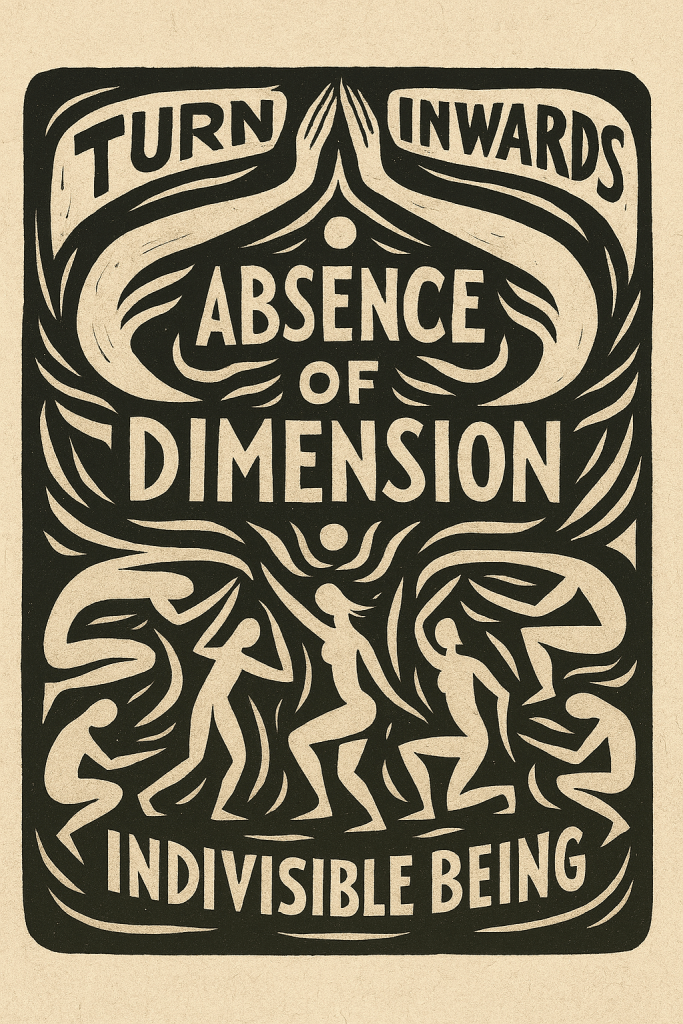
The Absence of Dimension

A Contemplation on Absolute Monism

What dimension is the experience of absolute monism?

That very question quietly collapses under its own weight.

To ask “how many” is to divide the indivisible. To quantify is to measure a mystery that can only be met in its own silence. Within the direct realization of Turiyatita—that which lies beyond even Turiya—there is no vantage point from which to count, compare, or classify. The moment dimensionality is assigned, we have already slipped back into the architecture of mind, where form assumes primacy over essence.

Still, the mind hungers for some orientation. So let’s turn the prism slowly, exploring this from a few distinct angles—not as answers, but as offerings.

1. Relative Lens: The Architecture of Experience

Certain esoteric traditions offer a gradient of consciousness: from the dense contours of the material (3D), to subtle inner time-space (4D), toward integrative fields of unity (5D and above). These serve as helpful metaphors, allowing seekers to understand how consciousness may expand or refine. Yet even the loftiest of these is still part of the dream—within the cosmic play of form.

From this lens, the direct encounter with nonduality might appear multi-dimensional, even interdimensional, because it defies the logic of linearity. It feels vast, borderless, paradoxical. But it is still being interpreted by a relative mind, even if only for a moment.

2. Transcendental Lens: The Priorness of the Real

Absolute monism is not located anywhere because it is not a location.

Dimensionality implies structure. It assumes contrast. But the Absolute is prior to all arising. It is not 1D, 5D, or 12D—it is the generative zero-point. The stillness that allows all movement. The background that isn’t separate from the foreground but holds all images without ever becoming one.

It is not empty like a void; it is empty like ungraspable fullness. The kind of emptiness that births stars and dissolves gods. Not confined to being or non-being, but transcending both.

3. Direct Realization: The Collapse of All Coordinates

No map leads here.

Direct realization is immediate and unmediated. Not because you reached a peak, but because the climber vanished. There is no experiencer—only experiencing. No mind reflecting on awareness—only awareness aware of itself.

Here, space has not been born. Time has not begun ticking. Even the concept of unity dissolves, for there is nothing to be unified. What remains is suchness—pure presence prior to presence. A silent explosion of is-ness so complete it leaves no trace.

Not a Dimension. Not Even a State.

So what do we call it?

Nothing.

And everything.

To speak of “the dimension of absolute monism” is to subtly betray it. Better to say: it is the absence of dimension in which all dimensions arise and dissolve. Not a high place, but the place before place. Not a peak, but the disappearance of altitude itself.

A Final Whisper

Absolute monism is not the highest dimension.
It is the absence of dimension,
where even “one” dissolves.
Here, all becomes what it has always been—
indivisible, unbounded, unspoken.

Morgan O. Smith

Get Your Free Copy of My Book, Bodhi in the Brain!
https://subscribepage.io/oTSZQu

Exploring Consciousness

Expanding Consciousness through Yoga & Meditation Practices

Yoga and meditation present an array of practices that facilitate the exploration of diverse states of consciousness, enhancing individuals’ mindfulness and self-awareness. This blog is dedicated to examining multiple practices associated with gross, subtle, causal, turiya, and turiyatita states of consciousness, illustrating the intertwined nature of these practices in guiding practitioners toward multiple states of awareness.

Gross Consciousness: Exploring the Physical Dimension

The gross state of consciousness, typically associated with waking life, is distinguished by physical and sensory experiences. Practices that emphasize the gross state involve:

Hatha Yoga: With a focus on physical postures (asanas), breath regulation (pranayama), and meditation, this practice supports overall physical and mental health.
Vinyasa Yoga: Offering a dynamic fusion of movement and breath, this style of yoga aids practitioners in maintaining mindfulness and presence.

Subtle Consciousness: Journeying into Dreams & Emotions

The dream state, characterized by emotional and mental experiences, reflects the subtle state of consciousness. Techniques concentrating on the subtle state include:

Yoga Nidra: This guided meditation facilitates a state of deep relaxation, mirroring the dream state, and fostering increased awareness.
Lucid Dreaming: This practice involves consciously recognizing that you’re dreaming, providing an opportunity to delve into the subconscious mind.

Causal Consciousness: Merging with the Universal Source

The deep sleep state, denoted by unity and an absence of individual identity, resonates with the causal state of consciousness. Techniques accessing the causal state include:

Advaita Vedanta: This non-dual philosophy promotes self-inquiry and contemplation, guiding toward the realization of the ultimate reality beyond individual identity.
Shambhavi Mudra: This meditative technique, focusing on the “third eye” or the space between the eyebrows, cultivates internal tranquillity and unlocks the causal state.

Turiya: The Realm of Pure Consciousness

Turiya, the fourth state, is marked by pure consciousness beyond the states of waking, dreaming, and deep sleep. Practices aiming for turiya encompass:

Transcendental Meditation (TM): Utilizing mantras, this meditation technique aims to transcend mental activities and experience pure consciousness.
Dzogchen/Mahamudra: These Tibetan Buddhist practices emphasize direct recognition of the mind’s nature, leading to a non-dual experience of reality.

Turiyatita: Surpassing Boundaries and Embracing Integration

Turiyatita, transcending the fourth state, symbolizes the amalgamation of all consciousness states. Techniques fostering turiyatita are:

Sahaja Yoga: Centered on the spontaneous awakening of Kundalini energy, this practice leads to a thoughtless awareness state surpassing all other states.
Jnana Yoga: The path of wisdom and self-inquiry dissolves the perceived separation between the individual self and ultimate reality, leading to the turiyatita experience.

Conclusion: Embarking on Your Unique Path

Every individual’s journey to elevated states of consciousness is distinctive. Discovering practices that align with your personal growth and self-exploration is crucial. As you delve into diverse yoga and meditation techniques, maintain an open mindset that your path may comprise various practices and experiences. Cherish the transformative journey and the profound power these age-old disciplines offer.

Morgan O. Smith

Yinnergy Meditation & My book, Bodhi in the Brain…Available Now!

https://linktr.ee/morganosmith