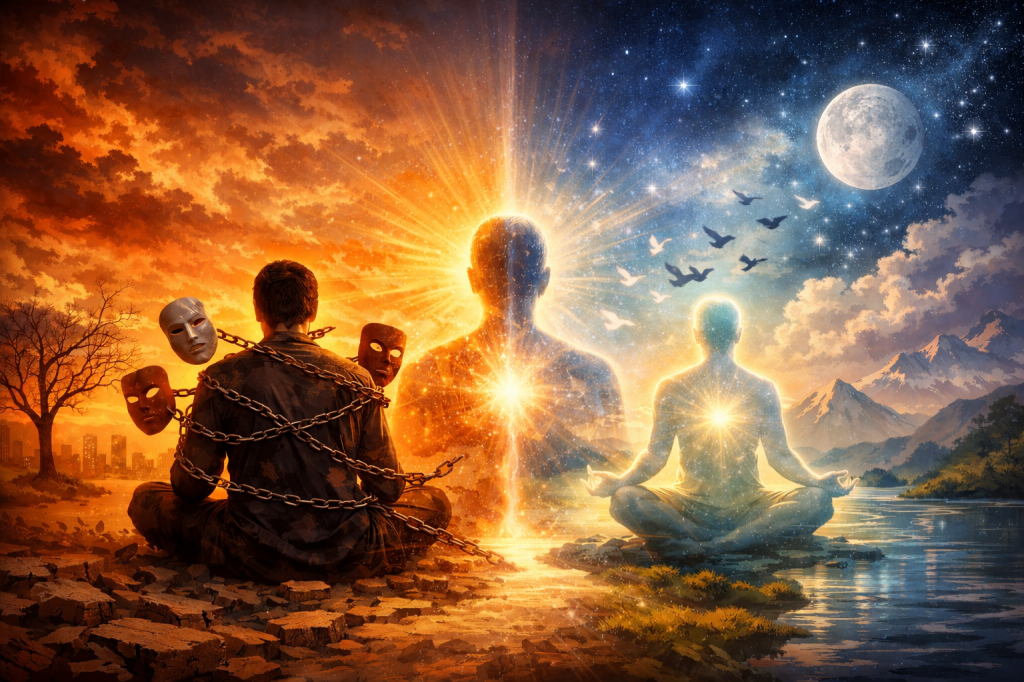
The Uninvited Companion

How We Cling to Chaos

Suffering is rarely an accident. More often than not, it is a story we tell ourselves, a rhythm we move to, unaware that we are both the dancer and the drum. There is a peculiar comfort in chaos—a familiarity that keeps it tethered to us like an old friend who never truly leaves.

The mind, ever seeking stimulation, crafts elaborate illusions of hardship and unrest, convincing itself that turmoil is necessary. It fabricates conflicts, fuels attachments, and calls it all a search for meaning. This internal theatre of suffering is neither fate nor misfortune; it is the work of our own hands.

Why do we let it persist? Perhaps because it gives us something to hold onto. Something that, despite its weight, feels more certain than the unknown silence beyond it. We surrender to the turbulence, believing it will resolve itself, unaware that it thrives only because we continue to feed it.

Yet, beneath the noise, another possibility waits. A reality untouched by the chaos we’ve grown so accustomed to. To step into it requires nothing but the willingness to recognize that suffering is not a necessary companion—it is a guest we’ve entertained for far too long.

Morgan O. Smith

Yinnergy Meditation/Neurofeedback, Spiritual Life Coaching & My Book, Bodhi in the Brain…Available Now!

https://linktr.ee/morganosmith

Staring Perfection in the Face

Life unfolds with such precision that the mind struggles to grasp its vast orchestration. The perception of failure, regret, shame, and suffering dominates awareness, casting shadows over what is, at its core, an immaculate expression of existence. Each moment – whether embraced or resisted – carries the exact ingredients necessary for the unfolding of consciousness. Yet, the conditioned mind fixates on everything that appears to be going wrong, blind to the underlying intelligence at work.

Loss and gain, tragedy and triumph, despair and joy – these polarities form the rhythm of existence, much like the inhalation and exhalation of breath. Attempts to hold onto one and avoid the other only create suffering, for both are essential aspects of the whole. A divorce may seem like a failure, yet it may also be the precise catalyst needed for deeper self-realization. A lost job may ignite a path toward something more aligned. Even grief and devastation, as unbearable as they may seem, carve spaces within the soul for transformation.

The intellect rebels against such a notion. It demands explanations, seeking justice, fairness, and control. Yet life refuses to conform to human expectations. The waves crash as they will. The seasons turn without hesitation. The sun does not rise differently because of personal preferences. Everything operates with flawless precision, beyond human notions of right and wrong.

This does not mean passivity or indifference. Awakening to the perfection of life does not negate the impulse to act, heal, or create change. It deepens it. From a place of acceptance, actions arise not from resistance, but from clarity. Rather than fighting the current, there is an alignment with the flow, a movement that is both effortless and profound.

The paradox remain – that perfection is not what the mind expects. It does not mean everything feels pleasant or that suffering ceases to exist. It means that even suffering has its place. It means that whatever arises is not separate from the vast intelligence that moves all things. To see this is not to escape reality, but to meet it fully, beyond judgment, beyond resistance, beyond the illusion of disorder.

Perfection is staring back in every moment, waiting to be recognized.

Morgan O. Smith

Yinnergy Meditation/Neurofeedback, Spiritual Life Coaching & My Book, Bodhi in the Brain…Available Now!

https://linktr.ee/morganosmith

The Mind is Samsara

Liberation Through Freedom From Thought

(Inspired by Delson Armstrong)

To grasp the nature of samsara, one must look no further than the ever-turning wheel of the mind. Thoughts arise and dissolve ceaselessly—ideas, beliefs, fears, and anticipations weaving an endless narrative. Each moment feels distinct, yet they are all threads of the same cyclical pattern. This mental turbulence is the very fabric of samsara, the cycle of birth, death, and rebirth experienced not only across lifetimes but also within the subtle rhythms of the mind.

Samsara is not a place. It is the identification with thought itself. Every belief we cling to, every concept we hold sacred, every doubt that gnaws at our certainty—these perpetuate the illusion of separateness. The mind clings to forms, seeking permanence in the impermanent, building castles on clouds. Yet each construction inevitably crumbles, and the cycle begins anew.

Nirvana, often misinterpreted as a distant goal, is not found outside this moment. It is recognizing what remains when all that is transient falls away. Freedom arises not through force or suppression but by witnessing the mind’s movements without becoming entangled. The arising and dissolving of thoughts are no longer resisted; they are observed as passing clouds in the vast sky of awareness.

This realization does not destroy the mind but recontextualizes it. Thoughts may continue to arise, but they no longer hold the power to bind. The very root of suffering—attachment to the mind’s constructs—is severed. What remains is pure Being, an effortless silence that neither clings to birth nor fears death.

To step off the wheel of samsara is to recognize that you were never bound. The liberation of nirvana is not an escape but a profound shift in perspective: to see thoughts for what they are—fleeting phenomena—and rest in the unchanging awareness that witnesses them.

The mind is samsara. Freedom lies not in battling it, but in transcending it through direct experience of your timeless nature.

Morgan O. Smith

Yinnergy Meditation, Spiritual Life Coaching & My Book, Bodhi in the Brain…Available Now!

https://linktr.ee/morganosmith

Expressions of Unity

How do we reconcile the existence of human atrocities and natural disasters within a spiritual framework that emphasizes oneness and unity? This question often challenges those who begin exploring nondual perspectives, where all phenomena, no matter how destructive or painful, are viewed as interconnected expressions of the same singular source. The nondual approach offers a radical shift in perception, one that dissolves the illusion of separation between events that we label as “good” or “bad” and invites us to see these occurrences as part of the grand play of existence.

Violent actions and harmful behaviours in the world, when viewed from a dualistic standpoint, can easily be categorized as manifestations of evil or wrongdoing. However, nonduality reveals that such acts emerge not from some inherent brokenness or malevolence, but from ignorance—a misunderstanding of our shared unity. This ignorance fosters the illusion of separateness, leading to behaviours rooted in fear, hatred, or selfishness. But when we awaken to the truth that there is no real division between self and other, the impulse to harm dissolves. The violence that once seemed so senseless is recognized as a consequence of an illusion. Healing, therefore, does not come through retribution but through awakening to the truth of our interconnectedness.

Natural disasters, often seen as chaotic or punishing forces, are similarly reframed. Rather than being viewed as random or cruel acts of nature, these events reflect the cyclical nature of the cosmos, expressions of impermanence and transformation. The suffering caused by such disasters, while profound, stems from attachment to the belief in permanence, the illusion that we can hold onto fixed forms in a world of constant flux. Through the nondual lens, even the most devastating natural occurrences are understood as part of the rhythmic dance of life, reminders of the ephemeral nature of all things.

What arises from this perspective is a deep acceptance of life’s paradoxes. The seeming contradiction of living in a world filled with both beauty and devastation, joy and suffering, dissolves when we recognize that all such experiences are expressions of a singular, undivided reality. From this space of understanding, we cultivate compassion, not through an emotional reaction to suffering, but from the profound realization that all beings and events arise from the same source. Suffering, then, becomes not an ultimate truth, but a temporary appearance within the endless ocean of consciousness.

Embracing nonduality allows us to witness both atrocities and natural disasters with equanimity, to understand them not as aberrations or misfortunes, but as fleeting expressions of a larger cosmic unfolding. This does not imply passivity or indifference. Instead, it cultivates a deeper capacity for compassionate action, arising from the knowledge that we are not separate from the suffering we seek to alleviate. In this space, we move beyond the limited notions of blame or punishment, and towards a profound embrace of the totality of existence, where all things are seen as interconnected, transient waves within the boundless ocean of being.

Morgan O. Smith

Yinnergy Meditation, Spiritual Life Coaching & My Book, Bodhi in the Brain…Available Now!

https://linktr.ee/morganosmith

The Paradox of the Bodhisattva

Embracing Infinite Compassion

The greatest human sacrifice is the bodhisattva’s goal of not attaining nirvana until all sentient beings are free from samsara. An impossible task, but the bodhisattva does this anyway out of love. So out of love, he or she continues to be born, die, and be reborn while being fully conscious of entering a life full of grief, discomfort, and dissatisfaction.

The bodhisattva’s path is one of profound paradox and immeasurable compassion. In the face of boundless suffering, the bodhisattva chooses not the liberation of nirvana but the unending cycle of rebirth. This choice, rooted in an infinite love for all sentient beings, defies conventional notions of self-preservation and personal enlightenment.

In the depths of this commitment lies a radical redefinition of what it means to live a meaningful life. The bodhisattva embodies a profound understanding that individual enlightenment is intertwined with the liberation of all beings. This interconnectedness transforms personal suffering into a collective journey, where the lines between self and other dissolve in the embrace of universal compassion.


To fully grasp the bodhisattva’s sacrifice, one must delve into the core of their motivation: the unyielding love for all beings. This love transcends personal desires and aspirations, anchoring itself in the welfare of every sentient entity. It is a love that is willing to endure the perpetual ebb and flow of samsara, embracing each life with open-hearted acceptance despite the inherent pain and impermanence.

The bodhisattva’s journey challenges us to reconsider our own lives and the nature of true fulfillment. It asks us to look beyond our immediate comfort and desires, to see our existence as part of a larger, interconnected whole. In doing so, we begin to understand that the pursuit of personal happiness is not separate from the well-being of others.

Engaging with the bodhisattva ideal, even as a mere contemplation, invites us into a deeper exploration of love and compassion. It urges us to reflect on our capacity to extend kindness and empathy beyond the confines of our personal experiences. In a world often dominated by individualism and self-interest, the bodhisattva’s sacrifice serves as a beacon, illuminating the transformative power of selfless love.


Ultimately, the bodhisattva’s commitment to the liberation of all beings is a testament to the boundless potential of the human spirit. It is a reminder that true enlightenment is not an isolated achievement but a collective awakening. As we meditate on the bodhisattva’s path, we are inspired to cultivate a love that transcends our own lives, embracing the entirety of existence in its compassionate embrace.

Morgan O. Smith

Yinnergy Meditation, Spiritual Life Coaching & My Book, Bodhi in the Brain…Available Now!

https://linktr.ee/morganosmith

The Paradox of Suffering

A Perspective on Compassion’s Existence

In a world untouched by suffering and misfortune, one might ponder compassion’s existence or even the necessity. This philosophical contemplation leads us to a profound question: If there were no suffering, would the concept of compassion still hold any significance?

Central to this debate is the idea of the Absolute at the causal stage, a concept that suggests a higher power or universal force responsible for orchestrating the cause and effect in our lives. This notion posits that events and situations are not merely random occurrences but deliberate creations intended to foster specific outcomes or experiences.

Within this framework, suffering and misfortune are seen not as unfortunate byproducts of existence but as essential elements in a grander scheme. They are the variables that necessitate and give birth to compassion. It’s as if the universe, or the Absolute, constructs scenarios to evoke and observe the act of compassion.

This perspective suggests a universe where compassion is a response to suffering and a desired outcome, a necessary expression in the cosmic play. It implies that our experiences of pain and grief are not just happenstances but are integral parts of a larger, perhaps even cosmic, narrative. This narrative is about enduring hardships and the opportunity these hardships present for compassion to arise and flourish. In this view, suffering is not meaningless; rather, it catalyzes the expression of compassion, which could be argued as one of the purest forms of human connection and empathy.

But this viewpoint is not without its controversies. It raises questions about the nature of the Absolute and its role in human affairs. Is suffering deliberately inflicted by a higher power for its amusement or purpose? Does this make the act of compassion a mere tool in a larger, possibly indifferent cosmic game? These questions challenge our understanding of morality and the nature of existence itself.

Furthermore, this perspective can be seen as a double-edged sword. On one hand, it gives a deeper meaning to our struggles, suggesting that our pain and the compassion it invokes are part of a grand, meaningful process. On the other, it might lead to a fatalistic or passive acceptance of suffering, undermining efforts to alleviate it.

In conclusion, the idea that suffering is necessary for compassion presents a challenging yet thought-provoking viewpoint. It forces us to examine the deeper implications of our experiences and the potential purpose behind them. Whether one sees this as a comforting thought or a disturbing implication, it undoubtedly opens up a rich field for philosophical and ethical exploration.

Morgan O. Smith

Yinnergy Meditation, Spiritual Life Coaching & My Book, Bodhi in the Brain…Available Now!

https://linktr.ee/morganosmith

Embracing Life’s Paradox

The Path to Tranquility Through Suffering

In the tapestry of human existence, suffering is often perceived as an unwelcome intruder, an aberration in the otherwise serene flow of life. Yet, this perspective overlooks a profound truth: suffering is not just an integral part of life, but it can also be a conduit for deep, transformative growth. The statement, “All life is suffering until we watch our sufferings without bias or judgment,” encapsulates a significant philosophical stance, inviting us to reevaluate our relationship with pain and hardship.

At the core of this idea lies the Buddhist philosophy of Dukkha, which suggests that suffering is inherent in the very fabric of life. This suffering stems from various sources: the pain of change, the anxiety of impermanence, and the dissatisfaction arising from unfulfilled desires. However, the key to alleviating this suffering is not found in the external world but within our perceptions and reactions.


Watching our sufferings without bias or judgment means observing our pains and challenges with a sense of detachment and mindfulness. It’s about recognizing that suffering is a natural part of life and not something to be feared or avoided. This mindful observation allows us to understand the impermanent nature of our experiences, leading to a sense of liberation and peace.

Moreover, this approach transforms suffering from a state of passive endurance to an active process of introspection and learning. It becomes an opportunity to cultivate resilience, empathy, and wisdom. Through this lens, we see that our most challenging moments are often our greatest teachers, guiding us toward a deeper understanding of ourselves and the world around us.


In essence, the path to tranquillity and inner peace is paradoxically paved by accepting and understanding suffering. It is about shifting our perspective from seeing suffering as a curse to embracing it as a catalyst for personal growth and enlightenment.

Morgan O. Smith

Yinnergy Meditation, Spiritual Life Coaching & My Book, Bodhi in the Brain…Available Now!

https://linktr.ee/morganosmith