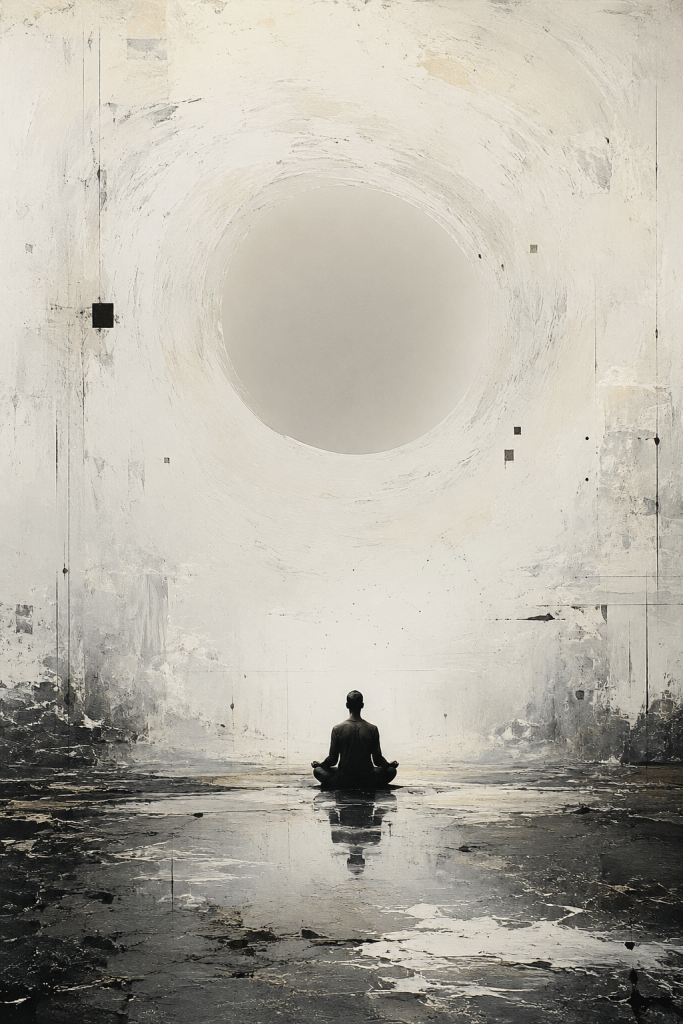
Why Is Nothingness Referred to as Nothingness?

Language faces an impossible task when attempting to speak about what precedes all appearances.

Every word points toward something. Every concept distinguishes one thing from another. Every description relies upon contrast, location, qualities, relationships, or characteristics. Yet what many contemplative traditions refer to as the Absolute, the Ground of Being, or pure reality before conceptualization possesses none of these.

Nothingness is not called nothingness because it is empty in the ordinary sense.

An empty room still contains space. A vacant lot still exists somewhere. Even darkness can be perceived. Ordinary emptiness remains something that can be identified, experienced, or described.

Nothingness, in its deepest philosophical and mystical meaning, points toward that which cannot be located, measured, conceptualized, perceived as an object, or distinguished from anything else.

Location cannot be assigned to it because location itself appears within it.

Time cannot contain it because time arises within experience.

Attributes cannot be given to it because attributes create distinctions.

Existence and nonexistence cannot adequately describe it because both are conceptual categories.

This creates a paradox.

The moment a reference is made, the reference becomes something. The moment a concept is formed, a boundary appears. The moment a description is offered, what is described has already been transformed into an object of thought.

Nothingness is therefore not a description. It is a linguistic surrender.

The word functions less as a definition and more as an admission that thought has reached its limit.

Mystics throughout history have encountered this difficulty. Some called it Brahman. Others called it Sunyata. Some referred to it as the Tao. Others spoke of the Godhead, the Absolute, the Unborn, or the Nameless.

Each term points toward the same problem.

Whatever is being indicated cannot actually be captured by the indication.

A finger pointing toward the moon is not the moon.

A concept pointing toward reality is not reality.

A word pointing toward nothingness is not nothingness.

From a nondual perspective, even calling it nothingness can be misleading. The term may suggest absence, voidness, or negation. Yet what is being pointed toward is not the absence of reality. It is reality prior to division into existence and nonexistence.

Thought asks, “What is it?”

Direct realization reveals that the question itself cannot reach it.

The mind searches for an object and finds none.

It searches for a location and finds none.

It searches for a boundary and finds none.

It searches for a reference point and finds none.

Because no reference can be established, language falls silent.

What remains is called nothingness.

Not because it is literally nothing.

Because every attempt to make it something fails.

Morgan O. Smith
https://linktr.ee/morganosmith

Embracing Anatta and Sunyata

A Buddhist Exploration of Spiritual Enlightenment

In the rich and intricate fabric of Buddhist philosophy, two profound concepts stand out: anatta, or the principle of no-self, and sunyata, or the notion of emptiness. These ideas challenge our conventional understanding of self and reality, offering a transformative path to spiritual enlightenment.

This blog post delves into the fascinating journey of embracing anatta and sunyata and what changes might occur in a person as a result.

Anatta: The Principle of No-Self

Anatta challenges the notion of a fixed and permanent self, a radical idea that has profound implications on how we perceive ourselves and the world. Upon realizing anatta, an individual may undergo the following transformations:

– **Loss of Attachment to Self-Identity**: Labels, roles, and personal narratives lose their grip, allowing for a more fluid and adaptable understanding of self.
– **Decrease in Ego-Driven Desires**: The pursuit of personal gain or recognition may fade, replaced by selfless compassion and loving-kindness.
– **Deepened Interconnectedness with Others**: Seeing beyond the illusion of separate selves fosters a profound connection with all beings.

Sunyata: Embracing the Emptiness

Sunyata refers to the empty nature of all phenomena, a state where things are devoid of inherent existence. The realization of sunyata leads to:

– **Transcending Dualities**: Ordinary distinctions such as good and bad, self and other, become irrelevant, replaced by an all-encompassing view of reality.
– **Detachment from Material Pursuits**: Recognizing the empty nature of material things may lead to a detachment from worldly desires and a more mindful way of living.
– **Harmony with the Present Moment**: Seeing things as they are, empty of inherent existence, nurtures a profound connection with the present moment.

The Journey Toward Enlightenment


Understanding anatta and sunyata is not an intellectual exercise but a profound experiential realization. The individual may engage in various practices such as meditation, mindfulness, and ethical living to cultivate this understanding.

The Impact on Relationships and Society

Embracing these principles fosters compassion, empathy, and altruism, reshaping relationships and offering a model of social harmony. It moves us towards a society rooted in wisdom and compassion, rather than division and selfishness.

Conclusion

The realization of anatta and sunyata is a transformative and enlightening experience that shifts our perception of self and reality. It dissolves the barriers that separate us and leads to a more compassionate and interconnected way of living.

In a world filled with complexity and conflict, these age-old Buddhist principles offer timeless wisdom and a path to inner peace. They invite us to let go of rigid self-identities and material pursuits, to see beyond the surface, and to embrace a more profound and holistic view of existence.

May the teachings of Anatta and Sunyata guide us towards a more awakened and compassionate life, where we recognize the interconnectedness of all beings and live in harmony with ourselves and the world.

Morgan O. Smith

Yinnergy Meditation & My Book, Bodhi in the Brain…Available Now!

https://linktr.ee/morganosmith