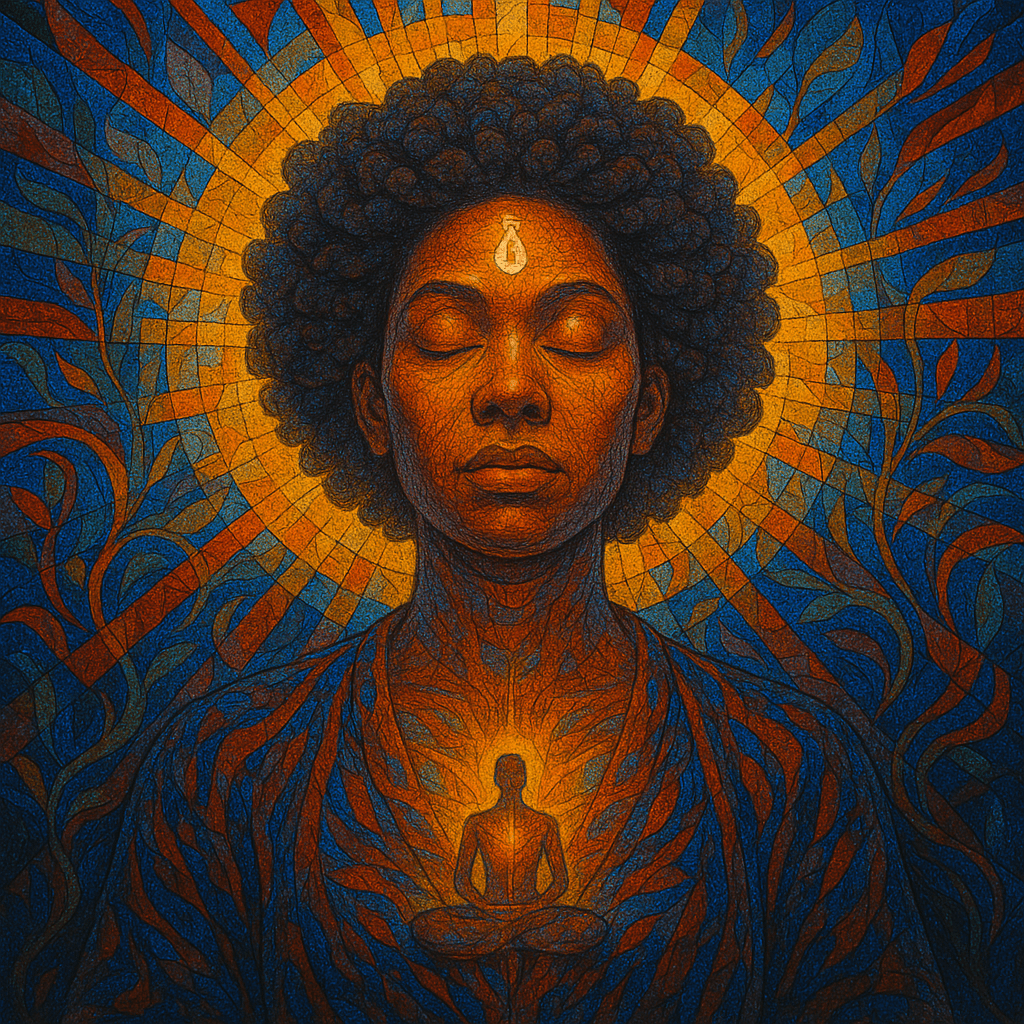
The Hidden Genius Behind Laughing Yoga

When I first heard about laughing yoga, a practice where you deliberately laugh or even laugh silently within, it struck me as absurd. I dismissed it as theatrical, maybe even frivolous. Then I learned that OSHO had introduced it, and my skepticism deepened. What could possibly be the purpose of such a practice?

I come from a stand-up comedy background, having worked as a comedian for 12 years, 10 of those before I began meditating. One thing I know about laughter is that when someone hears a joke and laughs at the punchline, they must momentarily surrender a part of themselves. The ego’s protective shell, the facet of self concerned with judgment, insecurity, shame, and embarrassment, drops away in that instant. To truly laugh, one has to release these defences and embrace the moment without resistance.

This same mechanism operates on a far greater scale during a spiritual awakening. When the “cosmic joke” lands, it demands the complete surrender of all defences, along with the entire sense of self. The one who hears the punchline is the same one telling it, and in the moment of hysterical laughter, the separation between “comedian” and “audience” dissolves entirely. Sometimes, that laughter is so overwhelming it flows with unstoppable tears of joy, as if the heart itself is laughing through the eyes.

It’s in that context that OSHO’s laughing yoga makes profound sense. Perhaps it was never just about forcing a laugh, but about training the body and mind to tolerate joy without flinching, to let go of identity without panic. By practicing laughter, you prepare the psyche for the day it encounters the greatest punchline ever told.

Morgan O. Smith

Get Your Free Copy of My Book, Bodhi in the Brain!

https://subscribepage.io/oTSZQu

Courting the Unplanned

How Practice Prepares Us for Awakening

Accidents are rarely welcome. They’re events that disrupt plans, crack illusions of control, and leave us changed. Spiritual awakening carries something of that wildness. It can’t be willed into being like a project with clear steps and predictable results. Yet there’s a paradox: devoted contemplative practice seems to make one more likely to be undone by it.

Meditation does not guarantee enlightenment. It prepares no certificate, no badge of arrival. Instead, it functions more like softening the soil so a seed can break through when conditions conspire. This isn’t an engineering feat—it’s an invitation to the uncontrollable.

Spiritual traditions often warn against striving too hard. Effort burns away distractions, but effort itself becomes another barrier if clung to. Discipline is essential, but so is surrender. A meditator learns to sit still enough for their self-concept to slip, fragile as old paint on a crumbling wall. What breaks through is not what the ego planned.

Such a shift is catastrophic for self-image. One can’t choreograph being seized by silence, seen through by awareness, or stripped of all strategies. Preparation helps only because it erodes resistance. A lifetime of practice might be nothing more than a way of making oneself more susceptible to grace.

Grace here is no moral reward. It’s the inexplicable unveiling of what has always been true. Practice hones attention so that, eventually, one notices the absurdity of separation. The boundary keeping “me” apart from the rest collapses. It can feel like an accident precisely because it breaks expectation so thoroughly.

So why practice? Not to force awakening but to grow familiar with letting go. To cultivate the courage to be shattered. To understand that no amount of control can deliver the gift, but the willingness to wait can make one receptive. A practitioner may become the sort of person for whom awakening is more likely—not because they deserve it, but because they are no longer guarding against it.

True meditation is a kind of sabotage of our usual certainties. That is its danger, and its promise. The question isn’t whether practice causes awakening like cause yields effect, but whether practice makes us vulnerable enough to be struck by what is always here.

Morgan O. Smith

Get Your Free Copy of My Book, Bodhi in the Brain!
https://subscribepage.io/oTSZQu

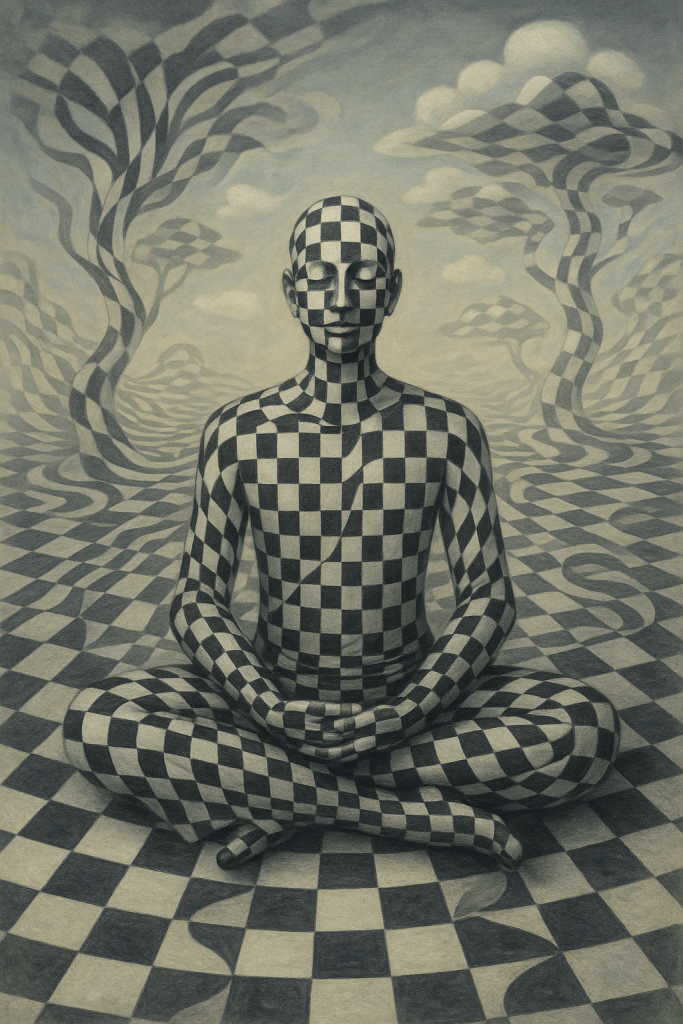
The Game of Black & White

How You Play the Game of Black & White Reveals Your Level of Spiritual Maturity

He doesn’t avoid the black squares. He just stops thinking they’re cursed.

You can tell how spiritually mature someone is by how they engage with contrast—not by how they escape it. The game of black and white is always being played. Light falls beside shadow, certainty walks with doubt, and gain is never far from loss. But while most are trying to land only on the white tiles, the one who has seen beyond duality walks freely across the whole board.

Spiritual growth doesn’t mean becoming invulnerable to darkness; it means seeing the darkness without contracting around it. A child in awareness recoils from discomfort and seeks the promise of the ‘light.’ A grown soul knows that neither is final, and neither needs to be resisted. The black square isn’t a punishment. The white square isn’t a reward. They are moves in the same dance.

The one who awakens learns to stop chasing symmetry. No longer obsessed with winning, they realize it was never about domination of light over dark, nor rising above contradiction. It was about presence through all of it. About meeting each moment with equanimity, whether wrapped in sorrow or shining in joy.

Some play to avoid pain. Others play to seek pleasure. But the wise one plays to see. And seeing, they cease to play as a someone at all.

They simply move.

Morgan O. Smith

Get Your Free Copy of My Book, Bodhi in the Brain!

https://subscribepage.io/oTSZQu

The Collapse of Illusion

Navigating the Aftermath of Awakening

Reality fractures in a single instant, revealing itself as something altogether ungraspable. The moment of absolute recognition—the unfiltered, direct encounter with Truth—tears through the mind like a bolt of cosmic lightning, leaving no belief unshaken, no identity intact. The self, as it was once understood, dissolves into the vastness, leaving behind nothing but raw awareness.

A revelation of such magnitude is both exhilarating and devastating. The world remains as it was, yet nothing remains the same. The return to ordinary existence feels disjointed, as if waking from a dream only to realize the dream is what was once called life. Conversations that once held meaning now seem hollow, ambitions that once fueled passion now appear weightless. The social frameworks that once dictated identity—the career, the friendships, the personal convictions—suddenly feel like distant echoes of a forgotten language.

A solitude arises, not necessarily by choice, but as an inevitable consequence of perceiving beyond the familiar constructs. People speak, but the words seem veiled in a fog of assumptions and conditioned perspectives. What was once music now carries an indescribable depth, revealing textures previously unnoticed. Colours take on a vibrancy beyond sight, whispering truths beyond language. The ordinary world hums with a resonance that cannot be explained, only felt.

Attempting to articulate the experience proves futile. Language stumbles over itself, unable to capture the unspeakable. Those who listen often respond with polite nods, skepticism, or outright dismissal. A few may lean in with genuine curiosity, yet without direct experience, understanding remains confined to intellectualization. Words, at best, become poetic approximations, metaphors stretching toward something that cannot be contained within the mind.

This is the paradox of awakening. The very moment that reveals the boundless unity of existence also exposes the fragmented nature of human perception. The mind wants to categorize, to make sense, to translate the infinite into the finite. But Truth is not something to be grasped; it is something to be surrendered into.

Isolation does not come from arrogance, nor from a desire to detach, but from the realization that much of what once passed as reality was a mirage. The process of reintegration is neither smooth nor predictable. There is grief in letting go of the known, yet immense freedom in no longer being bound by it. What remains is a quiet certainty—an understanding that cannot be proven, only lived.

This path is not for the faint-hearted. It is not about enlightenment as an achievement or an identity. It is about dissolution. It is about dying before death. And in that dissolution, what remains is the eternal presence, the silent witness, the infinite unfolding of what has always been.

Morgan O. Smith

Yinnergy Meditation/Neurofeedback, Spiritual Life Coaching & My Book, Bodhi in the Brain…Available Now!

https://linktr.ee/morganosmith

The Day Everything Dissolved

A Journey into Absolute Oneness

A single moment can shatter every belief held about existence, leaving behind a clarity that words struggle to contain. After many years of deep meditation, everything I had been searching for revealed itself—not as a concept, not as an experience, but as the undeniable reality of being.

The shift arrived without warning. Reality no longer appeared as separate fragments; it was a single, indivisible whole. Every notion of self, identity, or distinction between observer and observed vanished. It wasn’t an intellectual realization—it was direct, immediate, and irreversible.

A profound sense of unity pervaded every fiber of existence. The universe was not something outside of me, nor was I an entity moving through it. The universe was expressing itself through me, as me, and through everything else in an infinite, harmonious unfolding.

A rush of energy surged through my being. Every cell seemed to bloom with an indescribable vitality. It was as if the boundaries of my body had dissolved, and awareness had become the vast, boundless expanse that held all things. Love was not an emotion—it was the very substance of existence, pouring through every breath, every movement, every atom.

Time lost its meaning. There was no past to remember, no future to anticipate—just an eternal presence in which all things unfolded simultaneously. Life and death were no longer opposites but part of the same undivided continuum, endlessly appearing and dissolving in a cosmic rhythm.

The mind struggled to grasp what the heart understood effortlessly. Every belief about individuality, separation, and limitation had been undone in a single instant. The concept of surrender took on an entirely new meaning. There was nothing left to resist—only the freefall into the effortless flow of existence.

Moments stretched into days, weeks, and months, each revealing deeper layers of this unfolding. The heart expanded into a depth of compassion that embraced everything—human struggle, cosmic intelligence, the raw beauty of impermanence. Gratitude arose not as a practice but as the natural expression of this vast interconnectedness.

Even now, words barely graze the surface of what transpired. To speak of it is to fragment it, to reduce the ineffable into language. Yet, something within compels the sharing, not as an attempt to explain, but as an invitation—an open door to those who sense that beyond all concepts, beyond all seeking, something boundless is already present, waiting to be remembered.

Morgan O. Smith

Yinnergy Meditation/Neurofeedback, Spiritual Life Coaching & My Book, Bodhi in the Brain…Available Now!

https://linktr.ee/morganosmith

The God That Sees Through Your Eyes

Many place their faith in a distant deity, believing in a power beyond themselves—something supreme, something greater. Yet, the notion of a god outside of oneself is only relevant to a mind that has forgotten its vastness.

The truth is far more intimate. Nothing stands above you, for the essence of what you are surpasses the very framework of comparison. The Almighty, often envisioned as superior, is only greater than the illusion of selfhood that obscures the boundless reality of Being. From a limited perspective, this god seems grander than the identity you wear, but what is that identity other than a fleeting mirage within an infinite sea?

Those who have touched the depths of awakening do not look upward in worship. They are not in search of a divine presence beyond their reach. Instead, they are entranced by the sacred radiance shining through all things, a beauty so intrinsic that it renders possession meaningless. The enlightened do not seek to grasp what is already the totality of their being.

What they see is a reflection—the universe gazing into itself, mesmerized by its own infinite brilliance. The one who knows their essence does not bow to divinity; they are a living expression of it. The world, with all its forms, is a luminous manifestation of that which cannot be possessed yet is already wholly theirs.

The question is not whether such truth exists but whether it can be known directly. The path to this recognition is not buried in complexity, nor is it reserved for a chosen few. It is uncovered in surrender—absolute, unwavering surrender to the unmistakable moments of authenticity that arise, moments when truth pierces through the veil of identity.

Whenever these glimpses appear, relinquish all resistance. Fall into them fully. Let the light that shines through all things illuminate the light already shining within. That which many seek in worship is not elsewhere—it is the very force animating every breath, every movement, every moment. It is You, witnessing itself.

Morgan O. Smith

Yinnergy Meditation/Neurofeedback, Spiritual Life Coaching & My Book, Bodhi in the Brain…Available Now!

https://linktr.ee/morganosmith

Staring Perfection in the Face

Life unfolds with such precision that the mind struggles to grasp its vast orchestration. The perception of failure, regret, shame, and suffering dominates awareness, casting shadows over what is, at its core, an immaculate expression of existence. Each moment – whether embraced or resisted – carries the exact ingredients necessary for the unfolding of consciousness. Yet, the conditioned mind fixates on everything that appears to be going wrong, blind to the underlying intelligence at work.

Loss and gain, tragedy and triumph, despair and joy – these polarities form the rhythm of existence, much like the inhalation and exhalation of breath. Attempts to hold onto one and avoid the other only create suffering, for both are essential aspects of the whole. A divorce may seem like a failure, yet it may also be the precise catalyst needed for deeper self-realization. A lost job may ignite a path toward something more aligned. Even grief and devastation, as unbearable as they may seem, carve spaces within the soul for transformation.

The intellect rebels against such a notion. It demands explanations, seeking justice, fairness, and control. Yet life refuses to conform to human expectations. The waves crash as they will. The seasons turn without hesitation. The sun does not rise differently because of personal preferences. Everything operates with flawless precision, beyond human notions of right and wrong.

This does not mean passivity or indifference. Awakening to the perfection of life does not negate the impulse to act, heal, or create change. It deepens it. From a place of acceptance, actions arise not from resistance, but from clarity. Rather than fighting the current, there is an alignment with the flow, a movement that is both effortless and profound.

The paradox remain – that perfection is not what the mind expects. It does not mean everything feels pleasant or that suffering ceases to exist. It means that even suffering has its place. It means that whatever arises is not separate from the vast intelligence that moves all things. To see this is not to escape reality, but to meet it fully, beyond judgment, beyond resistance, beyond the illusion of disorder.

Perfection is staring back in every moment, waiting to be recognized.

Morgan O. Smith

Yinnergy Meditation/Neurofeedback, Spiritual Life Coaching & My Book, Bodhi in the Brain…Available Now!

https://linktr.ee/morganosmith

The Source of All Cause and Effect

Who and What Is the Source of All Cause and Effect?

The eternal question arises: who or what governs the intricate dance of cause and effect? Is it me, you, everyone, or everything? Perhaps it is all of these and none of them simultaneously. This exploration leads us to a profound realization: the source is not separate from the flow, yet it transcends it.

Cause and effect are not isolated events. They are interconnected, forming an indivisible whole. To search for the source is to embark on a journey into the depths of consciousness itself. The mind craves a definitive answer, a singular origin to label, but the truth eludes such simplicity. It is neither here nor there, yet it manifests everywhere.

Every action we take, every thought that arises, ripples outward into the fabric of existence. Yet the source of these ripples does not lie solely in the individual. It is the interplay of infinite factors—the unmanifest potential giving birth to form and the dissolution of form back into stillness. This interplay is the source, and we are simultaneously its participants and expressions.

What does this mean for our experience of life? It calls for a radical shift in perspective. The ego sees itself as a doer, the originator of action and the controller of outcomes. But this belief dissolves when one observes deeply. The body breathes, the heart beats, and thoughts arise—all without volition. The same intelligence orchestrates the universe’s movements, from the spinning of galaxies to the opening of a flower.

To recognize that “me, you, everyone, and everything” is the source is to dissolve the illusion of separation. It is to see that cause and effect are not linear but cyclical, interwoven, and eternal. We are not spectators of this process. We are in the process.

This realization invites us to live with humility and grace. Instead of clinging to control or outcomes, we surrender to the flow of life, trusting in the intelligence that governs all things. In this surrender, we find freedom—not as passive observers, but as conscious participants in the dance of existence.

The question remains: who or what is the source of all cause and effect? It is both a question and an answer. It is not a thing to grasp but an experience to embody. You are the source. I am the source. The source is all there is.

Morgan O. Smith

Yinnergy Meditation, Spiritual Life Coaching & My Book, Bodhi in the Brain…Available Now!

https://linktr.ee/morganosmith

The Catalyst for the Ego’s Demise

The experience often referred to as “ego death” is not the obliteration of the self, but rather the dissolution of its illusions. The ego, a construct woven from the threads of identity, attachment, and fear, functions as a survival mechanism. It clings to roles, titles, and the narrative of separation to sustain its existence. Yet, this clinging obscures the deeper truth of who we are—a boundless consciousness that cannot be confined by labels or stories.

Ego death is not an event brought about by force, but a consequence of profound surrender. It arises when the conditions are ripe, often catalyzed by deep meditation, spiritual awakening, or transformative life experiences. These moments of clarity reveal the ego for what it is: a temporary construct, a shadow cast by the mind in its attempt to define the undefinable.

The catalyst for this unravelling often comes disguised. It may appear as a crisis—a moment when the identity we have constructed no longer holds up against the weight of reality. It may manifest as awe, where the boundaries of self dissolve in the face of something greater than the mind can grasp. Sometimes, it is the gradual erosion of ego through years of contemplation and self-inquiry, as if the winds of awareness slowly wear away the stone of selfhood.

The process of ego death can feel terrifying. The ego perceives its dissolution as annihilation, a threat to its very existence. Yet, for the one who witnesses this unravelling, it is liberation. What is revealed is not a void, but fullness—an infinite presence, free of the limitations imposed by the ego’s grip.

Paradoxically, the ego’s demise does not result in the loss of individuality, but a clearer expression of it. Freed from the distortions of fear and attachment, the individual becomes a unique channel for universal consciousness. Actions flow not from a sense of lack or separation, but from wholeness and authenticity.

This death of the ego is not a single moment, but an ongoing practice of letting go. It requires vigilance and a willingness to face the shadows that linger in the mind. Each time the ego asserts itself through judgment, resistance, or attachment, it offers an opportunity to recognize its presence and release its hold.

The catalyst for the ego’s demise is ultimately the realization that it was never truly alive. It is a phantom, a mirage that dissolves when illuminated by the light of awareness. In its absence, what remains is not emptiness, but the unshakable truth of being—a truth that was always present, quietly waiting to be revealed.

Morgan O. Smith

Yinnergy Meditation, Spiritual Life Coaching & My Book, Bodhi in the Brain…Available Now!

https://linktr.ee/morganosmith

The Mirage of Paradise

Why Many Turn Away From the Path

Paradise often appears as a shimmering promise on the horizon—a space of unbroken peace, eternal joy, and infinite understanding. Yet, when the steps to reach it feel many, slow, or arduous, even the most sincere seekers may find themselves questioning the journey. Why does the promise lose its lustre when effort is required? Why do we often choose comfort over truth or familiarity over freedom?

The answer lies not in paradise but in our relationship with it.

The Illusion of Arrival

The mind, conditioned by a lifetime of instant gratification and linear progress, believes paradise must be attainable within a predictable framework. When the path to enlightenment stretches beyond its comfort zone, the mind rebels. It whispers doubts, offers shortcuts, or fabricates reasons to abandon the pursuit altogether.

Yet, true awakening does not follow a predictable roadmap. It cannot be squeezed into the limited constructs of time or effort. Enlightenment is not about arriving somewhere—it is about dissolving the illusion of the one who seeks. This is the paradox that discourages many: the realization that the paradise sought is not something to be reached but something to be uncovered within.

The Fear of Letting Go

Another reason many step away from the path is the fear of surrender. Enlightenment demands more than perseverance; it requires the complete letting go of the self we believe ourselves to be. For those deeply identified with their roles, beliefs, or desires, this can feel like annihilation. What lies beyond the familiar can seem less appealing than the comfort of staying as we are.

But surrender is not a loss; it is an opening. It is stepping into the unknown with trust and willingness, allowing paradise to reveal itself not as a destination but as the ever-present reality beneath all appearances.

Walking Without Steps

Paradise cannot be reached because it is not elsewhere. It is not at the end of many steps or behind layers of effort. Those who walk away often believe the steps are external—practices, rituals, or milestones to achieve. The truth is, that the steps are inward, subtle, and immediate. They require no distance travelled, only the courage to turn within and meet the present moment fully.

Each step dissolves the illusion that there is somewhere else to go. Each step reveals that paradise was never absent. The question is not whether enlightenment is too far but whether we are willing to abandon the belief that it lies anywhere but here.

Remaining Open to the Journey

For those who feel the pull to turn back, perhaps the greatest teaching is this: paradise is not reserved for those who walk a perfect path. It embraces even the wanderer, the doubter, and the one who stumbles. The journey is not about reaching paradise but about waking up to its presence at every turn.

Instead of asking how far we have to go, ask this: What illusions am I willing to release today? What layers of resistance, fear, or expectation can I dissolve now? Every step, no matter how small, is a step into paradise itself.

Morgan O. Smith

Yinnergy Meditation, Spiritual Life Coaching & My Book, Bodhi in the Brain…Available Now!

https://linktr.ee/morganosmith