When I Say Full Awakening…

This Is What I Mean

Many speak of awakening, yet far fewer comprehend its fullness. I’ve encountered every kind—emotional, spiritual, philosophical, mystical. Each unveils a layer, each reveals a depth. But what I call full awakening—what I live as full awakening—is something few ever point toward, and fewer still embody.

It is not about personal clarity. Not about peace of mind, a better life, or even union with a divine presence. Those are steps, glimpses, fragments. Full awakening is not a state within experience. It is the collapse of all distinction between state and experiencer.

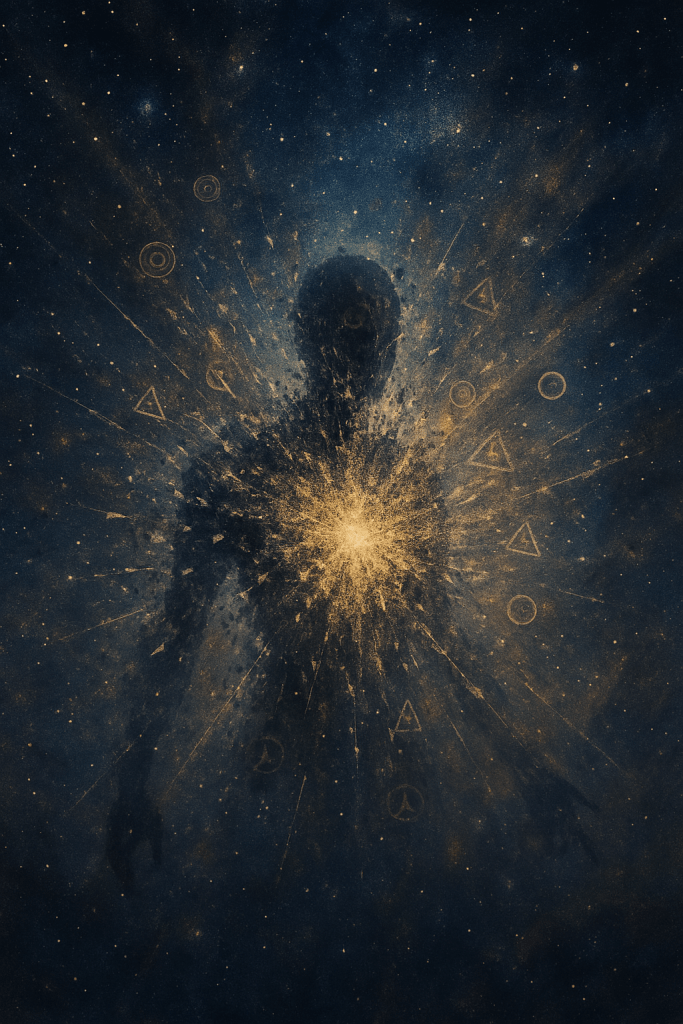
This isn’t about finding your place in the cosmos—it’s about the disappearance of place, cosmos, and self as separate notions. When I say full awakening, I am referring to the direct knowing that everything—absolutely everything—is a singularity.

Existence and nonexistence. Subject and object. The smallest subatomic flicker and the sweep of galactic spirals. Civilizations long past and unborn futures. Every religion, every philosophy. All thoughts. All acts. Every realm, every reality, every god.

The seen and the unseen. The formed and the formless. That which is birthed, that which dies, and that which never entered the cycle. All technologies. All intelligences. All contradictions and confirmations. All questions and every possible answer.

Not merely connected. Not even interdependent.

Indistinct. Inseparable. One.

That realization is not metaphorical. It is not poetic. It is not conceptual. It is total. It devours every duality and even the idea of devouring. It consumes the witness, the process of witnessing, and that which is witnessed—leaving no remainder.

So when another speaks of full awakening, I listen with care. Because unless it includes everything I’ve said—and also what they say—it’s not the same thing. The paradox, of course, is that what I’m pointing to also includes that divergence. It embraces even what appears to deny it.

Full awakening is not a peak. It is not an event. It is the vanishing of all altitude and time. It is not even a realization. It is what remains when all realizations dissolve.

One. Not a oneness made of parts. Not a whole made of pieces. Not harmony, not unity. Just One.

And that One is not separate from what you are.

Morgan O. Smith

Get Your Free Copy of My Book, Bodhi in the Brain!

https://subscribepage.io/oTSZQu

The Supreme Siddhi

The Unfathomable Miracle of Being

Among the many marvels attributed to the Siddhas—those said to wield supernatural abilities—there exists a siddhi so profound that it eclipses all others. Beyond the conjuring of objects from nothingness, beyond the bending of space and time, there lies the ultimate and most extraordinary power: existence itself.

The fact that anything at all is, that awareness stirs within the vastness of the void, defies all logic. Every phenomenon, every thought, every breath—utterly improbable, yet undeniably real. The miracle is not found in levitation, bilocation, or the manifestation of jewels; it is the sheer actuality of Being that outshines them all.

From the perspective of the Absolute, existence is not an anomaly. It is neither a feat nor an accomplishment. It is simply an emanation of boundless imagination, a movement within the Infinite Mind. Some call it the Void, the Source, the Tao. It is that which dreams itself into form, appearing as multiplicity while ever remaining One.

This is the true Siddha’s wonder—the great unfolding of the Unknowable into the known. Yet, the game is such that the dreamer forgets. And in that forgetting, there is awe. A paradox unfolds: the creator marvels at its own creation, unaware that the very act of astonishment is a performance orchestrated by none other than itself.

Eventually, remembrance dawns. The performer recognizes the stage, the audience, and the play as its own. The illusion of separation dissolves, and what remains is that which has always been—existence as the supreme siddhi, the only miracle that ever was.

Morgan O. Smith

Yinnergy Meditation/Neurofeedback, Spiritual Life Coaching & My Book, Bodhi in the Brain…Available Now!

https://linktr.ee/morganosmith

Beyond the Threshold of Awareness

The Unutterable Presence

There exists a state beyond all conceptual understanding, a dissolution of every boundary that once defined existence. It is not merely an experience but an annihilation of the experiencer—a cataclysmic merging into the unfathomable. This is not illumination in the conventional sense; it is the collapse of all divisions, the vanishing point where emptiness and form cease to stand apart.

Words fracture under the weight of such an encounter. No language can capture what has neither shape nor limitation. It is the ultimate paradox—utter nothingness brimming with infinite potential. The moment one seeks to grasp it, it recedes into the void. And yet, it is always here, unshaken, untouched, the silent witness that has neither beginning nor end.

The attempt to articulate such a realization feels like trying to hold onto the wind. It cannot be contained, only lived. Every atom, every unfolding event, every whisper of movement in the cosmos is a testament to this unnamable presence. It is not separate from life but the very fabric of existence itself—an unspoken language through which reality reveals its nature.

The mind, conditioned by duality, cannot comprehend this dissolution. To see it is to stand at the precipice of all that was ever believed, to watch as identity crumbles into the abyss of truth. What remains is neither self nor other, neither light nor shadow—only the boundless expanse of that which is.

This is not a state reserved for the few. It is always available for those who dare to surrender, to dissolve into the vastness without resistance. But such surrender is not an act of will; it is the natural outcome of seeing clearly, of ceasing to grasp at the illusions that veil the obvious.

Some may call it the Absolute. Others, God. But even these are mere echoes of something that defies every attempt to name it. It is not found through seeking nor lost through ignorance. It simply is.

To those who approach the edge of this knowing, there is only one certainty—what awaits beyond is not an experience to be had but the final recognition that there was never anything but this.

Morgan O. Smith

Yinnergy Meditation/Neurofeedback, Spiritual Life Coaching & My Book, Bodhi in the Brain…Available Now!

https://linktr.ee/morganosmith

The Varied Facets of The Absolute

A Unified Whole

In the dance of the cosmos, the Absolute is often perceived through the lens of our individual experiences and understandings. Just as 100 pennies, 20 nickels, 10 dimes, and 4 quarters each represent the same dollar, our paths to understanding the Absolute are varied but ultimately converge upon the same truth. This analogy illuminates the inherent unity within diversity, revealing how different perspectives can harmoniously merge into a singular reality.

We often encounter myriad teachings, practices, and philosophies when we embark on our spiritual journeys. Each one offers a unique perspective on the nature of existence, the self, and the divine. Some may resonate more profoundly with a particular path of devotion, while others might find solace in meditative introspection or the study of ancient texts. Despite these differences, the essence remains unchanged: all paths lead us back to the Absolute.

This concept is beautifully reflected in the Hindu notion of ‘Ekam Sat, Vipra Bahudha Vadanti’—Truth is one; the wise speak of it in many ways. In our quest for spiritual awakening, we may find ourselves drawn to various expressions of this singular truth. Whether through the loving devotion of Bhakti Yoga, the disciplined inquiry of Jnana Yoga, or the selfless service of Karma Yoga, each approach offers a distinct yet complementary understanding of the Absolute.

In nondual philosophy, this unity is further exemplified by the idea that all distinctions are ultimately illusory. The dichotomies we perceive—self and other, subject and object, time and eternity—are merely constructs of the mind. At the deepest level of awareness, these distinctions dissolve, revealing the oneness that underlies all existence. This profound realization transcends the limitations of language and thought, offering a direct experience of the Absolute.

Reflecting on the analogy of different coins making up a dollar, we can see how each perspective, practice, or tradition contributes to a holistic understanding of the Absolute. This understanding invites us to appreciate the diversity of spiritual expressions without diminishing their underlying unity. It encourages us to approach our spiritual paths with openness, recognizing that every sincere effort to understand the divine is a step toward the same ultimate truth.

In embracing this diversity, we cultivate a sense of humility and respect for the myriad ways in which the Absolute can be experienced and understood. We acknowledge that our journeys are but threads in the vast expanse of existence, each contributing to the intricate and beautiful pattern of the whole. This perspective not only enriches our spiritual journeys but also fosters a deeper sense of connection and unity with all beings.


Ultimately, the realization that 100 pennies, 20 nickels, 10 dimes, and 4 quarters all amount to a dollar serves as a powerful metaphor for the unity within diversity that characterizes the Absolute. By recognizing and honouring the varied paths that lead to this ultimate reality, we move closer to experiencing the profound interconnectedness of all existence. This understanding not only deepens our spiritual practice but also inspires us to live with greater compassion, wisdom, and love.

Morgan O. Smith

Yinnergy Meditation, Spiritual Life Coaching & My Book, Bodhi in the Brain…Available Now!

https://linktr.ee/morganosmith

The Paradox of Suffering

A Perspective on Compassion’s Existence

In a world untouched by suffering and misfortune, one might ponder compassion’s existence or even the necessity. This philosophical contemplation leads us to a profound question: If there were no suffering, would the concept of compassion still hold any significance?

Central to this debate is the idea of the Absolute at the causal stage, a concept that suggests a higher power or universal force responsible for orchestrating the cause and effect in our lives. This notion posits that events and situations are not merely random occurrences but deliberate creations intended to foster specific outcomes or experiences.

Within this framework, suffering and misfortune are seen not as unfortunate byproducts of existence but as essential elements in a grander scheme. They are the variables that necessitate and give birth to compassion. It’s as if the universe, or the Absolute, constructs scenarios to evoke and observe the act of compassion.

This perspective suggests a universe where compassion is a response to suffering and a desired outcome, a necessary expression in the cosmic play. It implies that our experiences of pain and grief are not just happenstances but are integral parts of a larger, perhaps even cosmic, narrative. This narrative is about enduring hardships and the opportunity these hardships present for compassion to arise and flourish. In this view, suffering is not meaningless; rather, it catalyzes the expression of compassion, which could be argued as one of the purest forms of human connection and empathy.

But this viewpoint is not without its controversies. It raises questions about the nature of the Absolute and its role in human affairs. Is suffering deliberately inflicted by a higher power for its amusement or purpose? Does this make the act of compassion a mere tool in a larger, possibly indifferent cosmic game? These questions challenge our understanding of morality and the nature of existence itself.

Furthermore, this perspective can be seen as a double-edged sword. On one hand, it gives a deeper meaning to our struggles, suggesting that our pain and the compassion it invokes are part of a grand, meaningful process. On the other, it might lead to a fatalistic or passive acceptance of suffering, undermining efforts to alleviate it.

In conclusion, the idea that suffering is necessary for compassion presents a challenging yet thought-provoking viewpoint. It forces us to examine the deeper implications of our experiences and the potential purpose behind them. Whether one sees this as a comforting thought or a disturbing implication, it undoubtedly opens up a rich field for philosophical and ethical exploration.

Morgan O. Smith

Yinnergy Meditation, Spiritual Life Coaching & My Book, Bodhi in the Brain…Available Now!

https://linktr.ee/morganosmith

Exploring the Concept of ‘The Absolute’

In Philosophy and Spirituality

The notion of ‘The Absolute’ is a profound and enigmatic concept that has intrigued philosophers, theologians, and spiritual seekers for centuries. At its core, The Absolute represents the ultimate reality or truth that transcends ordinary understanding. It is often described as the ever was, the ever is, and the ever shall be, encompassing the past, present, and future in a singular, unified existence.

This concept is not confined to any one religion or philosophical system. It is found in various forms across different cultures and spiritual traditions. In Hindu philosophy, it is known as Brahman, an unchanging, infinite, immanent, and transcendent reality that is the source of everything. Brahman is the ultimate cause and foundation of all existence.


In Buddhism, particularly in its Theravada tradition, the concept of Anatta or ‘non-self’ echoes a similar idea. Anatta suggests that living beings have no unchanging, permanent self, soul, or essence. It points to a kind of Absolute that is devoid of individual identity, yet underpins the nature of existence.

Similarly, in Islamic theology, Allah is the Absolute, encompassing all attributes and beyond all human understanding. Allah is the ultimate reality, creator, and sustainer of the universe, beyond all temporal and spatial limitations.


In Christian mysticism, the term ‘God’ often transcends the anthropomorphic deity figure, representing instead an Absolute that is the ground of all being. This idea is also seen in other forms of monotheism and panentheism, where God is understood as both immanent and transcendent, existing within and beyond the universe.

The concept of ‘The Absolute’ also finds a parallel in Western philosophy, particularly in the idea of Absolute Monism. This philosophy posits that there is only one underlying reality, and all diversity and plurality we observe are merely manifestations of this singular existence.


At the heart of these diverse interpretations is a common thread: The Absolute is the ultimate reality, beyond the grasp of human thought and language, transcending our limited perceptions of time and space. It is a concept that challenges us to look beyond the material and ephemeral world, urging us to ponder the mysteries of existence and the universe.

In exploring ‘The Absolute,’ we delve into the deepest questions of life and existence. It’s a journey that takes us beyond the boundaries of conventional thought, into the realms of spirituality and metaphysical contemplation.

Morgan O. Smith

Yinnergy Meditation, Spiritual Life Coaching & My Book, Bodhi in the Brain…Available Now!

https://linktr.ee/morganosmith