Unveiling the African Essence in Eastern Philosophy

A Tribute during Black History Month

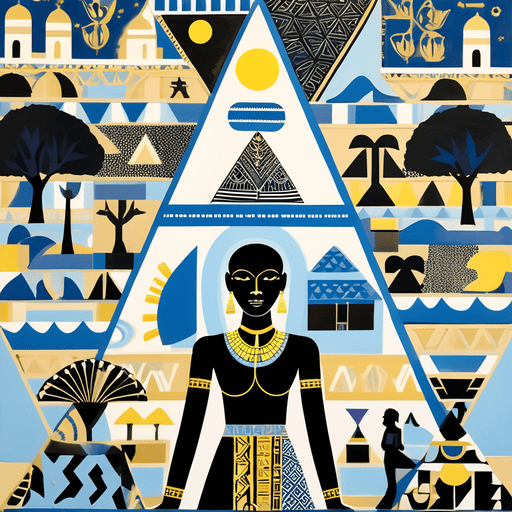
As we embark on the celebration of Black History Month, it’s essential to recognize the myriad contributions of African descendants not just in shaping modern civilization but also in sculpting the contours of Eastern philosophy. The historical interweaving of African traditions with Eastern thought offers a rich narrative, highlighting a profound exchange of wisdom that transcends geographical and cultural boundaries. This blog post seeks to illuminate these connections, drawing upon documented examples to honour the African influence on Eastern philosophies and spiritual practices.

### The Ancient Egyptian Influence on Greek Philosophy


The journey begins in ancient Egypt, a civilization that stood as a beacon of knowledge and enlightenment long before the Hellenistic era. It’s well-documented that Greek philosophers, who are often credited with laying the foundations of Western philosophy, were greatly influenced by their Egyptian counterparts. Thales of Miletus, who is recognized as the first Greek philosopher, is said to have studied in Egypt, immersing himself in the profound knowledge of the priests and sages. Plato, too, spent thirteen years in Egypt, learning from the wisdom of ancient hieroglyphs and the teachings of Egyptian mystics. This exchange illustrates how African wisdom traditions shaped the philosophical underpinnings that would later influence the development of Eastern thought through the Hellenistic spread into Asia.


### The Spiritual Synergy between African and Eastern Traditions

Further exploring the spiritual synergies, we find remarkable parallels between African spirituality and Eastern philosophies, particularly in their understanding of the universe and the interconnectedness of all life forms. African spiritual traditions, with their deep-rooted beliefs in the oneness of being and the ancestral realm, resonate with the core principles of nonduality and interconnectedness found in Eastern philosophy. For instance, the concept of Ubuntu in Southern Africa—emphasizing community, connection, and mutual caring for all—is echoed in the philosophies of Buddhism and Hinduism, which advocate for compassion, empathy, and the realization of oneness.

### The Yoruba Influence on Transcendental Meditation

An intriguing example of direct influence is the practice of Transcendental Meditation, which shares similarities with the meditation practices of the Yoruba religion of West Africa. The Yoruba spiritual system, with its intricate practices of meditation and communion with the divine, predates many Eastern meditation practices. The emphasis on achieving a higher state of consciousness and connecting with a divine realm in Yoruba spirituality is mirrored in the meditative practices of Hinduism and Buddhism. This parallel not only highlights the ancient wisdom of African spiritual systems but also their contribution to the global mosaic of spiritual practices.

### Conclusion: A Shared Legacy of Wisdom

The celebration of Black History Month offers a profound opportunity to acknowledge and honour the African roots intertwined with the philosophical and spiritual traditions of the East. By recognizing these contributions, we not only pay homage to our African ancestors but also embrace a more inclusive understanding of the world’s philosophical heritage. This exploration invites us to consider the depth and richness of African influence on Eastern thought, urging us to delve deeper into our collective spiritual heritage and celebrate the shared legacy of wisdom that unites us all.

Morgan O. Smith

Yinnergy Meditation, Spiritual Life Coaching & My Book, Bodhi in the Brain…Available Now!
https://linktr.ee/morganosmith

Exploring Consciousness

Expanding Consciousness through Yoga & Meditation Practices

Yoga and meditation present an array of practices that facilitate the exploration of diverse states of consciousness, enhancing individuals’ mindfulness and self-awareness. This blog is dedicated to examining multiple practices associated with gross, subtle, causal, turiya, and turiyatita states of consciousness, illustrating the intertwined nature of these practices in guiding practitioners toward multiple states of awareness.

Gross Consciousness: Exploring the Physical Dimension

The gross state of consciousness, typically associated with waking life, is distinguished by physical and sensory experiences. Practices that emphasize the gross state involve:

Hatha Yoga: With a focus on physical postures (asanas), breath regulation (pranayama), and meditation, this practice supports overall physical and mental health.
Vinyasa Yoga: Offering a dynamic fusion of movement and breath, this style of yoga aids practitioners in maintaining mindfulness and presence.

Subtle Consciousness: Journeying into Dreams & Emotions

The dream state, characterized by emotional and mental experiences, reflects the subtle state of consciousness. Techniques concentrating on the subtle state include:

Yoga Nidra: This guided meditation facilitates a state of deep relaxation, mirroring the dream state, and fostering increased awareness.
Lucid Dreaming: This practice involves consciously recognizing that you’re dreaming, providing an opportunity to delve into the subconscious mind.

Causal Consciousness: Merging with the Universal Source

The deep sleep state, denoted by unity and an absence of individual identity, resonates with the causal state of consciousness. Techniques accessing the causal state include:

Advaita Vedanta: This non-dual philosophy promotes self-inquiry and contemplation, guiding toward the realization of the ultimate reality beyond individual identity.
Shambhavi Mudra: This meditative technique, focusing on the “third eye” or the space between the eyebrows, cultivates internal tranquillity and unlocks the causal state.

Turiya: The Realm of Pure Consciousness

Turiya, the fourth state, is marked by pure consciousness beyond the states of waking, dreaming, and deep sleep. Practices aiming for turiya encompass:

Transcendental Meditation (TM): Utilizing mantras, this meditation technique aims to transcend mental activities and experience pure consciousness.
Dzogchen/Mahamudra: These Tibetan Buddhist practices emphasize direct recognition of the mind’s nature, leading to a non-dual experience of reality.

Turiyatita: Surpassing Boundaries and Embracing Integration

Turiyatita, transcending the fourth state, symbolizes the amalgamation of all consciousness states. Techniques fostering turiyatita are:

Sahaja Yoga: Centered on the spontaneous awakening of Kundalini energy, this practice leads to a thoughtless awareness state surpassing all other states.
Jnana Yoga: The path of wisdom and self-inquiry dissolves the perceived separation between the individual self and ultimate reality, leading to the turiyatita experience.

Conclusion: Embarking on Your Unique Path

Every individual’s journey to elevated states of consciousness is distinctive. Discovering practices that align with your personal growth and self-exploration is crucial. As you delve into diverse yoga and meditation techniques, maintain an open mindset that your path may comprise various practices and experiences. Cherish the transformative journey and the profound power these age-old disciplines offer.

Morgan O. Smith

Yinnergy Meditation & My book, Bodhi in the Brain…Available Now!

https://linktr.ee/morganosmith