Author, Philosopher, Spiritual Teacher, A Lead Facilitator at Sacred Media's Integral Mastery Academy, Founder of Yinnergy Meditation/Neurofeedback, Bodhi Mental Care & Wellness, Co-founder of KeMor Centre for Innovative Development
How You Play the Game of Black & White Reveals Your Level of Spiritual Maturity
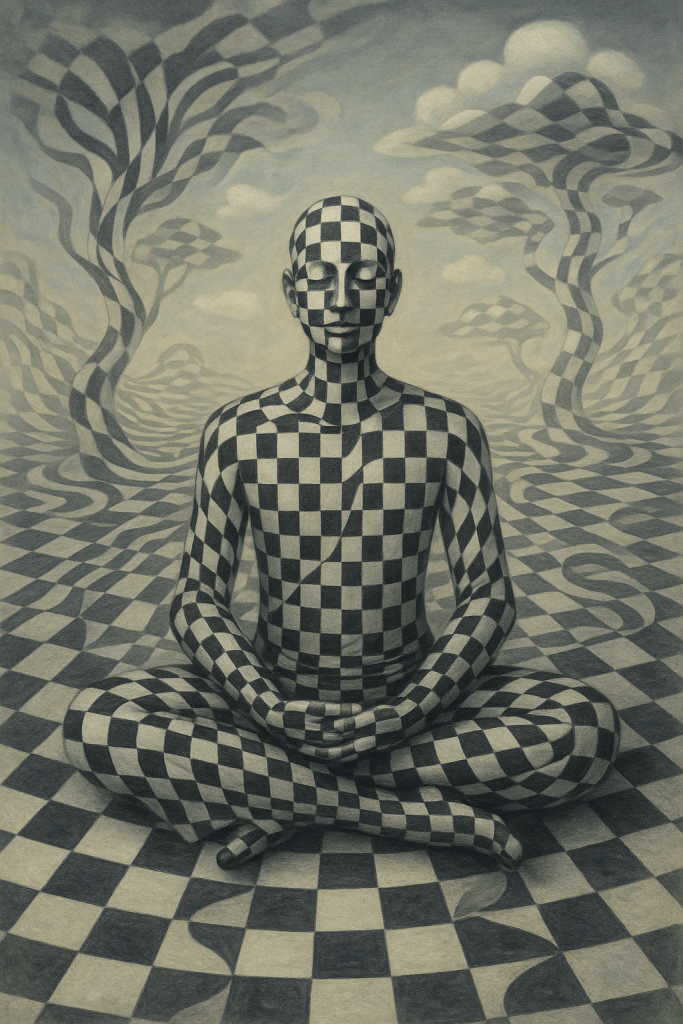
He doesn’t avoid the black squares. He just stops thinking they’re cursed.
You can tell how spiritually mature someone is by how they engage with contrast—not by how they escape it. The game of black and white is always being played. Light falls beside shadow, certainty walks with doubt, and gain is never far from loss. But while most are trying to land only on the white tiles, the one who has seen beyond duality walks freely across the whole board.
Spiritual growth doesn’t mean becoming invulnerable to darkness; it means seeing the darkness without contracting around it. A child in awareness recoils from discomfort and seeks the promise of the ‘light.’ A grown soul knows that neither is final, and neither needs to be resisted. The black square isn’t a punishment. The white square isn’t a reward. They are moves in the same dance.
The one who awakens learns to stop chasing symmetry. No longer obsessed with winning, they realize it was never about domination of light over dark, nor rising above contradiction. It was about presence through all of it. About meeting each moment with equanimity, whether wrapped in sorrow or shining in joy.
Some play to avoid pain. Others play to seek pleasure. But the wise one plays to see. And seeing, they cease to play as a someone at all.
They simply move.
Morgan O. Smith
Get Your Free Copy of My Book, Bodhi in the Brain!
Atman is identical to Brahman, fundamentally the same. While Atman is often viewed as the individualized aspect of Brahman, it retains its essence as Brahman. Brahman is the ground of all being, and Atman is but a speck of this divine soil. This soil, sharing the same substance as the ground, emphasizes their intrinsic unity.
Atman itself has no location, shape, or form, yet the physical body—the gross body—does. This physical body is also Atman but has shape and form, making it localized and subject to polarity. The physical body, dense and tangible, includes everything that constitutes it: vibrating strings, subatomic particles, atoms, molecules, and cells. Each of these elements, in their individual form, is Atman.
All the subtle bodies are also Atman, spanning from the most subtle to the gross physical body. When the physical body dies, the soul doesn’t leave the body because it is non-local. The soul, as Atman, remains ever-present. Atman offers a more sophisticated explanation of the soul. Remember, Atman doesn’t leave the body because there’s nothing there to leave. This nothing or nothingness is Atman, the empty witness.
The opposite of all shapes and form is indeed all shape and form. Nothingness is non-local, omnipresent, and ubiquitous. In its absolute state, nothingness manifests as everything. This empty witness manifests its individual reality. Every event that occurs from its individual perspective is Atman. Everything that happens, from all perspectives, is Brahman. Atman and Brahman are the same, transcending the ego and the sense of self.
Transcending the ego is an act, part of the cosmic play that Atman/Brahman engages in. The same Atman/Brahman that doesn’t exist yet does. Everything and nothing are the same, merely imagined from two different perspectives.
Morgan O. Smith
Yinnergy Meditation, Spiritual Life Coaching & My Book, Bodhi in the Brain…Available Now!
Everything and nothing. All at once. Time, space, matter, thought – everything is happening in a symphony of existence and non-existence. This concept might seem like an abstract rumination reserved for philosophers and quantum physicists, yet it is a reality that each one of us is connected to. This concept is known as the Ultimate Superposition.
In the realm of quantum physics, superposition refers to a particle’s ability to be in multiple states simultaneously until it is observed. An electron, for instance, can exist in several places at the same time. But the moment we try to measure it, the electron chooses a position. It’s as though our very act of observing compels the universe to make a choice.
In an expanded context, the Ultimate Superposition is a concept where everything within and outside all of existence is happening all at once, constantly transitioning and transforming in an infinite dance of possibilities. It represents the totality of existence and non-existence, potentials and voids, being and nothingness, coalescing into an eternally unfolding reality.
However, the intriguing aspect of the Ultimate Superposition is the role of the observer – the individual ego. The observer stands at the intersection of the macrocosm and the microcosm, the infinite and the finite, bridging the gap between boundless potentiality and concrete reality. The ego is a tool of separation, delineating ‘I’ from ‘not-I’. Through the lens of ego, we carve out our individual realities from the cosmos of possibilities.
Yet, as we separate from the Ultimate self of Superposition, we also limit our experience of reality. In our desire to discern, label, and understand, we may inadvertently narrow the spectrum of our conscious existence. The multitude of possibilities that once spanned infinite dimensions collapses into the singularity of our individual perception. Our attempt to observe the universe compels it to present a singular, understandable version of reality.
It raises an intriguing question: Is our perception of reality truly ‘real’, or is it simply one possible narrative out of an infinity of narratives that the Ultimate Superposition provides? And, more importantly, can we ever experience the Ultimate Superposition in its totality while confined within the boundaries of our individual egos?
Some spiritual traditions propose that transcending the ego or realizing our fundamental oneness with all existence, might allow us to experience the Ultimate Superposition in its entirety. In these moments of transcendence, we are no longer observers compelling the universe into a singular reality but participants in the unfurling dance of existence.
In essence, the Ultimate Superposition invites us to ponder our place in the grand scheme of existence and the nature of our conscious experience. By grappling with these questions, we may not only deepen our understanding of reality but also unravel the potential for a richer, more profound relationship with the universe and ourselves.
Thus, the exploration of Ultimate Superposition is not merely a philosophical or scientific endeavour but a deeply personal journey, a path that traverses the landscapes of our own consciousness. Perhaps, in this journey, we will discover that the observer and the observed, the finite and the infinite, the individual and the universe are but different facets of the same existential diamond, sparkling in the grand cosmic dance of the Ultimate Superposition.
Morgan O. Smith
Yinnergy Meditation & My Book, Bodhi in the Brain…Available Now!



 Morgan O. Smith